On its 60th anniversary, Goodman Gallery presents the global premiere of William Kentridge’s new nine-minute stop-animation film, ‘A Nicely Built City (Never Resists Destruction)’ – the twelfth in his acclaimed cycle of ‘Drawings for Projection’, ongoing since 1989. The films are famously made from the perspective of a South African raised in apartheid-era Johannesburg, and whose father, Sir Sydney Kentridge, was the lawyer of Archbishop Desmond Tutu and Nelson Mandela. The film and associated drawings are the centrepiece of a wide-ranging presentation including new work linked to Kentridge’s recent production of Claudio Monteverdi’s L’Orfeo at the 2026 Glyndebourne Festival. All the same, in Kentridge’s words, ‘Drawing is the heart of it. Even if it’s working with an actor onstage, the logic is that of making a drawing’
PCK: Where does the title ‘A nicely built city (never resists destruction)’ come from?
WK: It’s adapted from a collection of early 20th-century West African proverbs, from Ghana mainly, that I have used since the 1990s: ‘a cooler head is not to be trusted’, ‘one should not be too hopeful of a ship sailing from Europe’, ‘If the good doctor can’t cure you, find the less good doctor’…
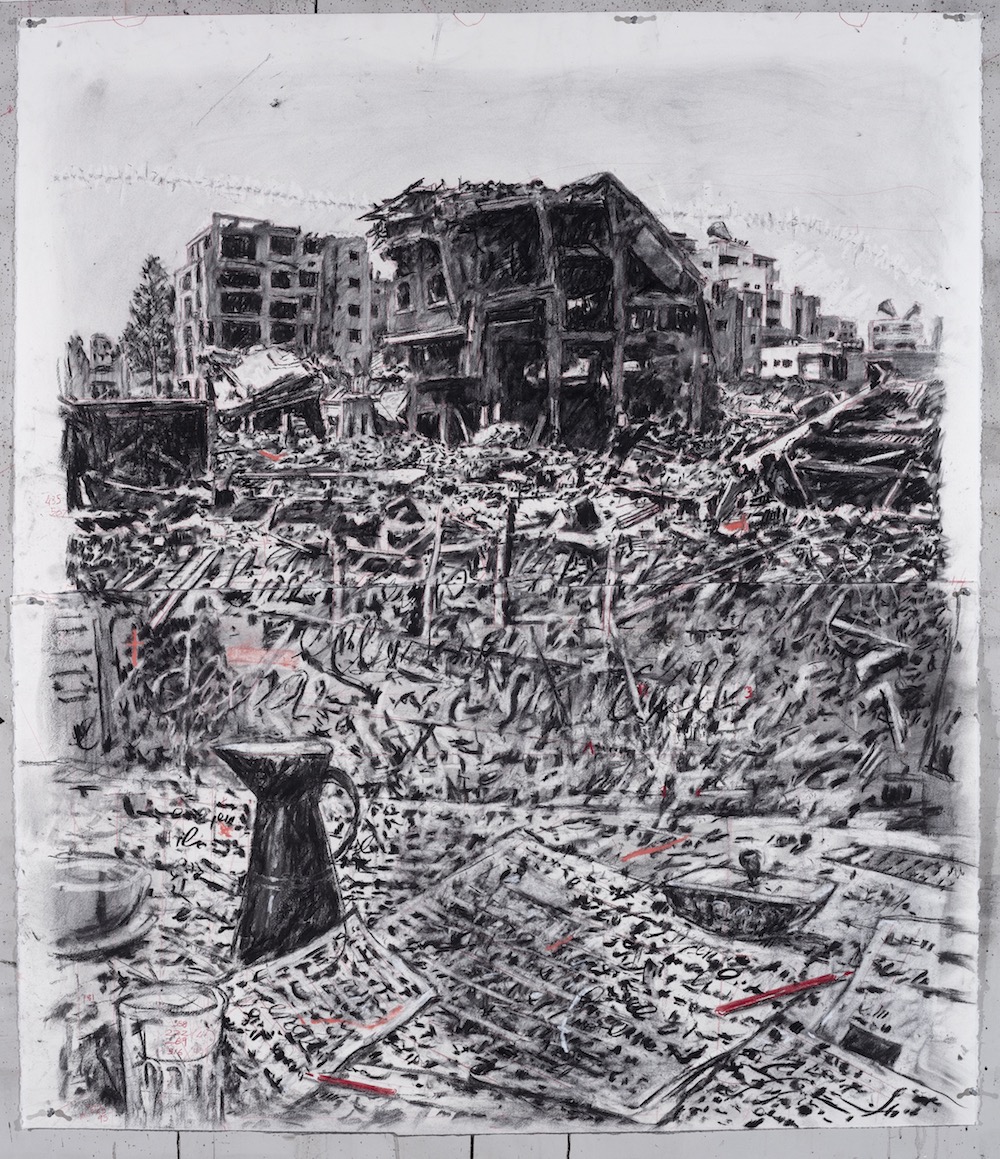
William Kentridge: Drawing for A Nicely Built City (Aftermath), 2026 – Charcoal, pastel and coloured pencil on paper, 141.5 x 120.5 cm
How did you begin the film?
The starting point was the drawing upstairs depicting the aftermath of an explosion in Johannesburg’s main thoroughfare in 2023. Due to a lack of infrastructure maintenance, a huge gas explosion occurred, which brought to mind other destroyed buildings.
And you planned the film from that point?
No… If I try to do a script or a storyboard, it doesn’t work. I’ve found that interesting things emerge not because I’ve thought of them in advance, but because I’ve seen them in the work when it’s done – like the trail of smudge in charcoal animation films. At first, I thought this was a mistake, that I couldn’t do a perfect erasure. I tried different papers and erasers, promised my friends I’d do it better in the future, until I was told that the trace and trail of the animation I had thought was a mistake was, in fact, a virtue.
Here, I started with drawings of a street explosion and the modernist home of industrialist Soho Eckstein, a central protagonist in the cycle of films. From there, the process was mostly improvisatory. An image leads to an impulse, to me recognising something as it emerges rather than knowing in advance how it should be. I trust that there are things inside ourselves that we know but may not know we know, that will emerge in the process.
How do the 50-odd drawings on show relate to the film?
They are the complete set of charcoal drawings used to animate it. They are altered and re-photographed frame by frame. You can still see, for example, a line showing all the gradations of where a bird flew across. Once the film is halfway made, I start working with a composer to match the different frames with music.
How many different states of the drawings are recorded?
A minute of the film has 1,500 frames, so that’s around 14,000 frames for the whole film. Sometimes the same drawing state will be used for two or three frames, depending on the required speed, but there might well be a hundred different drawing states. Sometimes cut-out drawings are collaged on. Sometimes a motif will have disappeared from the final state of the drawing, as happens with the cat which is at the start of the explosion in the film. Sometimes, due to editing, a drawing won’t actually appear in the film, but I still keep it in the set related to its making.
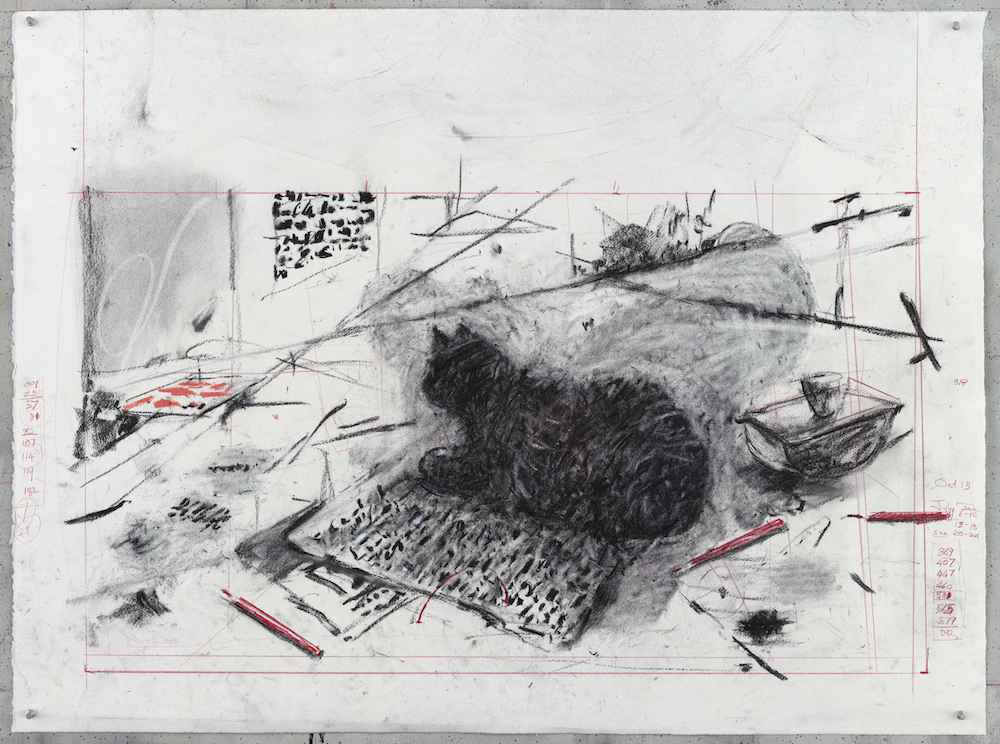
William Kentridge: Drawing for A Nicely Built City (Cat on newspaper), 2026 – Charcoal, pastel and coloured pencil on paper, 80 x 108.5 cm
Does a black cat often appear?
The cat is an animal uniquely suited to animation. That is to say, if you’re drawing a cat, you can draw any curved line, put a smudge of Charcoal around it, and you’ve made a black cat. Soho’s black cat has been around him in many of the films, but this is the one in which it has the largest role, because it has the most transformations. And in that sense, it’s also a protagonist that changes the story. The cat arrives like a herald before the explosion, and acts as the spirit of transformation and change. It turns into a typewriter, a cash register, a bare tree, a cremation urn…
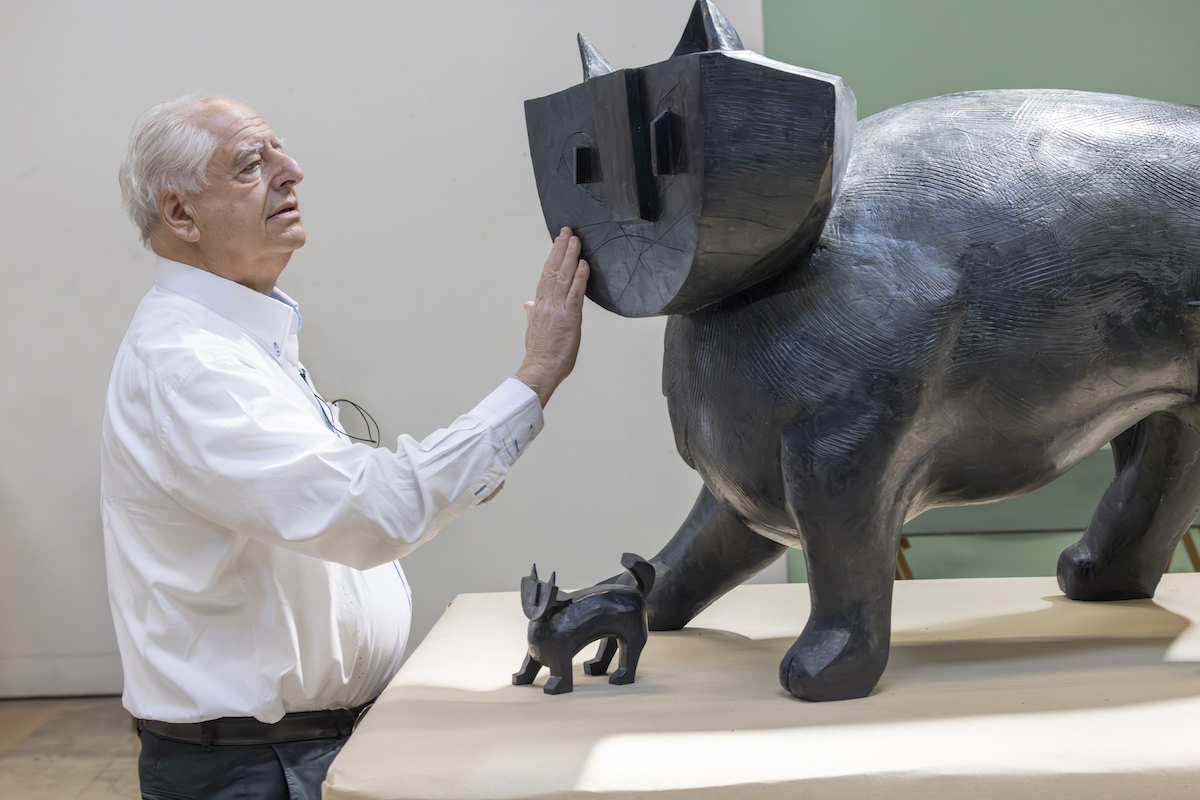
There’s also a sculpture of a cat?
That’s a different cat. ‘Fat Cat’ relates to a great novel, Mikhail Bulgakov’s ‘The Master and Margarita’ – written secretly in Stalinist Russia during 1928–40, but not published until 1966–67. It’s a new bronze depicting a flat-faced black cat with a huge belly, derived from a paperweight-sized edition I made earlier – a vodka-loving talking cat named Behemoth, a sidekick of the devil.
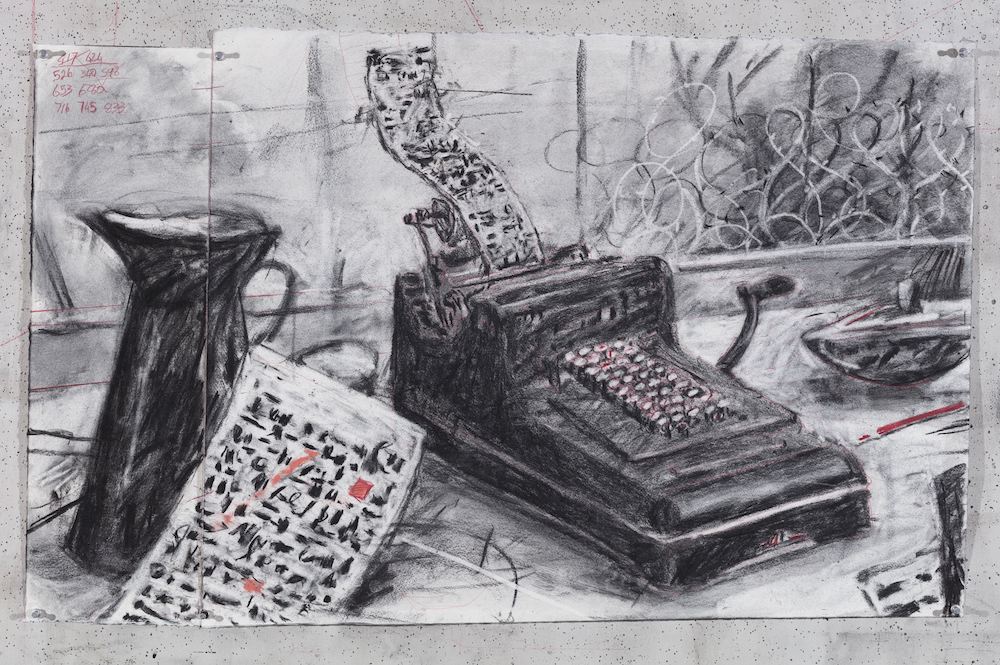
William Kentridge: Drawing for A Nicely Built City (Cash Register). 2026 = Charcoal and coloured pencil on paper, 63 x 98.5 cm
That’s an old-fashioned adding machine?
Soho hasn’t really aged in the films, and neither has the technology moved forward – as certain things are representative of ideas. Archaic technology is also visible technology: an old-fashioned rotary telephone with lines attached, linked to the telephone exchange, gives you a visual that corresponds to what we know but can’t see – the cloud, the Internet. A modern calculator’s workings are invisible, whereas an adding machine has a mechanism that provides a sense of what it’s doing… Some things are timeless: whether in 1989 or now, if you go down to Savile Row there’s no shortage of pinstripe suits.
You have stayed in South Africa, but your work shows plenty of the problems there. Are you pessimistic about the future?
I always feel that in South Africa to be an optimist or a pessimist is wrong, because two futures were unfolding, an optimistic one and a pessimistic one, but the difficult future feels harder to escape. Yet I would feel quite dislocated if I moved. In a way, I stay in South Africa because I don’t have to. Also, it is depressing when things are falling apart, but it’s a very interesting place to be.
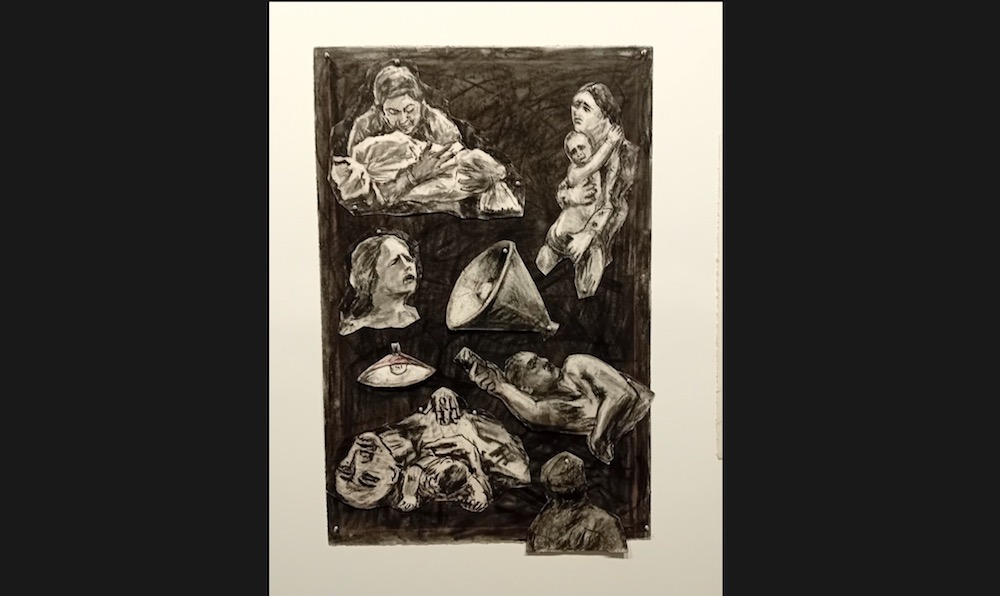
Did I spot some art historical references?
Yes…Giotto, Masaccio, David and Picasso are brought into the cut-out drawings.
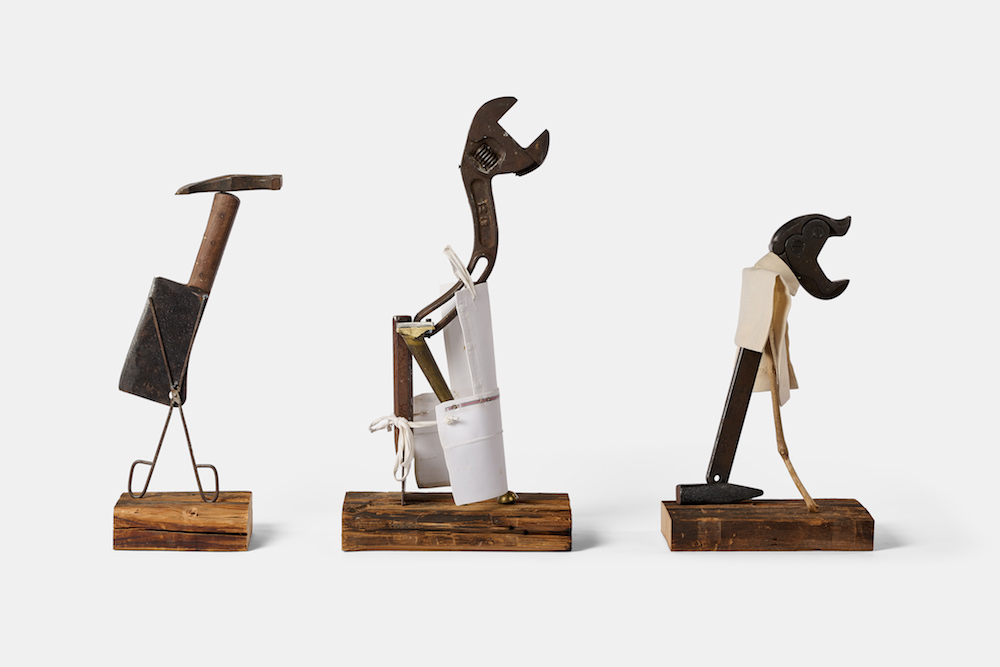
William Kentridge & Greta Goiris: Spirits of the Underworld from ‘L’Orfeo’, 2025 – Found objects, wood and fabric, 40 x 12 x 21.5 cm / 43 x 15.5 x 21 cm / 52 x 17.5 x 37.3 cm
Are you also showing a Pepper’s Ghost film installation that integrates workshop footage with sculptures and works on paper?
Yes, a diorama from an opera project. We wanted to create a sense of performance rather than just a video, so we worked on a version of Pepper’s Ghost, a nineteenth-century theatrical technique utilising a pane of glass and strategic lighting to make objects appear or disappear on stage. Another room has drawings and puppets from the production.
What does your work say about you?
It shifts between the personal and the world outside the studio… but if I had to think ‘what does it reveal about me?’ I wouldn’t go near it!
William Kentridge: ‘A Nicely Built City’ runs to 7 Nov 2026 at Goodman Gallery, Cork Street. Images courtesy of the artist and Goodman Gallery, photograph by Anthea Pokroy unless indicated otherwise—interview based on material from 24 Sept, supplemented by some earlier quotations from other sources.
Top Photo: William Kentridge with ‘Fat Cat’, 2025 – photo Helga Mundt