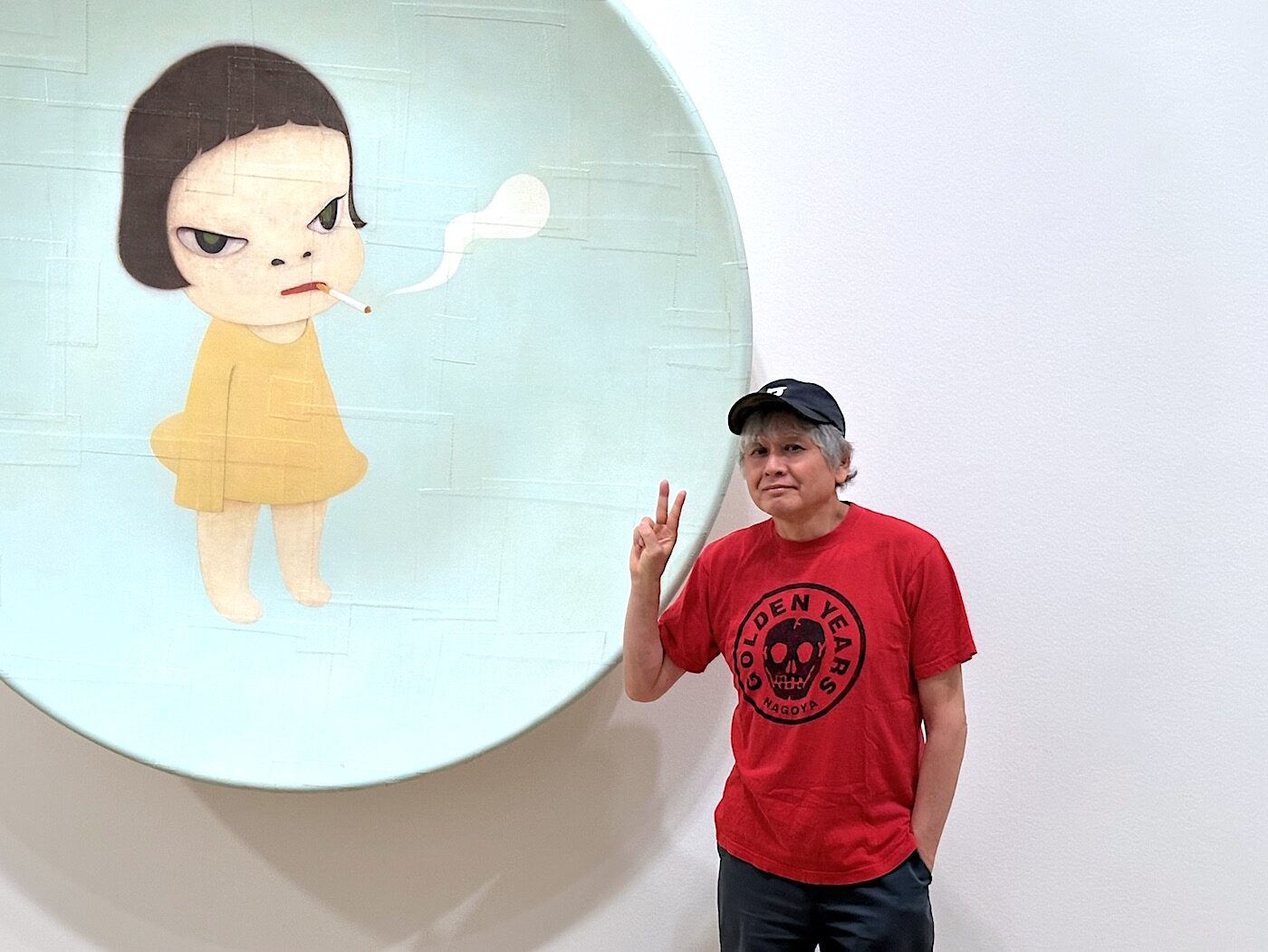
The large-scale exhibition Yoshitomo Nara: Works 1984-2024 will be held at the Guggenheim Museum Bilbao between 28 June and 3 November 2024. Spanning 40 years of the artist’s practice, and brought together by curator Lucía Agirre, it offers a unique insight into the life and work of one of contemporary art’s most loved and decorated practitioners.
Since his birth in 1959 in Hirosaki, Aomori, Japan, Nara has built his reputation around depictions of the head-and-shoulders portraits of children, typically characterised by oversized heads and strikingly large eyes. The children can appear menacing, sad, lost, or determined; their expressions capture almost every emotion imaginable and serve as the main conduit for the artist’s ideas.

Yoshitomo Nara Guggenheim Bilbao P C Robinson © Artlyst 2024
As mentioned above, the show was specifically curated to suit the architecture of the Guggenheim Museum Bilbao. By following the various recurring themes and symbols which appear throughout Nara’s practice (the house, grass, flames, knife etc.), the visitor can gain a detailed insight into the artist’s mind. Through this display method, a deep appreciation of the thought and technique behind Nara’s work becomes evident.
A strong influence running through much of Nara’s output is Music, predominantly Rock and Punk. His works have an almost impulsive quality, despite being highly regarded pieces. Since the onset of his career, music has driven and accompanied Nara as he develops each body of work. In addition, Nara incorporates elements of Pop Culture and allusions to other artists and cultures, East and West, to great effect.

Yoshitomo Nara Guggenheim Bilbao P C Robinson © Artlyst 2024
Through this retrospective, we can see how Nara’s strong graphic sense translates into a wide range of intimate and socially focused subject matter. From depictions of the domestic sphere to evocations of his own childhood, there are numerous points of entry for the viewer to project their own life onto his paintings.
A defining feature of Nara’s career has been the continual evolution of his art. During his many sojourns overseas, he found new inspiration and changed his approach to painting. It was when Nara visited Europe at age 20 in 1980 that he began to develop his current style. His encounters with medieval and Renaissance art, religion and key 20th-century European artists caused him to question his existing method of working.
This development continued during his time studying with the German artist A. R. Penck at the Kunstakademie Düsseldorf. Penck can be seen to have affected Nara’s distinctive handling of paint, colour palette and incorporation of story-telling devices. These factors combine to produce Nara’s highly emotive and pared-down oeuvre.

Yoshitomo Nara Guggenheim Bilbao P C Robinson © Artlyst 2024
During much of his stay in Europe, Nara found himself isolated once again because he did not speak any local language. This led him to express his desire to communicate via his artwork. He developed a tighter, more imposing style which began to attract critical acclaim across Europe. Pieces including Make the Road” and Follow the Road” (1990) demonstrate how he can merge everyday life and transcendentalism to form a mythos accessible to people around the world.
After 12 years living overseas, Nara returned to live and work in Japan. His career has since progressed and culminated in his large-scale show, “I DON’T MIN”, DON’T U FORGET ME,” at the York Hama Art Museum. Following the success of the show, it travelled to various other galleries and featured major pieces including Too Young To Die” (2001).
Following the tragedies of 3rd March 2011, the Earthquake, tsunami, and subsequent nuclear meltdown, Nara began to question his place as an artist. He went on to produce a series of artworks in collaboration with local communities throughout the Tohoku region, aiming to promote greater equality in Japanese society. From this point forward, we see greater awareness in many of his works; for example, “The Bomb Shelter” (2017), which shows a small boy creeping out of an underground shelter.
It is therefore fitting that Nara chose the Guggenheim Museum Bilbao to house a wide-ranging survey of his practice. Through the show, we can see the breadth and depth of the issues that occupy and concern Nara today, informed by both his own lived experience and our shared global condition.
In closing, Nara comments: “I finally felt like I now possessed the things I had been missing, like anything else I might need was right at hand, and I was capable of living in a provincial area. But I had to leave my hometown to understand this.”
Words/Photos PC Robinson © Artlyst 2024
Yoshitomo Nara: June 28 to November 3, 2024, Guggenheim Bilbao—The exhibition is set to tour the Museum Frieder Burda in Baden-Baden and the Hayward Gallery in London, with each venue reconfiguring the display to suit its space. This itinerant nature underscores Nara’s universal appeal and adaptability, as well as Nara’s transcendence of geographical and cultural boundaries.