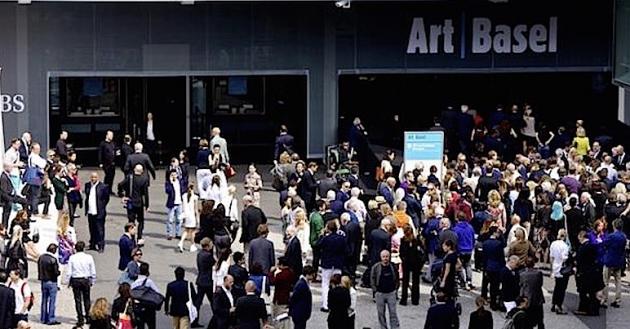
Here’s a rather perversely democratic choice of just one piece each from a dozen categories: Art Basel’s gallery section; Art Unlimited (the main fair’s hall of 74 separate installations); the Liste, Volta and Solo Project and Photo alternative fairs; the Art Parcours works out and about in the city; other external installations; the commercial gallery spaces in Basel itself; private museums; public museums; and the surrounding towns. That’s perverse because there is of course exponentially more good art in some categories (there were 287 highly-rated galleries in Art Basel against 32 more modest ones in The Solo Project) – but there were good things in all categories.

Inkjet print 171 x 252 cm – Chantal Crousel, Paris
There were more spectacular pieces of course, I was struck by three photographic versions of time travel. 2000 Turner Prize winner Wolfgang Tillmans’ larger-than-life photograph of a TV screen had a peculiar allure. He took it in St Petersburg, while on a residency for Manifesta last year, and its intricate and subtly coloured patterns incorporate time travel of a sort. Russian TV is still issuing analogue signals, which Tillmans found were poorly tuned on his TV. He also found that his modern digital camera could capture those distorted signals with a clarity unavailable to a photographer at the peak of analogue broadcasting. Tillmans was sufficiently interested to ask for the room with the bad TV signal on future trips! Gillian Wearing showed a triple format self-portrait at Maureen Paley: as now, looking pretty good for fifty; as she expects to be at 70 through a computer projection, decidedly the worse for wear; and as she actually will be in 2035 – a space left blank for obvious reasons, but which Wearing undertakes to fill at the time. Frankael had the neat conjunctions of Nicholas Nixon’s famous and ongoing series The Brown Sisters, showing his annual photographs of them in a set order from 1975-2014, with Idris Khan’s layering of them into one photograph of the first 20 years…
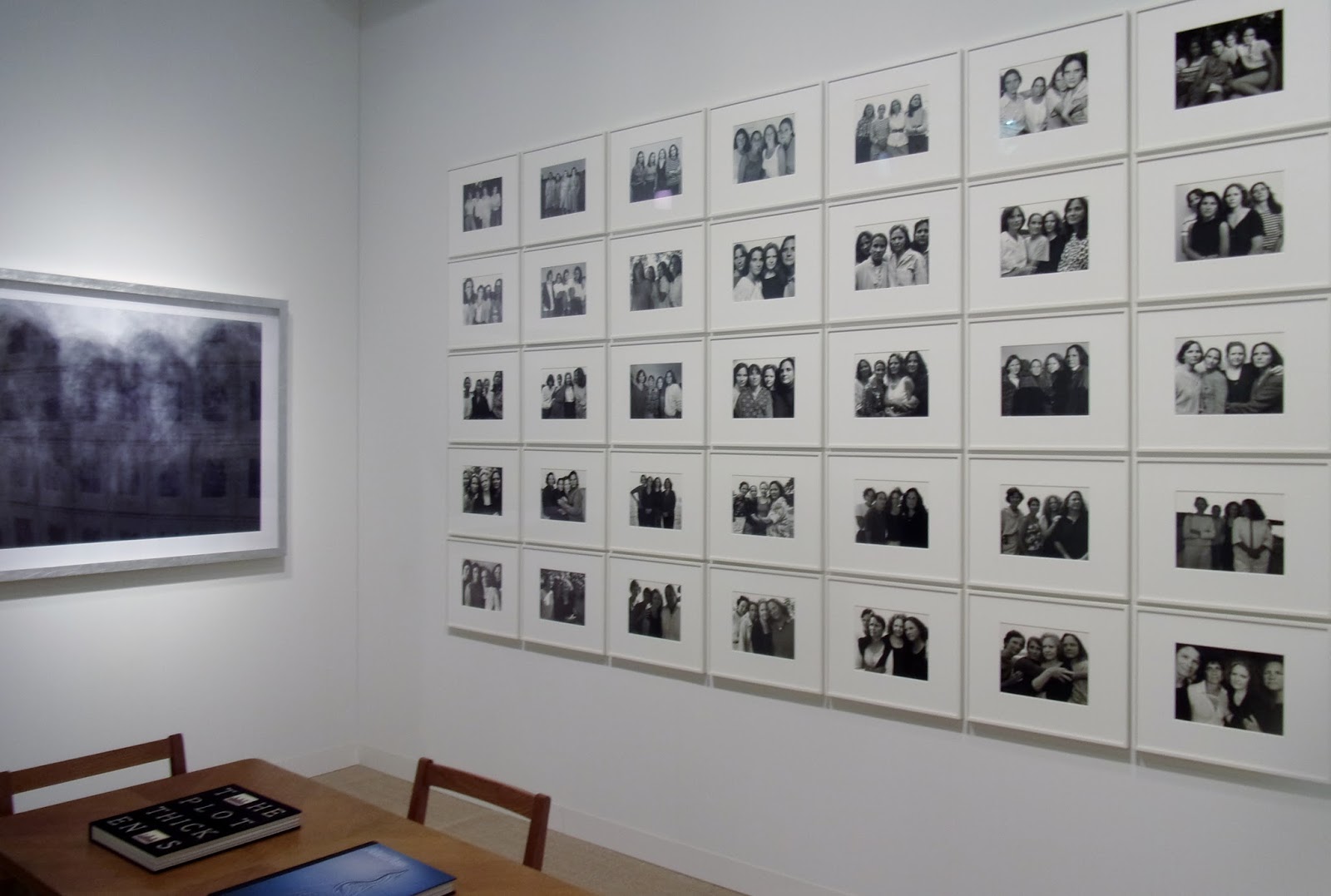 Idris Khan alongside Nicholas Nixon’s sequence of the Brown Sisters
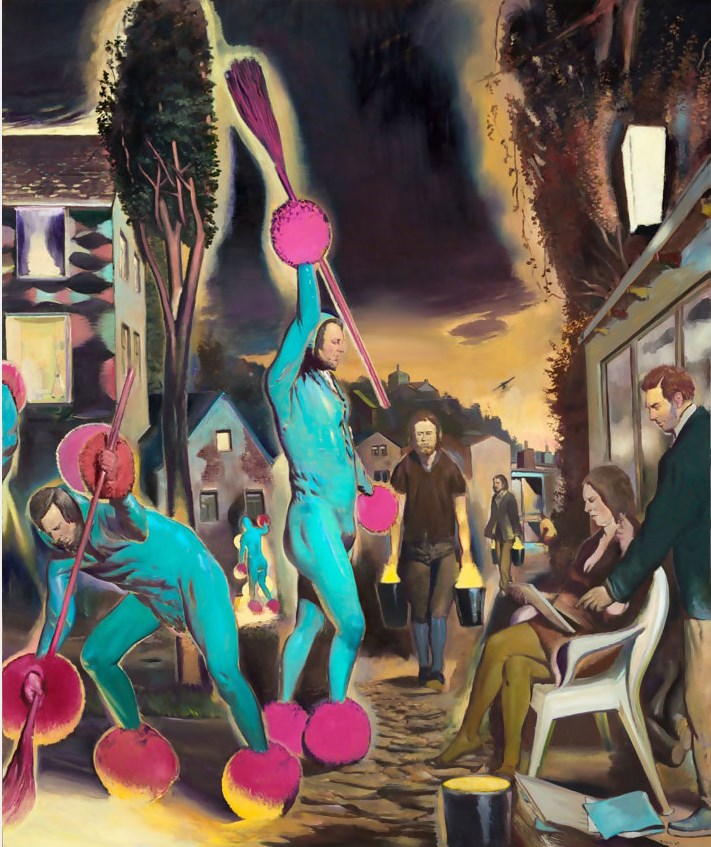
Neo Rauch: Der Lehrling, 2015 – Oil on canvas, 300 x 250 cm – courtesy Galerie EIGEN + ART Leipzig/Berlin
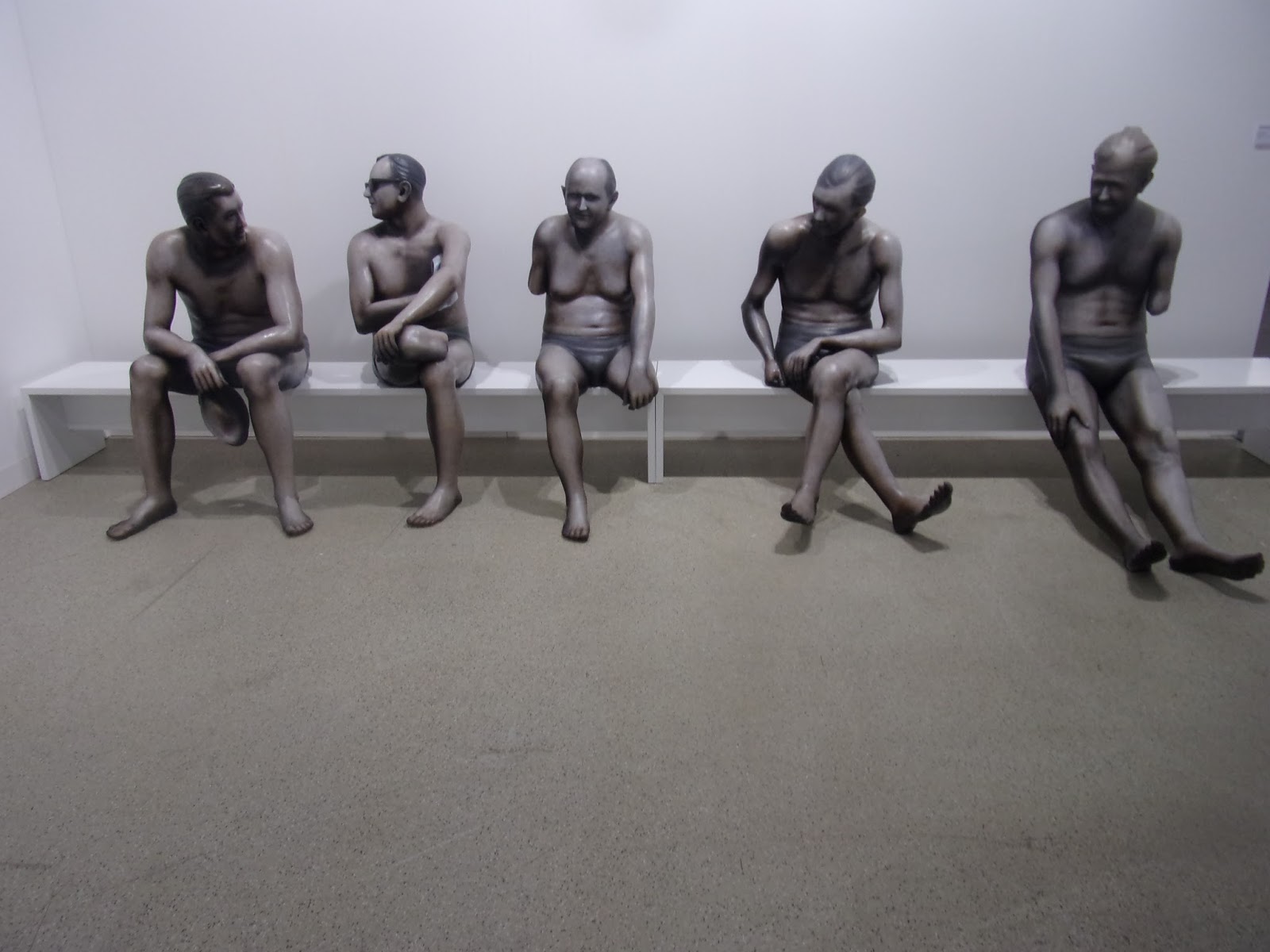
Martin Honert: VSG Gruppe, 2015 at Johnen Gallery, Berlin
I’m tempted by a comparably-themed sculpture, too. Martin Honert makes 3D versions of photographs of personal significance to his own development, with enough attention to exactitude that his oeuvre develops slowly. His latest shows his father (centre) together with other veterans – albeit they were still young men – injured in World War 2. Once more, a modern technique facilitates access to the past through which we see our own times.
Art Unlimited
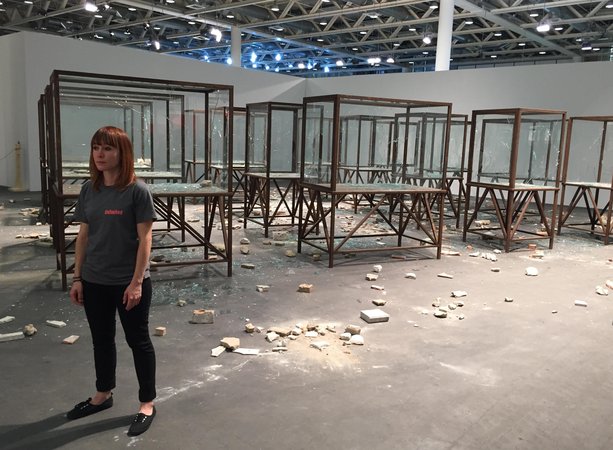
Liste
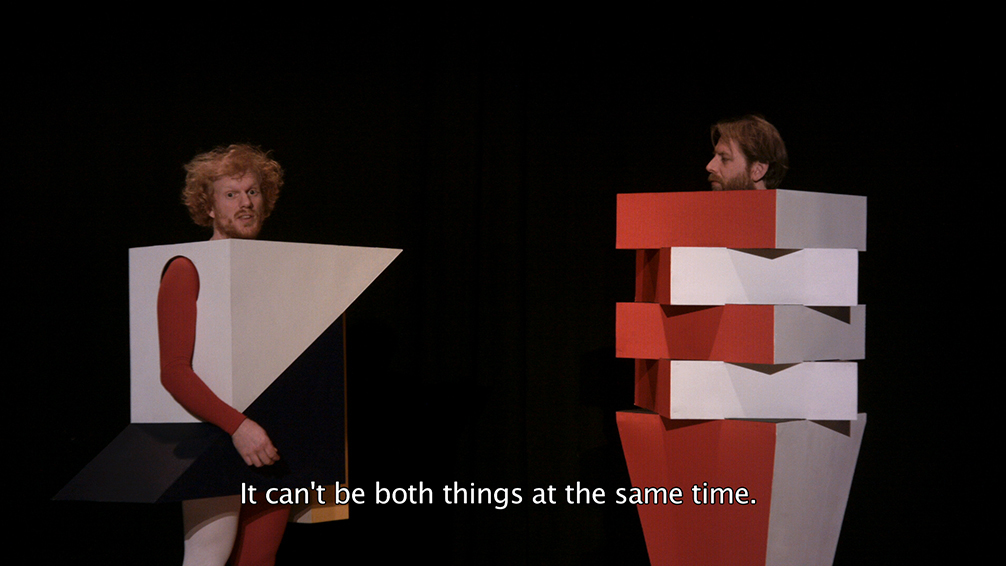
I could easily do with more effective humour, good writing and bite-sized narratives in video art – especially towards the end of a fair. Step forward Dutchman Feiko Beckers with a set of three four minute films in which he and a friend, dressed in Malevich designs to signal idealism, discuss paradoxes such as: how do I commend my old washing machine as worth giving to you without undermining my case to myself for spending significantly to replace it? Several plates, broken and fixed in tune with the changeability of his beliefs, provided more bite-sized flavours of his winning tone. Other Liste highlights included Alec O’s screens of broken glass patched up, Michael Rey’s big oddly-shaped monochromes on plasticine over clay, and a complex film installation in which artist-partners Anna K.E. and Florian Meisenbergen produce an iterative double-selfie.
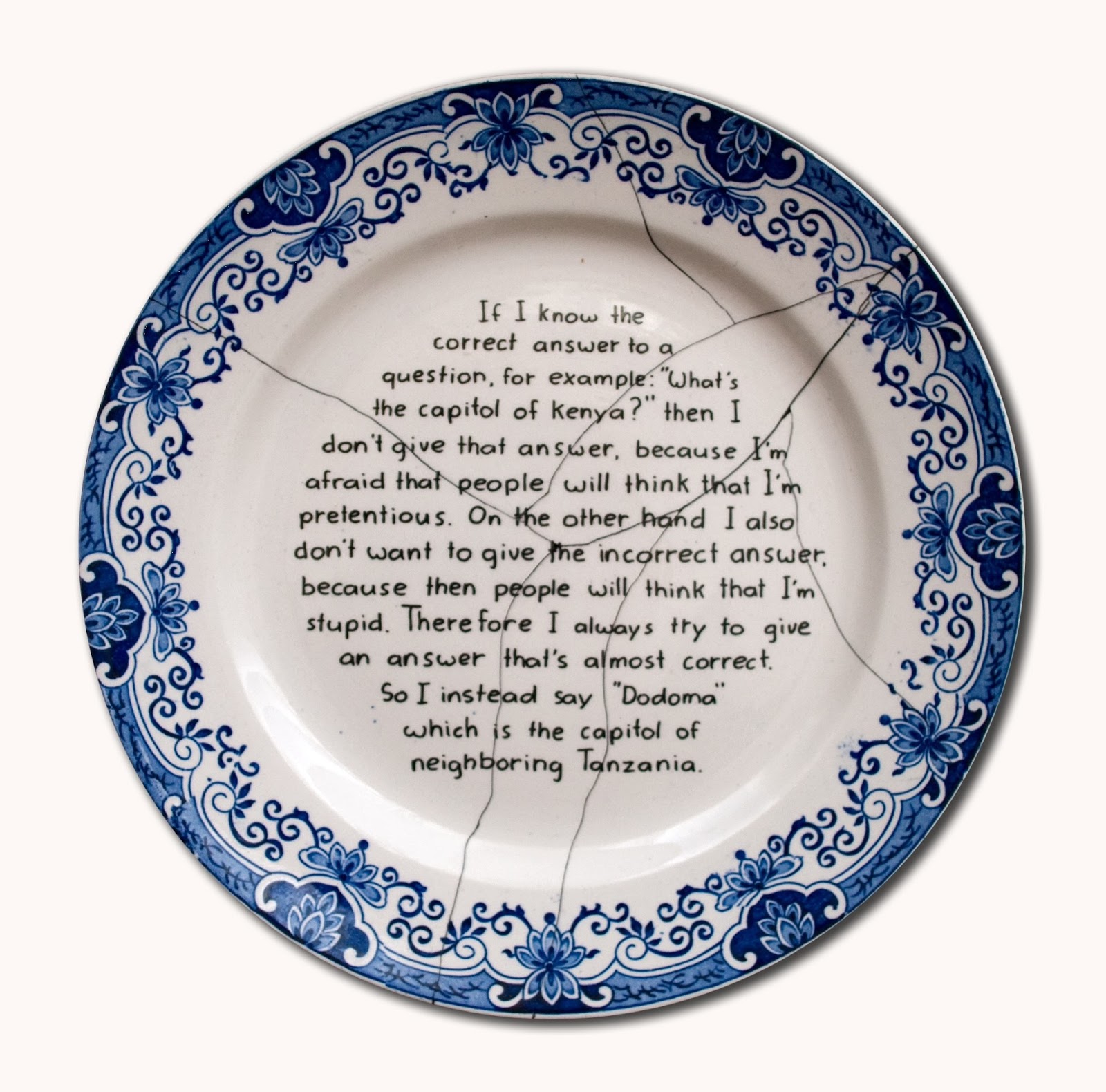
Feiko Beckers – from: Things I once believed in, that I then stopped believing in and that I now believe in again, 2015
Volta
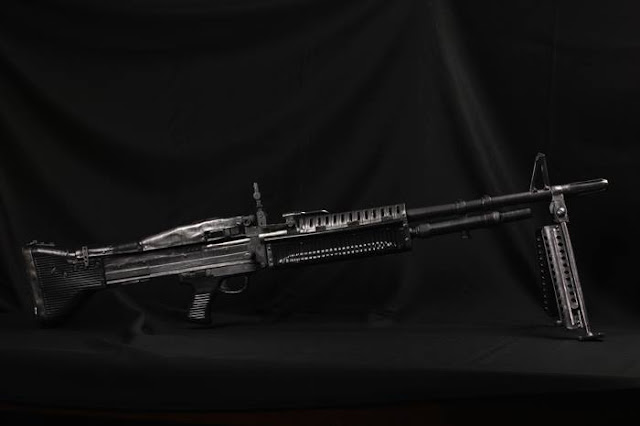 Manabu Hasegawa: M60 – paper, pencil, coloured pencil, 145 x 55 x 55 cm
Manabu Hasegawa at Tezuayama Gallery, Osaka
Here I liked plenty, such as Carina Linge’s photo tableaux, Susanne Kühn’s architectural presentation of paintings, Rose Eken’s kooky yet real ceramics and Andrea Canepa’s timeline of scenes of the future from sci-fi films. There was also Jeannette Ehlers applying a charcoal-dipped bullwhip against white canvas for the performance Whip It Good! – the sound of which echoed louder than I’d expected through the Fair. Manabu Hasegawa makes innovative Trompe l’oeil use of frottage by creating 3D models, here including gold coins (for which he rubs the sides as well as front surface with a coloured pencil), a massive vault to hold them, and a wide range of knives and guns. Violence, greed and fragility: no surprise that the Tokyo artist cites Buddhist sources, and specifically how what may seem permanent is ‘as dust before the wind’ (in the words of the 14th century epic ‘Tale of the Heike’).
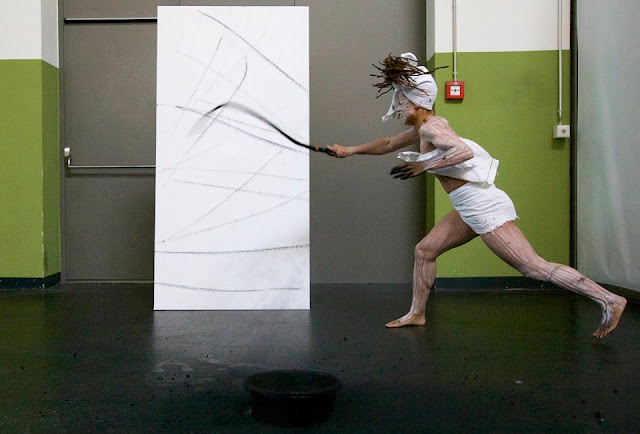 Jeannette Ehlers in performance
The Solo Project
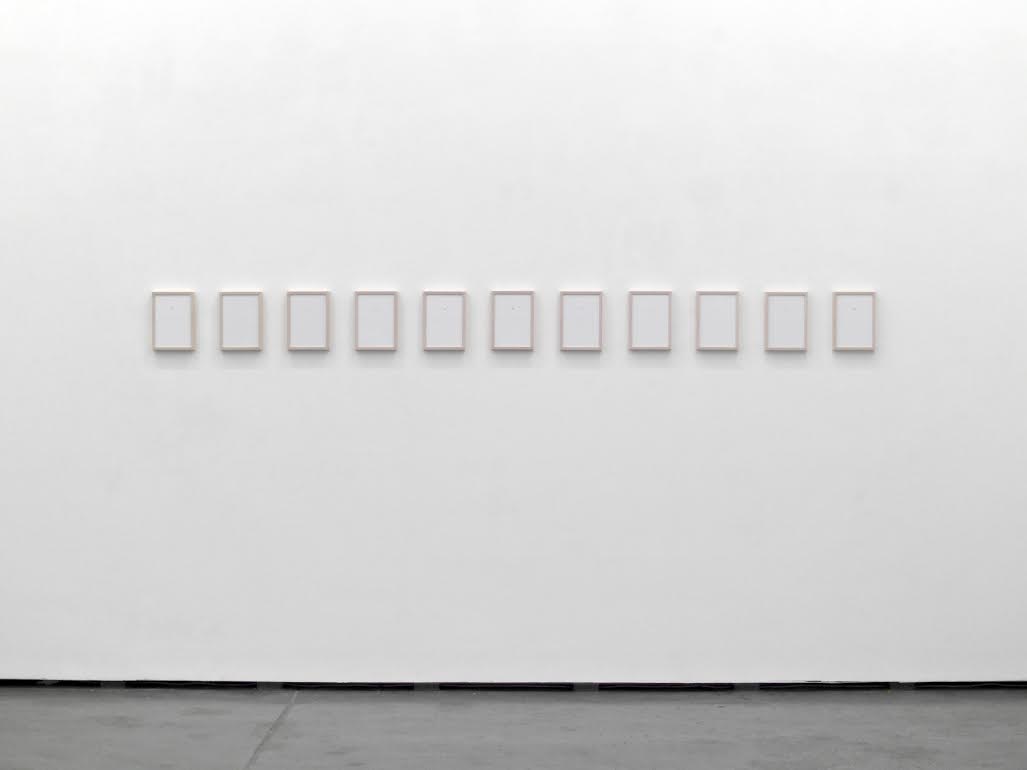
Christoph Brünggel: For V, 2015 at Galerie Bob Gysin, Zurich
The Solo Project is always a pleasant viewing experience, having a generous layout, an excellent catalogue (as does Liste), good representation of a small number of artists, and no crowds. One impressively economical piece was Swiss artist Christoph Brünggel’s eleven part text work, which said ‘I still haven’t figured out how to deal with it inside’. The words were hard to make out, as the typing had overlapped them, suggesting that the inside not dealt with was literally the space inside the words. But once you knew that the quote was from a veteran of the Afghanistan War, the formal conceit read more darkly as a mind impacted.
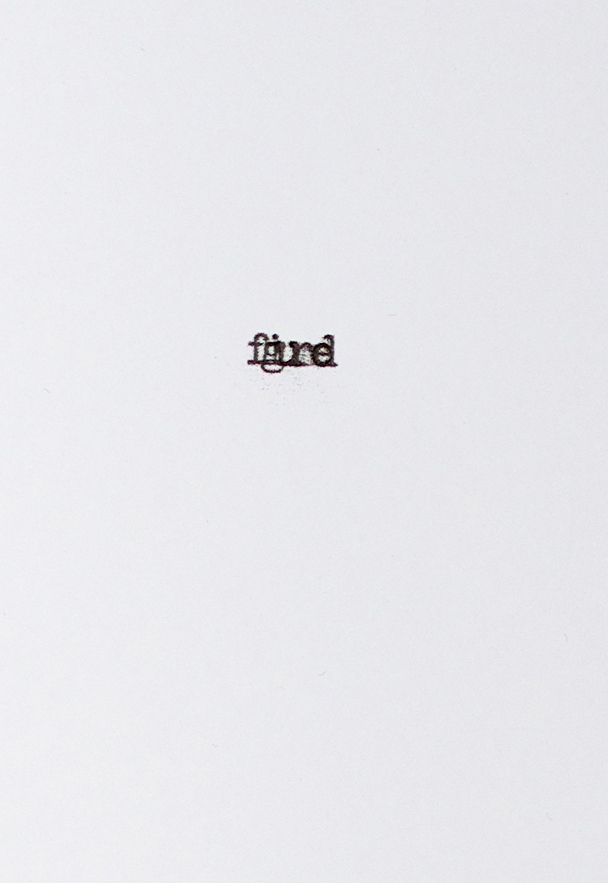 Go figure: one page detail close-up
Photo Basel
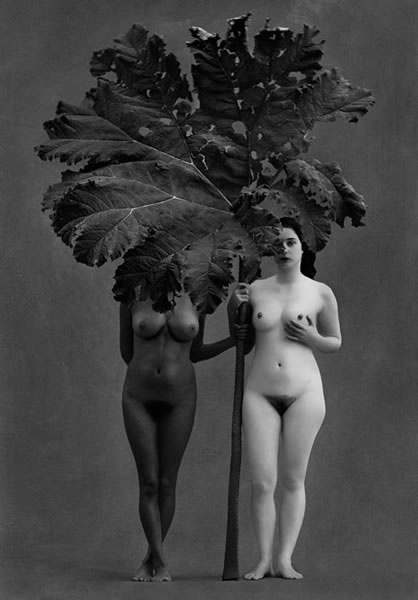
Flor Garduño – Eden, 2001 at David Guiraud, Paris
This new venture was small and somewhat scruffy, but included a wall of surreally tinged images by the Mexican Flor Garduño, who trained with Manuel Alvarez Bravo. The mythic Eden is in line with her own description of her nudes as ‘a search for the people who inhabit my dreams’. I like the echoes of Maillol’s sculpture, and how black and white replaces the expected male and female as the contrasted couple in paradise – or is it just that there would be no men there? I also liked Ishiuchi Miyako’s highly atmospheric and grainy images of US bases in Japan after they’d been abandoned (at Tokyo’s amanasalto).
 Ishiuchi Miyako from Club & Courts (1988-1990)
Art Parcours
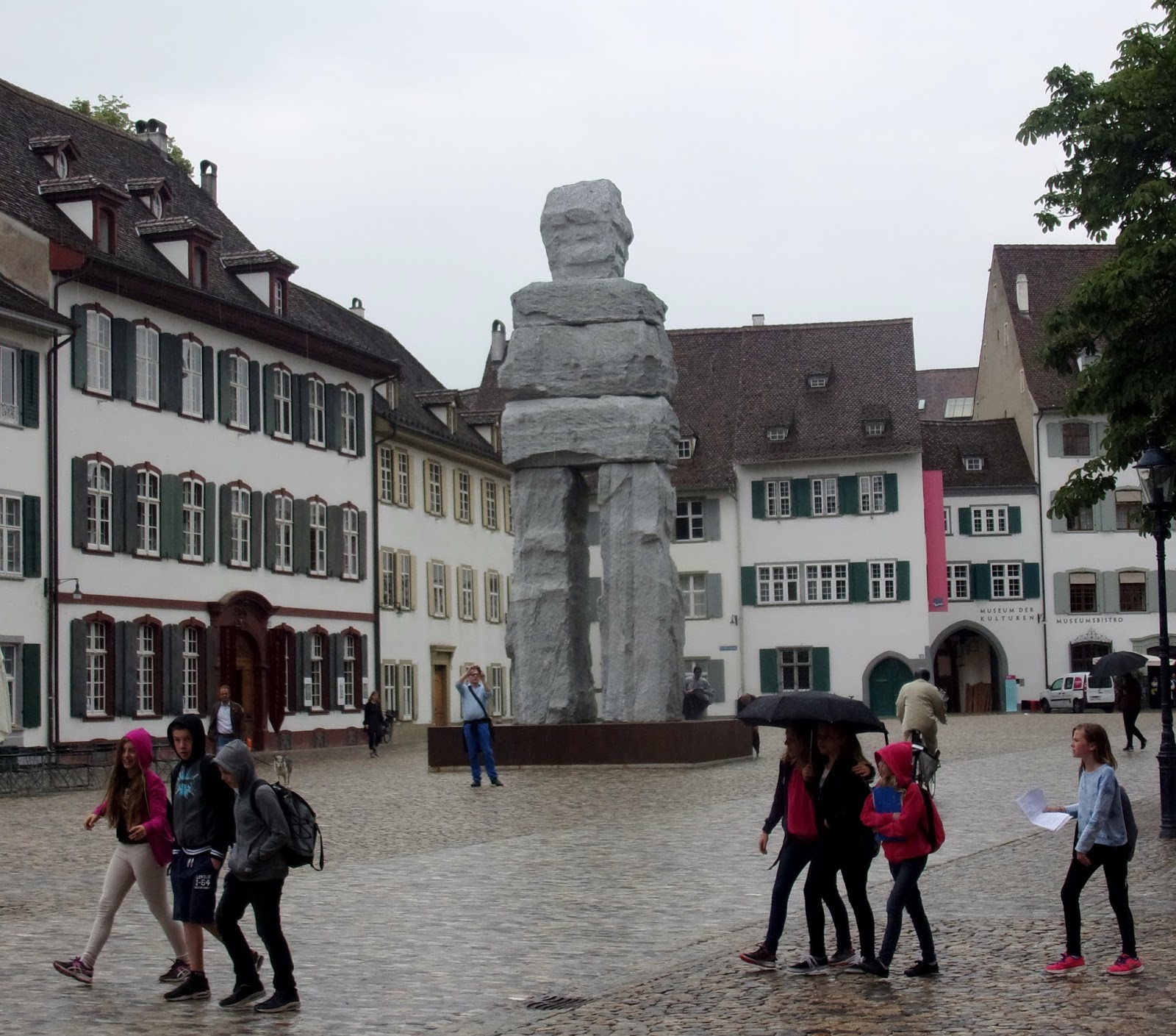
At 10 metres, the most imposing work in the xx stop Art Parcors route of art placed in the environs of the cathedral was Ugo Rondinone’s stone sculpture which used modern quarrying and carving techniques to mimic a prehistoric monument. The figure rose to the level of surrounding four storey buildings. Yet I suspect the project for which plans could be seen in Sadie Coles’ booth might trump even that (despite the best pink and blue preview efforts of the local schoolchildren in my photo above). The New York based Swiss artist intends to build a mountain of sorts from hyper-intensely coloured piles of boulders. The gallery presented three of these in front of comparably hued work by Jonathan Horowitz to provide the chroma-spectacle of the fair.
 Rondinone’s will-be-mountains with Horowitz’s Beyoncés at Sadie Coles’ stand
Also in the city
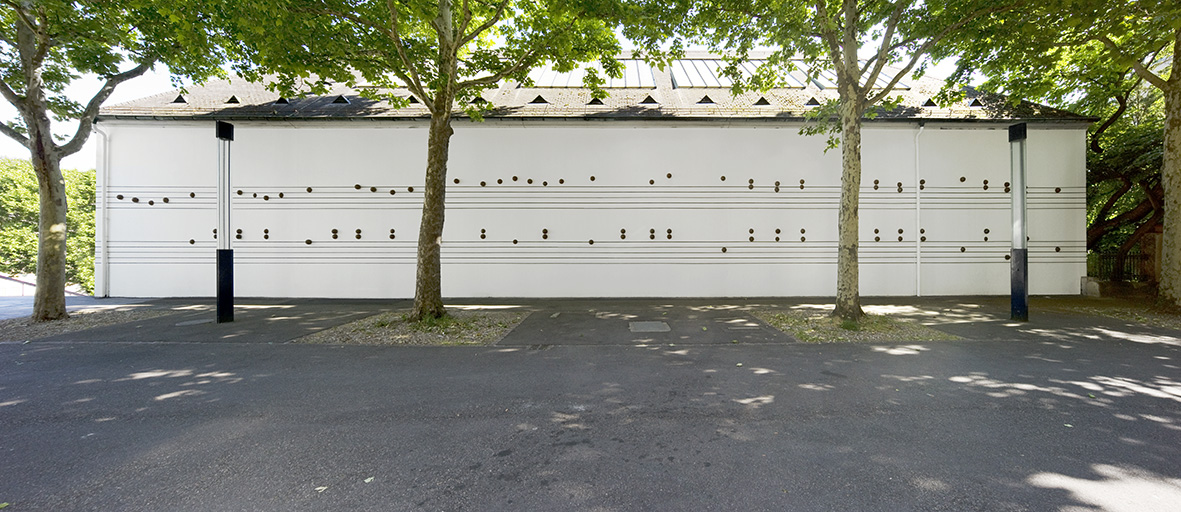
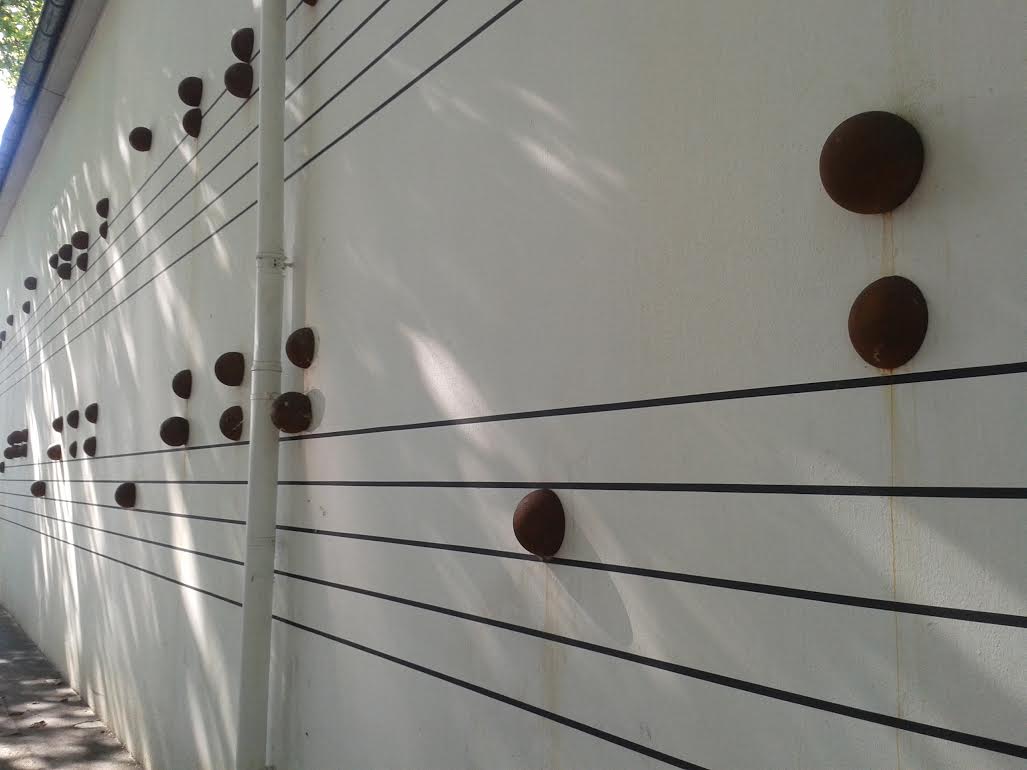
Nevin Aladağ: Marsch, 2014 at Kunsthalle Basel, back wall
Berlin-based Turk Nevin Aladağ was the discovery of the trip for me. I travelled via Stuttgart, where she was showing two captivating three screen film installations in which musical instruments were played by non-human processes, one urban and one set in the desert: sand falling on drums, bells wafted by the tide, a violin bowed on each circuit of a roundabout. The musical theme continued on the back wall of Basel’s Kunsthalle, where cannonball forms indicated the notes of Mozart’s Rondo alla Turka, the best-known example of Orientalism in classical music, whilst flagging the colonial basis of Orientalism and returning the military march to its origin as army signalling between the lines (of the army / stave).
 Martin Boyce: A River in the Trees, 2009
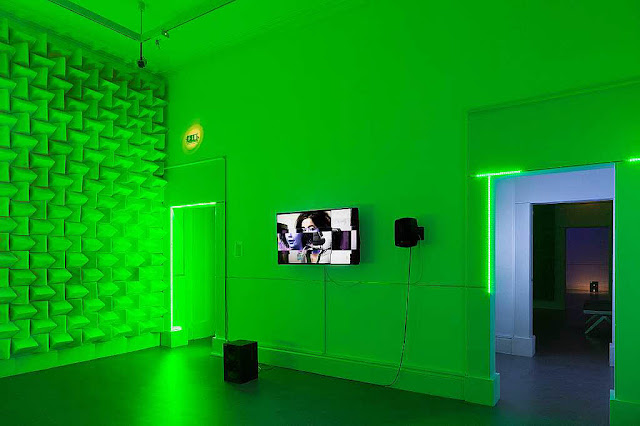 Haroon Mirza: The System, 2014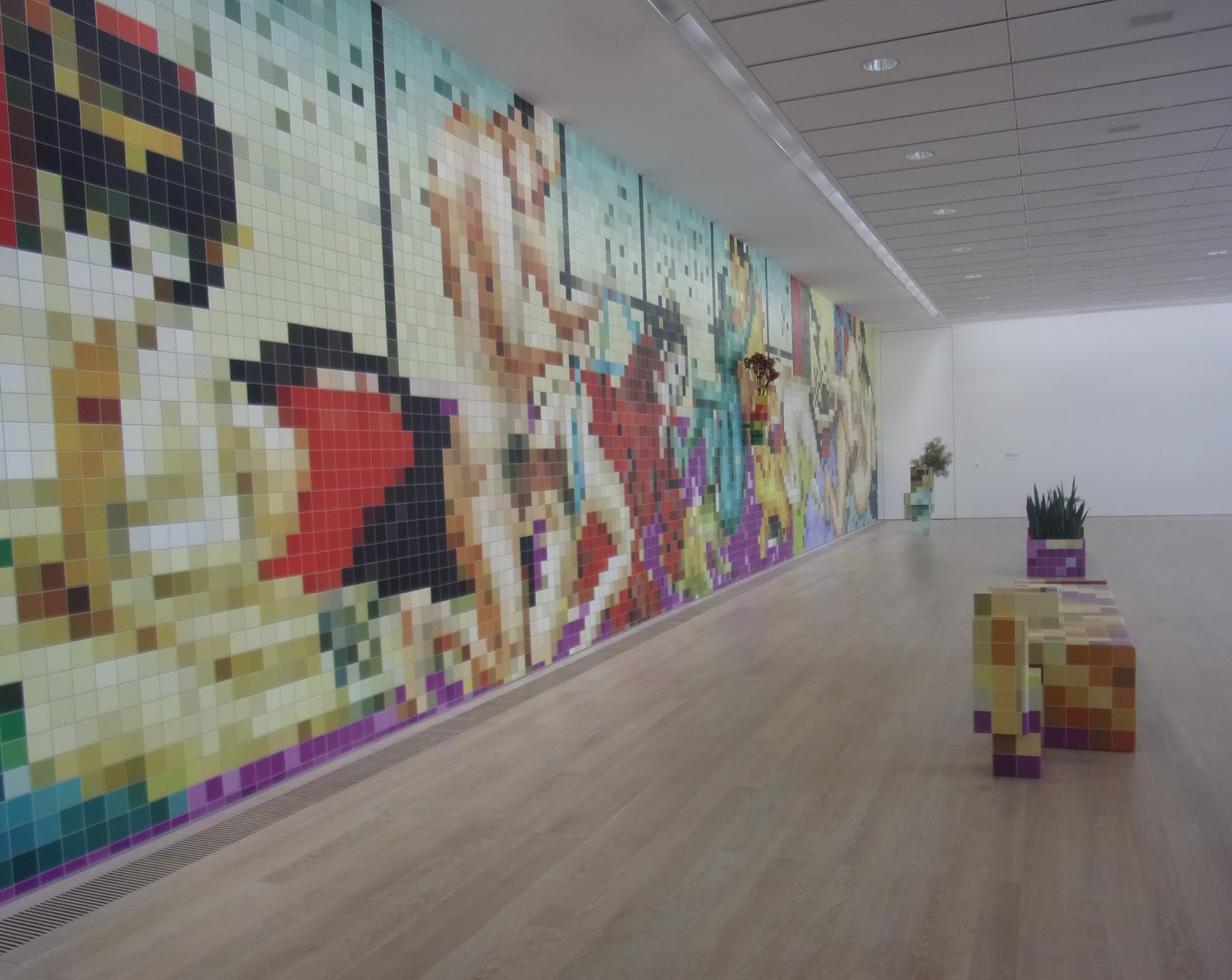
The Foundation Beyeler can be relied on for heavy-hitting exhibitions, and this year there were two: Paul Gaugin and Marlene Dumas. Less familiar, especially if you’d seen the Dumas at Tate Modern, was Tobias Rehberger’s takeover of the large basement space. It was so spectacular it would have fitted right in to the Schaulager’s typically impressive retrospective of installations from Barney, Fischli and Weiss, Kabakov et al. The German artist has made a 26m-wide mural, using monochrome squares of wallpaper as pixel-like coloured tiles. Vases (with plants) and benches sit in front with matched patterns such that they disappear if seen from the right angle, whereas the tiles come into focus, given distance, as sex acts taken from Japanese manga. Thus disguise operates in two directions, and fine art is derived from what might be termed a combination of décor and the undecorous. In the fair, Berlin’s neugerriemschneider had a less subtle version in which sex toys replaced the plants…
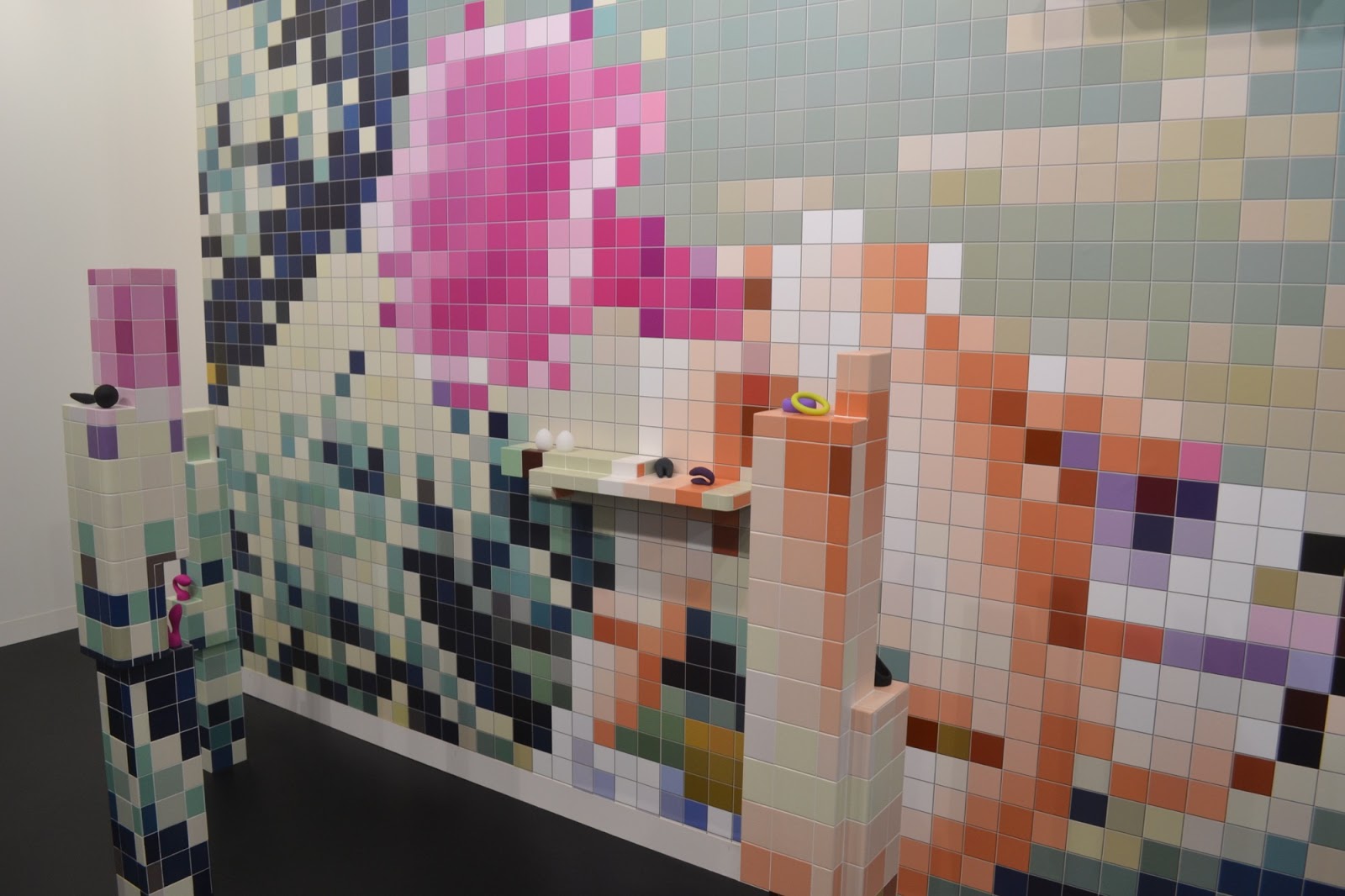
Tobias Rehberger: Oki Nami Ura, Katsushika Hokusai,1832 and Manga Girl, 2015
Commercial galleries in Basel
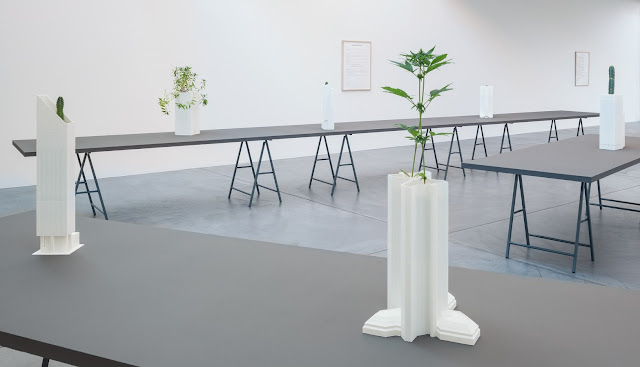 Superflex: installation view ofInvestment Bank Flowerpots, 2015 (photo Andreas Zimmermann)
Superflex at Von Bartha’s Garage
Von Bartha has my favourite commercial space in Basel: it takes up most of a former garage, but there are still operative petrol pumps outside. Inside, the Danish collective Superflex (perhaps you’ve seen their flooded McDonalds) brought their witty brand of anti-capitalist subversion to bear. They included contracts requiring corrupt practices to be followed; memorials to bankrupt banks; and plant pots in the form of the world’s top investment bank HQs in which psychotropic plants were growing, so suggesting that high finance dealings might be comparably addictive, euphoric and irrational. There was also a ten day film simulation of how an architectural ideal of modernism would deteriorate if left to do so over thousands of years, originally shown on a 40 m2 screen in front of its subject, the Stora Enso building in Helsinki.
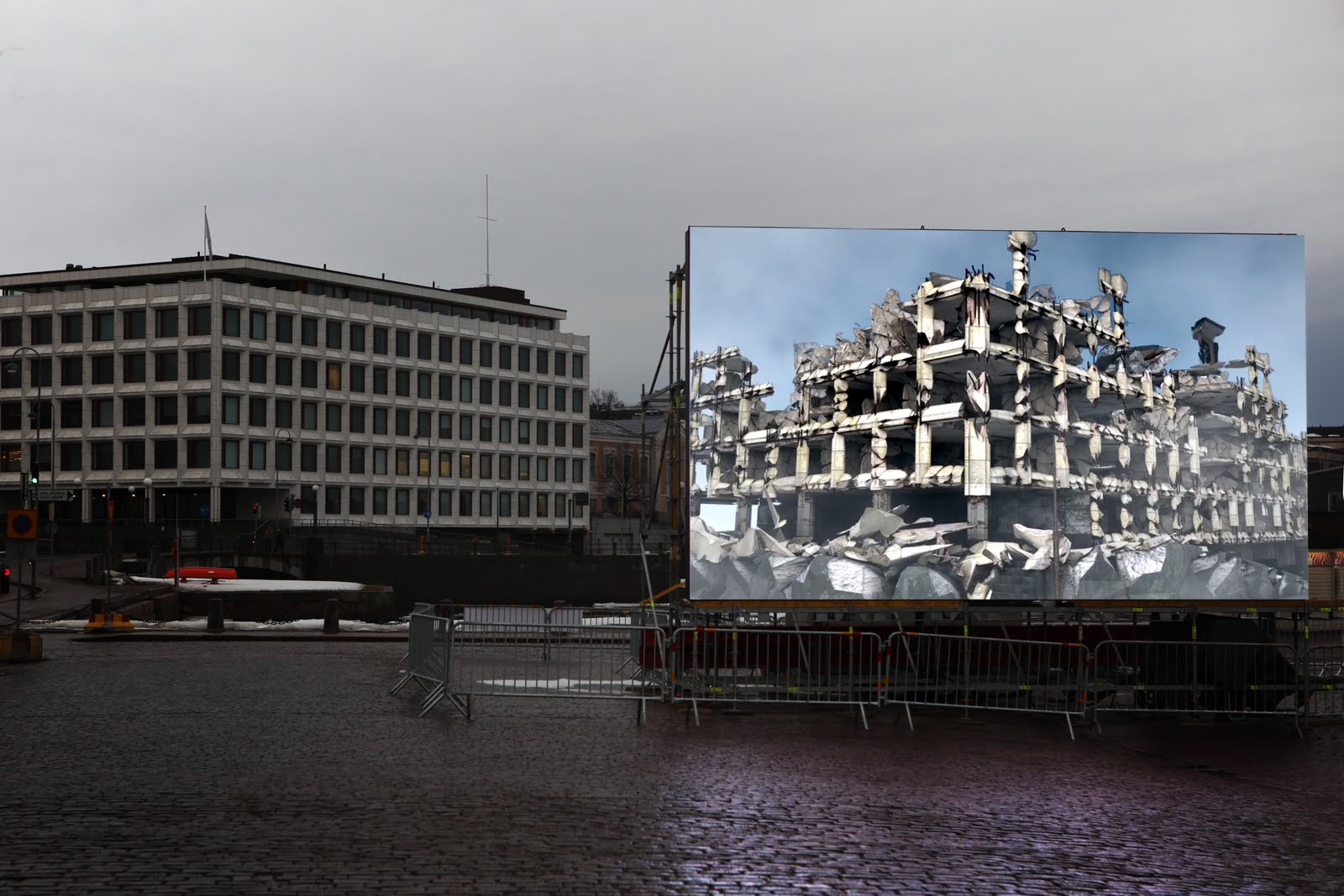 View in Helsinki of Modern Times Forever, 2011
Outside the City

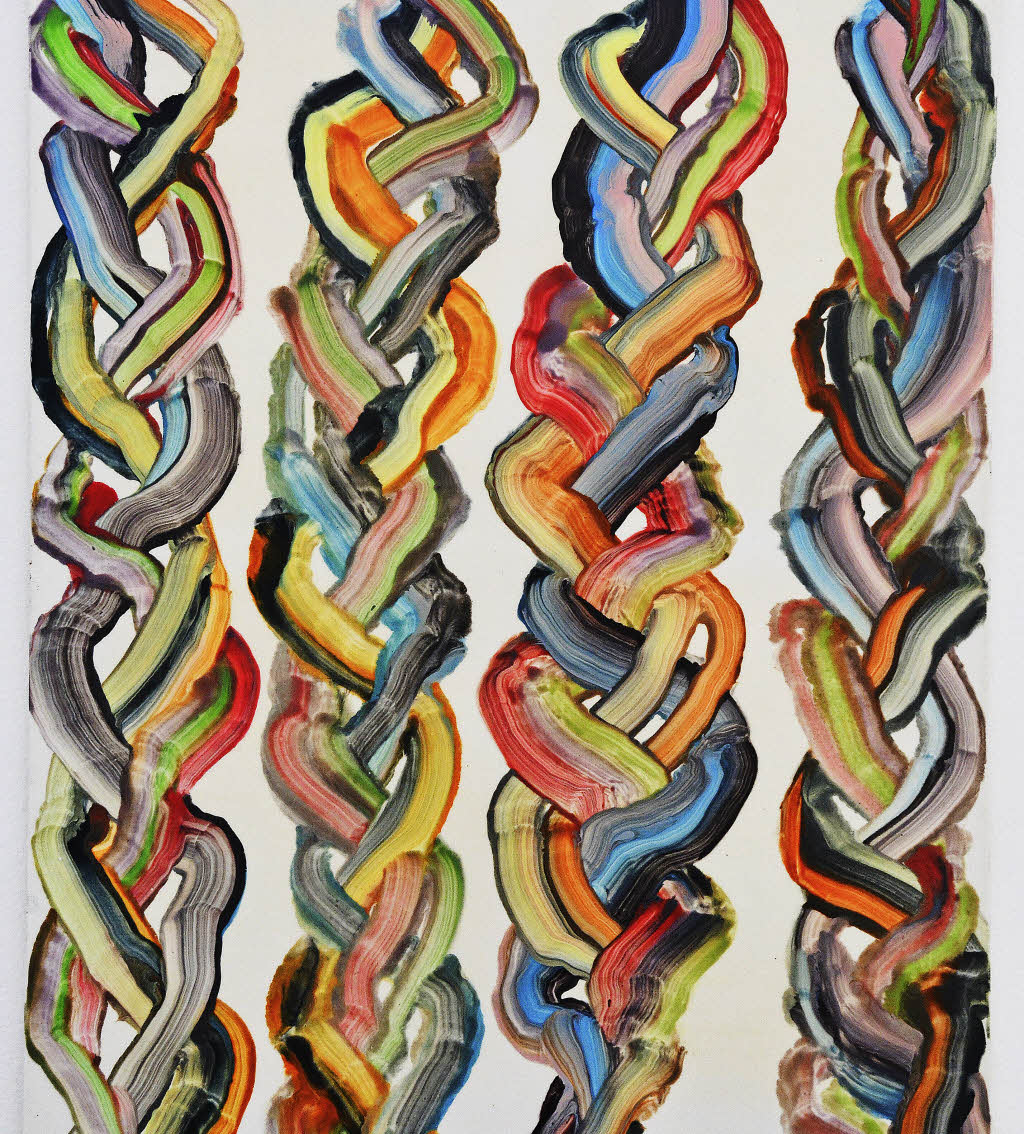 Bernard Frize: Quarante et un point quatre, 1999