For the March 2026 diary, I begin with several exhibitions and other events to visit this season. Lent is a season when churches often have a significant encounter with art. These include Southwark, Portsmouth and Winchester Cathedrals, St Mary’s Guildford, and Goldsmiths College. Exhibitions exploring the religious inspirations of artists, including Gwen John and Anna Archer, can also be found at the National Museum Cardiff, Dulwich Picture Gallery, Compton Verney, and Grand Palais, Paris. Architectural inspirations can be found in exhibitions featuring John Piper, Antoni Gaudí, and Sir John Vanbrugh. I end with exhibitions exploring aspects of mental health, ordinary life, and our sources of wisdom at venues including Two Temple Place, Tache, and Centre for Contemporary Arts, Tashkent.
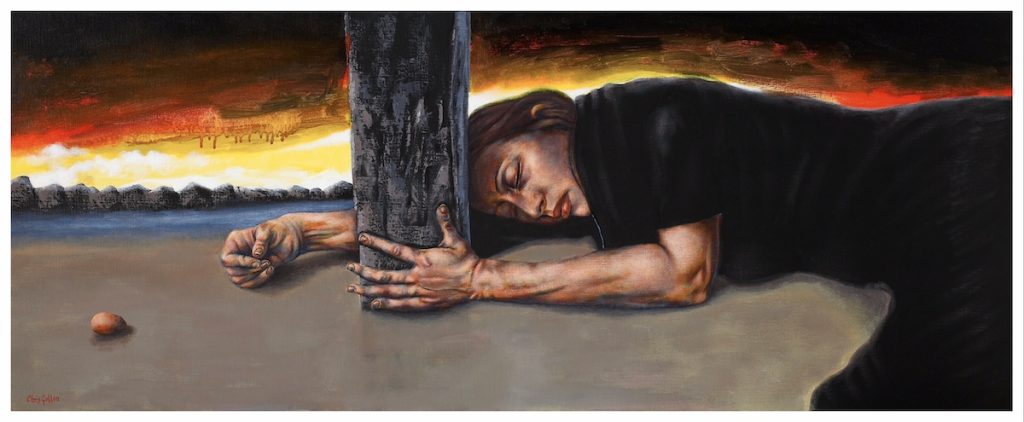
Chris Gollon, Magdalene at the Base of the Cross (Private collection)
‘Magdalene at the Base of the Cross’ by Chris Gollon is being displayed beside the High Altar of Southwark Cathedral for the duration of Lent as both an aid to worship and to overlap with Women’s History Month in March, in which there will be talks and reflections on the Magdalene. The painting is on loan from a private collection, but originally formed part of Gollon’s national touring exhibition to English cathedrals’ Incarnation, Mary and Women from the Bible’ (2014 – 2016), which travelled to the cathedrals of Guildford, Chichester, Durham, Norwich and Hereford, focusing only on women from the Bible.
The Cathedral will also be screening ‘CHRIS GOLLON: Life in Paint’. This documentary recently premiered at the Barbican Centre and in New York. The film explores the artist’s sensitive portrayal of women, his innovative techniques, and his pioneering boundary-crossing collaborations with leading musicians, beginning with his collaboration with Thurston Moore in ‘ROOT’ at the Chisenhale Gallery, alongside Yoko Ono, David Bowie, and Gavin Turk.
In the film, Sara Maitland remarks: “I’m an old-style feminist […] trying to bring that sort of feminism into some sort of relationship with the Gospels, and Chris just does it”. Gollon biographer and art historian Tamsin Pickeral notes: ” Magdalene at the Base of the Cross” has an increasing earthiness, seen in her muscly, knotted arms and her workmanlike hands. Clearly, this is a woman who has toiled, and yet she is also incredibly beautiful.”
‘Virgin & Child’, the largest painting from the ‘Incarnation, Mary and Women from the Bible’ exhibition, can also be seen in Guildford Cathedral, on a long-term loan from the Chris Gollon Estate. Painted in 2013, ‘Virgin and Child’ is the largest single canvas Gollon painted. It shows the Virgin brushing her cheek gently against that of the Infant. The two figures seem to float in a white void, highlighting this touching moment of loving intimacy between mother and child.
‘Religion & Art + the subjective’ is a one-day public event taking place at Goldsmiths College, London, on Saturday, 14 March 2026, with presentations and performances across film, sound, installation, poetry, and mixed media. This event is part of a continuing project with a series of public cultural and critical events in different formats that set out to create interdisciplinary encounters between religion and art from a generative position and to create a field of research and further enquiry in art practice.
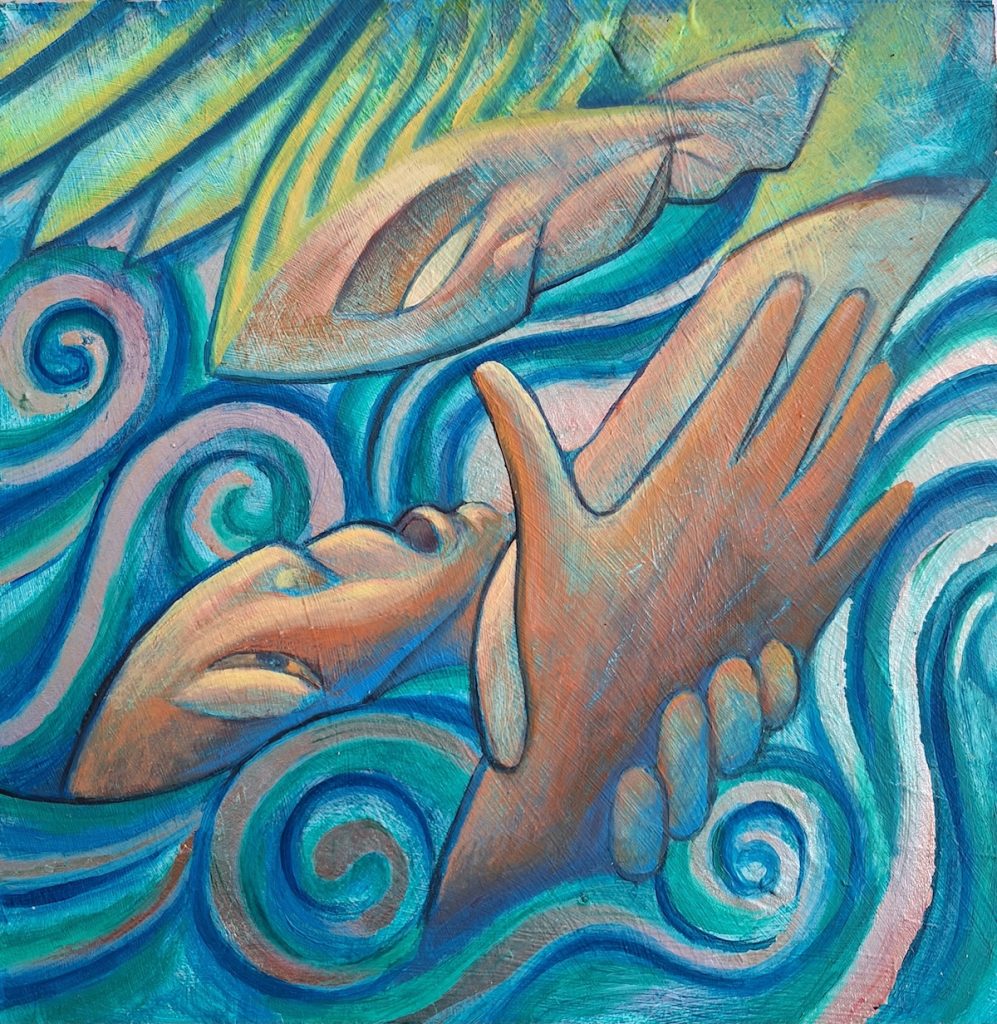
Nicholas Mynheer, Rescue – oil and silver leaf on panel 2025 20cm x 20cm
‘Sanctuary’ is an exhibition by artist Nicholas Mynheer at Portsmouth Cathedral, which features paintings and sculptures that explore the experiences of refugees, both ancient and contemporary. At the heart of the exhibition is the reminder that Jesus, Mary and Joseph themselves became refugees, forced to flee their home to escape violence and persecution. This ancient story is placed alongside contemporary experiences of people displaced by war, famine, political instability, and persecution across the world, as well as the ongoing, often perilous journeys of those attempting to cross the English Channel.
Mynheer’s work invites us to reflect on difficult and urgent questions. What would we do if our home were no longer safe? How would we respond if our faith, culture or identity placed us in danger? What does it mean to hope for a better life when the risks are so great? These questions are not posed from a distance, but with humility and compassion, encouraging each viewer to consider their own response. The exhibition also acknowledges the courage and kindness of those who offer help and protection, including the RNLI, border staff, charities and agencies that seek to bring rescue, care and dignity to people in danger. In these acts of compassion, Mynheer points us towards the love of Christ at work in the world today.
‘From Darkness … To Light’ is the title for an exhibition of 25 works from the Methodist Modern Art Collection at St Mary’s mediaeval church in Guildford, a joint Methodist and Anglican place of worship. The exhibition sets the scene by showcasing some of Christ’s ministry and, staged during the final part of Lent, focuses on Christ’s journey to the Cross, Resurrection and Pentecost. A full programme of events includes poetry readings, musical performances, and Lent reflections inspired by several of the paintings.
The Methodist Modern Art Collection has over 50 works, including works by Graham Sutherland, Elisabeth Frink, William Roberts, Patrick Heron, Edward Burra, and Georges Rouault. This exhibition includes work by Heron and Sutherland, plus Mark Cazalet, Eularia Clarke, Elizabeth Frink, Maggi Hambling, Francis Hoyland, John Muafangejo, John Reilly, Ceri Richards, and Jyoti Sahi, among others.
For twenty years, artist Sophie Hacker has been part of the creative and spiritual life of Winchester Cathedral. ‘Sophie Hacker – A Winchester Retrospective’ brings together a rich body of work created during that time, marking Hacker’s departure from her formal involvement in the Cathedral and celebrating her enduring contribution to the worship, mission, and visual language of this sacred place.
Running across Lent, Holy Week and Easter, the exhibition is anchored by the powerful work ‘Crucifixion Now, Resurrection Now’, which speaks directly into the drama, pain, mystery, and glory of this most significant season in the Christian calendar. ‘Crucifixion Now, Resurrection Now’ is a two-part work that evokes the movement of Easter weekend — from the suffering of Good Friday to the radiance of Easter Day. When closed, this work presents the Crucifixion: wounded wood from a cathedral workshop, marked by deep cuts, alongside black volcanic sand and blood-red lines, speaking of pain, earthiness, and sacrifice. When opened, the Resurrection is revealed — found materials transformed, gold catching the light, and circular forms hinting at eternity and the mystery of the Trinity.
Alongside this central work, the exhibition presents a predominantly 2D display of paintings, drawings, prints, and archival material, with a small selection of 3D works including ceramics and wood. Together, they trace the development of an artist whose practice is deeply rooted in Christian theology and expressed through symbolism, material, and form. Significant commissions by Hacker can also be found throughout the Cathedral, including the Epiphany Chapel altar frontal, festal vestments, seasonal banners, the processional cross, the silver and enamel virge, the Alphege Chapel, and Creative Producer for the ‘Chronicles of Light’. This exhibition offers a rare opportunity to encounter these works — and others — in one place, and to explore the thinking and creative process behind them.
Gwen John created her major body of work while in France during the French Catholic Revival. She converted to Catholicism in 1913. She admired the work of Georges Rouault, the pre-eminent Roman Catholic artist of his time, and Paul Cézanne, who sought to explore the eternal element of the Universe, the “Pater Omnipotens Aeterna Deus”. Jacques Maritain was a neighbour, and she visited his home, making a number of portrait drawings of him and becoming enraptured by his sister-in-law, Ukrainian-born Véra Oumançoff. Her friend Rainer Maria Rilke was also an influence as he sought in his writings “to restore spirit to Western materialism” and encourage “a heightened awareness of how to live with the world as it is, of how to retain a sense of transcendence within a world of collapsed spiritual certainty.” John wrote of herself as being “God’s little artist” and of entering “into art as one enters into religion”. She wrote of God as “a God of quietness” and viewed every moment as holy and not to be soiled.
‘Gwen John: Strange Beauties’ at the National Museum Cardiff brings together rarely seen works from Amgueddfa Cymru and collections from around the world to celebrate John’s 150th birthday. It tells her story as never before — revealing new ways of seeing her life and art and celebrating an artist whose vision still feels strikingly modern today.
Raised in a deeply religious household, Anna Ancher often painted scenes of faith and spirituality and was a cosmopolitan traveller and a pioneering modern woman. Today, she is celebrated as one of Denmark’s greatest painters and not just as a woman artist, but as an artist whose radical vision continues to inspire. ‘Anna Ancher: Painting Light’ at Dulwich Picture Gallery has brought her work to British audiences for the first time, showcasing over 40 paintings from across her career — including masterpieces on loan from The Hirschsprung Collection and Skagens Museum.
Ancher painted glowing interiors of her family’s inn and her own home, often using her relatives as models. Far from being confined by domestic subjects, exhibition curator Helen Hillyard argues that she transformed them into radical studies of light and colour. Her true genius lies in her treatment of light. She captured sunbeams spilling across walls, the golden glow of a lamp and subtle shifts in daylight. In some works, her experiments verge on abstraction and are so modern they almost anticipate 20th-century expressionism.
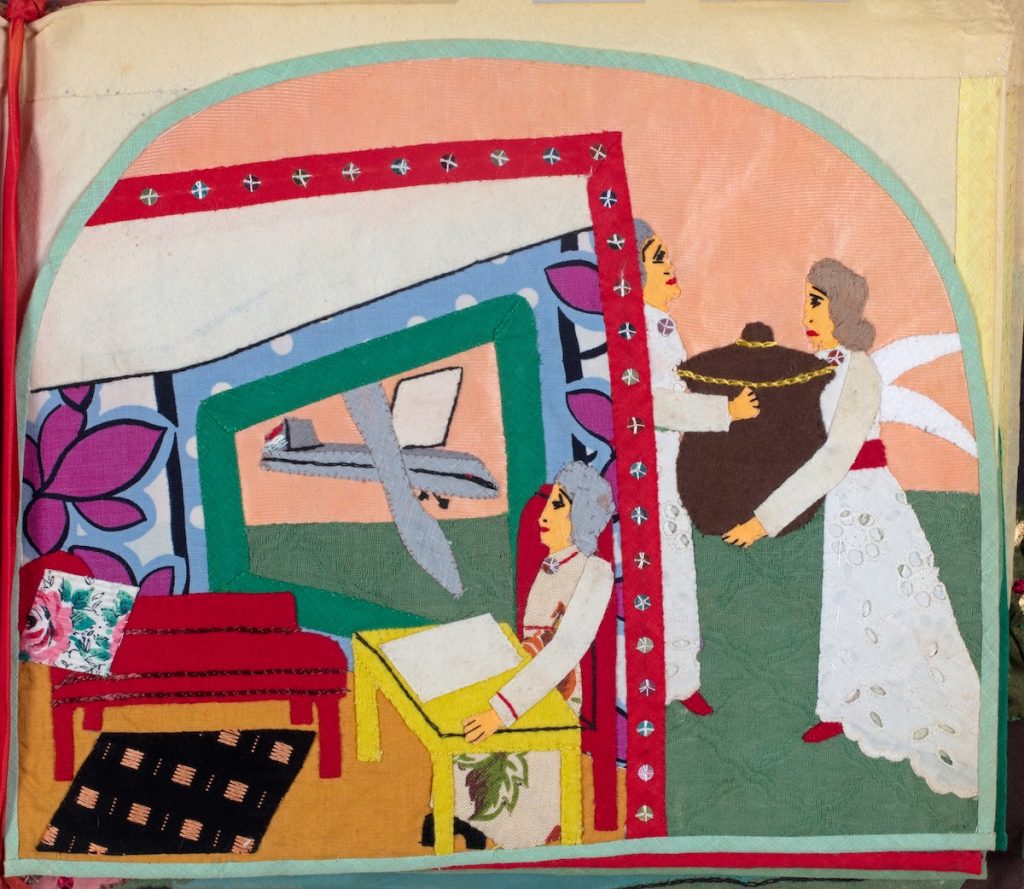
he Autobiraggraphy of her called Elizabeth Allen, In the Year of Grace 1961 © Jamie Woodley and Compton Verney – Full credit: The Autobiraggraphy of her called Elizabeth Allen, In the Year of Grace 1961, Elizabeth Allen. Photo © Jamie Woodley and Compton Verney
Following a period of homelessness, Elizabeth Allen ended up living for the rest of her life in isolation in a cabin in Biggin Hill. It was from here that she created her fabric art, mostly at night when she chose to stay awake out of fear of the dark. She was heavily influenced by a quasi-mystical reading of the Old Testament, including the belief of an impending apocalypse (which she thought would happen in 1996), as well as contemporary concerns she heard on the radio – from the actions of Wall Street to African revolutionary movements and the rise of popular culture.
Through a chance encounter with an art student and gaining fans including Patrick Heron and Michael Kidner, Allen’s textile proclamations found an audience at London’s Crane Kalman Gallery in 1966. Solo exhibitions followed in New York and L.A. However, although on the brink of worldwide recognition, Allen would not see most of this success as she died in 1967, the year following her first London exhibition.
Now, 60 years after her debut exhibition, her absurd, bitterly funny and often boldly prophetic creations are being rediscovered, and Compton Verney is displaying 12 of her textiles, including ones never seen in public before. These are displayed alongside works by other visionary artists, creatives who have made work in ways similar to Allen. These artists are also interested in the supernatural and religion, and take elements of the real world, making it strange through their work.
In an exhibition entitled ‘In One Breath’ at Grand Palais in Paris, Claire Tabouret presents life-size models, sketches, and preparatory work for the six stained-glass windows she created for Notre-Dame Cathedral in Paris. Winner in December 2024 of the competition organised by the Ministry of Culture, in association with the Simon-Marq workshop, she reveals the behind-the-scenes story of this exceptional project.
Each model reproduces, at full scale, a bay window in the south aisle of the Cathedral. Created using monotype printing, a technique the artist frequently employs, they are enhanced with stencils for the rosettes and decorative motifs. Inspired by the theme of Pentecost, a symbol of unity and harmony, Tabouret invites us to enter into the intimacy of her creative process and experience a rare moment: the inner workings of an extraordinary creation.
The first ever exhibition devoted to showing how the late artist John Piper responded to the landscape and architecture of Wiltshire and Dorset – including Devizes, his favourite market town – is at the Wiltshire Museum. More than three decades after his death, Piper’s work remains highly popular, and he is considered one of the most significant British artists of the 20th century. It was in the South Country that he made some of his most important paintings, portraying subjects from the region, including Stourhead, Fonthill and Lacock – yet there has never been an exhibition focusing on the work he did in this area, until now.
Renowned for working in a variety of media, the exhibition features one of Piper’s finest early collages, depicting the Neolithic site at Avebury. His strong Anglican faith also imbued his work, and he painted a number of churches in the locality, from Inglesham to Knowlton and Britwell Salome. In November 1940, while working as an official War artist, Piper persuaded the War Artists’ Advisory Committee to allow him to concentrate on painting bombed churches, which led him to depict the ruins of architectural landmarks in cities such as Bath and Bristol.
Guest Curator, Andrew Lambirth, says: “Piper’s enduring appeal resides in his ability to celebrate buildings in the landscape, from the stone circles of Neolithic man to churches, cottages and grand houses. By focusing on Wiltshire and Dorset, this exhibition shines a light on a wide range of Piper’s remarkable achievements: the early collage drawings of Avebury, Knowlton and Salisbury Plain, the majestic semi-abstract Autumn at Stourhead and the paintings of Fonthill and Lacock, then the various potent interpretations of Portland, Bradford-on-Avon and finally Stonehenge. Together with stained glass, ceramics, book illustrations and textiles, here are riches to be seen.”
In 2026, Barcelona assumed the status of World Capital of Architecture and is hosting numerous exhibitions, conferences, and events, including those commemorating the Gaudí Year, marking the 100th anniversary of the architect’s death. Barcelona is a magnet for tourists and art lovers because of the sense of exuberance and abundance created by the sinuous, sensuous curves and colours of Antoni Gaudí in Cornet’s amazing buildings. Whether we are encountering the shifting sea-like blues of the Casa Batlló, the abstract collage of the wave-like trencadis mosaic bench at Park Güell, the whirlpool-like undulations on the ceiling at Casa Milà, the columns in the Crypt of Colònia Güell, which form a wood of trees, or the sunflower forms on the ceiling of the Sagrada Familia, Gaudí’s work possesses an ecstatic sense of natural beauty.
The Sagrada Familia, his still unfinished magnum opus, attracts over 4.5 million visitors a year, 85 per cent of whom come from outside Spain. Recently, the upper arm of the cross was put in place on the tower of Jesus Christ at the Sagrada Família, a milestone that completes works on the exterior of this tower. This piece is the highest point of the Temple, measures 4.5 metres by 4.5 metres by 4.9 metres, and completes the grouping of the six central towers of the Sagrada Família. In 2027 and 2028, works will continue inside the structure.
Much of Gaudí’s work was marked by his big passions in life: architecture, nature and his Catholic faith. His work transcended mainstream Modernism, culminating in an organic style inspired by nature. He utilised natural forms in his work both for utilitarian and aesthetic reasons and described nature as “the Great Book, always open, that we should force ourselves to read”.
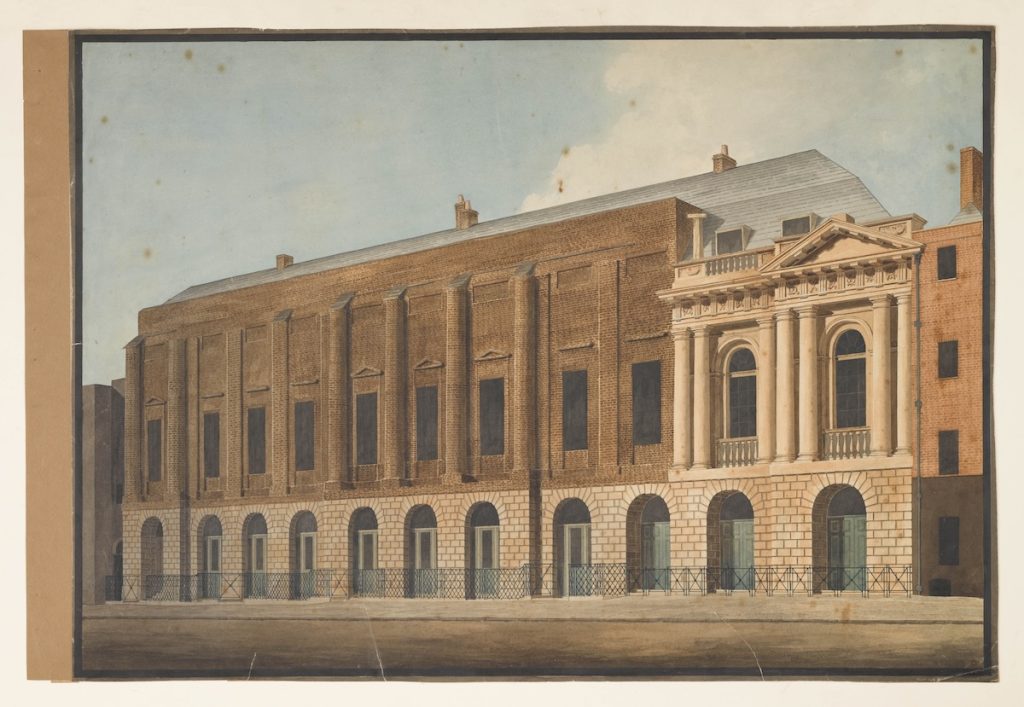
Soane office, Royal Academy Lecture Drawings of the work of Sir John Vanbrugh, London: Queen’s Theatre, Haymarket, 1801, back elevation, SM 75/4/2
300 years after his death, a major new exhibition exploring one of the UK’s greatest architects, Sir John Vanbrugh is at Sir John Soane’s Museum, London. Sir John Soane cited Vanbrugh as one of his great influences, remarking that he had “all the fire and power of Michelangelo and Bernini”. I first became aware of Vanbrugh as he was buried at one of my previous churches, St Stephen Walbrook.
Hailed as ‘The Rockstar of the English Baroque’ and ‘The original starchitect’, Vanbrugh designed some of the UK’s most admired and loved country houses, including Blenheim Palace and Castle Howard, with each one featuring his signature ability to exploit the emotional impact of architecture by making exciting and dramatic use of light and shadow, recessions and projections.
Although his body of architectural work was not large, he almost single-handedly popularised the ornate, full-blooded Baroque style that became de rigeur for grand country houses. Vanbrugh’s bold and daring designs extended beyond country houses to temples, belvederes, pyramids and other garden features. The originality of such work means he is also credited with a vital role in the development of the 18th- century English garden.
‘Vanbrugh: The Drama of Architecture’ is an appropriate title, as he was also one of the country’s great Restoration dramatists, with his architectural work just as bold and daring as his risqué plays, such as ‘The Provoked Wife’ and ‘The Relapse, or, Virtue in Danger’.
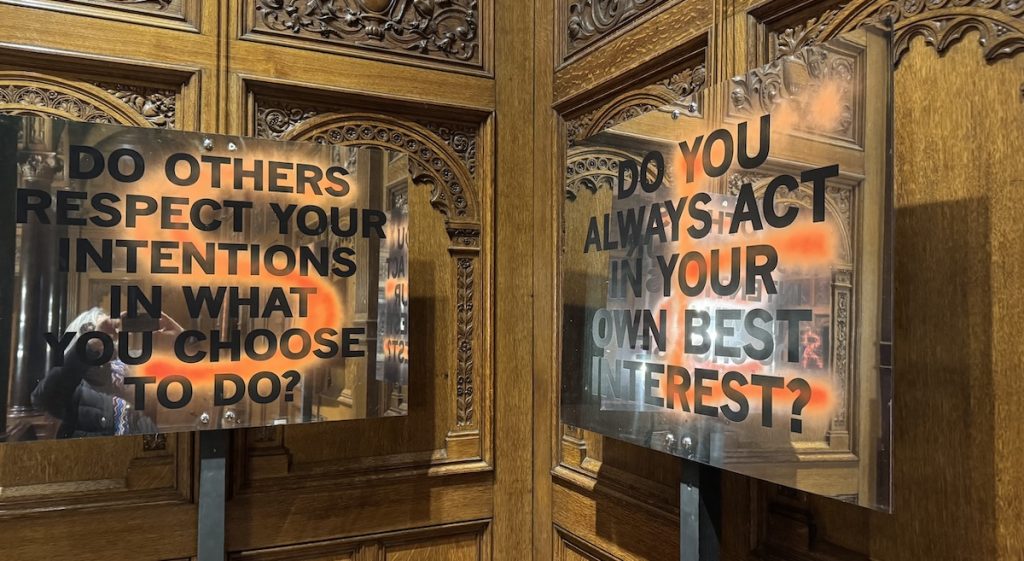
Mark Titchner, Some Questions About Us 2019-20 on loan from Bethlem Museum of the Mind
‘The Weight of Being: Vulnerability, Resilience and Mental Health in Art’ at Two Temple Place explores artistic expression and mental health. Through depictions of deeply personal and collective experiences, it examines the powerful ways in which artists capture vulnerability, resilience, and their search for solace. Including the work of a diverse range of twentieth-century and contemporary artists and their varying perspectives, The Weight of Being showcases how artists have captured the psychological and emotional impact of societal pressures, resilience in the face of adversity, and existential uncertainty.
Alongside dozens of artworks drawn from galleries and collections across the UK, the portraits, landscapes, and figurative studies of the lesser-known artist John Wilson McCracken are woven throughout. Denied the opportunity to return to the Slade School of Art following a period of hospitalisation for mental health reasons, McCracken spent much of his career in Hartlepool, producing work that reflects a profound sensitivity to the emotional and social pressures of his time. Shaped by personal and collective struggles, his art offers a deeply human perspective on the exhibition’s themes, revealing how external forces imprint themselves on the mind, body, and creative spirit.
Through the wide range of artists, mediums, and represented demographics, The Weight of Being is intended to spark meaningful conversations about resilience, identity, and emotional well-being, offering a profound reflection on the toll of existence and the strength found in shared experiences, ultimately fostering hope and deepening understanding.
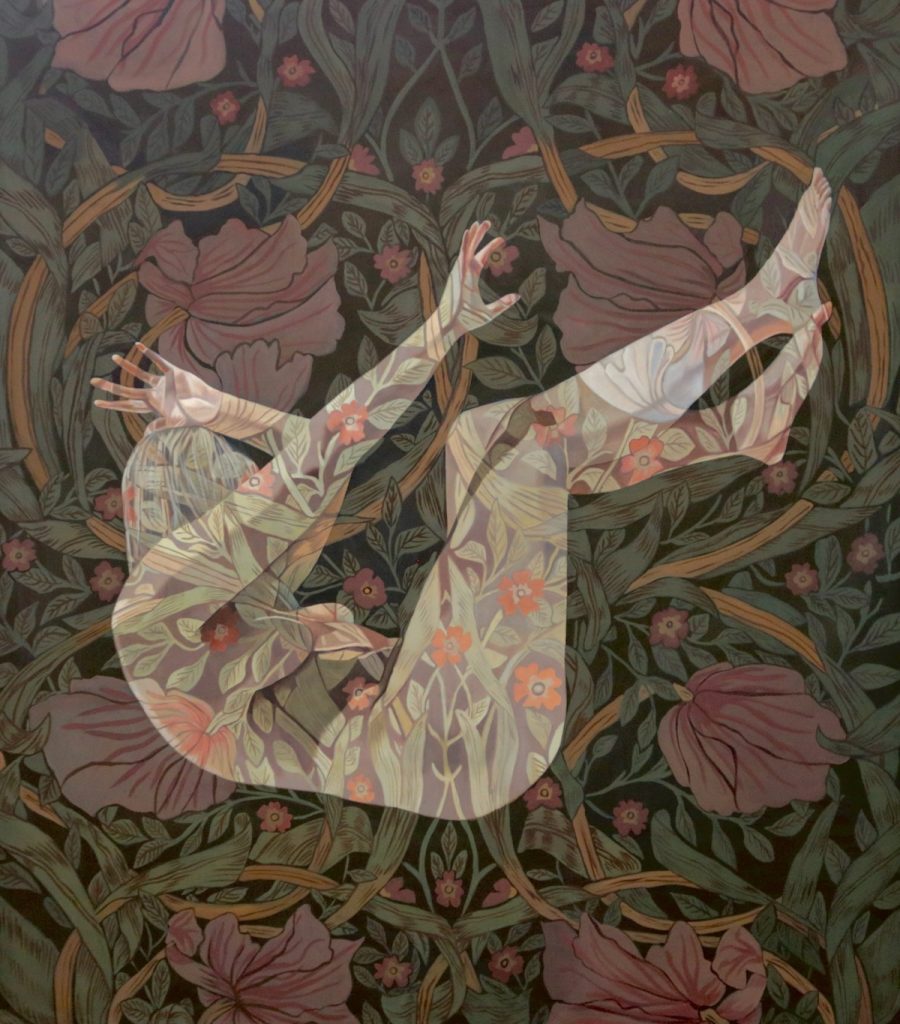
Breanna Gordon, Perpetual Inbetweenness, 2023, copyright the artist, courtesy of Tache
Tache presents ‘Introspect’, the debut solo exhibition of 14 new and recent paintings by Canadian-British artist Breanna Gordon. The show’s exploration of mental health is shaped by the artist’s lived experience. For Gordon, navigating this topic sees painting become a tool for healing and situates her work within the current wider dialogue on the health benefits of making and experiencing art. Gordon’s paintings explore the pervasive nature of anxiety through densely layered compositions defined by dark colour palettes and elaborate patterns. In her practice, the artist draws on art-historical motifs; she particularly finds inspiration in historical genres of European painting. Fusing the Italian Baroque with the Pre-Raphaelite Movement, her works tread the boundaries between waking reality and dreamlike states. In her patterned works, the intricate backgrounds, informed by the textiles of William Morris, aim to visualise the cyclical nature of intrusive thoughts.
Gordon comments: “When I think about the role that introspection plays in my practice, it can feel disruptive and uncomfortable—but this is what fuels the work; painting becomes a tool for healing and a ritualistic process. I look forward to inviting reflection on this in my debut solo show at Tache.”
London-born, Denmark-based artist Neil Tye presents a focused body of work centred on ‘The Things We Carry’, an ongoing exploration of inner burden, memory, and the emotional loads we carry through life. Tye examines how the invisibly accumulated weight is held, shared, and released, both physically and emotionally. His practice is intuitive and process-driven. He does not begin with a fixed concept; instead, he allows movement, gesture, and mark-making to guide each work as it develops. Forms accumulate and press against one another, finding balance through tension and restraint. Colour carries emotional weight, while line functions as structure, rhythm and containment.
‘The Things We Carry’ builds on a body of work first presented in Houston and expands in Austin with new sculptures and smaller works alongside paintings. These additions extend the language of accumulation and support into three dimensions, reinforcing the work’s physical presence of weight and balance.
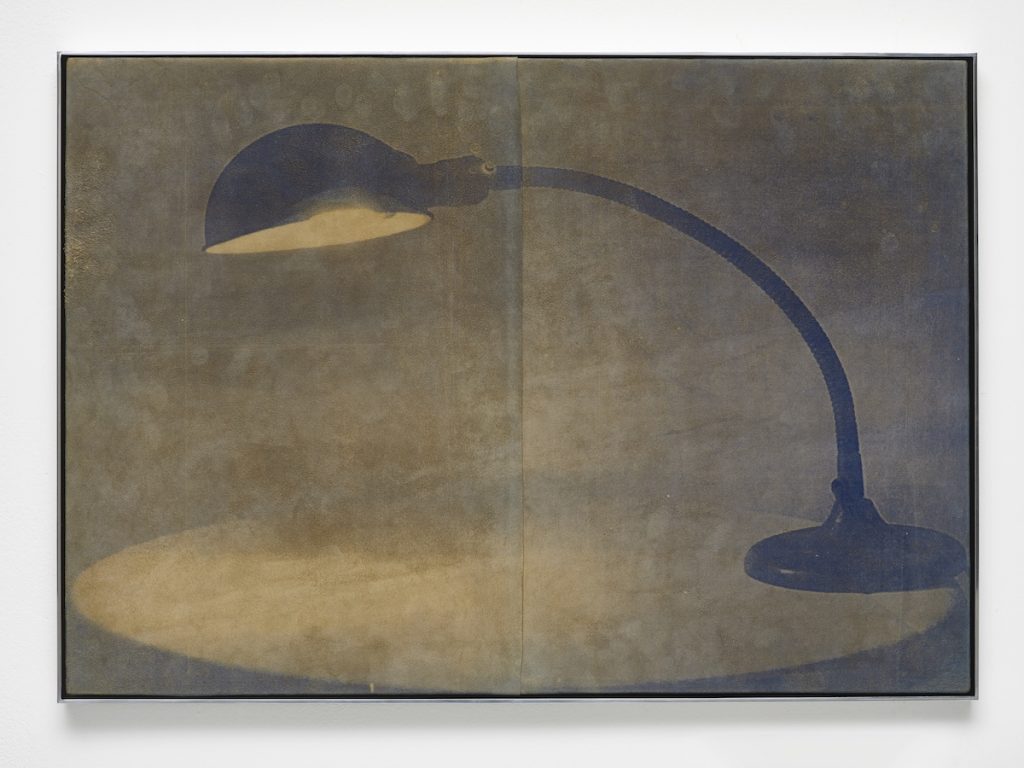
Poppy Jones, Slow Fall, 2023. © Poppy Jones. Courtesy of the artist and Herald St, London. Photo by Andy Keate. Herald St, London.
Sussex-based artist Poppy Jones is best known for her timeless still lifes on repurposed textiles, which sit somewhere between painting and object, with haptic surfaces crisply contained in aluminium frames, and a concise group of which will be on display. In ‘Poppy Jones: Frozen Sun’ at Towner Eastbourne, she debuts several new, larger works she has been developing in her studio. Together, these works exemplify her focused attention to incidental, chance encounters with the familiar and the quotidian.
Working on an intimate scale that feels true to life, subjects range from closely cropped sections of clothing and glowing reading lamps to small fruits and cut flowers – fading from full bloom to inevitable decay. Often photographed in the artist’s home, these images invite deeper considerations of memory, life, death, and the passage of time. Each piece incorporates the artist’s photography, lithographic printing processes and illusory veils of watercolour on found fabrics. Jones works on cotton, silk and suede canvases, often cut from her own garments or from vintage clothing sourced online. As well as being connected to the artist’s life, individual artworks are often caught in a self-referential loop in which, for instance, a panel of suede holds an image of the jacket it was cut from, or the image of a buttoned shirt is woven into the fabric of that exact piece of clothing.
‘Hikmah’, curated by Dr Sara Raza, has a title that means “wisdom” in Uzbek. ‘Hikmah’ marks the first exhibition in the Centre for Contemporary Arts (CCA) Tashkent’s new space, featuring site-specific works that respond to the building and its architecture. The CCA is the first institution of its kind in Central Asia, a permanent centre for contemporary art, research, and community engagement in the heart of historic Tashkent.
This inaugural group exhibition brings together leading voices from across the globe to explore ideas of wisdom, spirit, and material transformation through powerful new commissions and celebrated works. Exploring ideas around insight, intelligence, and divine wisdom, the exhibition features new commissions by Muhannad Shono, Nari Ward, Shokhrukh Rakhimov and Tarik Kiswanson. The exhibition also includes a loaned work by Nadia Kaabi-Linke from the Solomon R. Guggenheim Museum, a participatory work by Kimsooja and works from the Savitsky Museum in Nukus by Vladimir Pan, Daribay Saipov, and Bakhtiyar Saipov.
‘Magdalene at the Base of the Cross’ by Chris Gollon (1953 – 2017), 18 February – 4 April 2026, On Loan to Southwark Cathedral for Lent & Women’s History Month 2026 – Visit Here
Screening of the documentary ‘CHRIS GOLLON: Life in Paint’ at Southwark Cathedral on 6 March – Visit Here
‘Religion & Art + the subjective’, 14 March 2026, Goldsmiths College – Visit Here
‘Sanctuary’, 18 February – 12 April 2026, Portsmouth Cathedral – Visit Here
‘From Darkness … To Light’, 9 March – 5 April 2026, St Mary’s Guildford – Visit Here
‘Sophie Hacker – A Winchester Retrospective’, 9 March – 7 April 2026, Winchester Cathedral – Visit Here
‘Gwen John: Strange Beauties’, 7 February – 28 June 2026, National Museum Cardiff – Visit Here
‘Anna Ancher: Painting Light’, 4 November 2025 — 8 March 2026, Dulwich Picture Gallery – Visit Here
‘Troublemakers and Prophets: Elizabeth Allen and Other Visionary Artists’, 28 March – 31 August 2026, Compton Verney –
Visit Here
‘Claire Tabouret: In a single breath’, 10 December 2025 – 29 March 2026, Grand Palais, Paris – Visit Here
‘John Piper in the South Country’, 7 March – 7 June 2026, Wiltshire Museum – Visit Here
Gaudi Year – Visit Here
‘Vanbrugh: The Drama of Architecture’, 4 March – 28 June 2026, Sir John Soane’s Museum – Visit Here
‘The Weight of Being: Vulnerability, Resilience and Mental Health in Art’, 24 January – 19 April 2026, Two Temple Place – Visit Here
‘Introspect’, 6 March – 9 April 2026, Tache – Visit Here
‘Artist in Focus: Neil Tye’, 12 February – 14 March 2026, Unchained Art Contemporary Gallery, Austin – Visit Here
‘Poppy Jones: Frozen Sun’, 28 March – 31 May 2026, Towner Eastbourne – Visit Here
‘Hikmah’, 21 March – 30 June 2026, Centre for Contemporary Arts, Tashkent – Visit Here