
This is my second visit to Thailand’s travelling biennial — I came to Chiang Rai in early 2024 — and returning makes one thing clear: this exhibition has found a formula that works. It takes contemporary art out of the gallery and into the territory itself, inviting both visitors and locals to discover and reflect upon their history, their economic tensions, and the social forces that have shaped their world. Art is placed where life actually happens in spaces that already have something to say—and the conversation that results feels genuine.
The theme, Eternal [Kalpa], takes its name from a Hindu-Buddhist unit of cosmic time — a kalpa is roughly 4.32 billion human years, the span of one day in the life of the creator god Brahma. It sounds grand, but the curators bring it down to earth through a single, beautiful image: the sun setting over Promthep Cape, melting into the Andaman Sea, as it has done every evening and will continue to do so long after we are gone.
Artistic directors Arin Rungjang and David Teh, with curators Hera Chan and Marisa Phandharakrajadej, use this idea to push back against the relentless pace of modern life — the tourism economy, the development logic, the clock time that governs everything. Instead, they ask us to pay attention to slower rhythms: the breeding cycles of sea turtles, the tidal knowledge of Urak Lawoi sea nomads, the long memory of Phuket’s Chinese diaspora. The island has been a tin-mining hub, a UNESCO City of Gastronomy, and a global beach destination. All of those histories are present here at once, and the biennale takes that seriously.
65 artists and collectives from 25 countries are taking part, with roughly one-third Thai. The balance feels right — this is neither a showcase of local talent for foreign visitors nor a parade of international names dropped onto a tropical backdrop. The 50 new commissions were developed in real conversation with the island, and it shows. The 19 venues spread across three districts are what give this biennale its particular energy. A decommissioned power station, a former liquor distillery, an abandoned hotel, a 4,000-seat gymnasium, a Taoist shrine, the old Pearl Theatre — these are not neutral spaces. They come loaded with history, and the artists have responded to that.
Woraphob Tantinantakul, who grew up in Phuket, makes one of the most personal and precise works in the show. A Path No Longer Smooth (2025) builds steel walkways over piles of tin slag — the waste material from the island’s mining past — then covers everything with coconut husks, coffee grounds, and tourist industry leftovers. Phuket’s roads were once paved with this same slag, said to be hard enough to make rocket shells. Today, those roads are full of potholes. It is a simple but sharp observation about what development leaves behind.
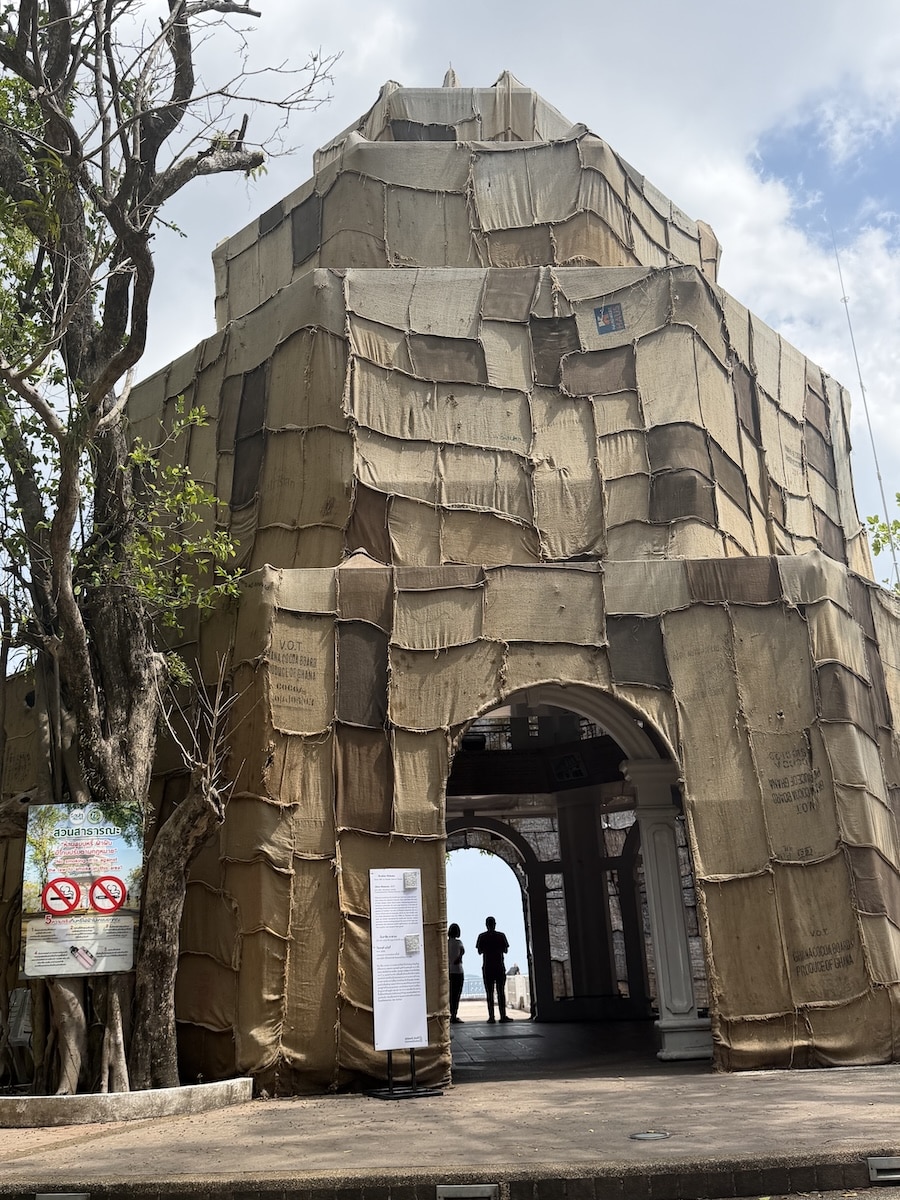
Ibrahim Mahama
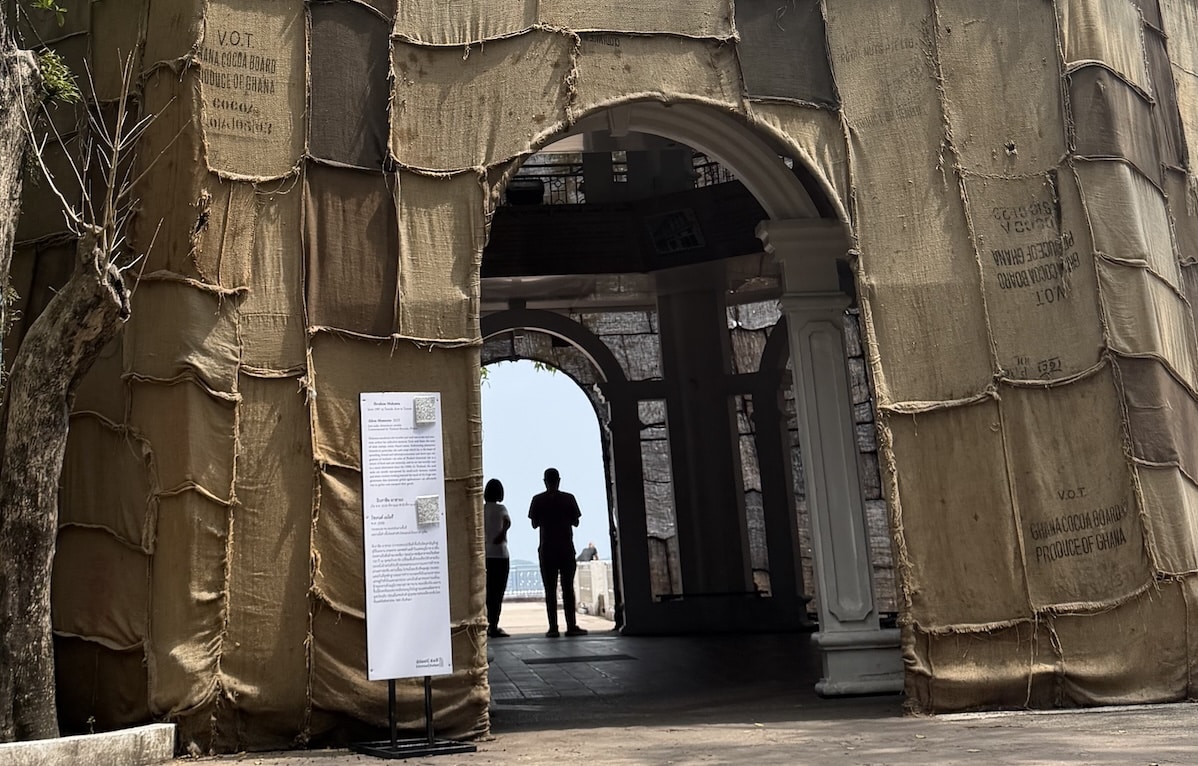
Ibrahim Mahama works across two sites. At the Chao Fah Power Station, decommissioned and filled with an eerie stillness, he installs works that examine the colonial history of extraction and the resistance it produced. Then at Khao Rang Viewpoint — a hilltop gazebo where tourists come for panoramic views — he covers the structure in jute sacks, stitched together by hand and worn with the marks of trade and labour. The wind moves through them. Something familiar becomes something else entirely.
Ayoung Kim fills part of the Municipal Gymnasium with speculative fiction — work that sits at the intersection of climate crisis, labour, and technology, using imagination not as an escape route but as a tool for thinking about how things could be different.
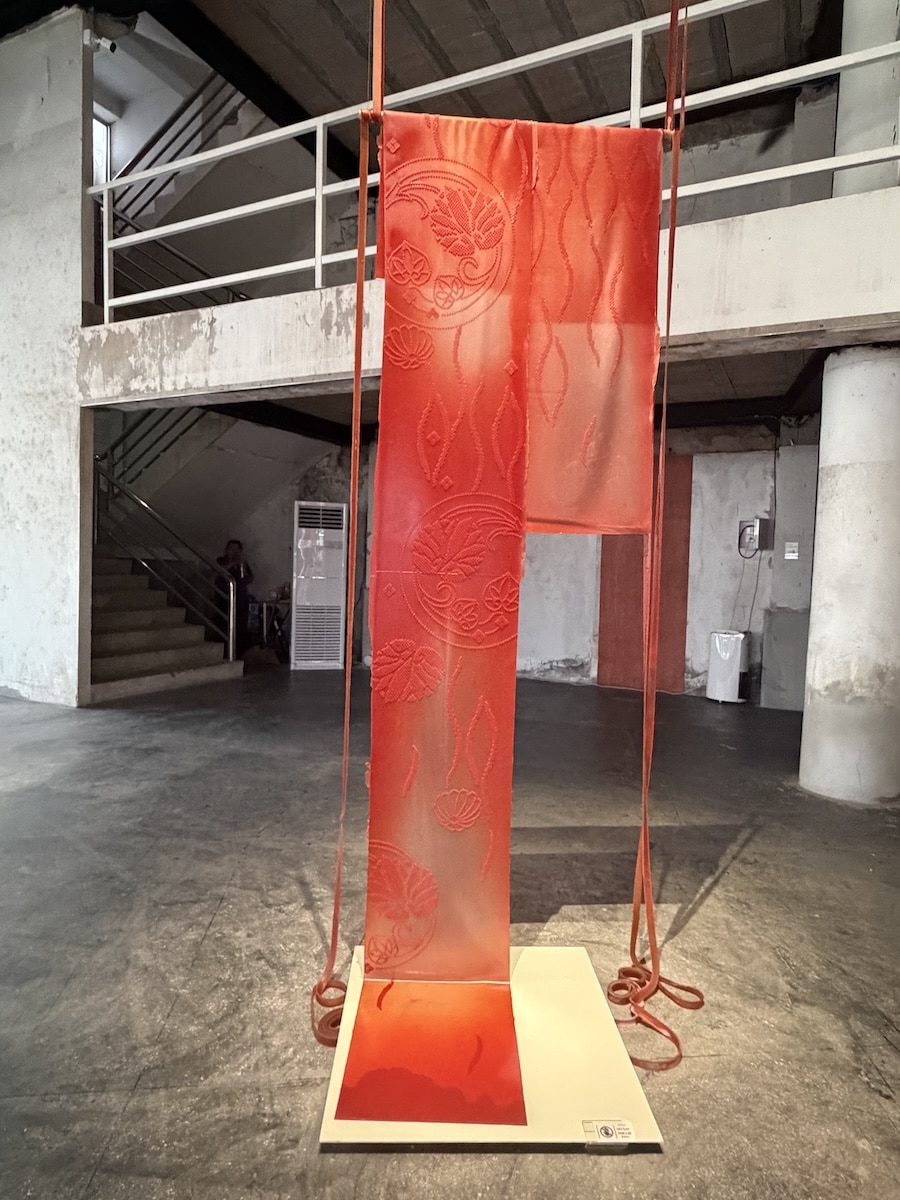
Rossella Biscotti, RUBBER WORKS
At the Poon Phol Building, Rossella Biscotti hangs large latex sheets as part of her RUBBER WORKS series. Named after women in Pramoedya Ananta Toer’s novels — written while the author was imprisoned in Indonesia under Suharto — the works trace the colonial rubber trade from Southeast Asia to the Congo. One sheet carries the red stains of Surati, a character who deliberately infects herself with smallpox rather than submit to servitude. The material is quiet, but the weight of what it carries is not.
Aleksandra Domanović takes over a cavernous gallery with Departures (hottest to coldest) (2025). This real-time LED display continuously ranks the world’s capital cities by current temperature, like an airport departures board with no flights left. In a city built entirely around tourism and passenger movements, it lands with particular force. A soundscape mixing industrial music with Phuket rainforest recordings wraps around it.
The Pearl Theatre is the most charged venue. In this former adult entertainment space, Imhathai Suwatthanasilp displays bikinis and burlesque costumes woven from wigs donated by trans performers at the Simon Cabaret — beautiful, political, and full of the people who made them. Oat Montien’s Pearl Boy Operating Theater (2025) turns the space into a mock queer nightclub, where oysters in kinbaku knots hang near a sequinned operating chair. The connection between pearl farming — inserting a foreign body into a living creature to manufacture value — and the experience of sex workers is pointed and uncomfortable in the best way.
At Kathu Shrine, Serene Hui’s Tiger’s Head, Nail’s Tail (2025) brings together her 102-year-old grandfather’s transcriptions of qiaopi — the letters that Hokkien tin miners sent home to China — displayed in the very shrine that was once their community’s heart. It is one of the most moving works in the show.
What holds all of this together is not just a curatorial idea but a genuine commitment to the communities of Phuket. The local population here is not the audience — they are part of the work itself, as docents, storytellers, and active participants in interpreting their own history and territories. The Thailand Biennale does not disappoint. There is a true dialogue between the spaces and the artworks — these are not works dropped into picturesque locations for effect. They talk back to their surroundings, and the surroundings talk back to them.
I made genuine discoveries here and left with a longer list of artists I want to follow. Getting around takes effort — the venues are scattered across three districts and require planning — but that journey is part of the experience and worth it. I will never see Phuket the same way again. That, ultimately, is what the best biennales do — They change not just how you see the art, but how you see the place, and through the place, something larger. Eternal [Kalpa] does exactly that.
Words and photos – Virginie Puertolas-Syn ©Artlyst 2026
Thailand Biennale, 29 November 2025 – 30 April 2026, Phuket
Visit Here