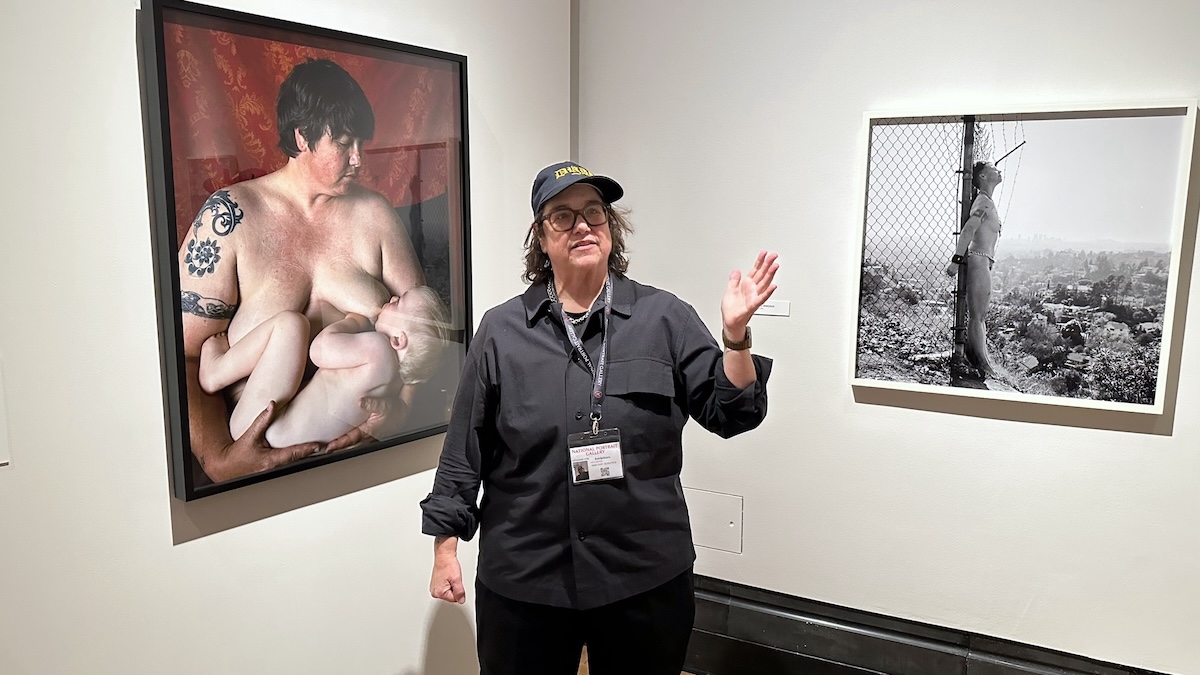
Catherine Opie is standing at the entrance to her exhibition proudly wearing a baseball cap emblazoned with the word DYKE in gothic script – a piece of merch the National Portrait Gallery has produced to accompany her exhibition. Referring to a portrait entitled Dyke from 1993 in the first room, depicting her friend brave enough to permanently mark the back of her neck with this slur, Catherine Opie has been documenting her community for decades, and now they are finally being ‘seen’.
I got to know Cathy Opie when I moved to LA in 2005 and worked at Getty, the Hammer and LACMA – she’s embedded in the fabric of those and other institutions, also through her teaching at UCLA. It’s great to see her here now I’m living back in my hometown. Opie cares deeply about showcasing her community on a par with historical portraiture, giving voice to the underdog, the different, or otherwise sidelined or marginalised—something she couldn’t do in the US right now.
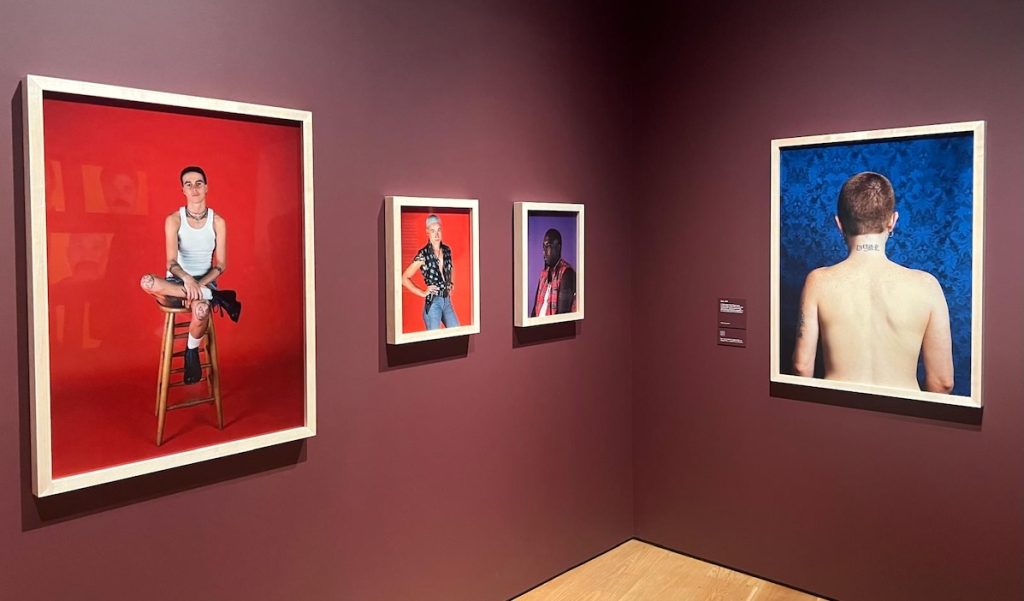
Catherine Opie, National Portrait Gallery, installation view ©Artlyst 2026
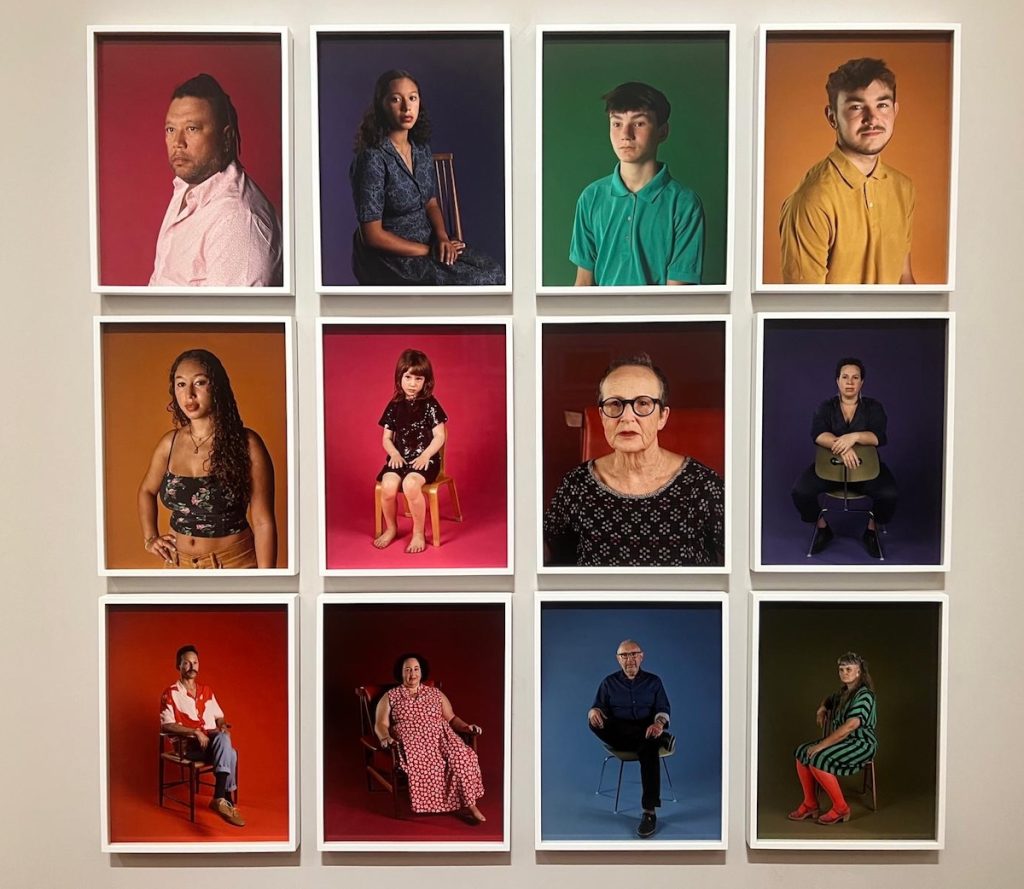
“This installation is an incredibly personal narrative of not only my history of politics through ideas of portraiture, but also of my life. For those who know me, they’re gonna understand the sight lines and what I did in terms of creating these different moments – you go from Self Portrait, nine years old, to Self-Portrait/Cutting, and then to Self-Portrait/Nursing. I started off grappling with ideas of portraiture, and I knew I didn’t want to be a Nan Goldin or a Wolfgang Tillmans. I wanted to somehow figure out how to elevate my community in a very different way. So I chose to use the formality and whole mind as a marker of what it was to make formal portraits of a community that is often about fragmentation of body parts. I decided that I was gonna make my own Royal Family in the ’90s, beginning to make these very formal portraits on the coloured backgrounds.”
The exhibition space itself, even down to the specificity of the paint colours echoing those of the formal galleries throughout the NPG, has been carefully designed in collaboration with Opie by her friend Katy Barkan, Principal of Now Here (her family portrait shares the room downstairs with that of Elton John’s family, one of many ‘interventions’ Opie has displayed around the permanent collection galleries).
Katy spoke to me about the sight lines – the enfilade through three divided spaces – who’s included in those ‘rooms’, who gets to be in the museum and who doesn’t. The idea of the street around those boxes, the ones on the periphery, the political works are hung outside. So the architecture afforded the space for these kinds of conversations.
I ask Opie how she thinks audiences here will react to her exhibition.
“I find it very interesting that a lot of people refer to my photographs as paintings, because I’m definitely using a history of portraiture and painting within the work. I think that the slow quietness will hopefully just seep into their ways of being. I see people here every day with their drawing pads. This institution means so much to the community. And to then imbue it with my own community. I hope that it’ll create a further idea of how we need to be connected as human beings, quite frankly. It’s really important for people to feel that they’re seen and included. There are so many young queers who need a hug from me right now. So I hope those in vulnerable communities, especially the young ones, that they come in and they see somebody who’s been doing this bravely for four decades, and that they feel that they’re seen and they have a place to be, see their own communities on the walls in somewhere like this is very important.”
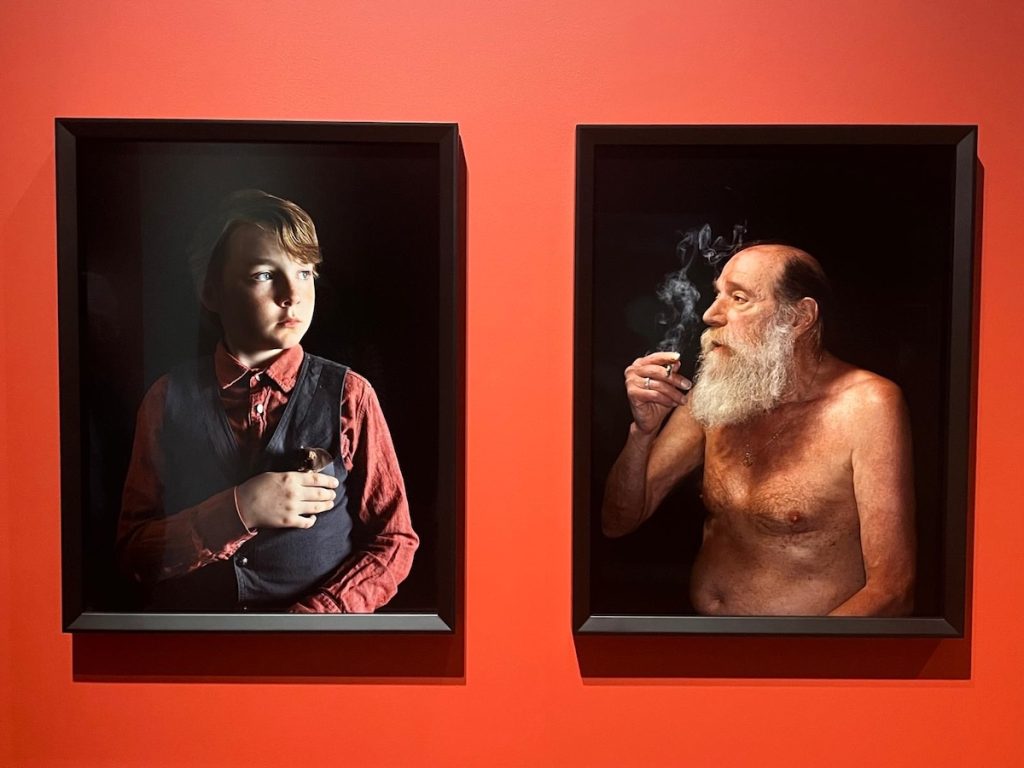
Left: Catherine Opie, Oliver & Mrs Nibbles, 2012, Right: Lawrence, 2012
The painterly quality that imbues Opie’s works has been clearly influenced, as she tells me, by seeing the Leonardo da Vinci exhibition next door at the National Gallery in 2011/12, also by the shadows of Caravaggio and the Holbeins hanging upstairs in the NPG. Hanging together in what she calls the ‘formal’ deep red room is a portrait of her son Oliver and Mrs Nibbles, which refers directly to Leonardo’s Lady with an Ermine, Oliver’s attribute here being his pet mouse (also available as a crochet keyring in the shop). Hung alongside is a portrait of artist Lawrence Weiner (looking to me like a modern day Saint Jerome). Figures against a dark ground.
Opie has sixteen other works – interventions – juxtaposed within the permanent collection of the NPG. We see familiar faces – British artists David Hockney, Isaac Julien, Gillian Wearing, Lynette Yiadom-Boakye – but also tattoo artists, performers and friends. She walks us through a few of these in the galleries adjacent to her main exhibition.
Catherine Opie, Barkan Family 2022, intervention at NPG
“The interventions are everything because they allow everybody to have the right to be represented. Why is it always kings and queens and celebrities? Doesn’t everyone have the right to actually be acknowledged in this world? I knew that if I didn’t make these photographs of my community, at a time of watching my friends die of AIDS, of my friends transitioning from female to male to everything that was happening during the Culture Wars in the US, with Mapplethorpe. And so I knew that if I had gone in and been brave enough to make this work, then I was gonna lose a whole portion of my own history within my community. So it really begins, there in the incredible sense of loss, of having so many friends die. How do I elevate somebody that I know is on their deathbed and actually make a portrait of them that makes them look bigger than life? And so they do become very personal; they’re formal for you to look at, but they’re also who I love and who I surround myself with in the world. And the only way to do that is to actually intervene. It’s also a correction of who is allowed to be seen within history, especially in this place, especially in this place. The amazing thing about the National Portrait Gallery, and why I love this place so much, is everybody’s looking at everybody.”
The exhibition will travel to the National Galleries of Scotland in August, and Opie had hoped it would then be shown at the Smithsonian National Portrait Gallery in Washington, DC.
“Yeah, that’s what I wanted, I don’t get to have that dream. It’s the Culture Wars all over again. It’s incredibly hard in my country – this show would not be possible right now for me to make there. I’m not spending Fourth of July in America. I open a show in Norway with works from a road trip I did two years ago, an exploration of ideas of national identity through the landscape. I’m bringing my whole family over for that opening – my niece, who’s there on the wall as a baby, my son Oliver, my grandson, who’s next door in the Victorian room, and we’re not gonna be in America for the 250th anniversary.”
“I’m a long-form novelist, photography has always been my language. And so I am very secure and it’s the most happy place that I’ve been making, where I find my peace.”
Catherine Opie: To Be Seen, National Portrait Gallery 5 March – 31 May 2026, £19.50
Visit Here
Catherine Opie: To Be Seen, Royal Scottish Academy, 8 August – 1 November 2026, £14
Visit Here
Lead photo by Paul Carter Robinson ©Artlyst 2026