In the mid-17th century, a printmaker from Amsterdam, Geertruydt Roghman, made a series entitled ‘Five Feminine Occupations’. The tasks depicted comprised cleaning, cooking, spinning, sewing and making ruffles. They didn’t include making art, although Roghman – whose works are included in a groundbreaking exhibition that just opened in Ghent – clearly wasn’t the only woman of her time to be creating magnificent prints, paintings, sculpture, lace, and more.
The show – Unforgettable: Women Artists from Antwerp to Amsterdam, 1600-1750 – begins from the premise that, though the big names that come to mind from this time and place might be male (think Rubens, van Dyck, Rembrandt, Vermeer – we only need their surnames to recall their paintings), there were in fact many women working alongside them. We’re talking figures such as Judith Leyster, Clara Peeters, Maria Sibylla Merian, and Michaelina Wautier. That they’ve been forgotten is, the curators quite fairly hope we’ll agree, a tragedy: Leyster’s lively genre pieces, Peeters’ exquisite still lifes, Merian’s intricate botanic studies and Wautier’s pensive portraits are fabulous works that sing out from the walls of the Museum of Fine Arts in Ghent.
But what’s shocking is that these women didn’t just produce great art under the radar: they were great artists, in their time. Peeters (1587-after 1636) created paintings for the open market, and her work shows a keen knowledge of collectors’ whims, such as Still Life with a Peregrine Falcon and its Prey (c1612-21), a new subject beginning to appeal to the elite after an overhaul of the hunting laws. Wautier (1614-89) is believed to have sold work to Brussels royalty and to an Austrian archduke. Merian (1647-1717) travelled to the Dutch colony of Surinam in South America to document its plants and insects for the intellectuals of Europe, and Leyster’s Self-Portrait (c1630) shows her at her easel, confidently and cheerfully wielding her paintbrush.

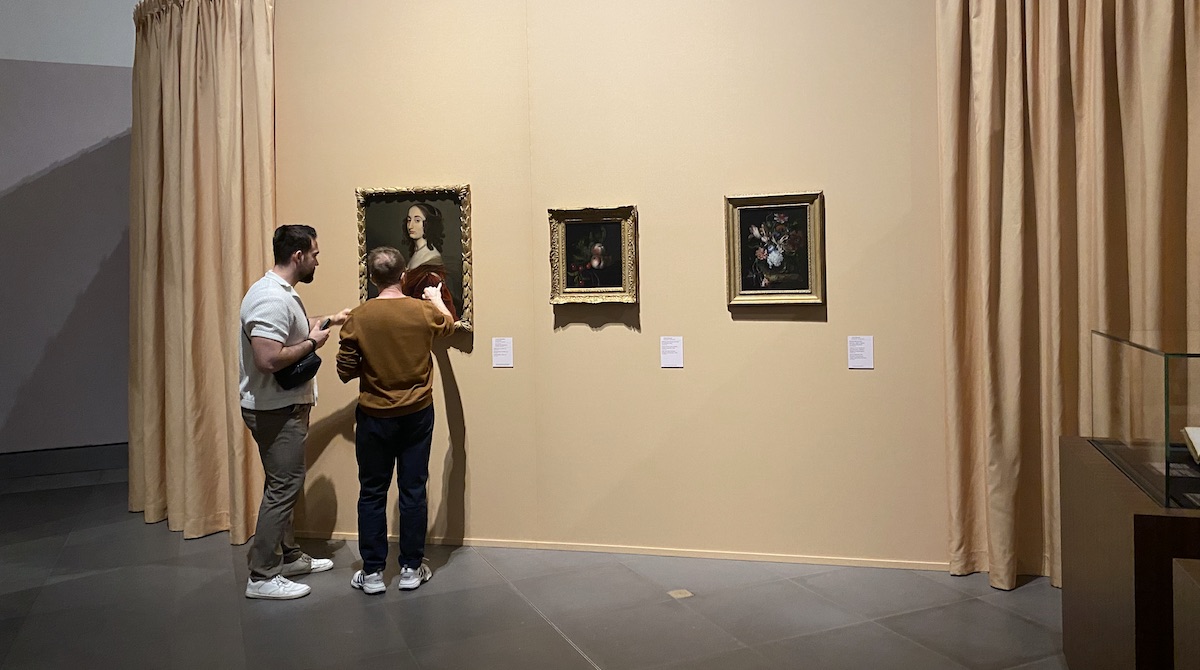
Unforgettable: Women Artists from Antwerp to Amsterdam, 1600-1750 Photo: Joanna Moorhead
In other words, these women played significant roles in the art world of their own day. It was art history that left them out, a sector dominated for many years by male academics who looked for people like them, rather than for artists from a more diverse pool, including women.
What has been hidden is richly on display in Ghent, in an exhibition that has travelled from the National Museum of Women in the Arts in Washington. Exotic, brightly-coloured vases of flowers and bowls of fruit by Rachel Ruysch (1664-1750): in one, Still Life with Cherries, Grapes and Peaches (1684), a fly hovers on a succulent peach, and specks of light gleam from the skin of the cherries. There are fascinating pair of self-portraits by Louise Hollandine (1622-1709): in one, she is the princess of the royal family she was born into, all red velvet and carefully curled hair; in the other, she wears the habit of the Benedictine order, having chosen to enter a convent perhaps to allow her the space to pursue a career as a painter rather than having to become a wealthy wife and mother.
In Maria Theresa van Thielen’s Still Life with Parrot (1661), the just-swooped bird has his beady eye on a juicy red berry, while in Alida Withoos’s Forest Floor Still Life with a Mouse, Butterflies, Honeysuckle, Polly and Other Flowers (undated), the rodent is camouflaged against the brown earth below, pecking unobtrusively at an ear of corn.
New information has been revealed about some of the 50 or so artists in this 200-work show during research for this exhibition, says Katie Altizer Takata, a research assistant at the NMWA. She cites, in particular, the Flemish Baroque artist Johanna Vergouwen (1630-1714): the exhibition includes her monumental double portrait of child twins dressed as knights, wearing metal breastplates and feathered hats.
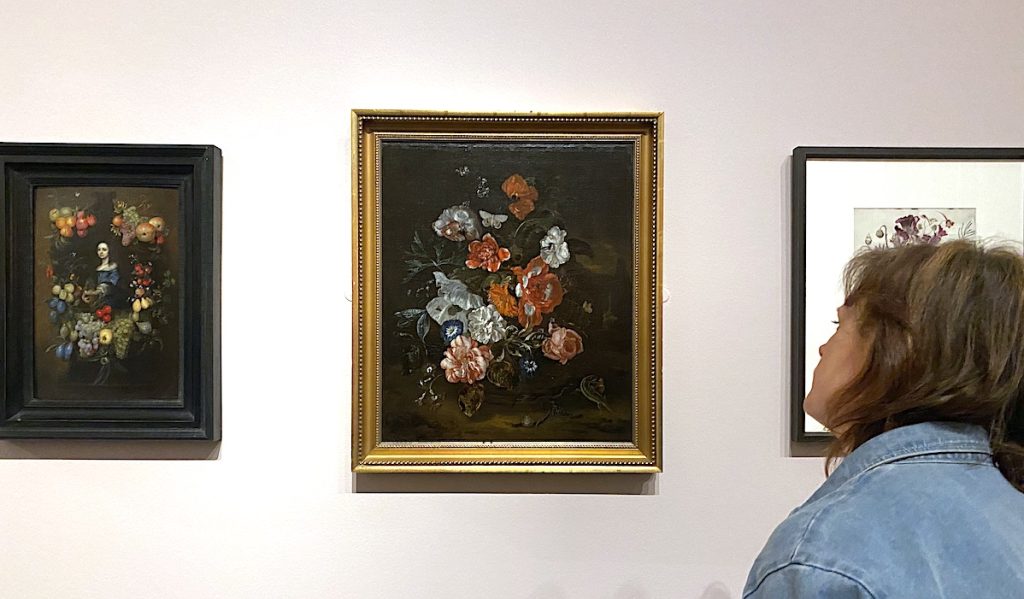
Unforgettable: Women Artists from Antwerp to Amsterdam, 1600-1750 Photo: Joanna Moorhead
The Ghent show comes in the wake of a series of other exhibitions of the work of women artists of history: in autumn 2023 I travelled to Madrid for Maestras at the Thyssen-Bornemisza Museum, and the following year to Rome for Roma Pittrice: Women Artists at Work in Rome (16th-19th centuries), and to London for Tate Britain’s Now You See Us: Women Artists in Britain 1520-1920. Each one is an attempt at a corrective overview to the long-established canon that the ‘greats’ of past centuries were male.
All these exhibitions find the same patterns time and again. The work of women artists has often been wrongly attributed to male artists (sometimes deliberately: the signature on Maria Schalcken’s Young Woman Accepting Grapes from a Boy (c1675-82) has been doctored to make it appear to be by her brother Godefridus, whose work commanded higher prices). Women have chosen, or been forced or encouraged to choose, art forms less likely to stand the test of time: art made with paper, for example. Women have been barred or discouraged from pursuing art as a career, and often it has only been possible because of family and connections: many women artists come from families of artists, including in this show Josina Margareta Weenix (1684/85-1724) and Alida Withoos (1660/62-1730).

Unforgettable: Women Artists from Antwerp to Amsterdam, 1600-1750 Photo: Joanna Moorhead
Curator Frederica Van Dam says she hopes the Ghent show will prompt a rethink on the place of women in the history of art. “Women and their rights are very much in the public debate at the moment, and through art we can make connections between past and present,” she says. “There are many new insights and information to be gleaned from this exhibition.”
Unforgettable: Women Artists from Antwerp to Amsterdam 1600-1750 is at the Museum of Fine Arts Ghent until 31 May 2026
Joanna Moorhead is a freelance writer and the author of The Surreal Life of Leonora Carrington (Virago) and Surreal Spaces: The Life and Art of Leonora Carrington (Thames and Hudson). Her book The Lost Artist of Florence, about the life of the 16th-century Italian painter Plautilla Nelli, will be published by Thames and Hudson in March 2027.
Words/Photos: Joanna Moorhead © Artlyst 2026