‘Bruegel to Rembrandt: Drawing Life, Sketching Wonder’ at Compton Verney takes us back to the rise of naturalism in Dutch art to see images of life drawing, landscapes, village and city scenes, mythology, religion, vices and virtues.
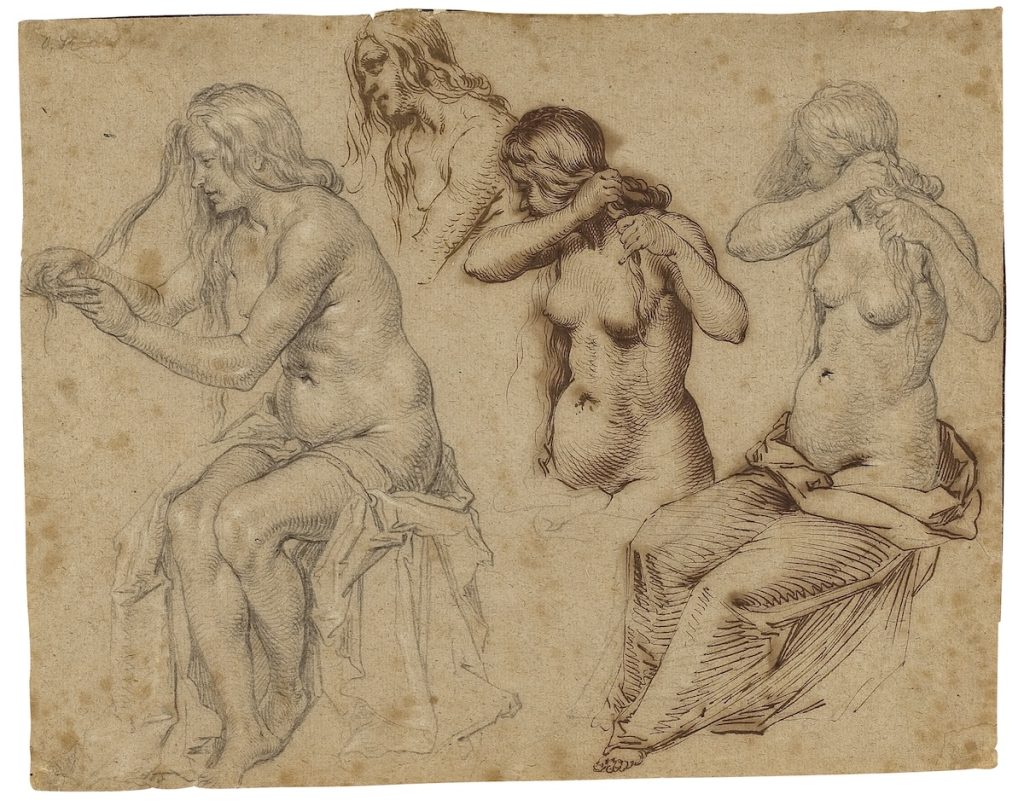
Jacques de Gheyn II (1565-1626), Four studies of a nude woman combing her hair, Black chalk, pen and gall ink, partly over an earlier black chalk sketch, heightened with white chalk on coarse-grained beige-grey paper, Inv. 4060 / 1346, Royal Museums of Fine Arts
of Belgium, Brussels / photo: Grafisch Buro Lefevre, Heule
Many of the artists with whom I’ve worked who had a traditional art education have lamented a perceived shift in art schools away from viewing drawing as foundational to visual art. Conceptual and digital forms of art don’t require drawing as a prerequisite in the way that naturalistic painting once did, and, as a result, such artists bewail the standard of drawing practised by many artists today.
It is possible, however, that what some lament also frees drawing to be its own medium and to be perceived as its own medium in a way that was not possible when it was seen primarily as the initial stage in producing other work. It may be that this only becomes possible once drawing is no longer seen primarily as the starting point of artists’ creative endeavours, or as the 17th-century Flemish biographer and artist Karel van Mander (1548–1606) put it, ‘de deur om tot veel Consten te commen’ (the door through which one gains admittance to many Arts).
In the exhibition, across the categories of life drawing, landscapes, village and city scenes, mythology, religion, vices and virtues, we see a naturalistic style applied to images created from life, memory, and imagination. The combination of these elements led to a great variety of styles, images, and content, highlighting the scope that drawing continues to offer artists today, whether within naturalistic approaches or in other fields.
Curator, Jane Simpkiss, argues that drawing ‘is the immediate interface between the artist and the world around them, through which they can record, manipulate and interpret their thoughts and experiences.’ This is so, whether drawing is used as the precursor to other works or as a medium in its own right. As such, the selected works reveal how Dutch and Flemish artists interpreted the world around them during a period of massive religious, social and political change, migration and colonial expansion.
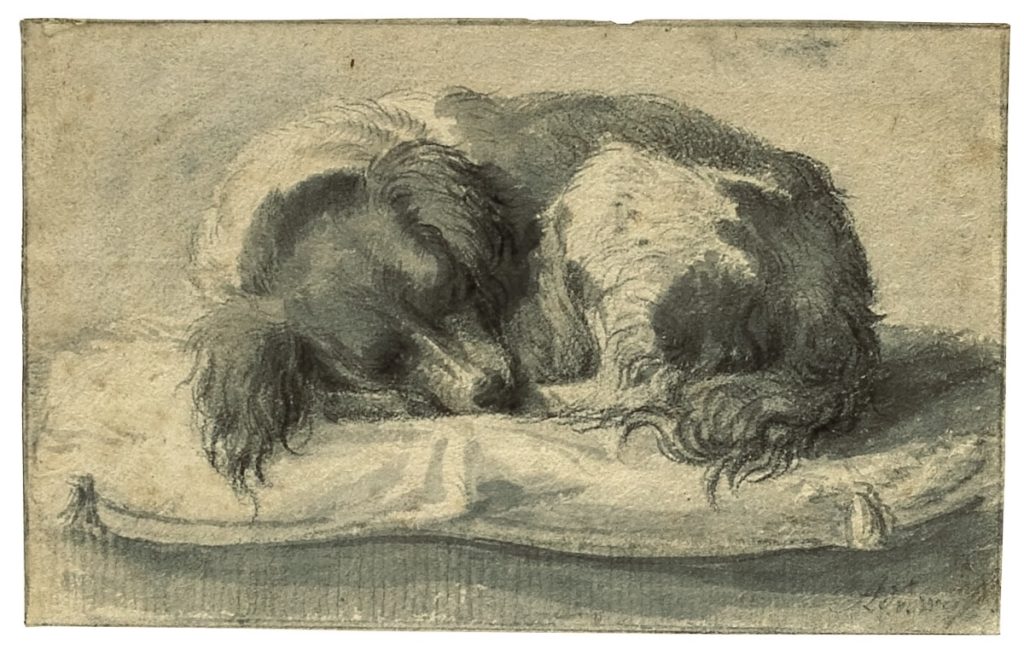
Adriaen van der Werff (1657-1722), Spaniel on a cushion, Black chalk, brush and gray ink, gray wash, Inv. 4060 / 4006,
Royal Museums of Fine Arts of Belgium, Brussels /photo: Grafisch Buro Lefevre, Heule
The growing interest in realism that began to take place in this period saw artists increasingly draw the world beyond their studios from life. Their depictions of local landscapes, views of villages and city life, religious and mythological tales, and the world beyond the Netherlands reveal that these artists were grappling with how to represent the changing world around them, navigating shifting belief systems (or religious convictions) and developing conceptions of national identity.
Simpkiss states that, in the Low Countries, ‘art production was determined predominantly by a free market and the desires of public bodies as well as private collectors to furnish their homes in the city and in the countryside’. This led to increased interest being shown to genres such as still life, portraiture and landscape, with some artists becoming specialists in particular sub-genres, such as Hendrick Avercamp (1585–1634) and his focus on winter scenes. Simpkiss also notes that the ‘evolving Dutch art market also witnessed a growing interest in drawing as a collectable art form – both for independent (finished for sale) drawings, and compositional and figure sketches, which were originally conceived as exercises for students or as preparatory stages for works in other media’.
As a demonstration of these developments, the exhibition includes 64 remarkable drawings from the 16th and 17th centuries, including exceptional works by Dutch and Flemish Old Masters from the Royal Museums of Fine Arts of Belgium, many of which have never been seen in the UK before. They include works by the two giants of the Northern Renaissance and Dutch Golden Age, Pieter Bruegel the Elder and Rembrandt van Rijn, alongside other world-renowned masters such as Jacob Jordaens, Avercamp, Jacob van Ruisdael and Peter Paul Rubens. The exhibition, as a whole, features works by over 50 artists, each of whom was either born in or spent most of their lives in the Netherlands, Belgium or Luxembourg.
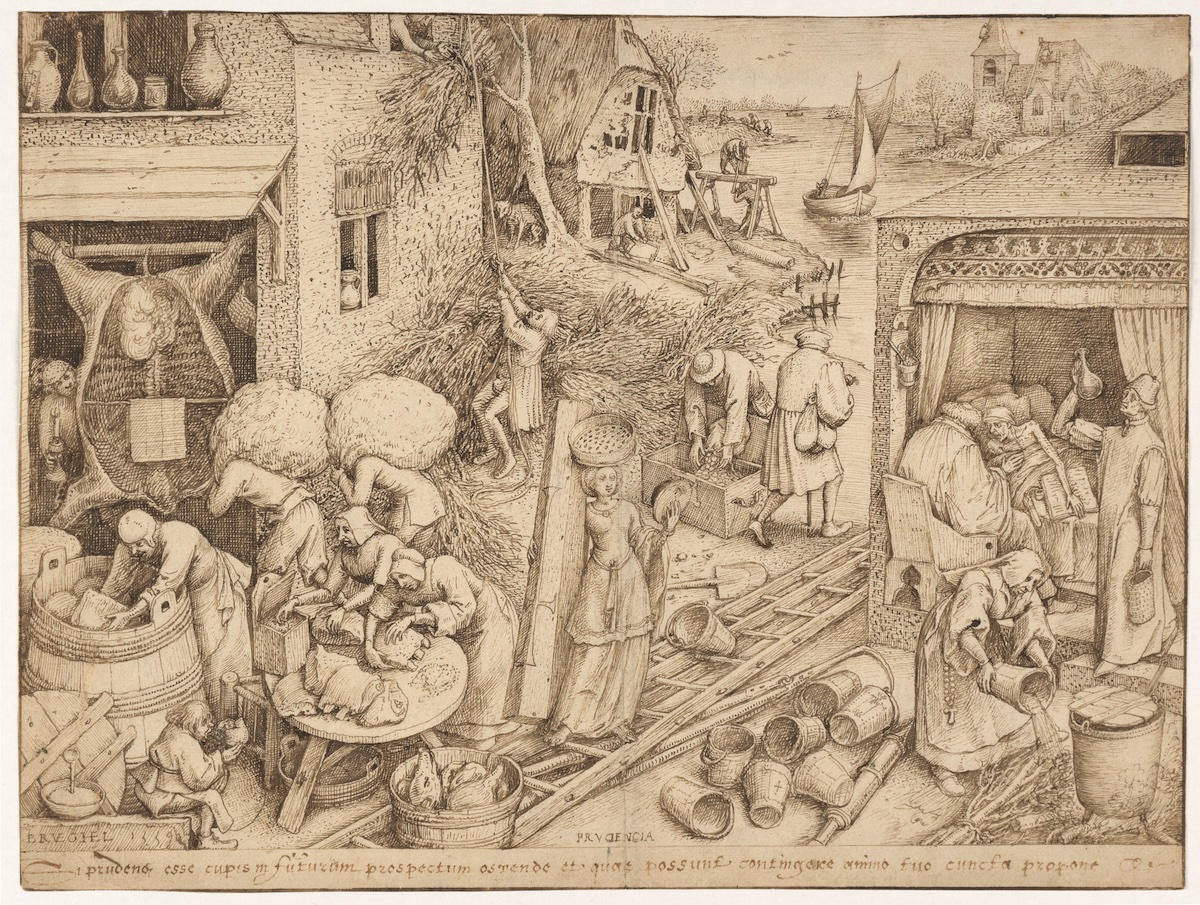
Simpkiss writes that there are many ways to consider the history of drawings in the 16th and 17th-century Netherlands – chronologically, geographically, by workshop or by their function. The genre-based approach taken places the demonstration of a key development in the exhibition’s final rooms. Bruegel’s ‘Prudence’, from the series of ‘The Seven Virtues’, can be seen in the room entitled ‘Vices and Virtues’.
This incredibly detailed drawing moves away from Bruegel’s connections to the devilish depictions of Hieronymus Bosch, as seen in his ‘Patience’, to focus on the scenes of everyday peasant life for which Bruegel was to become famous. ‘Patience’ shows naturalistic drawing utilised in the service of fantastical moral fables, while ‘Prudence’ shows the same style utilised in the service of realist moral fables. This shift from a focus on a fantastical demonic scene to a realistic rural scene in which, ‘as now, people look for a sense of control in times of uncertainty – preparing for harder days, these peasants store food and money, repair dilapidated buildings, and gather firefighting equipment’ – is part artistic, part social and part theological.
Religion plays a significant role throughout the changes explored and the genres displayed. An exquisitely illustrated 16th-century Flemish Book of Hours illuminates the relationship between prayer books and the depiction of everyday country life across the Netherlands in this period. However, a secularising element can also be seen, particularly when the Biblical content is minimised within an image to focus on the landscape in which the scene is set. An example of this tendency can be seen in Abraham Bloemaert’s ‘Landscape with the Prodigal Son’, where Bloemaert’s interest is mainly with the dilapidated house or barn against which the miniscule Prodigal leans and the living trees that the barn is built around.
A painting by one of Rembrandt’s most favoured pupils, Gerbrand van den Eeckhout, ‘Rebecca and Eliezer at the Well’, has been reunited with the artist’s preparatory drawing for the work for the first time. This pairing clearly reveals the drawing’s much more expressive nature compared to the finished painting. Simpkiss rightly comments on the way ‘the pen moves back and forth in a dynamic manner, in long expressive loops and scribbles’ and how the drawing is ‘brought to life by layers of wash that create a sense of light and shade with luminous accents.’
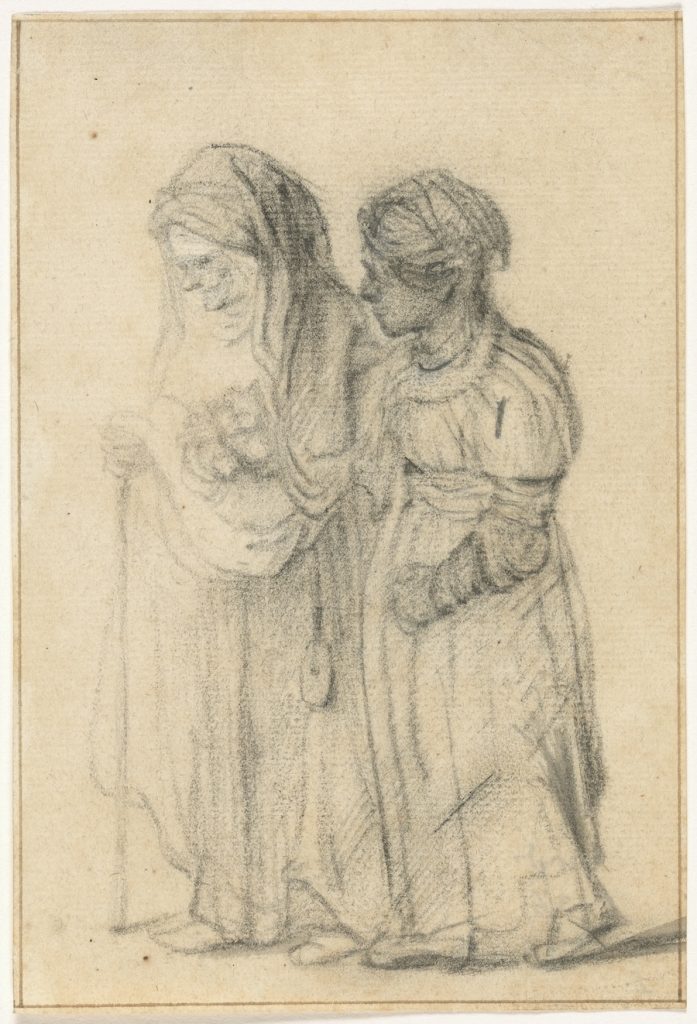
Rembrandt Harmensz. van Rijn (1606-1669), Old lady supported by a young girl (Ruth and Naomi?),
Black chalk, some scattered highlights of white gouache, gray wash; edged with pen and brown ink ,Inv.4060/1200 ,Royal Museums of Fine Arts of Belgium, Brussels / photo: J. Geleyns – Art Photography
Rembrandt, himself, would often sketch Jewish people and black people from his neighbourhood, who he would then include in his biblical paintings for authenticity. An example is ‘Old lady supported by a young girl (possibly Ruth and Naomi)’, a beautiful scene of an elderly woman and a younger woman or girl walking together. This image raises interesting questions about when Rembrandt drew from life and when he relied on the rich repository in his head. He often seems to have taken aspects of pre-existing sketches and combined them with his own imagination to create images which initially give the impression of having been drawn from life.
Simpkiss argues that this tension ‘between reality and imagination can be found at the heart of artistic development in the Netherlands at this time’. The Flemish Renaissance painter Joachim Patinir pioneered ‘a new form of landscape known as the Weltlandschaft or ‘world-view’, a panoramic landscape setting that used a high viewpoint to create a scene that would be impossible to see in reality’. Examples of this style of naturalistic imaginary landscape can be seen here in the work of Matthijs Cock, Cornelis Metsys, Hans Bol, Pieter Stevens and Peeter Baltens. Gillis Neyts’ ‘Imaginary view of Antwerp, with the Kipdorppoort, the mills of Saint-Willibrord and Dambrugge’ is a pocket-sized, detailed and panoramic drawing of Antwerp. Yet, the artist ‘has taken much artistic license, removing buildings which those acquainted with Antwerp would have expected to see, creating an imagined, yet familiar cityscape’.
Other exhibition highlights include a beautiful double-sided sketch by Rubens – one side made in preparation for a religious painting, one for a mythological scene – that provides an insight into his practice (reusing paper that was at hand to capture new ideas) and the key role drawing played in his work. There is also a drawing after a Tintoretto painting to which Rubens has added his own ‘improvements’.
A stunning early painting by Aelbert Cuyp, ‘River Landscape’, connects beautifully with a drawing by the artist from the same period – another inspired pairing of works! Maria Sybilla Merian is an important female artist and scientist whose beautiful drawings record extraordinary insects found in Dutch Suriname. Adriaen Hendriksz Verboom’s ‘View of dunes with ravaged trees’ uses a wide range of expressive marks to focus on the complexity and interest of the plants in the foreground of his image, including a twisted tree which frames two walkers found in the centre of the composition. With this and other of his drawings, Verboom was following the example of van Ruisdael, who, from the 1640s onwards, ‘inaugurated a new phase of landscape art by choosing to paint a small element of the natural world – a tree, a wood, a waterfall – thereby imbuing it with a sense of monumentality and grandeur’.
Simpkiss rightly concludes that these ‘drawings show us how artists combined their own boundless imagination in contemporary life and the past to create rich, layered images that were beautiful and intellectually stimulating and continue to excite and resonate centuries into the future’. As such, they open and offer routes to use drawing as a means to explore the challenges and changes of our own day and time. It is hoped that this exhibition will be a catalyst for those who will seek to use drawing as their medium of choice in future.
‘Bruegel to Rembrandt: Drawing Life, Sketching Wonder’, 14 March – 28 June 2026, Compton Verney, Warwickshire
Visit Here
Brussels and Antwerp: The Heart of Flemish Art – Artlyst Diary