
If contemporary art holds a mirror to the world, then things are in bad shape. The 61st Venice Biennale will be remembered as the most contested, controversial and chaotic in recent history, and not only because there was no curator at the helm, with the loss of the late, great Koyo Kouoh. With wars raging across the globe, the presentation of work in national pavilions without conflict proved near impossible; meanwhile, every storm cloud since the 20th century gathered for the opening and broke unceremoniously above the lagoon. Why do we expect so much from artists? How can artists be true to their vision whilst simultaneously fulfilling the objectives of soft power? Beyond the Giardini, a different form of patronage has emerged.
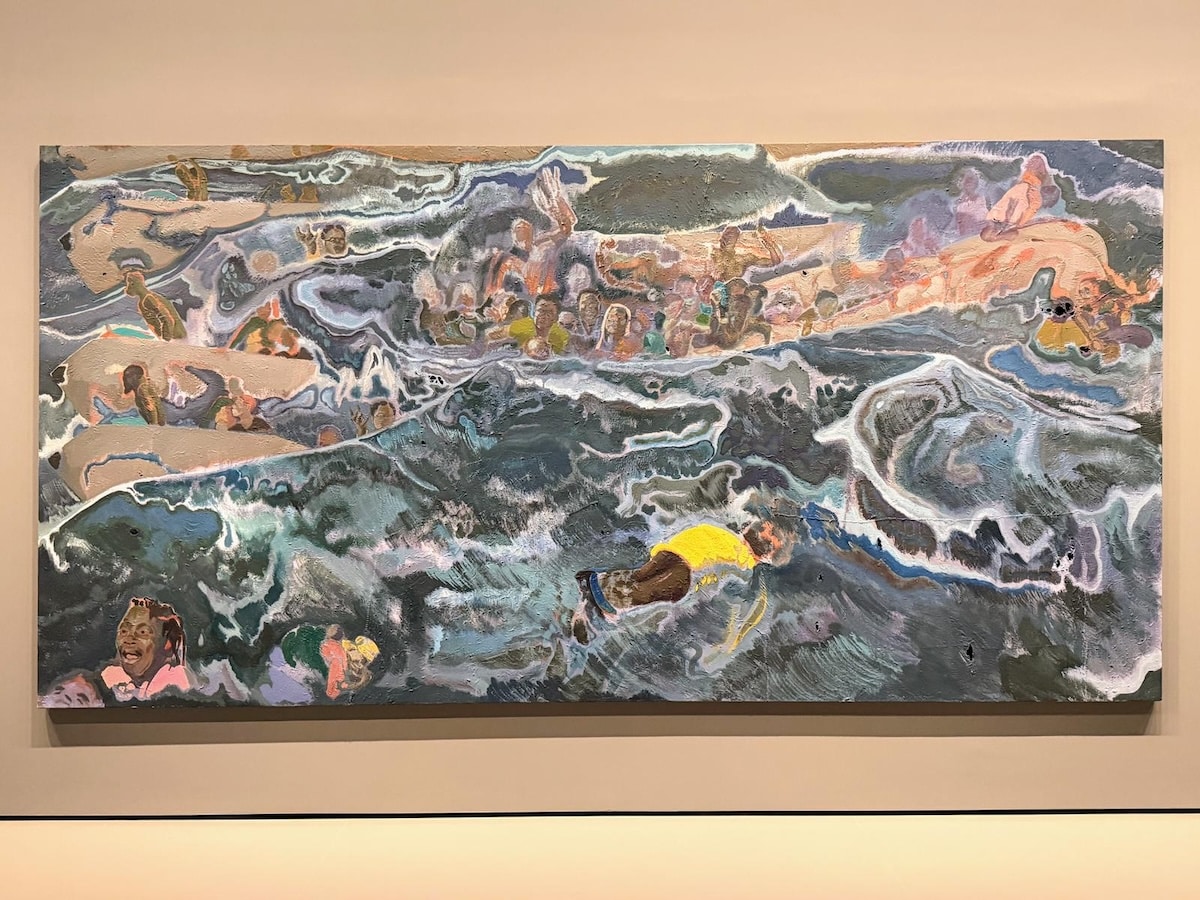
Michael Armitage, Raft (II), Palazzo Grassi, Pinault Collection
The Promise of Change, Michael Armitage, Palazzo Grassi
At a safe distance from the surreal, fractious cacophony of the Giardini, over a little bridge and down several small alleyways from Campo Santo Stefano is the magnificent Palazzo Grassi, currently host to the standout exhibition: The Promise of Change by Michael Armitage. Resonating powerfully with the late Koyo Kouoh’s curatorial wish for in depth through subtlety with presentations “in minor keys”, curated by Jean-Marie Gallais, curator Pinault Collection, in collaboration with Hans-Ulrich Obrist, Art Director, Serpentine Galleries, (with Caroline Bourgeois and Michelle Mlati for the catalogue), this gentle blockbuster draws you into a dark history of complex narratives through softly painted scenes in sweet harmonic tones. We step towards beauty, then become quietly horrified as the subject is revealed, but we stay with the picture, let waves of grief wash over us, and accept that we must give each majestic, epic work its time.
Armitage (born in Nairobi in 1984) purposefully addresses issues of our time, including sociopolitical tensions and continued global violence, holding that art cannot ignore reality but must instead grapple with it. His epic genre paintings open with sensitivity and critical acuity to broader reflections on post-colonial identity and the consequences of war, corruption and instability in equatorial regions. We see devastation of the migration crisis, through drowned figures in Raft (II), (2024), enveloped in undulating waves of colour; the isolation of societal judgement in the hunched bodies of Nyali Beach Boys, (2025), cowering together under moonlight, and abuses of power brutally witnessed in Necklacing, (2016). The complex interconnectedness of these subjects is materially anchored in his choice of substrate – traditional bark cloth sourced from Uganda and Indonesia – giving each work natural irregularities. Holes, creases, and rough textures – imperfections that guide the visual composition and remind us of the fragile impermanence of everything.
(Once again, Hans Ulrich Obrist – aka God – had shepherded a devoted team in realising something transcendent – perhaps he will throw his hat into the ring for the 62nd Biennale.)
Palazzo Grassi, From 29 March 2026 to 10 January 2027
Visit Here
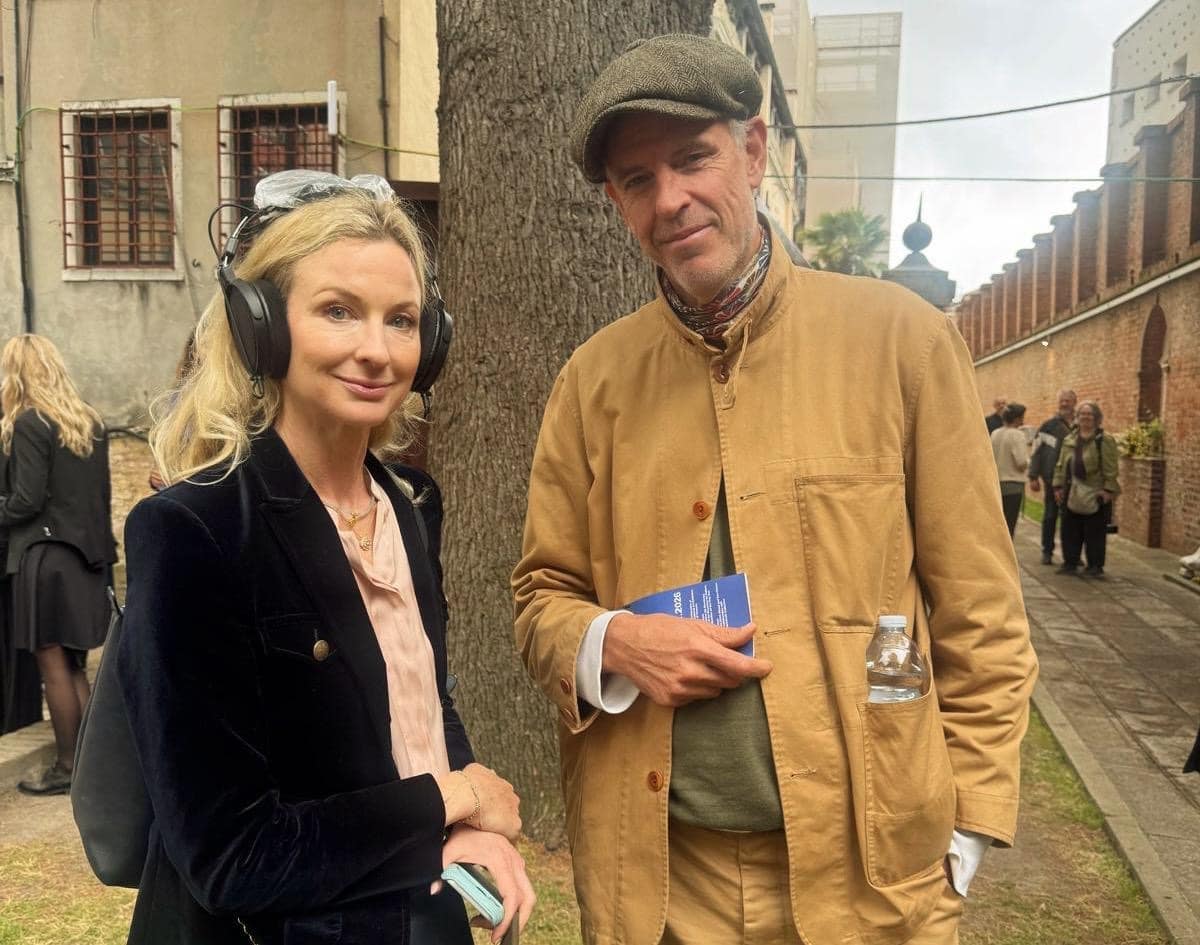
Nico Kos and Stephen Crasneanscki, founder of Soundwalk Collective at the Holy See Pavilion
The Ear is The Eye of The Soul, , The Holy See Pavilion, Giardino Mistico dei Carmelitani Scalzi
On the theme of sound, perhaps the most ambitious, mind-altering and quietly disruptive pavilion was The Holy See Pavilion, curated by Hans Ulrich Obrist and Ben Vickers and The Vatican. Conceived as a sonic prayer under the artistic direction of Soundwalk Collective, an ensemble of new commissions by contemporary composers was unified and then embedded along a walk through the Giardino Mistico dei Carmelitani Scalzi. An ancient convent garden, created for contemplative, haptic experience of light (spirit) and ‘viriditas’ (greenness). The Ear is the Eye of the Soul unfolds along the seven planted beds of the garden, reaching a crescendo with Patti Smith’s haunting prayer to the Mother Mary in a small chapel.
Orchestrated in response to Koyo Kouoh’s curatorial wish for us to slow down and attune to the small miracles that abound in daily life, this project was inspired by Saint Hildegard of Bingen (abbess, poet, thinker and composer), who believed that sound is a way of knowing; chant being the vehicle to integrate vision and music being the bond between the body and world. Upon entering the garden, you are provided with headphones and told, ‘You are a guest of a living community… walk slowly. Let the garden set your pace’. Mystical, elegiac music begins, inspired by Hildegard’s chants, writings and visionary images. It mingles with the birdsong and roses blooming, their scent being the top note amongst the herbaceous borders that converge on a central pomegranate tree. As you walk, the soundtrack shifts; Holly Hendron and Mat Dryhurst’s ghostly choir merges into Brian Eno’s transcendent sounds. You might see someone cry, shivers as you enter Moor Mother’s section, and wonder with Terry Riley, Laraaji and Meredith Monk – on and on – you hear gravel crunching underfoot, you want to slow time, sit, forget, be present. It was like being gifted a mix tape by angels, who understood exactly how you felt about the world.
Visit Here
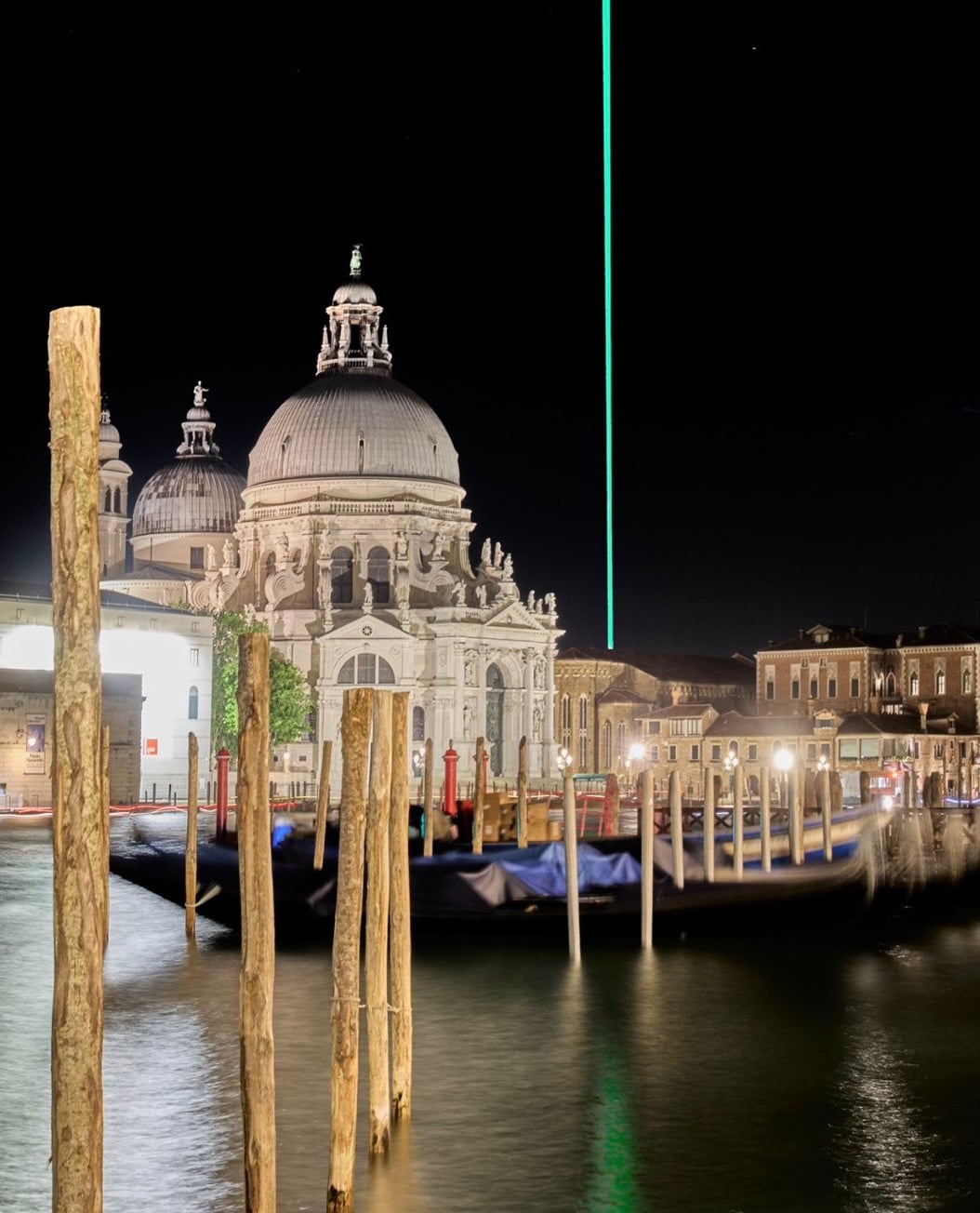
Chris Levine, Make Light not War
Make Light not War, Chris Levine at the San Clemente Palace
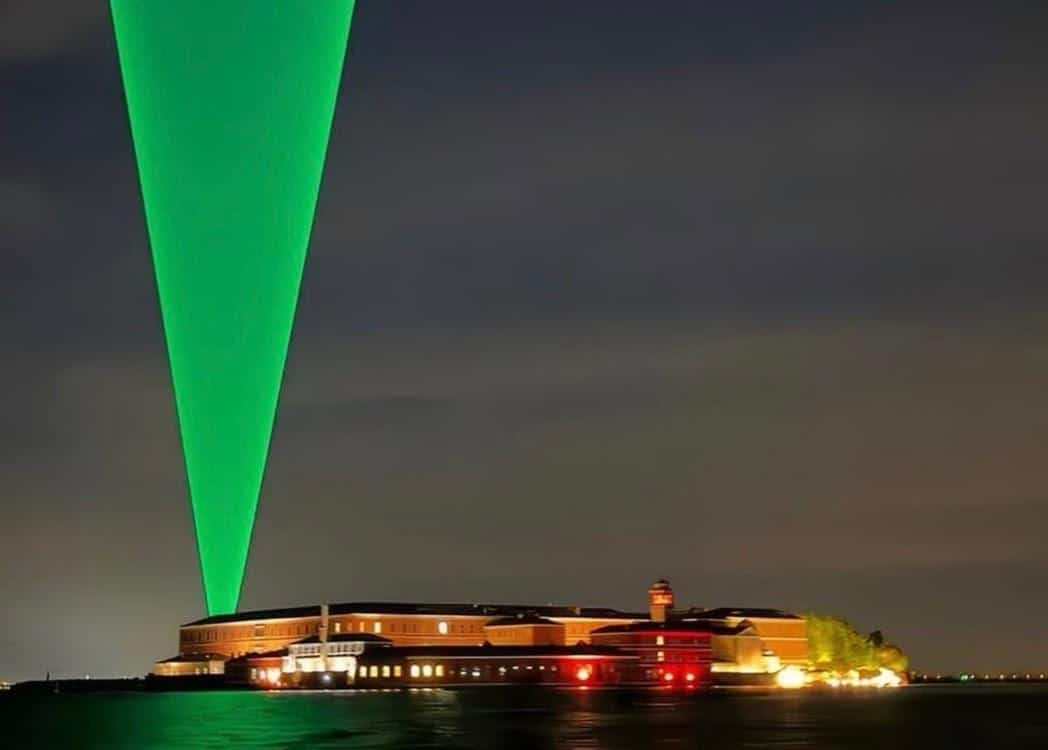
For all the chaos, protests and fury at the 61st Biennale, there was one work of art beaming with possibility that captured all of our attention. ‘Higher Power’ by Chris Levine, shining like a beacon into the night sky from the chapel of San Clemente Palace, was seen by everyone, everywhere and all around. A public work of art, accessible to all: no queues, no limited access, no VIPs skipping ahead, just a pure singular beam of ‘veriditas’; a word I learned at The Holy See Pavilion (The Vatican), which sometimes translates as greenness, or ‘a divine vital breath flowing through all living things’, expressed by Saint Hildegard of Bingen. Inspiring the sonic prayer that began my Venice journey, created by Soundwalk Collective, her verdant message seemed to be amplified by this ultra beam of extraordinary purity, and everyone was touched.
Brilliantly, Levine created this piece using technology that was originally developed for war. “There is only one of these in the world. I’d been working with my engineers in Germany to make infrared light visible,” says Levine. “This single wavelength of pure green light also has a rate of 432 Hertz, a very healing frequency from the solfeggio scale”. These are unprecedented times, and we live in a realm of light and dark, but we do have a choice: “make light not war”. Looking out across the lagoon, this singular vertical beam cut through everything, like a form of cosmic alignment. Privileged to see it with my art-world friends, that night my prayer was for those who do have the freedom to make or show work, and hope for our collective future.
Visit Here

Marina Abramović in conversation with TAEX+ Jordan Roth
Transforming Energy, Marina Abramovich, Jordan Roth and Florentina Hozinger Performing at La Biennale
Who is Florentina Holzinger, and why did her performance at the Austrian Pavilion steal the show? How do her physically confrontational theatrics, including submersion in a sewage tank, relate to the couture-led operatics of Jordan Roth, described by gallerist Kristin Hjellegjerde as “the Diva of our time”? The answer might be found in Transforming Energy by Marina Abramovich at Accademia Del Arte. One of the most anticipated shows of the 2026 Biennale, she is the first living female artist to be given a major solo exhibition in the historic Renaissance museum.
Abramović’s cheeky allusion to Jesus as the start of her conversation with TAEX seemed to hold some answers: she has many disciples. Holzinger is often compared to Marina Abramović because both artists reject the symbolic body in favour of the real body. But where Abramović strips performance down into silence, endurance, and sacred ritual, Holzinger amplifies everything into feminist body-apocalypse theatre. Abramović uses pain almost spiritually to reveal presence and vulnerability; Holzinger weaponises spectacle through excess, horror, opera, and physical extremity. One seeks transcendence through reduction, the other through overload – our senses knocked comfortably numb.
Jordan Roth exists at the opposite pole entirely. Emerging from Broadway, opera, and haute couture rather than endurance art, Roth turns fashion and self-presentation into theatrical performance. Educated at Princeton in theatre and philosophy, he creates living sculptures through costume, glamour, and transformation. Instead of shock/horror, the audience assembled was quivering with collective anticipation & adoration; disciples who follow his grams in silent voyeurism. Everything, even the paintings he peeled back, was glossy, slick and ready for reposting.
Abramović uses the body as a sacred endurance ritual, Holzinger as a violent feminist spectacle-machine, and Roth as a couture-led theatrical image. They are transformed, but are we? How do these artists fit into the wider genres of theatre and art, and why is our appetite for public, witnessed transformation so voracious?
Visit Here
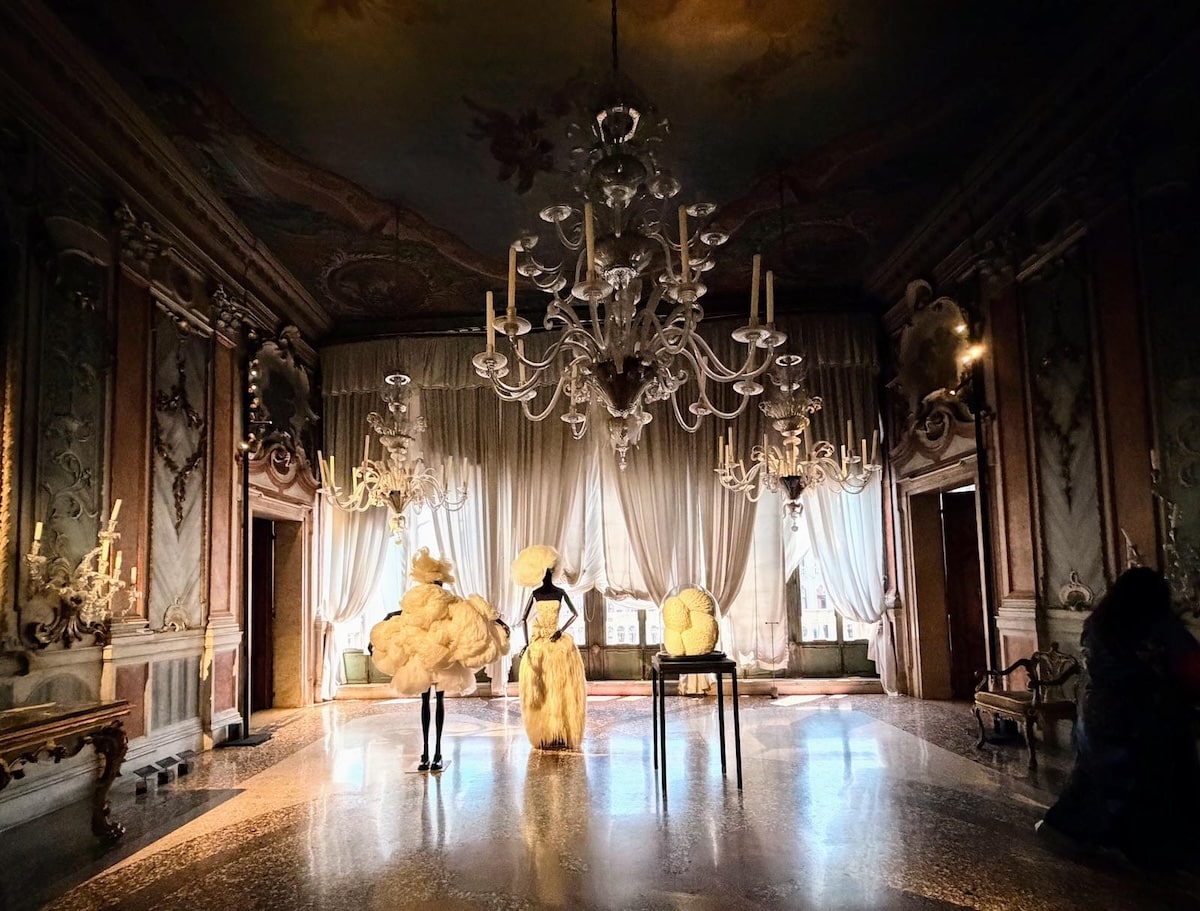
Fondazione Dries Van Noten, Venice
Fondazione Dries Van Noten, Palazzo
When the new Fondazione Dries Van Noten opened in April 2026 in Venice, Palazzo Pisani Moretta, ahead of La Biennale, it confirmed that luxury fashion has become one of the art world’s most powerful parallel infrastructures. Established to platform, nurture and protect craftsmanship across a constellation of related disciplines, Van Noten’s sensational inaugural exhibition, The Only True Protest Is Beauty, is curated around the idea that fashion, craft, sculpture and art share an emotional language. Pairing artists, such as Kate MccGwire and Joseph Arzoumanov, with iconic fashion designers like Van Noten and Lacroix, set in dialogue with the historic architecture, the show’s title was inspired by activist Phil Ochs, and frames beauty as a catalyst, upending expectations and creating meaningful connections.
We see relationships unfold through materiality; MccGwire’s work – made primarily from gathered bird feathers and assembled into twisting sculptural forms – speaks to the tension of beauty and discomfort in fashion. Meanwhile, many of the garments shown, such as Comme des Garçons and Christian Lacroix, treat clothing as living sculpture. The rooms are sparse, darkly lit, and full of magic – they feel inhabited. Upstairs in the perfectly restored music room, shimmering with gold leaf, is L’Échiquier des Songes (“The Chessboard of Dreams”) by Joseph Arzoumanov. Inside a glass case, a mechanical arm adorned in gold fabric moves chess pieces around the board in an infinite sequence, inspired by the love story of his grandparents. Highlighting the relationship between human craftsmanship and emerging technologies, the chessboard could also be a metaphor for fashion itself: the strategies, illusion, hierarchy and coded movement. A work that reflects Dries Van Noten’s own practice, balancing historical references with unexpected modern interventions, like the Palazzo Pisani Moretta itself, this work (which took three years to complete) will most certainly reach into the next century – and beyond.
Visit Here
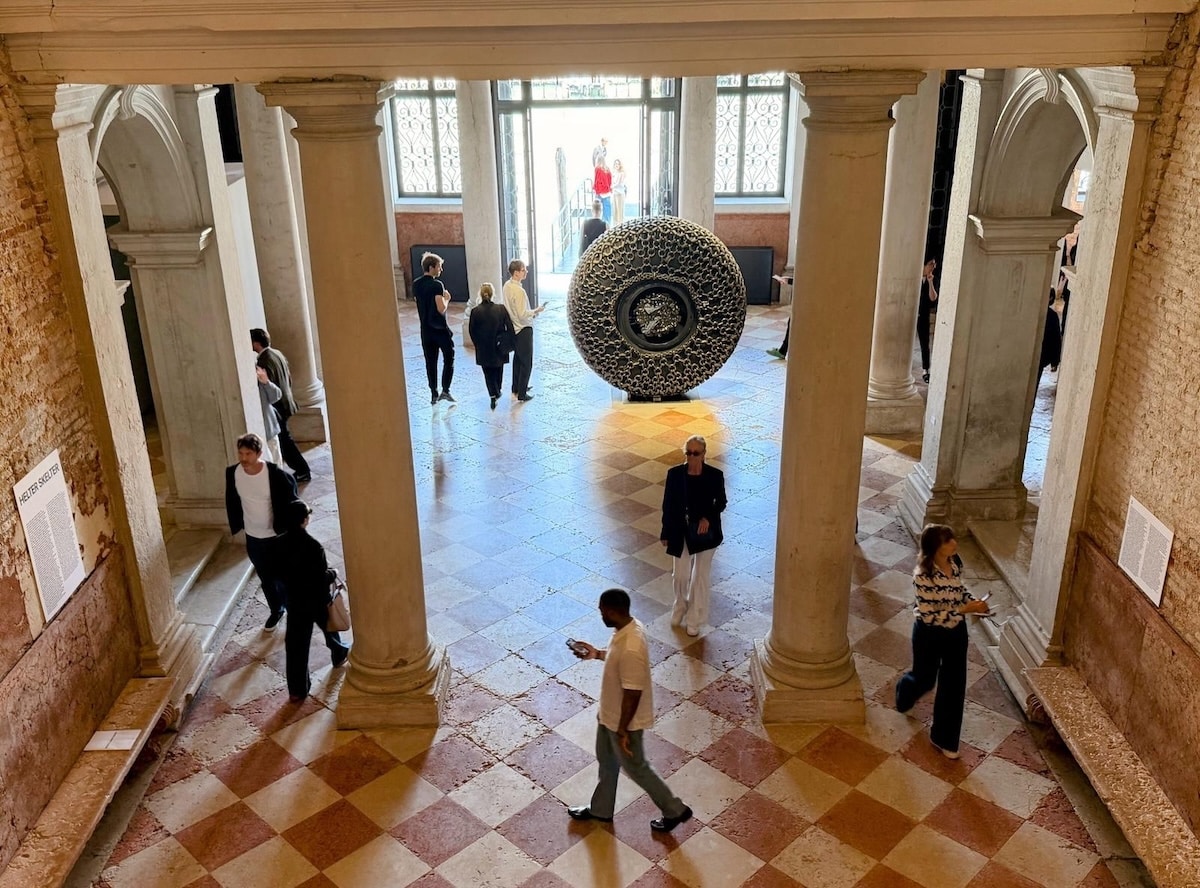
Fondazione Prada
Helter Skelter by Arthur Jafa and Richard Prince, Fondazione Prada, Ca’ Corner della Regina, 9 May – 23 Nov 2026
In breadth and scope, this show was mirrored by ‘Helter Skelter’ pairing Arthur Jafa and Richard Prince, curated by Nancy Spector at the Fondazione Prada, located in the 18th-century palazzo Ca’Corner della Regina, also on the Grand Canal. A prime mover, the Prada Foundation was established in 1993 by Miuccia Prada and Patrizio Bertelli, explicitly as a cultural institution rather than for marketing, and like the Chanel Culture Fund Fellowship in association with the Guggenheim, has become a fundamental pillar of the art world.Now Bulgari is the exclusive partner of the Venice Biennale’s International Art Exhibition for 2026, 2028 and 2030, and is presenting Lotus L. Kang at the Bulgari Pavilion. Whilst Venice itself attests to the lasting importance of patronage, these initiatives also highlight the fragility of public arts funding. They risk shifting cultural power toward private luxury brands, where art becomes part of brand world-building, client hospitality and reputational capital. Does fashion fund art, or does art authenticate fashion? In Venice, the answer is both.
Visit Fondazione Prada Here
Bulgari Pavilion
Visit Here