The Artist Agosto Machado has died following a brief illness. Agosto never disclosed his age, but he was thought to be in his 80s. In 1959, he came into being when he assumed the pseudonym inspired by China Machado, the first Asian model to appear on the cover of a major fashion magazine. Before that, he was someone else. After that, he was Agosto, and downtown New York was never quite the same.
Obituaries will struggle to contain him. Performance artist, visual artist, activist, archivist, muse, caretaker, friend, none of these categories quite covers it, and all of them are true. He was a self-described “orphan with a sixth-grade education and a degree from the university of the streets,” who arrived in Greenwich Village in the late 1950s to lead, in his own words, “the life of a pre-Stonewall street queen,” and spent the next six decades at the living centre of New York’s underground cultural life.
He met Candy Darling and Jackie Curtis on the streets of the Village. They brought him to Warhol’s Factory. He met Marsha P. Johnson and stood alongside her at the Stonewall Rebellion in 1969, and marched with her in the first Gay Liberation March in 1970. He was an early member of the Gay Activists Alliance, participated in protests in Albany against discrimination toward gay teachers, and helped collect signatures for Frank Kameny’s pioneering congressional campaign. He helped find and secure the Firehouse on Wooster Street in SoHo, the GAA’s first permanent home and a landmark in LGBTQ+ political history. He carried the banner. He showed up.
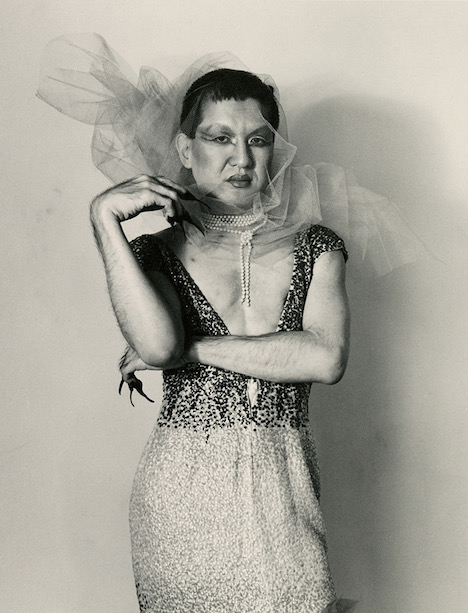
Peter Hujar, Agosto Machado, 1980 ©The Peter Hujar Archive/Artists Rights Society
The performing came almost by accident. Jackie Curtis encouraged him across the footlights for his Off-Off-Broadway debut in Vain Victory in 1971, a production that also featured Candy Darling, Holly Woodlawn, Taylor Mead and Mario Montez. “It never occurred to me that I would cross the footlights,” he said later. “People were so welcoming. I couldn’t understand why, because I don’t sing, dance, or act.” He attributed his stage career, with characteristic self-deprecating wit, to the fact that “the other queens were too busy to rehearse, and I was reliable.”
What followed was six decades of performance across virtually every significant underground venue New York produced La MaMa, Judson Memorial Church, Club 57, the Mudd Club, Pyramid Club, P.S. 122, the Performing Garage, Dixon Place, and MoMA. He performed with The Angels of Light, The Cockettes, Ethyl Eichelberger, Taylor Mead, Jack Smith, Tabboo!, John Vaccaro and Stephen Varble. He was, as he put it, part of the most magnificent, wonderful, Alice in Wonderland world of downtown New York — and he was also one of its most faithful witnesses and chroniclers.
He met Jack Smith while scavenging fabric from a dumpster on Crosby Street. That encounter, characteristically, defined something. “Jack was a pure genius,” Machado recalled. “You were in another dimension when you were with him.” The Cockettes, the Angels of Light, the avant-garde theatre community that gathered around Ellen Stewart at La MaMa, was present for all of it, performing in it, remembering it, preserving it.
The preservation instinct was fundamental to who he was. His East Village apartment which he called the Forbidden City, after the legendary palace in Beijing, was an ever-changing immersive archive: photographs and paper ephemera covering every surface, objects arranged in jars and on shelves, artworks acquired as gifts or found on the street, invitations and flyers and memorial cards from six decades of cultural life. Friends whose work he collected included Keith Haring, Peter Hujar, David Wojnarowicz, Thomas Lanigan-Schmidt and Nan Goldin. The archive was not separate from the art. It was the art.
From the beginning of the AIDS crisis, which devastated his community in the early 1980s, Machado nursed friends, attended funerals, kept every memorial programme and announcement, preserving the faces and names of people the wider world was content to forget. That act of faithful, painstaking remembrance carried out privately, without recognition, for decades was as significant as anything he made or performed.
His visual art, practised in private throughout his life, only became public in 2022, when his first solo exhibition of shrine and altar works opened at Gordon Robichaux in New York. He was in his mid-sixties. A second solo show followed in 2025. During both exhibitions, he gallery-sat in person, attending to visitors, sharing stories, existing in the space not as an artist behind a press release but as himself, generous, present, inexhaustible in his recollections. Works from those exhibitions have since entered the collections of MoMA, the Whitney Museum of American Art and the Hessel Museum at Bard College. A group of works created between the 1960s and 2025 is currently featured in the 2026 Whitney Biennial.
This year, he presented a solo exhibition at Maureen Paley in London, his first in the UK. Profiles had appeared in the New York Times, Frieze, Artforum, The New Yorker, and The Paris Review, recognition, long overdue and arriving fast. A publication dedicated to his life and community is forthcoming from the Centre for Art, Research and Alliances.
Every year from the 1970s until this one, Machado collaborated with friends to create a self-portrait in elaborate makeup and costume, used for his New Year’s card. He sent them out faithfully. He kept showing up.
“I want to be remembered as I was,” he said, near the end. “I’m going to join all our friends.”
There were a great many of them. And there will be a great many people left behind who understood, in some essential way, that downtown New York — the real one, the one that mattered — had him at its heart for longer than most people knew, and that his leaving makes the city smaller in ways that will take time to understand fully.
A memorial will be held in the coming months.
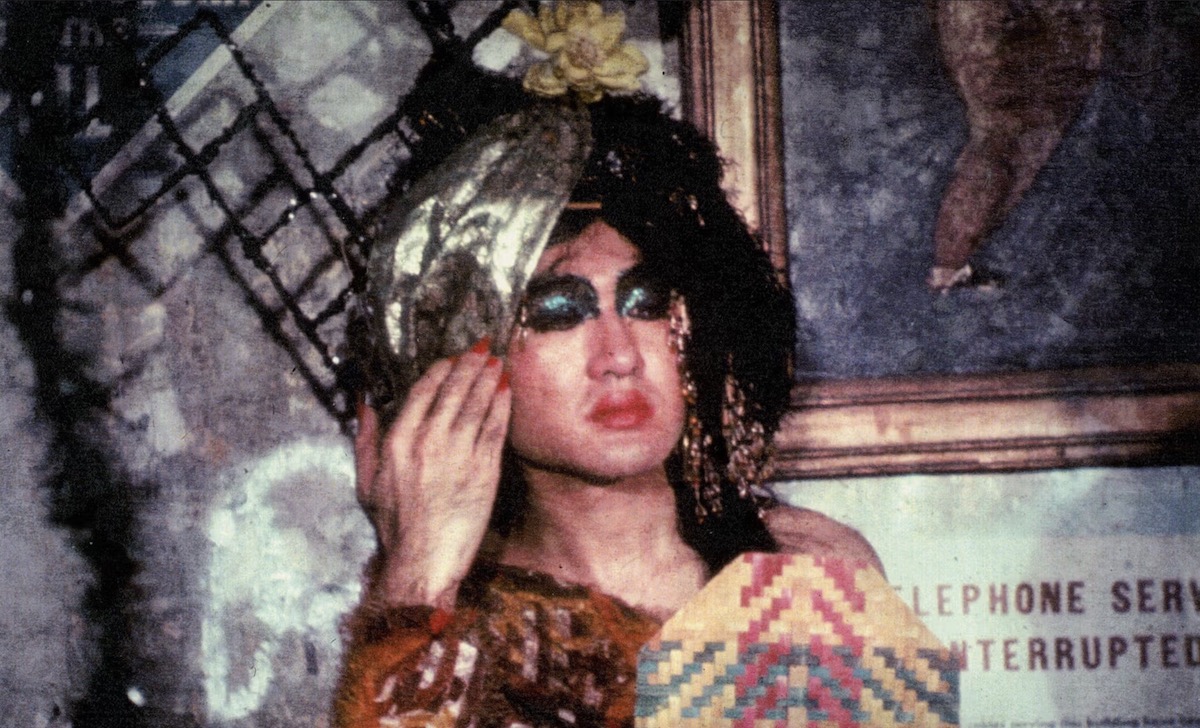
Top Photo: Jack Smith. Untitled (Agosto Machado). c. early 1980s. Digital print from original slide, 8 1/2 × 11″. Courtesy Gordon Robichaux, New York.
PS: Maureen Paley hosted Gordon Robichaux for Condo London 2026 with an exhibition of recent work by Agosto Machado at Studio M. For his London debut, which closed on 14 March.