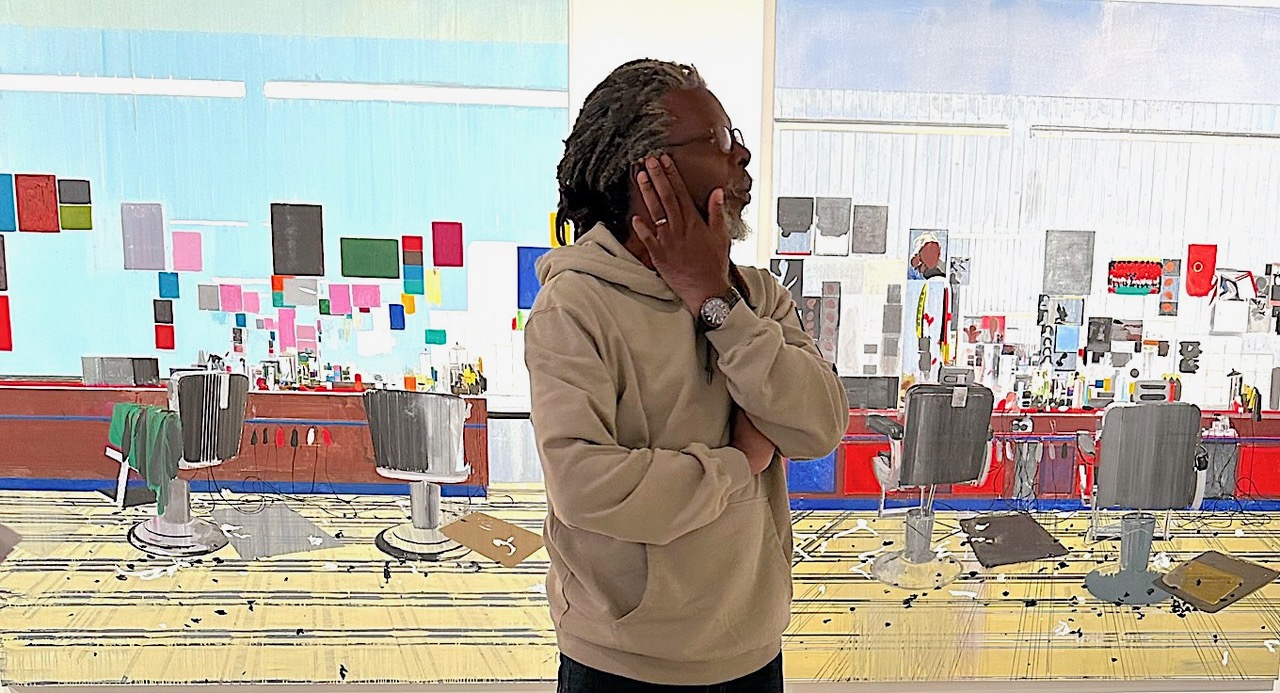
Comprising some 80 works, Hurvin Anderson’s Tate Britain show is a rich tapestry of painterly reconstructions and deconstructions of the Windrush experience. Anderson sees the past from an awful lot of angles, binding the two sides of the migration experience together. Some beauty is here, some ghosts are there, and it’s always a very visual experience.
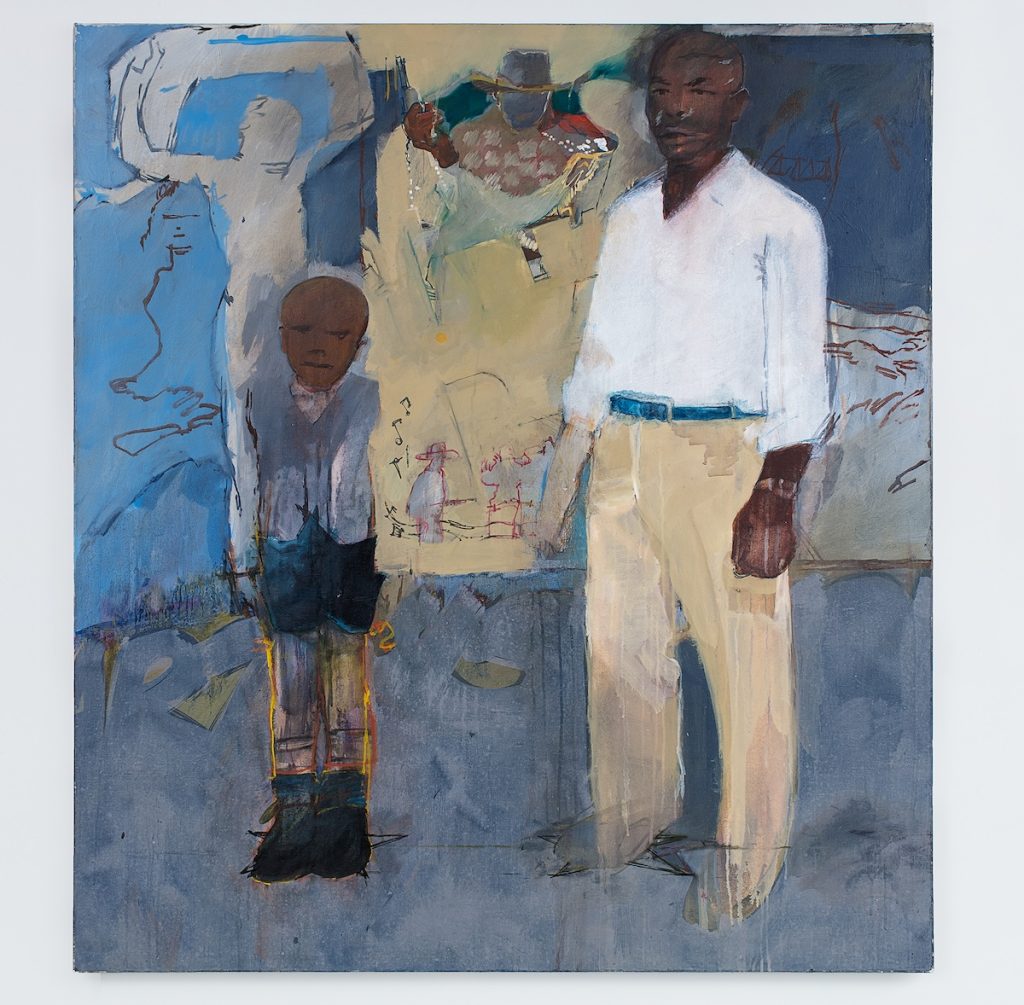
Hurvin Anderson, Hollywood Boulevard, 1997 © Hurvin Anderson. Courtesy the artist and Thomas Dane Gallery. Photo: Richard Ivey.
Two small sketch paintings, painted in black and white like photos, relate to this Windrush experience of moving between two worlds. Figures whose faces we cannot see are shown descending a staircase and on the tarmac beside a plane – sort of empty, symbolic representations. Hollywood Boulevard (1997) is the only painting of Hurvin (the first member of his family born in England after emigrating from Jamaica in 1961) standing next to his father.
A painting from the Ball Watching series (1997) is based on a photo of a group of young people looking off across the pond at Handsworth Park in Birmingham, where a football has landed. Photo document and painterly transformation go back and forth in a continuous exchange. As with Peter Doig’s paintings, Anderson’s scenes become like islands of memory. And like Doig, Hurvin Anderson never abandons figuration. What were willow trees on the other side of the pond, become people but mere symbolic markings of what people could represent. Again, this distance and memory. As existential painterly projections, the animation is suspended. Life hangs in a precarious balance between there and here. In another large painting, we see his sister Bev (1995) at Beaver Lake on Mount Royal in Montreal. It’s a sharp double portrait of her as an adult next to herself as a young girl.
Passenger Opportunity, the largest commission ever, reworked in places for the show, occupies an entire wall. Named after the fliers given to Jamaican people after the war, inviting people to work in the UK, it’s a multi-panel composite of paintings that include brief visual sketches of family life, forests, and interiors, a composite of images about departure and arrival that was inspired by Carl Abraham’s two-part mural at Norman Manley International Airport in Kingston, Jamaica. The reworked areas in the lower right now depict scenes of a slave market, with chained children and adults being directed there.
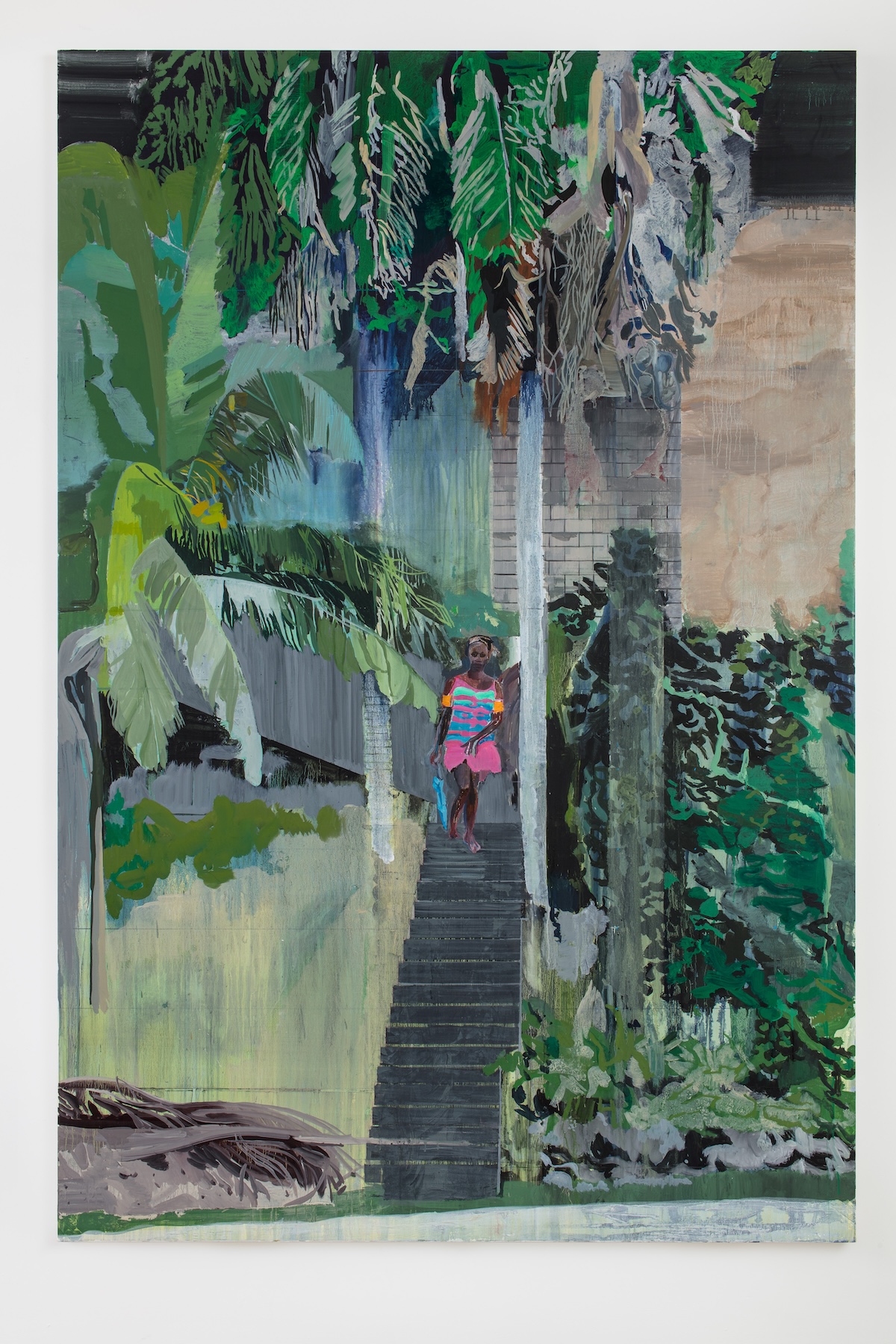
Hurvin Anderson, Grace Jones, 2020. © Hurvin Anderson. Courtesy the artist and Thomas Dane Gallery. Photo: Richard Ivey.
In Country Club, Chicken Wire (2008), based on a visit to Trinidad, the geometry of the fencing partially obstructs your view of the tennis court within. It is a closed world, only visually accessible. Maracas III (2004) and Untitled (Red Flags) (2004) are simply great paintings, with all that Caribbean colour. There is an incompleteness as if a few more touches and it would all be done. This splay of brush layers and areas of colour brings life to these unfinished worlds, unfinished memory paintings. They don’t look out to the sea, but inwards to the beach. One of the most haunting and spectacular paintings carries echoes of the slave past of Jamaican ancestors. All the figures of women, some mere shadow outlines, others more clear, all relate to the form of a tree. It’s haunting, otherworldly. Anderson’s environmental portrait of Grace Jones (2020), walking down concrete stairs, is immortal, colourful, lovable, and resplendent.
In the final area of the Anderson show called Rafts, there are hints of a rekindling of historic events, personalities, and the paintings rise to the occasion. We see the Emperor Haile Selassie I descending from an airplane on April 21, 1966, during a visit to Jamaica, an event Jamaica’s Rastafarians worshipped. Is it OK to be Black (2016) has progressives from Black history like Martin Luther King and Malcolm X, as well as others whose faces are ghosted, obscured or mere silhouettes. The suggestion is of censorship or a reframing of history.
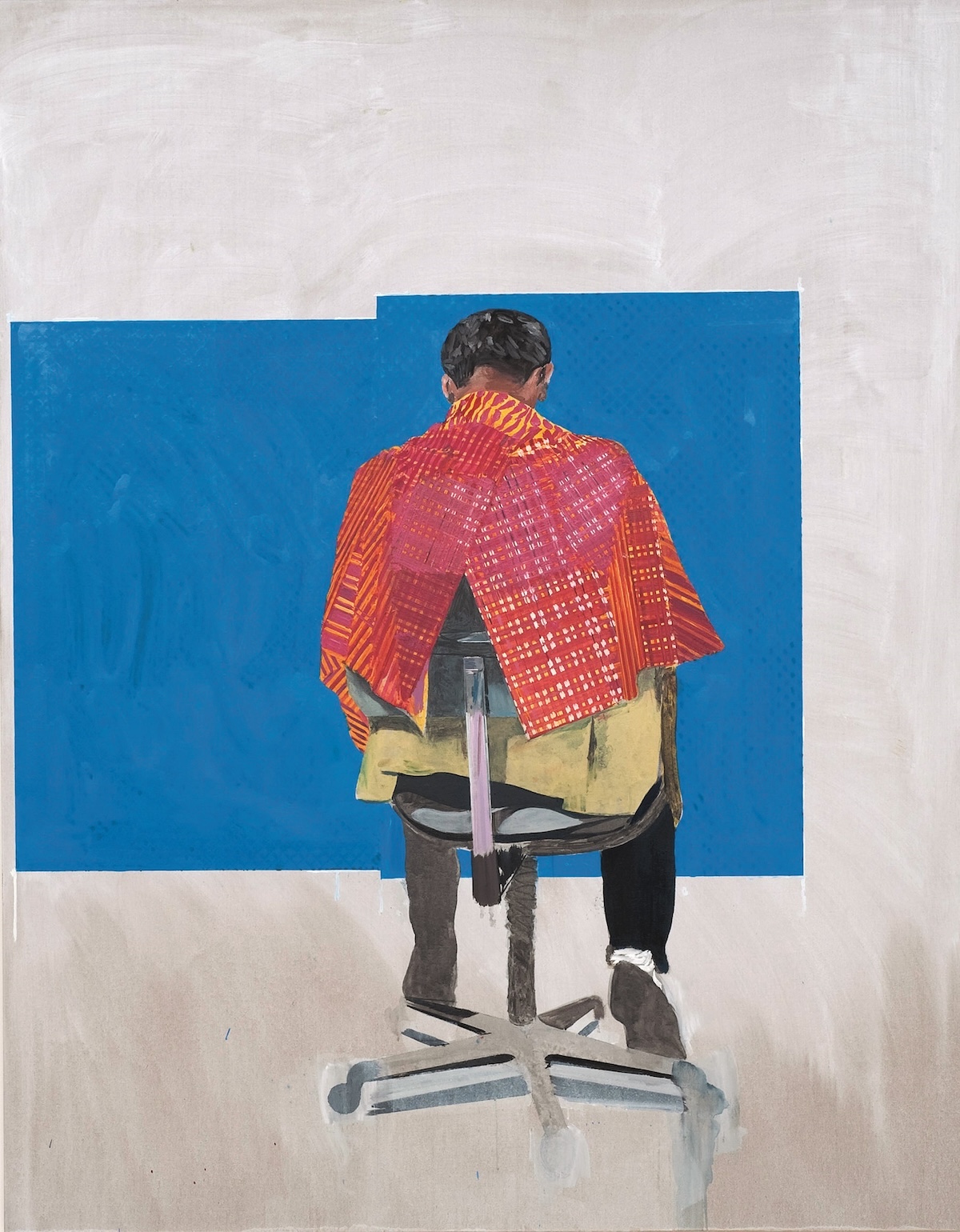
Hurvin Anderson, Peter’s Sitters II, 2009. Zabludowicz Collection. © Hurvin Anderson. Photo Catherine Wharfe
Ashanti Blood (2020) marks a return to history and is named after a West African evergreen shrub with blood red flowers. It is also the name given to Tacky’s Revolt (1860-61), a slave rebellion that was suppressed. It’s a crime scene enacted over centuries… The scars of history surface as nature’s sublime growth, a feast of colour and chaos. Nature overpowers the structures of the past. Outside history inside nature, it’s a kind of inverse Romanticism, where the traces of the past become visual transplants. Hurvin Anderson’s paintings aren’t tourist souvenirs! They expose the emigrant condition brilliantly from both ends of the line. Departure and arrival, or neither of these. How existential is that? The angular layouts of Peter Brown’s barber shop become abstracts. Generations of Windrush people went upstairs there for a haircut. Old men in paintings like Sheer Cut (2024) and a young man seen from the back in Peter’s Sitters II (2009).
One such painting is a perfect embodiment of how we look backwards, only to find remnants of an unoccupied building, now dilapidated, that nature has taken over. This wild, chaotic growth, a tangled garden, a chaos of nature blankets the underlying Brutalist geometries. Entire communities have vanished. Nature reclaims it all.
Anderson is a canny painter. From a distance, he digests the details and draws something human out of the cold. The act of painting undoes the photo and the memory and brushwork back it up. A quote attributed to W B. Yeats, but actually from the lesser-known Eden Phillpotts, says it all: “The universe is full of magical things, patiently waiting for our wits to grow sharper”. Hurvin Anderson’s paintings sharpen how we see things seemingly effortlessly – a painter’s painter. It’s one of the best surveys to be seen in a while… the world is watching and for good reason…
Hurvin Anderson, Tate Britain, 26 March – 23 August 2026
Visit Here