A great deal has already been said about the cacophony in Venice during preview days, and in my mind, there was also a visual cacophony in the central exhibition, which seemed at times overcrowded and confusing. Perhaps that was the point – not to be confined by curatorial dogma but to wander through and take it all in. So, what to make of this?
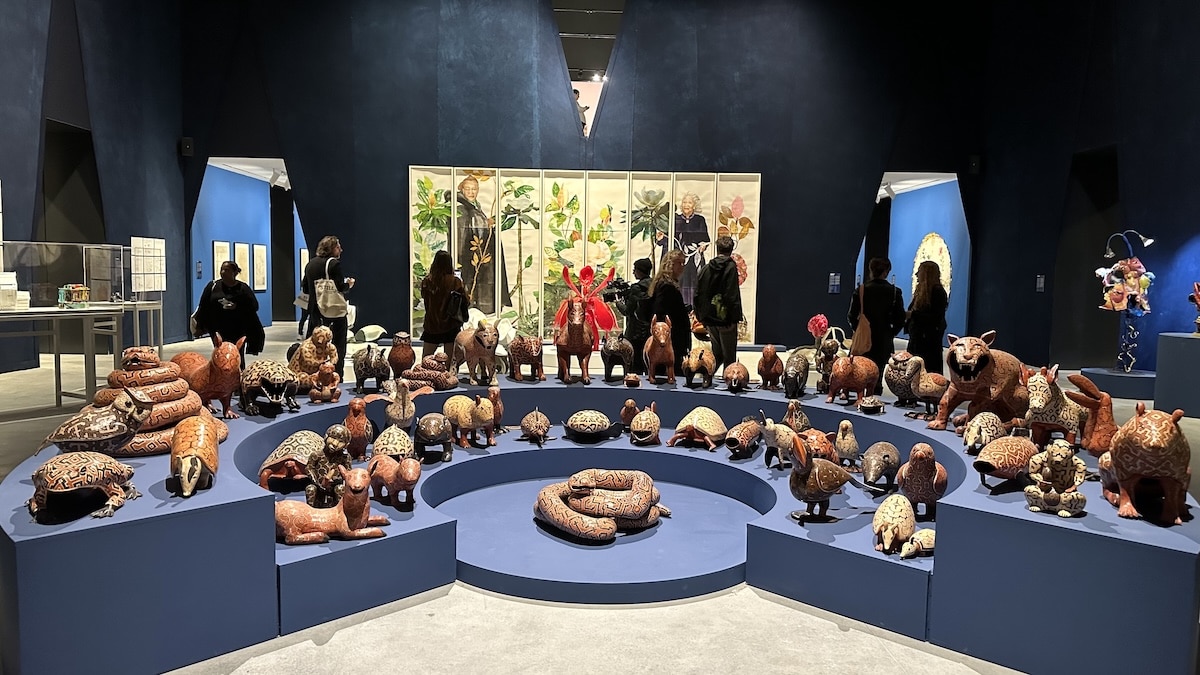
Koyo Kouoh, the curator assigned to bring this 61st Venice Biennale together, died in 2025 and left the foundation of her vision for ‘In Minor Keys’, the title of her central exhibition featuring 110 artists, collaboratives, collectives and artist-centred organisations. A group of 5 helped to realise this after her death – ‘la squadra di Koyo’: Gabe Beckhurst Feijoo, Marie Hélène Pereira, Rasha Salti, Siddhartha Mitter, and Rory Tsapayi. The viewer is greeted by introductory panels as you enter both buildings; the title wall expounds Kouoh’s vision – ‘Take a deep breath, exhale, drop your shoulders, close your eyes…’. To pause, slow down, rest. And sometimes it was possible to do just that, to wander between terracotta figures and vessels with their earthy tones, savour exquisitely elaborate embroidery and intricate drawing, and read the poems. Throughout both exhibition spaces, poems and quotes hang on indigo banners at intervals, breaking up the spaces – amongst them words by Refaat al-Areer, Etel Adnan, Toni Morrison, Ben Okri.
There are two venues for the Central exhibition of the Venice Biennale, the Giardini and the Arsenale. The Giardini building was constructed in 1894 to house all the countries exhibiting before their own national pavilions were built. It has since been added to by notable architects and artists, and as a result, it just doesn’t flow coherently. The Corderie at the Arsenale was originally the rope-making workshop of the Venetian Republic’s naval fleet, dating back to 1303 and rebuilt in the 16th century. It’s a 317 metre-long brick building, extremely high with a timber roof – a perfect vessel for showing a variety of contemporary artworks. That may be why the Arsenale part of the exhibition is more successful.
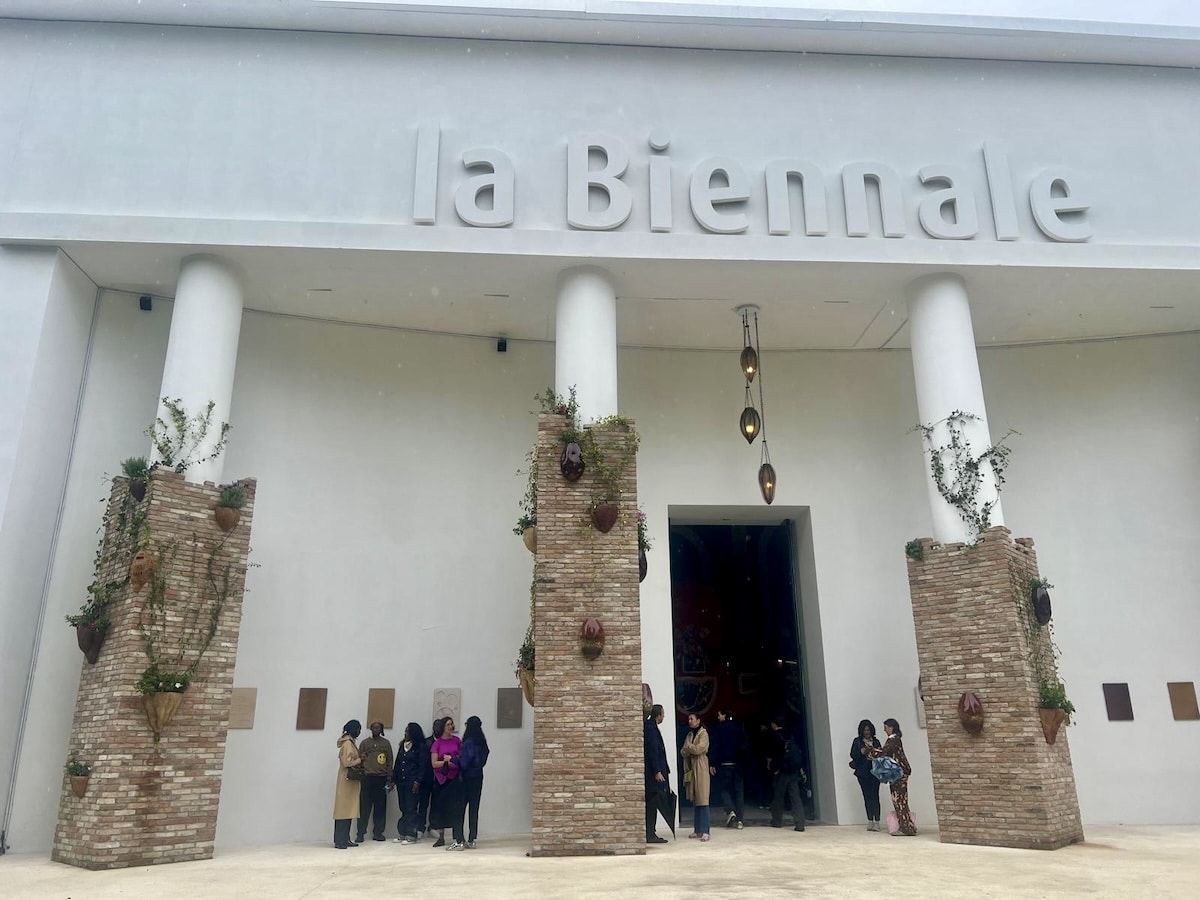
Otobong Nkanga, Soft Offerings to Silenced Voices and to All Who Have Turned to Dust, 2026, Giardini, Venice
Nigerian artist Otobong Nkanga has transformed the facade of the Giardini building with ‘Soft Offerings to Silenced Voices and to all Who Have Turned to Dust’ (2026). The four columns have been clad with locally made brick tiles, and ceramic pots have been attached, containing plants that will eventually consume the columns. Alongside these are wooden insect houses, ceramic tablets imprinted with poems, and Murano glass objects. It’s like a gateway to what lies beyond inside – a preface to a space inviting people to pause and slow down. An extract from Okri’s poem Brexit and our Times from The Unknown Hour, hangs near Garden of the Broken Hearted (2026) by Theo Eshetu – an uprooted olive tree stands on a rotating stage, a video projected onto its trunk of its previous status when growing. The tree will eventually shed its leaves, shrivel and die during the course of the Biennale, a completely opposing conceit to the growing vines on the facade of the Giardini building. The poem uses the analogy of trees’ tenacity to survive: “They grow when they can, they die when they can’t.”
Nick Cave, Two Points in Time at Once
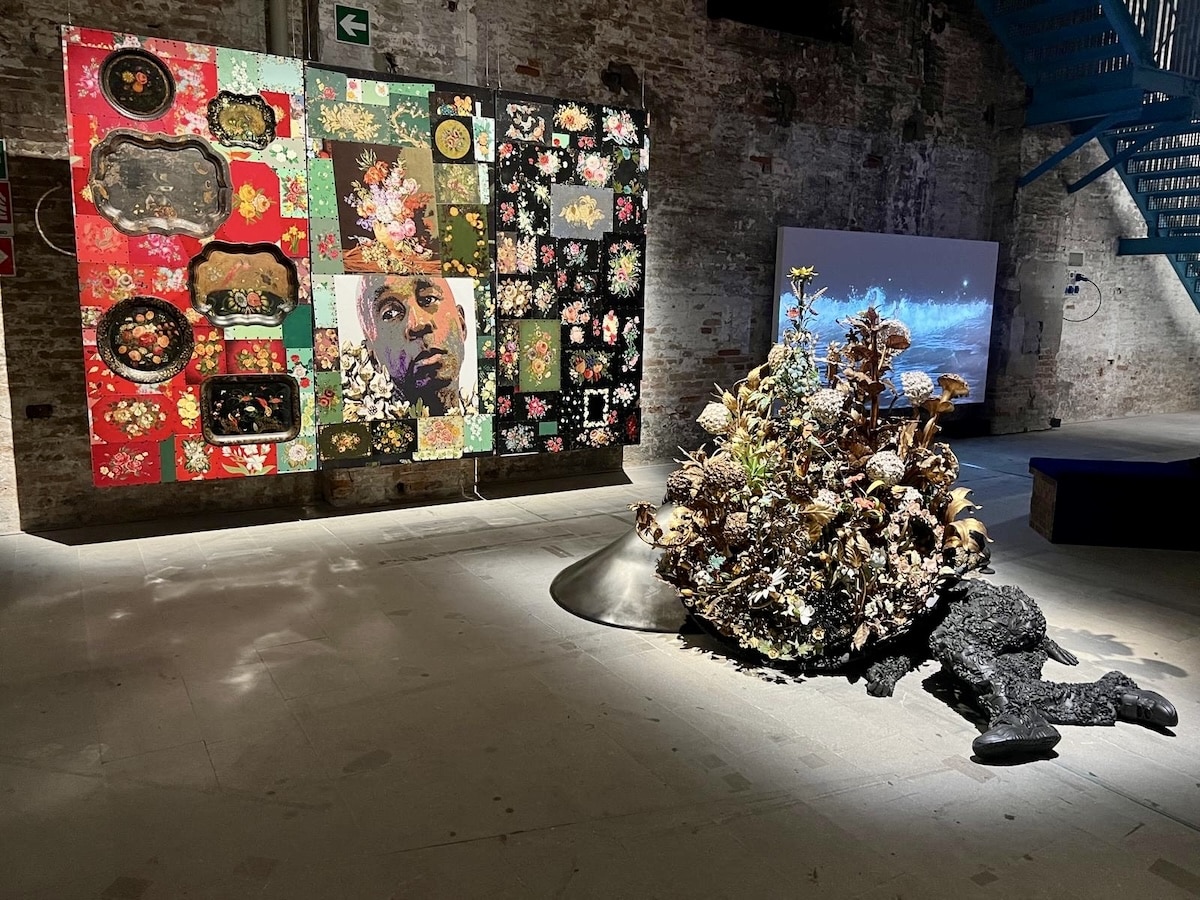
Welcoming all through the threshold of the Giardini building is a loud and vibrant work by Big Chief Demond Melancon – a red-feathered Carnival costume featuring panels showing the first colonial Mardi Gras. Also, referencing Carnival is Alvaro Barrington’s brightly painted pink, green, and yellow truck or float, parked close to the Austrian pavilion in the Giardini. His Labor Day Parade ’91 (2026) speaks to memories of West Indian Day Parade in Brooklyn, of carnival rhythm and music – the words ‘We be jammin’ scrawled across one section of the pantechnicon. Nick Cave’s works abound both inside and outside – a standing figure with birds on branches sprouting out from his back like a magnificent Saint Francis. Inside, similar figures covered in flowers, again conjure ceremony and procession.
Khaled Sabsabi’s site-specific multimedia experience Khalil (2026), welcomes you to the Corderie at the Arsenale and envelops you within its spiral enclosure of video, scent and sound. Khalil is an Arabic word for close friend or companion. It’s a poetic and immersive work that demands contemplation and reflection.
Seyni Awa Camara
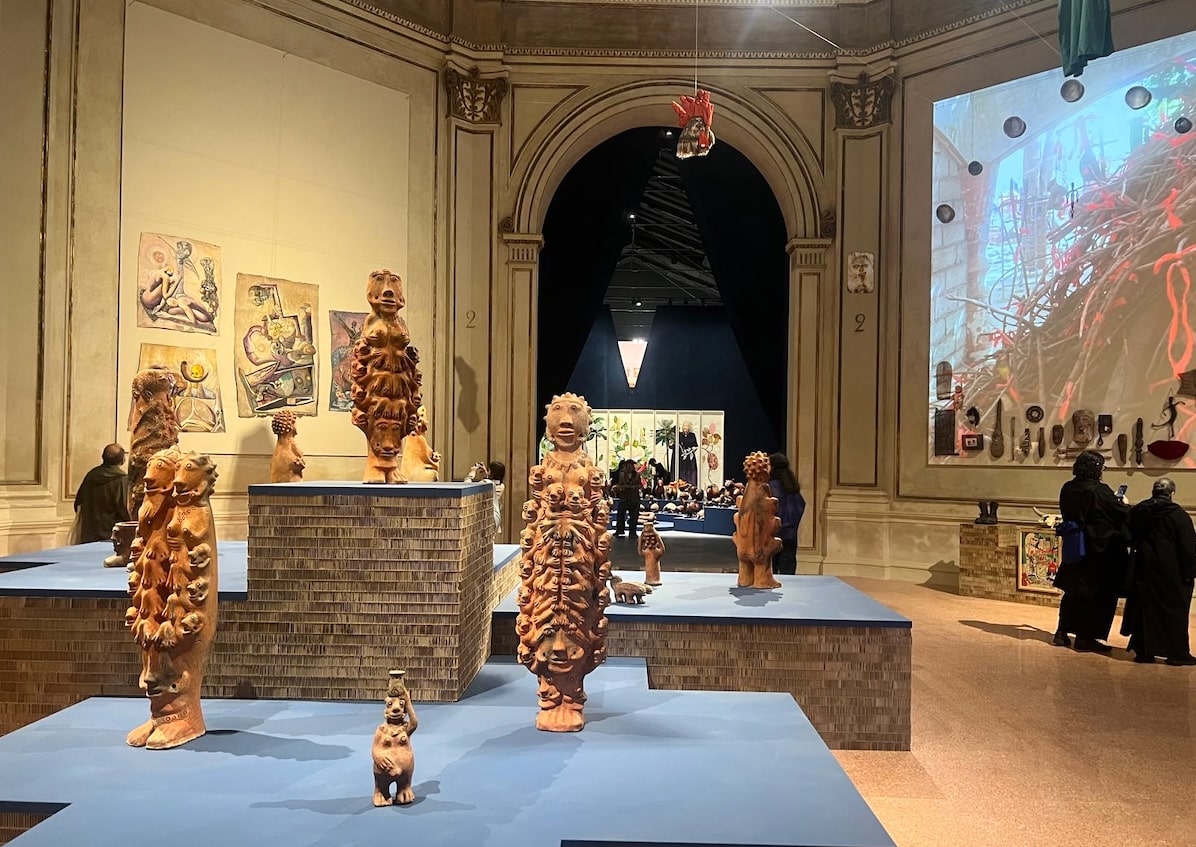
Seyni Awa Camara’s terracotta figures, a pantheon of mythical multi-limbed and many-breasted figures, greet you in the first main space in the Giardini building. Similarly ambiguous, Wangechi Mutu’s magnificent bronze SimbiSiren (2026) in the Gaggiandre at the Arsenale is a sphinx-like extraterrestrial amphibian/human Kongo guardian spirit with a reptilian tail, webbed paddle-like hands drooping over its metal plinth, water dripping from them to sustain the flowers at its base. Alice Maher’s four large-scale drawings of the prophetic women of myth, The Sibyls (2025), depict one entangled in coils of hair, as if weighed down by them, and one sitting atop the coils like the Copenhagen mermaid. Her sculptural work Les Filles d’Ouranos (1996/2025) comprises 15 orangey-red buoy-like heads floating in the Gaggiandre, the covered dock at the Arsenale. These ‘daughters’ reimagine the Greco-Roman myth, the birth of Aphrodite/Venus, emerging from the sea.
Pio Abad’s delicate series of drawings, entitled 1897.76.36.18.6 (2023-26), features Benin bronzes from the British Museum collection, balanced precariously atop piles of books and alongside other objects, relocating them into a domestic setting. The suppressed histories of looted objects are also represented in, i am singing a song that can only be borne after losing a country (2023), a to-scale drawing of the so-called ‘Powhatan’s Mantle’ in the Ashmolean. Banua (2026) shows a garment from the Philippines made from mother-of-pearl buttons in the collection of Chicago’s Field Museum.
There are numerous references to the global pillaging of natural resources.
Sammy Baloji’s works address the extraction of natural resources in Congo, as well as how African art has been contextualised. His sculptures are formed from scanned statuary interspersed with cubes representing uranium crystals, harshly breaking up the figure. Baloji’s prints combine imagery from ethnographic catalogues alongside precision diagrams of crystal formations. On the wall is a timeline, a list detailing the collection and classification of Kongo objects in Italy from 1450-1922, from the first Portuguese Christian missionaries, through the Atlantic slave trade, to the establishment of an ethnographic museum in Rome after Italian Unification. The list concludes in 1922 when it states the Venice Biennale hosted a Negro Art exhibition.
I found it hard to stay too long inside Alfredo Jaar’s The End of the World (2023-24), an intense, deep crimson-red room with a cube at one end made up from compressed rare-earth minerals. The text on the wall describes the process of its formation, refers to lithium used in atomic bombs, and speaks to the process of extraction and child labour. Bonnie Devine from Toronto’s Anishinaabe community of Genaabaajing Serpent River First Nation speaks to the impact of uranium mining in Anishinaabitude (2014-15), a work comprising three willow basket figures and other elements gathered from the St Clair River, the Serpent River, and the Don River.
Johannes Phokela
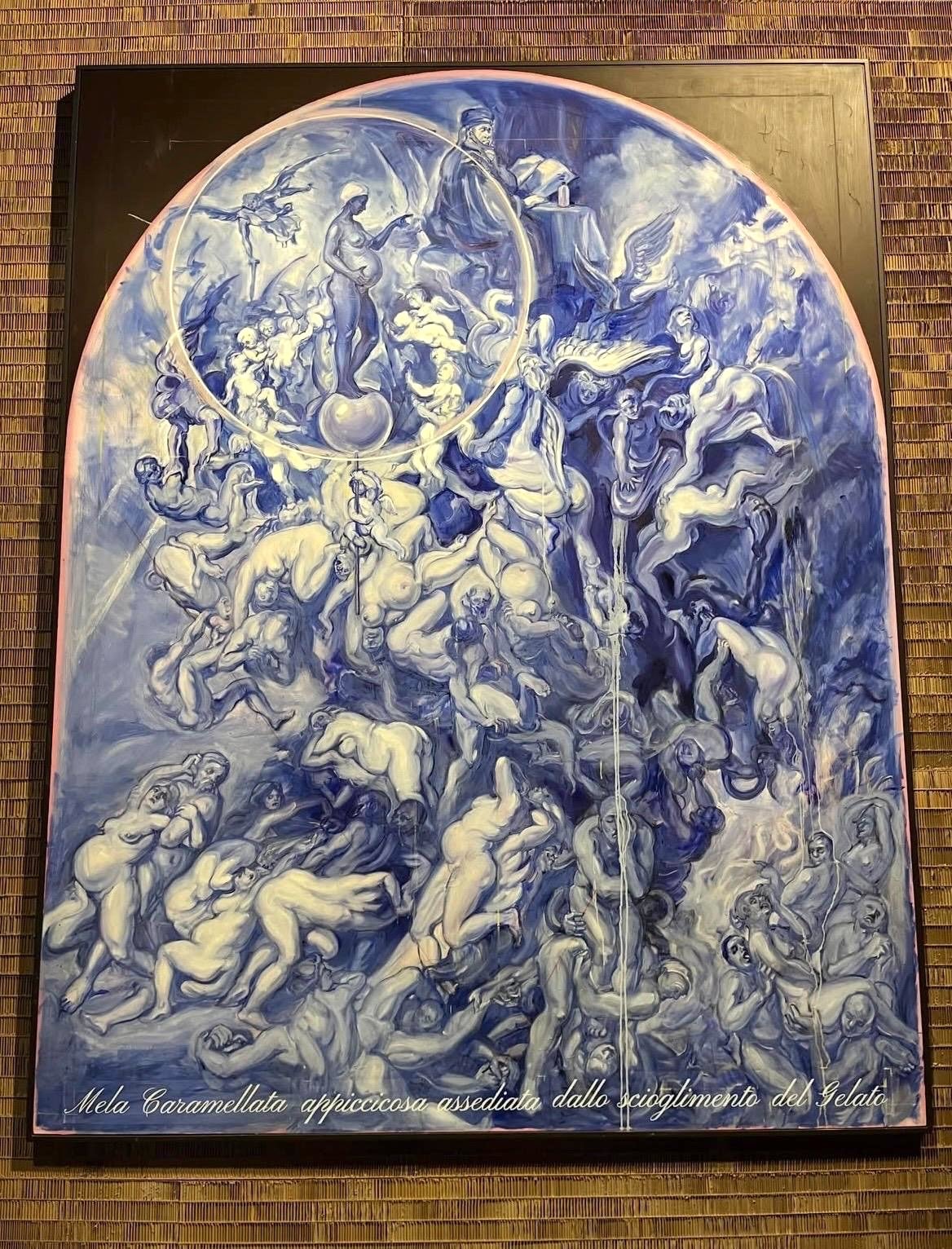
South African artist Johannes Phokela uses a palette of blue and white much like that of Delftware – the colours of Chinese and Japanese porcelain imported by the Dutch East India Company, the largest corporation in human history. His style mimics that of European artists of the past, such as Bosch and Brueghel, and their representations of non-Western people. The satirical scenes he paints are very Hogarthian, especially in The Seven Virtues (2024), which depicts a violent and perverse world descending into chaos. Phokela’s Original Sin (Inner Circle) (2021) depicts a contrived Rubens-esque Last Judgement, though in this version, only a pregnant Black woman survives. There’s a lot going on in these scenes, which remind me of Paula Rego’s detailed monochrome works featuring cautionary tales or nursery rhymes. In contrast to these works, Eric Baudelaire’s film in the Arsenale, a day in the life of a vast Dutch flower market warehouse, alludes to global commodification and present-day trade in imports and exports.
Kaloki Nyamai
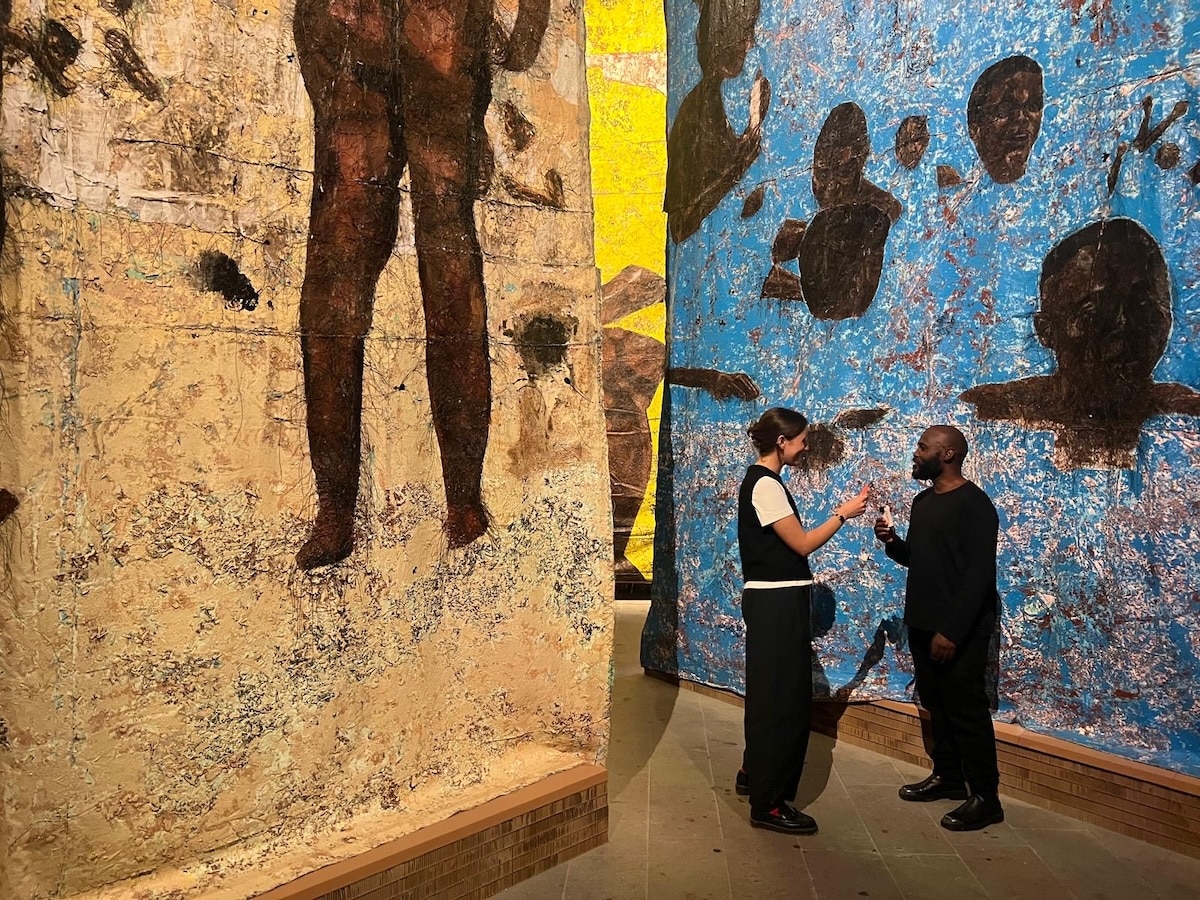
Kennedy Janko’s massive John Chamberlain-like crushed sculptures and Kenyan artist Kaloki Nyamai’s elegiac, huge, handmade hanging canvases featuring almost abstract figures also stood out. Mohammed Joha left Gaza in 2004, but its landscapes form the focus of his work. He creates collages of overlaying fabric, paper and cardboard onto canvas. There’s a terrible beauty to his series of watercolours entitled No Shelter 12-29 (2026). As Kouoh states in her vision for this exhibition, ‘…produce beauty despite tragedy’.
The 61st International Art Exhibition of La Biennale di Venezia, In Minor Keys by Koyo Kouoh, Giardini and Arsenale, Venice, 9 May to 22 November 2026
Visit Here
Ten Political Statements By Artists At The 2026 Venice Biennale
Venice Biennale 2026 Collateral Events Six Of The Best – Nico Kos Earle