There was a lot of death around in the 19th and 20th centuries. First, Nietzsche declared God dead. Then, Roland Barthes, that darling of 20th-century French philosophy, gave us the death of the author, which allowed for the primacy of each reader’s interpretation of a text over the author’s voice. In the late 19th century, the preeminence of painting was challenged by photography and film. Wassily Kandinsky claimed that only abstract art could reach spiritual heights, a position later supported by the guru of American Abstract Expressionism, Clement Greenberg. While the Russian artist, Alexander Rodchenko, insisted that painters needed to be more like workers and contribute to social progress. Painting, it seemed, was in danger of ending up in the scrapheap.
By the middle of the last century, video and installation began to dominate the galleries. Painting was seen as the enemy of the avant-garde and considered, unless playfully ironic and eclectic, as retrograde and passé. Yet the truth is that it never really went away. Painting has continued to refresh its vocabulary, to reinvent itself in ways that feel relevant to a changing society. Painters such as Elizabeth Peyton and Amy Sherald have reimagined figuration. At the same time, the likes of Chris Ofilli have pushed the boundaries of what can be included in a painting, from beads to elephant dung.
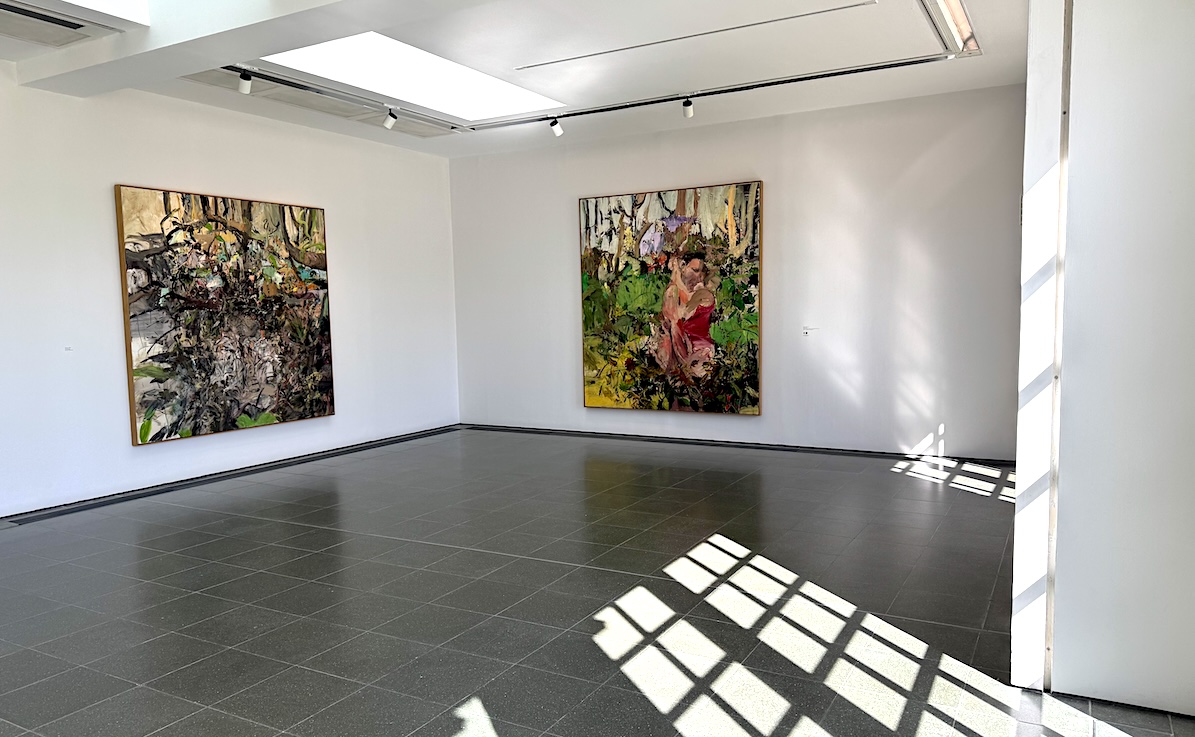
Cecily Brown: Picture Making, Serpentine South Gallery, installation view © Artlyst
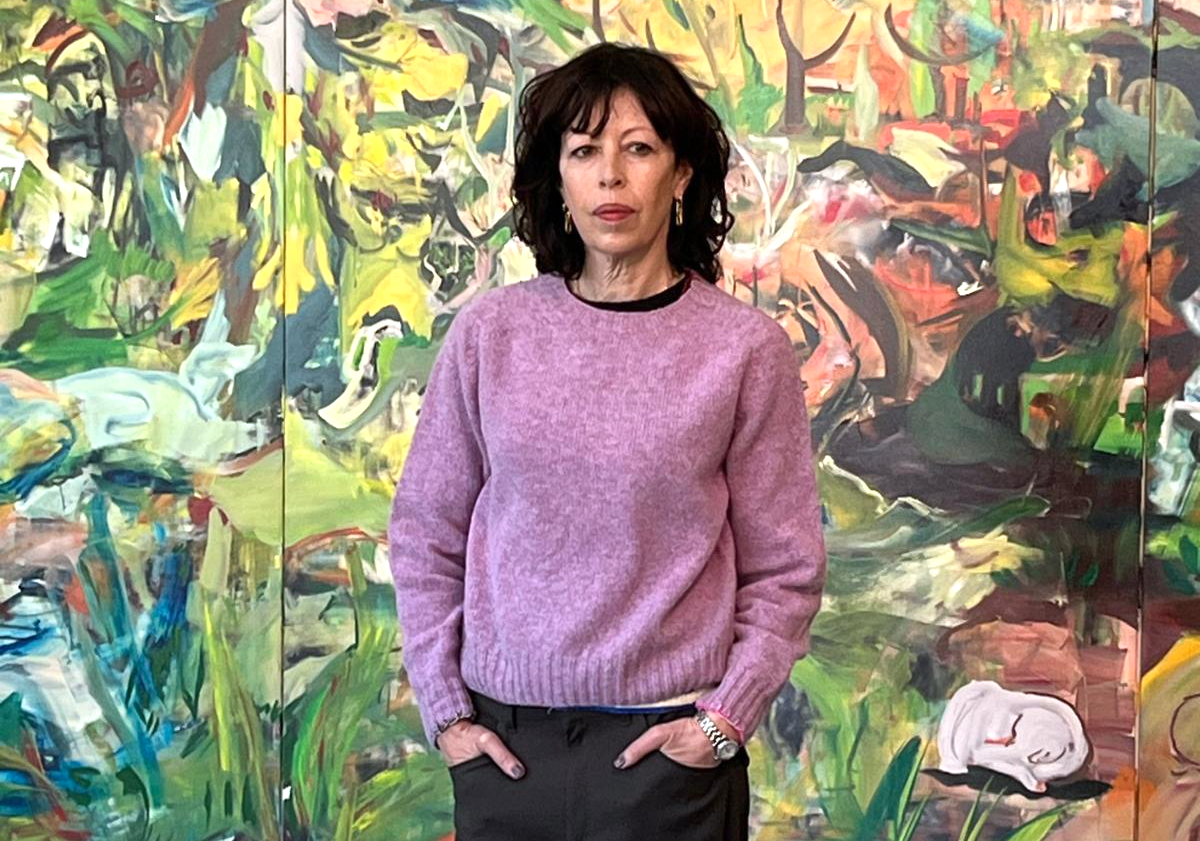
Over the last three decades, Cecily Brown has produced paintings characterised by her febrile brush marks and vivid colour. Working across multiple canvases at any one time, there’s a sense of a sentient body behind each brush mark. In 1994, after training at the Slade, she distanced herself from the YBAs and moved to New York. There she developed her own postmodern take on painting, filching magpie-like from old Masters and Abstract Expressionism in a series of visual quotes and puns, as happy to reference Breughel as Beckett’s poem “Bitter Moon”.
In this new one-person show at Serpentine South, she draws on a wide range of visual material, plundering art history and the illustrations of children’s classics. There is a greater reintegration of the figure here than was evident in her Gagosian show, and a move away from the fleshy tones, the deep carnal crimsons, and skin pinks. Inspired by the Serpentine’s location in Kensington Gardens, these works are less visceral, with a palette of naturalistic woody browns and greens. Bodies emerge out of the layers of paint or seem to dissolve back into it. Nature walks, and woodland scenes hang alongside those of amorous couples boating or kissing. Yet what we are presented with is not an altogether comfortable idyl. There is something dark lurking in these bucolic landscapes, something threatening hidden amid the trees. The uncanny is highlighted in her references to nursery rhymes and cautionary tales. In folklore, the wood, the glade, and the forest are often presented as places of dread and enchantment. Think of Midsummer Night’s Dream or As You Like It, where it is a space of transformation, where everyday order can be subverted. The woods, to quote the American poet Robert Frost, may be ‘lovely dark and deep’, but they are also dangerous, transgressive places filled with repressed desires, with what is animal and not quite human. Free from social constraint, those who enter can reimagine and live out alternative identities.
The urban park provides Brown with a liminal space that hovers somewhere between civilisation and the untamed wilderness of the Romantics. It is a place of clandestine and furtive sexual encounters. Bodies, trees and grass all merge beneath the erotic charge of her textured surfaces. She has said that sometimes, as an artist, she doesn’t quite know what she’s doing, that that is the most interesting part of making a painting ─ the discovery. ‘…if I knew what I was going to paint, what would be the point of executing it?’
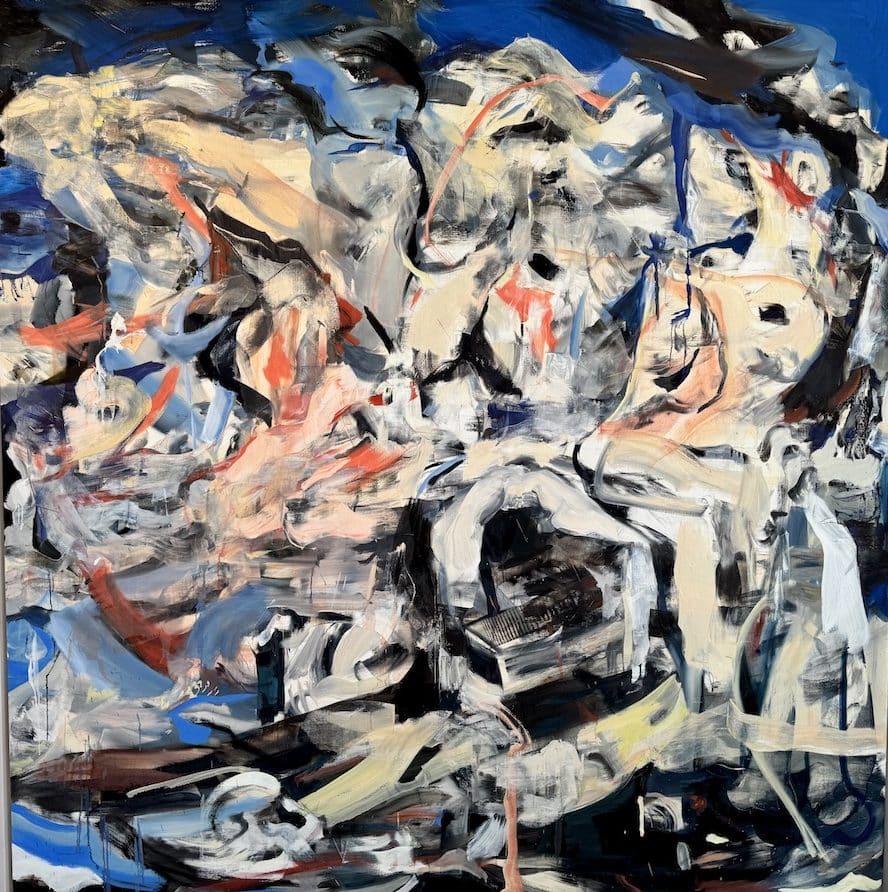
Cecily Brown, The Last Shipwreck 2018
Her interest in shipwrecks began in 2016, inspired by Théodore Géricault’s turbulent The Raft of the Medusa, which depicts the carnage of a French naval shipwreck. Brown’s own The Last Shipwreck, painted in 2018, is full of writhing pink forms that seem to sink back and disappear into the thick layers of paint like a drowning body being reclaimed by the waves. Couples boating in the park are a rather less deadly reimagining.
She has said that in painting, ‘anything is possible.’ That it is a kind of artificial, fantasy realm constructed by the artist.’ The animals in her drawings, taken from children’s tales, allow her to explore the uncanny side of human nature in a vein similar to that of Paula Rego. There is a whiff of cruelty here. (How many, I wonder, will recognise in the central showcase of drawings, Beatrix Potter’s tale of Two Bad Mice, where Hunca Munca Mouse takes a swipe at the little plaster ham in the doll’s house with a pair of fire tongs or Jemima Puddle Duck is tricked by the fox into coming to dinner). The innocent rubs shoulders with the horrific.
Despite the exhibition’s more figurative bent, there remains a tension between image and paint mark, between the subject and the process of making. Things remain fluid and ambiguous. Each work is a discovery that the artist makes about her own creative process. She doesn’t have a message to get across, so the subject is always just painting and how to push painting in new directions. Painting is the language by which she explores the world, a way of looking at things that might otherwise be too hard to confront. In an age that often seems brutal and overwhelming, painting provides her with an in-between, surrogate realm that helps her make sense of the world.
Words/Top Photo Sue Hubbard © Artlyst 2026
Cecily Brown: Picture Making, Serpentine South Gallery, 27 March – 6 September 2026
Visit Here
Sue Hubbard is an award-winning poet, novelist and freelance critic.
Her fourth novel Flatlands, from Pushkin Press 9781911590743 can be bought here.
Her latest poetry collection God’s Little Artist: poems on the life of Gwen John from https://www.serenbooks.com/book/gods-little-artist/