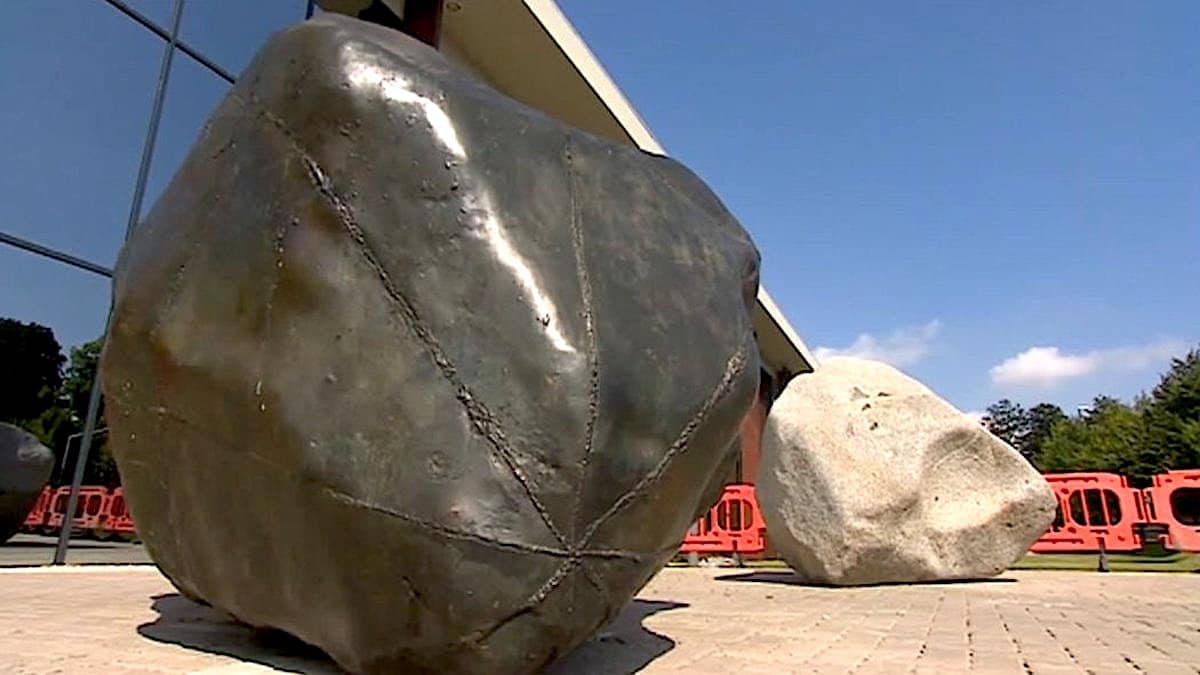
A work by Antony Gormley, one of Britain’s most significant living sculptors, has been sold by Kent County Council without public debate, official announcement, or formal scrutiny. Two Stones, one of the artist’s earliest commissions and a work with particular biographical resonance, given that the artist studied and later taught at the Maidstone School of Art. The bronze-and-granite artwork, weighing several tons, was removed from its position outside the Kent History and Library Centre in Maidstone sometime last week. It has been sold back to Gormley himself, though the council has refused to confirm the sale price, identify who authorised the transaction or clarify what oversight process governed it. The sculpture was installed outside the Kent History and Library Centre in Maidstone. It previously sat at Singleton Lake in Ashford, but had to be removed in 2010 after being vandalised.
“The sale was not announced. It was noticed” – Stuart Jeffery
Stuart Jeffery, Kent County Green Councillor of Maidstone Borough Council, stated that the removal had been carried out without any public communication. “They did it quietly,” he said. “It disappeared sometime last week, and then we found it missing.” The council, run by Reform UK, has since confirmed the sale but has offered no further transparency regarding the circumstances that led to it.
The disposal of Two Stones is not an isolated incident for Kent County Council. It forms part of what critics describe as a broader fire sale of public art assets owned by Kent County Council under Reform’s leadership. This pattern sits uncomfortably alongside the authority’s decision to raise local taxes by almost four per cent in January. The financial logic of selling public artworks while increasing the burden on residents has not been explained.
Gormley is among the most celebrated British artists of his generation. The Turner Prize winner of 1994 and the creator of works that have become embedded in the cultural landscape of the United Kingdom and beyond, including the Angel of the North in Gateshead. Two Stones was among his first commissions, which stood outside a public library in a town where he spent a formative period of his career. Public art of this kind is not simply an asset. Its value is relational, tied to place, community, and memory in ways that make its quiet removal a loss that cannot be fully quantified.
Gormley, born in London in 1950, studied at Trinity College, Cambridge, before travelling extensively in India and Sri Lanka, an experience that proved formative for his practice. He went on to train at the Central School of Arts and Crafts, Goldsmiths College and the Slade School of Fine Art. He began making plaster casts involving the human form after observing, during his travels, how people created private space in public places by covering themselves with cloth. From that observation grew one of the most distinctive bodies of work in contemporary sculpture.
His practice engages with questions of human presence, vulnerability and the relationship between the body and its environment. The Field installations that won him the Turner Prize, comprising tens of thousands of small terra-cotta figures packed into gallery spaces and staring toward the entrance, posed fundamental questions about observation and being observed. His outdoor works extended those questions into natural and urban landscapes. Another Place, installed at Crosby Beach in Merseyside in 1997, placed 100 cast-iron figures facing the sea across a two-mile stretch of shoreline. Event Horizon, installed across the Flatiron district of Manhattan in 2010, placed figures on rooftops and ledges at heights sufficient that the New York City Police Department felt compelled to reassure the public that the sculptures were not people in crisis. His recent work has ranged from the galleries of the Uffizi in Florence to the ancient island of Delos in Greece, where he became, to the best of our knowledge, the first artist to exhibit new work since the island was inhabited more than two thousand years ago.
The manner in which Kent County Council has handled Two Stones is particularly troubling. The council’s refusal to disclose the terms of the sale, to name the decision-maker or to describe what scrutiny the disposal received suggests an institution that does not understand the value of public works of art. Transparency is needed to explain the reasoning behind the sale. Whether the sale represented fair value for a work of genuine cultural and historical significance, and whether that value was ever seriously considered alongside its financial equivalent, remain entirely unanswered.