
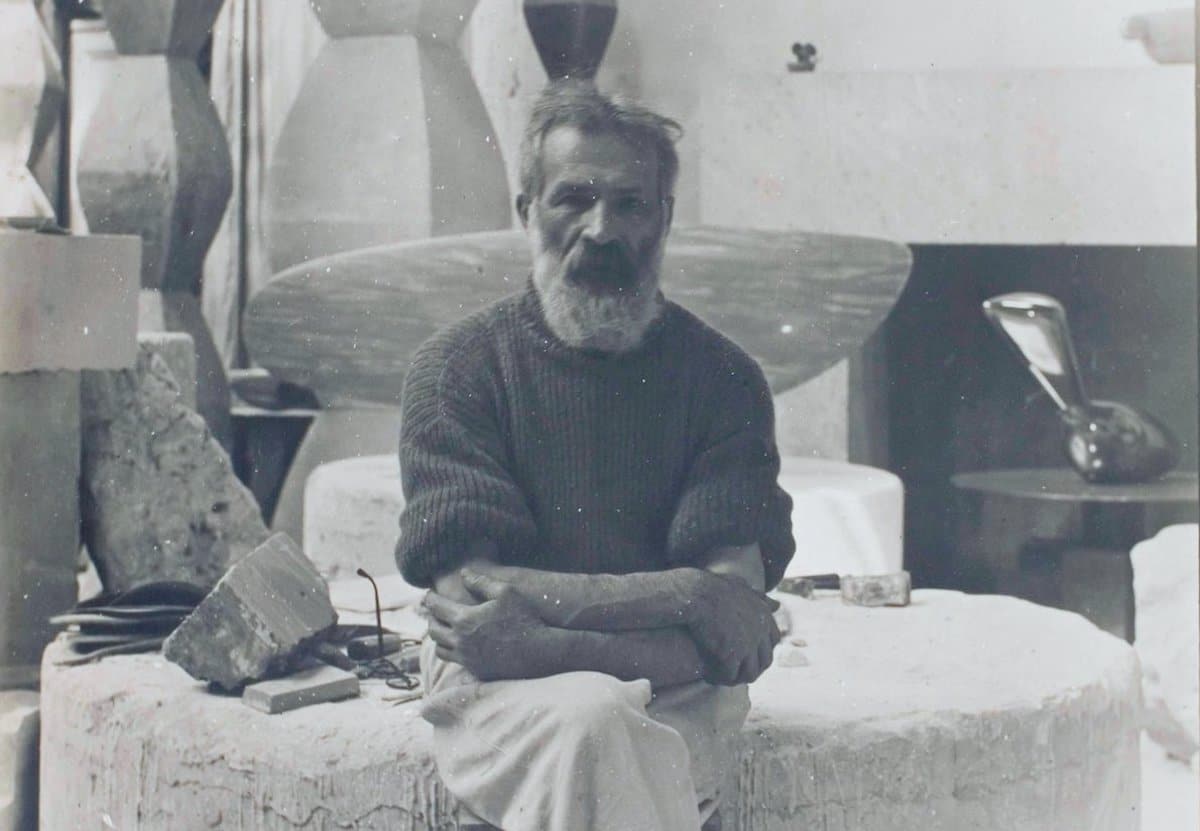
Pace Gallery has announced its global representation of the Constantin Brancusi Estate. This development positions one of the most significant bodies of work in the history of modern sculpture within the commercial framework of one of the world’s leading galleries. The announcement arrived ahead of a bronze sculpture by the Romanian sculptor, which brought in $107.6 million at Christie’s last night. It came from the S.I. Newhouse collection, making this one of the most consequential estate relationships in the contemporary art market.
Brancusi, born in Romania in 1876 and based in Paris for the greater part of his working life, died in 1957, leaving behind a body of work that fundamentally altered the course of twentieth-century sculpture. His influence extends from his immediate contemporaries in the School of Paris through to the Minimalists of the 1960s and beyond, and it is difficult to identify a serious sculptor working in the decades after his death who does not carry some trace of his work. That Pace should seek to represent his estate is a statement of ambition consistent with the gallery’s broader positioning in the upper reaches of the modern and contemporary art market.
Brancusi arrived in Paris at a moment when Auguste Rodin’s fluid, theatrical figuration represented the dominant model for serious sculpture, and he proceeded, with remarkable deliberateness, to dismantle that model entirely. Where Rodin worked through accumulated surface and emotional complexity, Brancusi moved in precisely the opposite direction, stripping his subjects to their essential geometric forms in pursuit of what he described as the cosmic essence of matter.
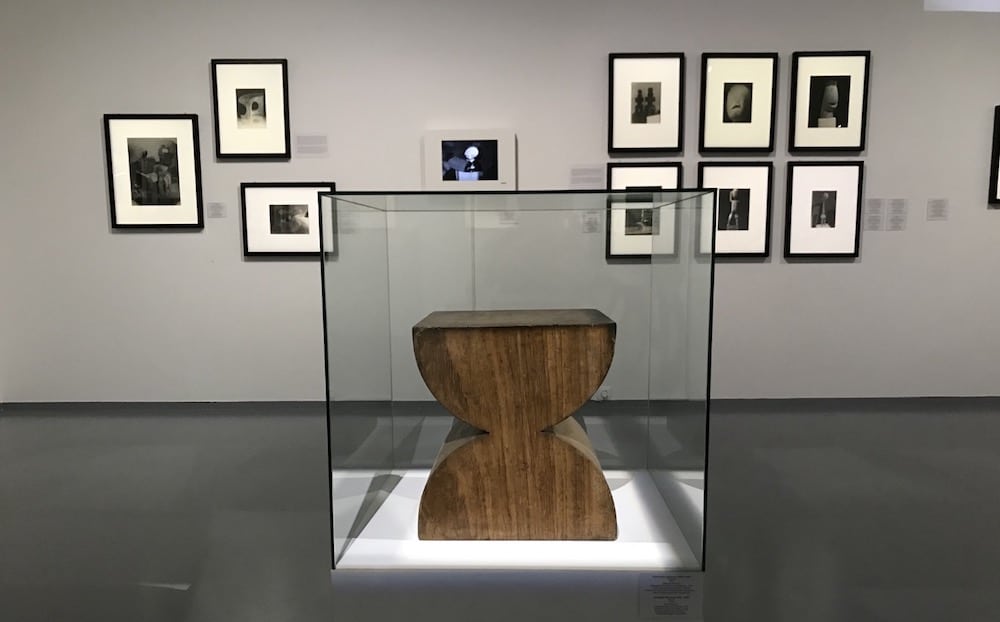
Constantin Brancusi Estate Photo P C Robinson © Artlyst 2026
He rejected the label of abstraction, maintaining that his sculptures were more realistic than conventional figuration because they captured a subject’s inner reality rather than its superficial appearance. It is a philosophical position that remains provocative and genuinely difficult to argue with when you stand in front of the work.
His methods were as distinctive as his formal ambitions. Brancusi carved directly into wood, stone and marble rather than producing models to be realised by assistants, a practice he maintained throughout his career as both an aesthetic and an ethical commitment. The direct carving tradition allowed the intrinsic qualities of each material to participate in determining the final form, and it gave his works a sense of material necessity that cast or modelled sculpture rarely achieves. His treatment of pedestals was equally particular. Refusing to regard the base as a neutral support, he designed and carved his own, treating it as an extension of the sculpture itself and drawing on Romanian folk architecture for its formal vocabulary.
The surfaces he achieved through sustained polishing and filing have become among the most recognisable qualities of his work. His polished bronzes interact with surrounding light in ways that make them appear almost weightless, their sleek, reflective finishes transforming the material density of bronze into something that seems to dematerialise as you move around it.
Among his most celebrated works, The Kiss, from 1907 to 1908, stands as one of his earliest mature statements, with its two interlocking figures remaining monolithic with the limestone block from which they are carved, in deliberate and pointed contrast to Rodin’s treatment of the same subject. The Bird in Space series, produced in marble and bronze from 1923 to 1940, eliminated wings and feathers to evoke the pure sensation and mathematical trajectory of flight. A customs dispute over one of these works in 1927, when American authorities declined to classify it as art and attempted to levy an import tariff, led to a landmark court ruling that legally defined abstraction as a valid artistic category. The case remains one of the more remarkable intersections of legal and art historical argument in the twentieth century.
Sleeping Muse from 1910, with its isolated ovoid head and barely articulated features, captures a state of serenity that approaches the absolute, a work in which the reduction of the human form has reached a point where further simplification would tip into pure geometry. The Târgu Jiu Monumental Ensemble in Romania, completed in 1935 as a memorial to those who died in the First World War, extends its formal concerns into public space on a monumental scale. The Endless Column, with its stacked, repeating rhomboidal modules ascending toward the sky, anticipates the serial structures of Minimalism by several decades and remains one of the most formally radical works of outdoor sculpture produced in the twentieth century.
Pace’s representation of the estate places all of this within a commercial and curatorial framework that will shape how Brancusi’s work enters the market in the years ahead. With a potential $100 million auction sale on the horizon, the financial stakes are considerable. The art historical stakes, as they have always been with Brancusi, are considerably higher.
Pace Stated in a press release:
Pace Gallery Welcoming the Constantin Brancusi Estate
We are honoured to announce our global representation of the Constantin Brancusi Estate. Regarded as one of the most important figures of 20th-century sculpture and a pioneer of Modernism, Brancusi is known for his rigorous inquiries into the material and conceptual possibilities of elemental forms in space. Working in a series of concentrated works across decades of his career, Brancusi created iconic, impactful sculptures that have inspired generations of artists, from his contemporaries in the School of Paris to the Minimalists and beyond.