
A new exhibition of James McNeill Whistler at Tate Britain, the largest and most comprehensive survey of the artist in a generation, spans 150 works and largely succeeds in bringing together some of his most seminal works.
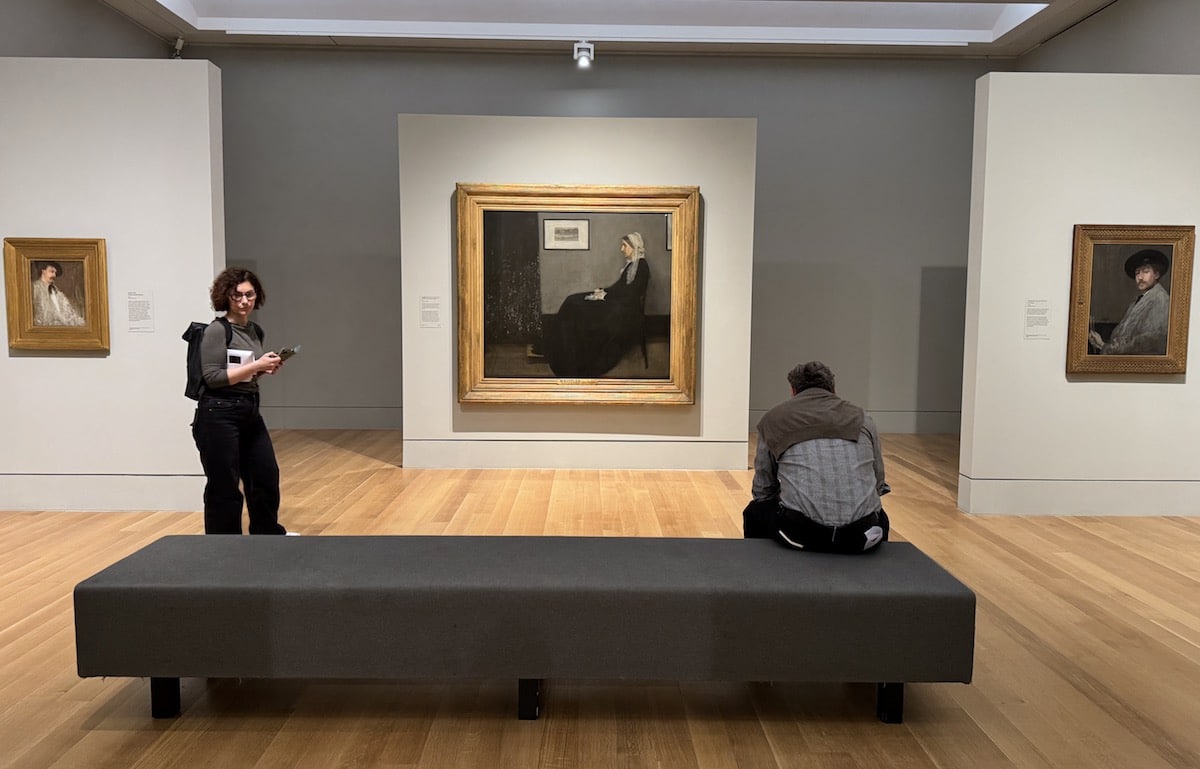
Arrangement in Grey and Black No. 1, the Portrait of his Mother that became one of the most recognised paintings in the world, has for years overshadowed Whistler’s other output, reducing a genuinely radical and restlessly experimental artist to a single gesture of respectful piety.
The exhibition opens in a room conceived as a tribute to Whistler’s studio. The decision is both practically effective and conceptually apt. Four major self-portraits spanning his career are brought together here, including The Artist in His Studio from 1865 to 1866, which depicts him surrounded by his own collections of East Asian ceramics, Japanese prints, and artist-designed furniture, as well as his easel, palette, and brushes. The effect is to establish Whistler not as a historical figure to be approached reverentially but as a working artist whose environment shaped his ideas and whose ideas shaped his environment.
The exhibition moves chronologically through a career that was genuinely global in its reach. For the first time, Whistler’s teenage years are explored through the studies he made at the Imperial Academy of Arts in St Petersburg and at West Point, the United States Military Academy, and his earliest notebooks are displayed publicly here. These are not merely biographical curiosities. They establish the cosmopolitan foundation of a practice that would draw on sources ranging from Japanese printmaking to Spanish portraiture to the emerging Impressionism of Paris in the 1860s, where Whistler worked alongside Edgar Degas and developed a shared interest in working-class subjects and spaces that would run through both their practices for years.
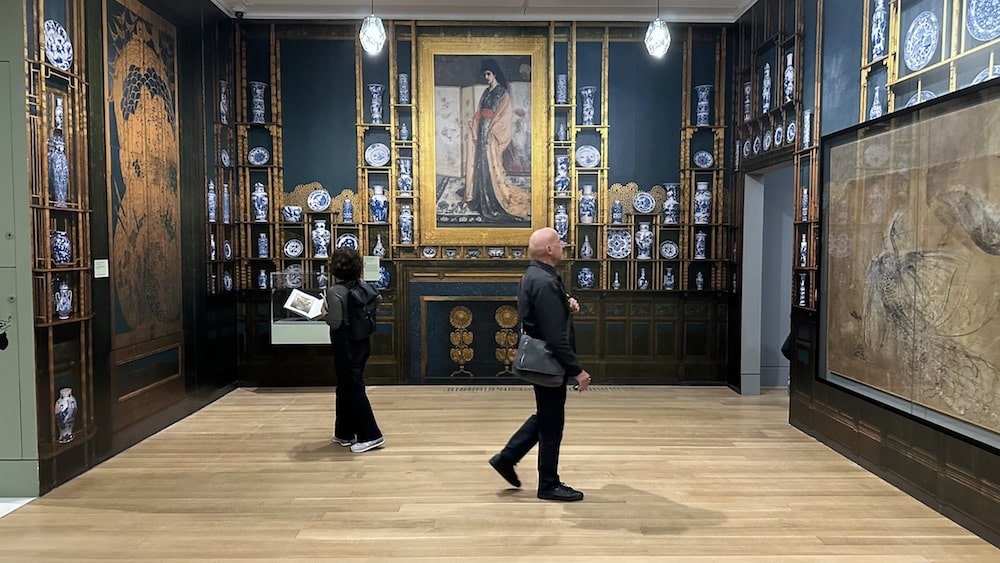
The Peacock Room, Tate Britain Photo: Artlyst © 2026
The exhibition has reproduced in photographs Harmony in Blue and Gold, more commonly known simply as The Peacock Room, which stands as one of the finest surviving interiors of the nineteenth century.
Conceived by James McNeill Whistler in collaboration with the architect Thomas Jeckyll, the room now resides in the Freer Gallery of Art in Washington, D.C., part of the Smithsonian National Museum of Asian Art. Completed between 1876 and 1877, it remains a defining expression of the Aesthetic Movement and one of the clearest manifestations of the Anglo-Japanese style that swept through late Victorian Britain.
Created as the dining room of shipping magnate Frederick Richards Leyland at his London home on Prince’s Gate in Kensington, the interior began as an ambitious decorative commission overseen by the architect Richard Norman Shaw. Shaw delegated the room to Jeckyll, whose fascination with Japanese design informed every aspect of the scheme. He intended to create a kind of porcelain chamber, a setting in which Leyland’s celebrated collection of Chinese blue-and-white ceramics could be displayed almost theatrically.
Whistler later transformed the room entirely. Working in luminous blue-green tones heightened with metallic gold leaf, he submerged the architecture, shelving and surfaces into a total work of art. The result is an immersive environment where painting, ornament and collection dissolve into one another. Even now, The Peacock Room retains the strange intensity of something simultaneously opulent and quietly obsessive.
The etchings of modern life from this period are among the exhibition’s most revealing material, reassessed here alongside his earliest oil paintings and the self-portrait Whistler Smoking from 1856 to 1860, unseen since his death. They show an artist already committed to the direct observation of contemporary life and already possessed of a technical fluency that his academic training had given him without constraining him.
His Portrait of his father, Dr William McNeill Whistler, from 1871 to 1873. Seen together, his Mother’s Portrait and a self-portrait read as a statement of a minimal new pictorial style and a meditation on family and identity, the deliberate austerity of the palette and composition operating simultaneously as an aesthetic programme and an emotional restraint. The loan of the Mother from France for this exhibition is a significant gesture, and the work repays the close attention that the hanging encourages.
The Nocturnes occupy their own room and represent the exhibition’s most atmospheric achievement. The largest assembly of these paintings in over thirty years spans the first, painted in Chile (Nocturne in Blue and Gold: Valparaiso from 1865 to 1874), and the last, painted in Venice (Nocturne: Blue and Gold, St Mark’s from 1880). Between them, the Thames at night is transformed by Whistler’s handling into something that anticipates abstraction by several decades, the factories, pleasure gardens, and reflected fireworks of industrial London dissolving into fields of tone and colour that carry the idea of landscape while abandoning its conventional requirements. The exhibition gives a clear account of why they were so disturbing to contemporary taste and why that was a flash point. One missing link was Nocturne in Black and Gold – The Falling Rocket, painted around 1875 and now held by the Detroit Institute of Arts. It remains the defining image of late nineteenth-century modernity. central to Whistler’s infamous libel case against the critic John Ruskin, who accused the artist of “flinging a pot of paint in the public’s face.” The lawsuit, brought in 1878, has since entered art-historical mythology, crystallising a wider argument about artistic freedom, value, and the role of criticism in the modern age.
The final rooms address the last two decades of his career, spent moving between Britain, Europe and North Africa in an increasingly experimental engagement with every medium available to him. The full-length portraits of this period, repeatedly reworked until they became almost apparitional, from Portrait of Lady Archibald Campbell to the Rembrandt-inspired Gold and Brown: Self Portrait, show an artist who never stopped pushing his materials toward the edge of what they could carry.
Whistler argued that nature is very rarely right and that the true artist invents their own harmony of colour and line. This exhibition demonstrates that he spent his entire career living by that conviction. Tate Britain has given him the space and the seriousness the work has always deserved. – Paul Carter Robinson 2026
Top Photo Sara Faith © Artlyst 2026
James McNeill Whistler is at Tate Britain. Organised with the Van Gogh Museum and the Mesdag Collection. Until 27 September 2026