When I first saw Anish Kapoor’s work in the 1980s, piles of Kleinian blue and saffron coloured pigments piled on the gallery floor, it felt as if I was seeing something different and new, a melding of traditional India (the piles of pigment evoked spice markets) with European conceptualism. This was sculpture as poetry, brimming with metaphorical and transformative possibilities. The richly hued, evocative works were both delicate and monumental. At any moment, the pigment might be blown away. Yet the intensity of the pure colour held the space in which it was placed. At the height of the YBAs’ popularity, here was an artist not only concerned with colour and form but with creating sculptures that opened up spatial, spiritual, and psychological possibilities. Anyone with a smattering of art history would know that in Renaissance painting, blue suggests the celestial, and Kapoor’s use of it was a signpost in that direction. His work also explored a number of binaries: his Indian background and his life as an artist in Britain, sensuality and a rigorous formalism, the pull between minimalism, conceptualism, and a new romanticism. Hovering in a liminal space between presence and absence, it seemed to suggest an inherent instability and fluidity that hinted at the possibilities of transformation and the sublime. The sublime, as the Romantics understood it, is awe that embodies both what is inspiring and terrible. As the poet Rainer Maria Rilke wrote in the Duino Elegies, a sentiment Kapoor would, undoubtedly, subscribe to: “For beauty is nothing/but the beginning of terror, which we are still just able to endure.”
In this new show at the Hayward (the first public gallery to host a major survey of his work in 1998), Kapoor again confronts an awareness of spiritual and bodily boundaries. Employing a range of materials, he explores what the French philosopher Simone Weil referred to as ‘Gravity and Grace’: the tension between human limitation and spiritual freedom. For, according to Weil, to experience grace, we must first fight ‘gravity’ ─ our instinctual natures, our egos ─ choosing to endure emptiness and the void into which, only then, can self-knowledge and creativity flow.
Anish Kapoor, Hayward Gallery ©Artlyst 2026
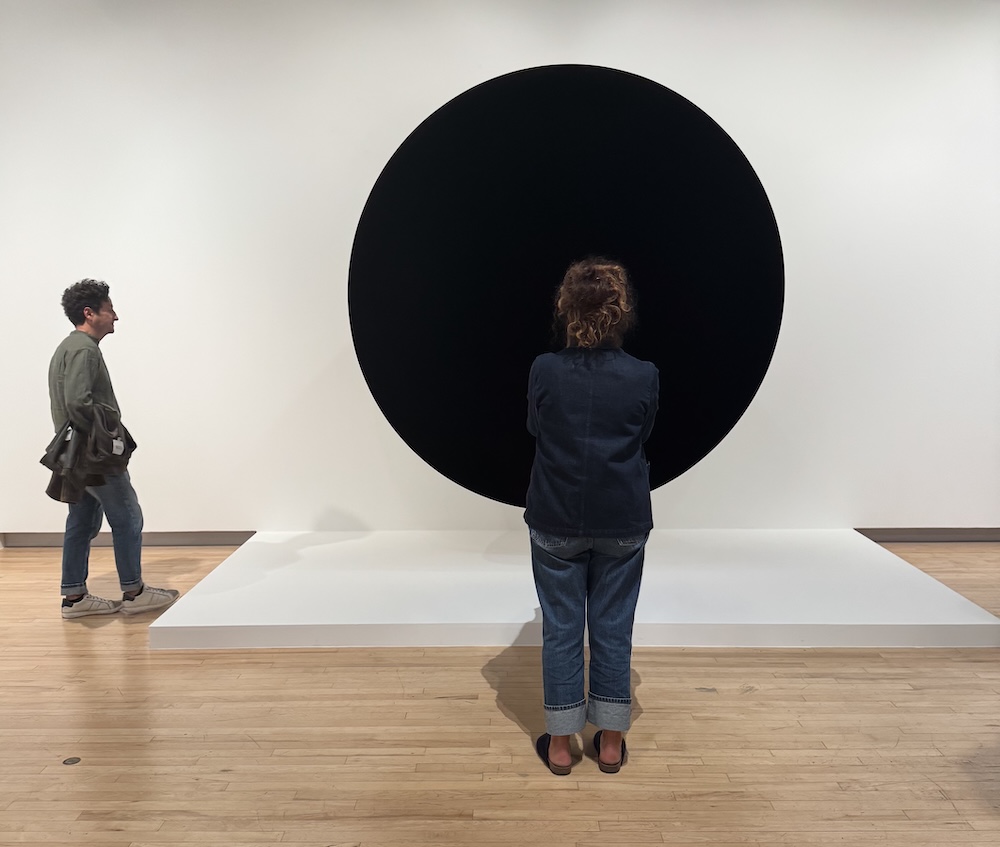
The first gallery deals with illusion and transformation. In a series of austerely minimal works, we encounter black shapes and spaces that ambiguously suggest depth, as well as flat surfaces. Unable to trust our eyes, they read like portals into another dimension, suggesting an enigmatic, possibly more spiritual world beyond. Their dark density has the same effect on the viewer as standing in front of one of Rothko’s deep maroon/black paintings. We are absorbed, sucked into the space, for the black is very black. The Vantablack used is a nanotechnology-based substance that absorbs 99% of visible light. What looks like a stone sarcophagus has a black rectangular centre that appears to expand into an endless, deep void. Kapoor seems to be asking – ‘how can we imagine nothingness, a state of non-being?’ In front of these works, I kept thinking of other artists: Malevich’s iconic black square and the Italian artist Fontana’s ripped and slashed canvases, which also seem to lead into a space beyond. Kapoor, undoubtedly, was aware of these references in these works he calls ‘non-objects’.
Sacrifice and ritual have long been an element in his work. He caused huffs and puffs of disapproval with his 2009 show at the RA, when a cannon belched red spatters of pigment, wax, and Vaseline onto the Academy’s walls, making the classical proportions resemble the site of the last Tsar’s bloody execution. In the Hayward, we are confronted by a lumpy, gory, red work that hangs from the ceiling like a flayed carcass in the second gallery. Walking beneath it feels like Jonah must have felt trapped in the guts of the whale. The word ‘visceral’ has been somewhat overused in describing Kapoor’s work, but it’s hard to avoid here.
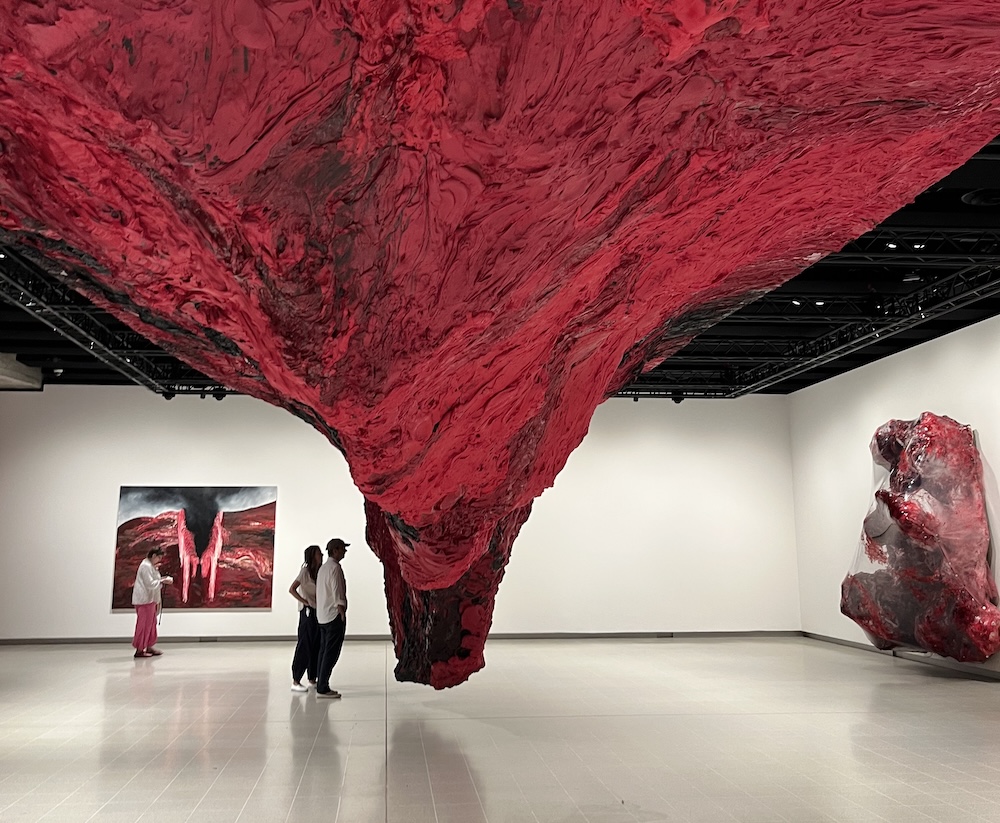
Anish Kapoor, Mount Moriah at the Gate of the Ghetto
In fact, the title is Mount Moriah at the Gate of the Ghetto. In the Old Testament, Mount Moriah is the place where Abraham prepared to sacrifice his son, Isaac, to God. Only for Isaac to be saved by divine intervention when the Almighty provided Abraham with a convenient ram. For me, this adds another dimension to Kapoor’s work that is not often talked about: his Jewishness. His mother was an Iraqi Jew, married to a Punjabi Hindu. There is an implied reference, here, to the slaughter that befell European Jewish ghettos in the Second World War, just as his bloody, rumbling 130 ton train in his RA show conjured up the ghost of the transports to Auschwitz. Of course, these works are not specifically about these events, but slaughter and cruelty are themes that Kapoor returns to, just as much as a quest for meaning. “We are,” he says, religious beings, […] we carry within ourselves the mystery, the masked feat that sits behind the ritual act ─ the fear of death”. The only painting in this gallery is The Dark. Kapoor is no painter, but the mountainous shape could be read as Vesuvius or Etna (as civilisation?) erupting, even the body of some great beast being cleaved along its breastbone to reveal its dark core.
In the upper gallery, there is more blood and plenty of guts. Rembrandt’s or Soutine’s bloody sides of meat come to mind, even Titian’s Flayed Marsyas. Though, for me, these works looked a little too much like something from Madame Tussauds’ Chamber of Horrors or props from a sci-fi thriller.
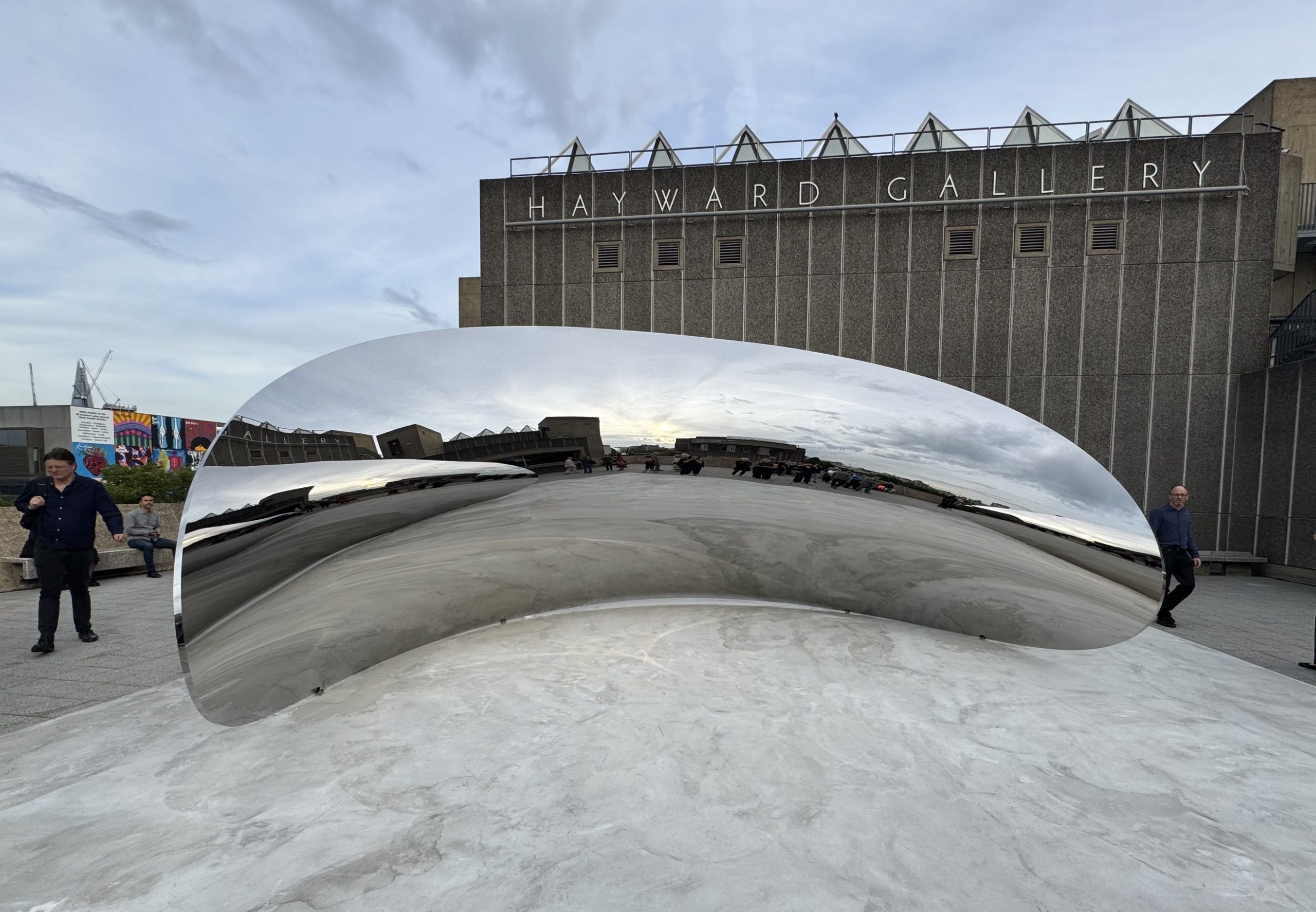
Throughout the exhibition, there are some beautiful reflective works ─ Kapoor at his signature best ─ such as the indented disc, Iris, made in 1998. Standing in front of it, the world is turned upside down. As with those fairground distorting mirrors, nothing is what it seems. It’s the same reflective trick he used on his sensational Cloud Gate (affectionately known as the Bean), which is in Chicago’s Millennium Park and reflects the sky and the magical Chicago skyline. Less, with Kapoor, is so often more.
Anish Kapoor, Hayward Gallery, 16 June – 18 October 2026
Visit Here
Sue Hubbard is an award-winning poet, novelist and freelance critic. Her fourth novel Flatlands, from Pushkin Press can be bought here. Her latest poetry collection God’s Little Artist: poems on the life of Gwen John availabe here