
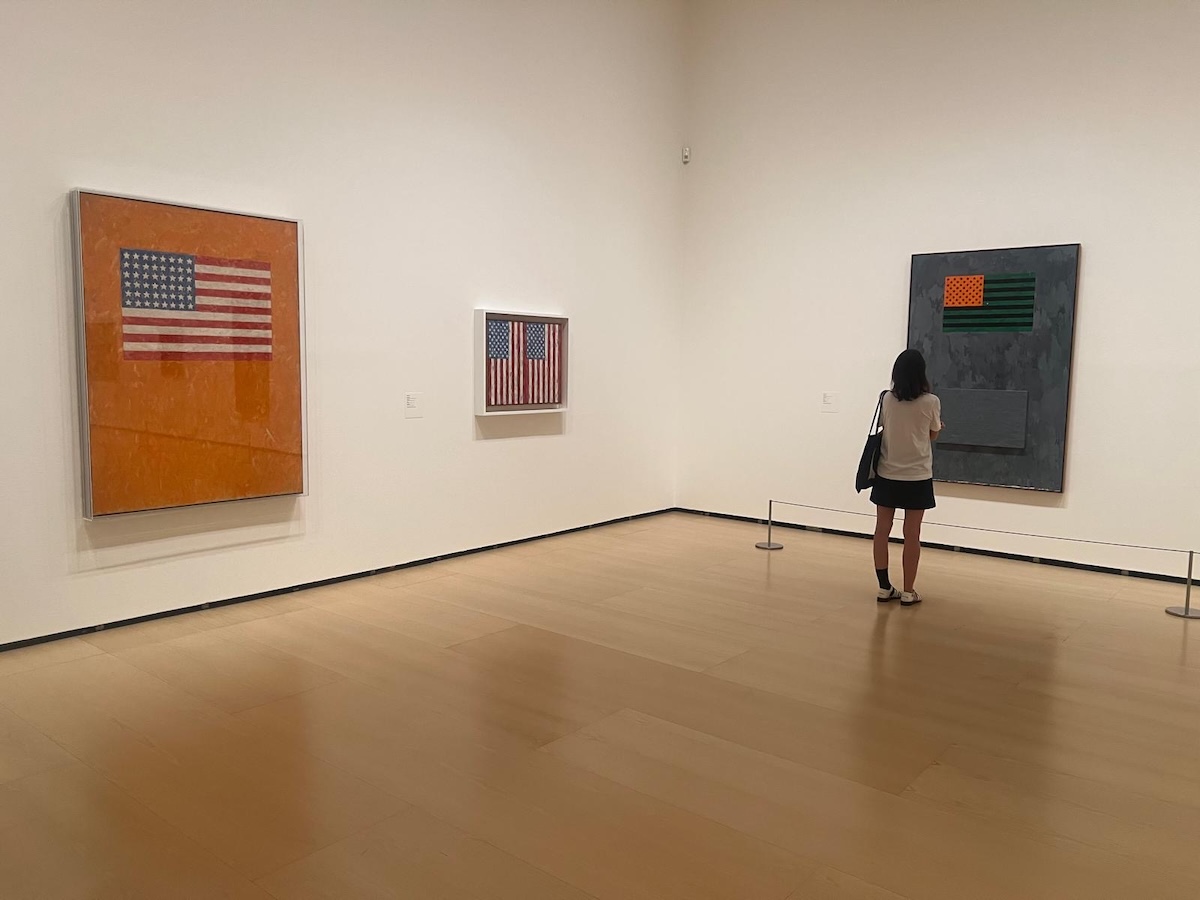
“I dreamt one night I painted the flag of America. The next day I did it.” With the imminent anniversary marking 250 years since the signing of the Declaration of Independence, Jasper Johns: Night Driver opens at the Guggenheim, an American institution, in Bilbao, the cultural capital of the Autonomous Community of the Basque Country.
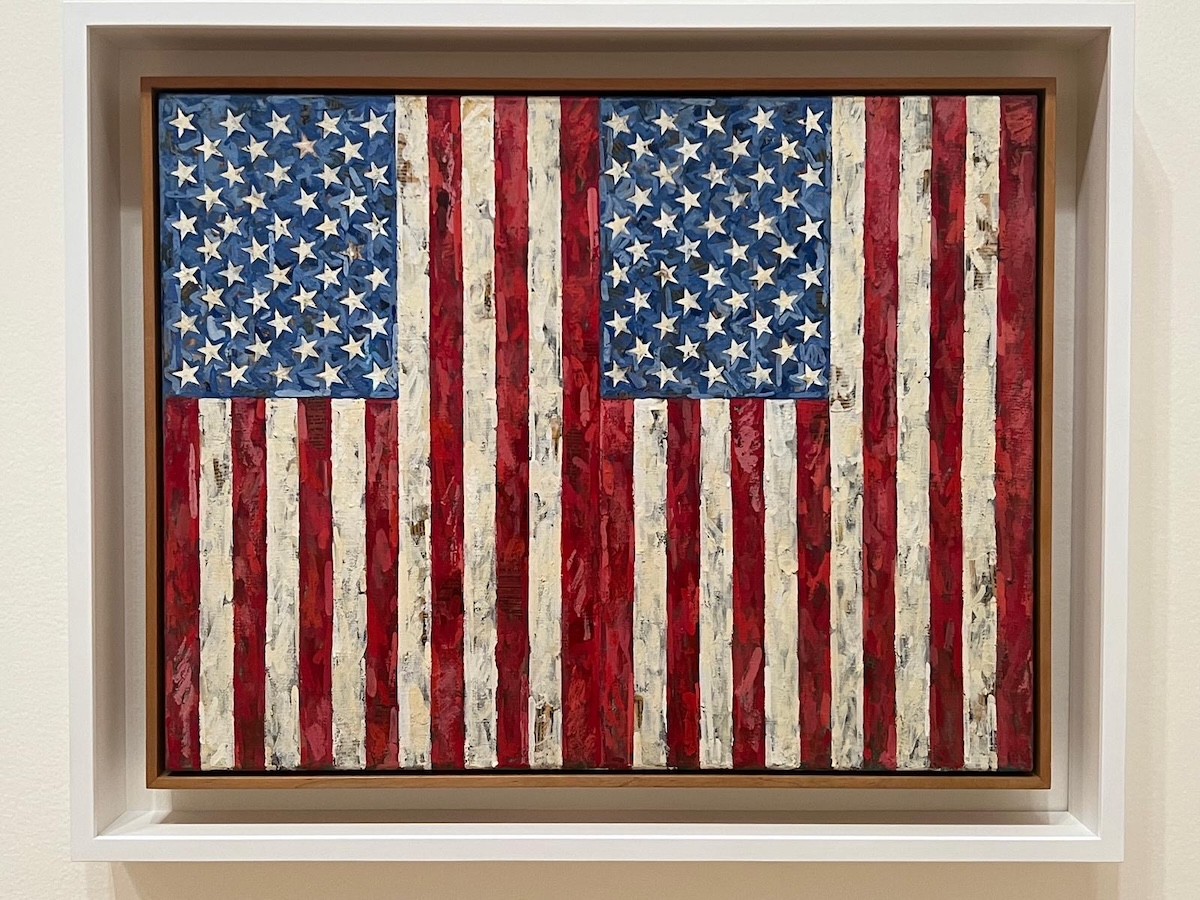
Jasper Johns Flags
The familiar flags, targets, letters, and numbers feature in the first gallery of early works, setting the scene as recurring motifs for this journey through over seventy years of Jasper Johns’s work. Almost 140 works are displayed, including paintings, stage designs, and sculpture, while works on paper are on show in two rooms nearby.
Painting with Two Balls (1960) is one of Jasper Johns’s most well-known works – apparently an ironic comment on the intensity of masculine emotions that characterise Abstract Expressionist painters. It seems like there’s a crossing of a bridge here from AbEx towards some form of Pop Art. The painting’s multi-layered surface of encaustic and collage has the two small sculptural spheres placed in a gap between and above two panels and holding up the top panel, resembling a cut in a Lucio Fontana painting. The title is written along the bottom of the lowest panel. The three canvas panels are covered in abstract patches, almost scribbles of colour, predominantly red, blue and yellow. The spheres peer out of the slit like a pair of eyes glaring at the viewer, daring them to challenge.
In an essay by Colm Tóibín in the accompanying catalogue, he argues that the viewer could be reading more into the paintings than was intended, or is that the point – the viewer sees what they want to see, or interprets that way. Johns is quoted as saying that Abstract Expressionism was “a primal expression of feeling – this was not what I wanted my work to be like. Not an expression of my feeling but something else.” But what is that something else? Perhaps he’s synthesising things that don’t normally go together, blending and combining different things to see if they work. Trying to make something coherent from it, make sense of the chaos. “Take an object. Do something to it. Do something else to it. [Repeat].”
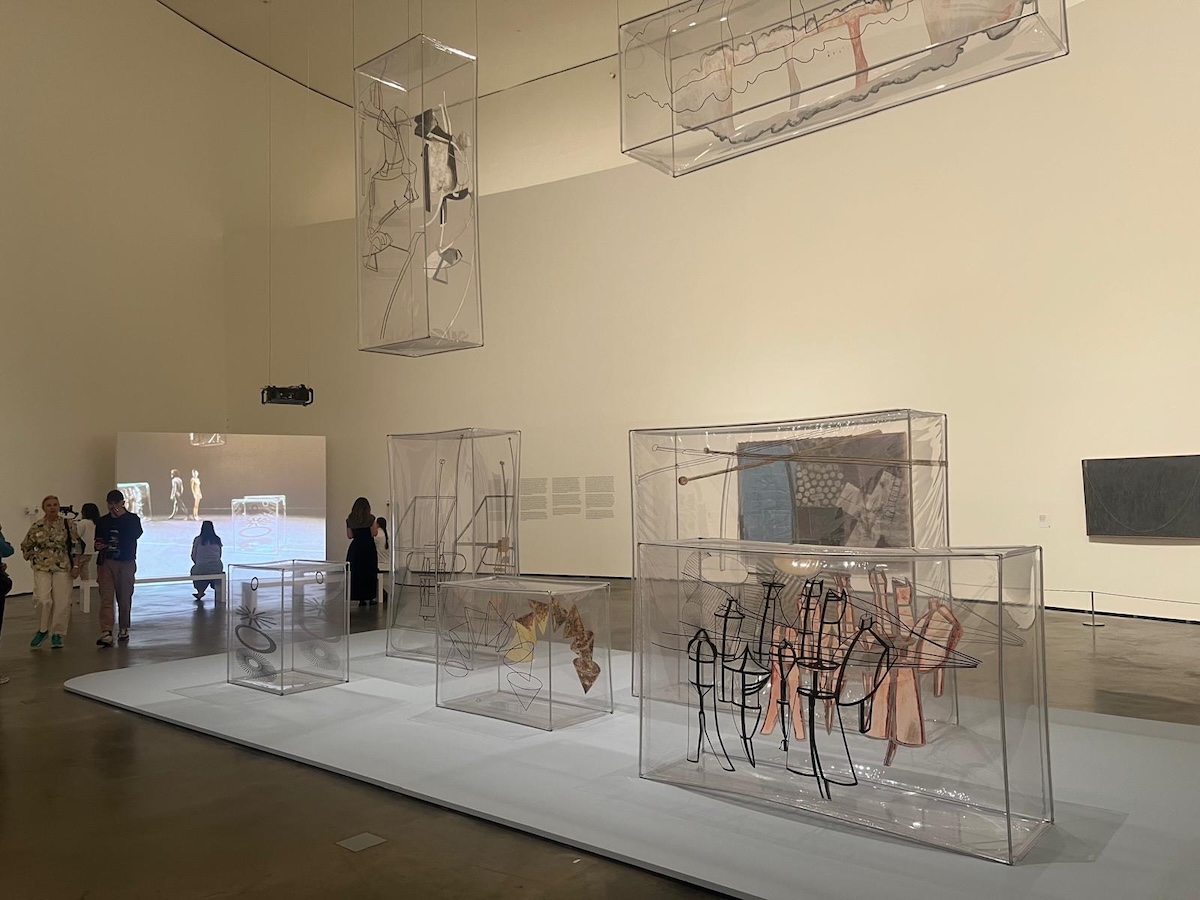
Jasper Johns: Night Driver, Guggenheim Bilbao, installation view
There’s a large gallery with a screen at one end showing a collaboration between Johns and choreographer Merce Cunningham, called Walkaround Time (1973). Johns designed the set and costumes for this after The Large Glass by Duchamp. The objects on the stage are shown in the centre of the room, some hanging from the high ceiling. During his relationship with Robert Rauschenberg, Johns had met Duchamp and also John Cage, and continued to be influenced and inspired by both.
But it’s the two rooms in a separate area, away from the main exhibition galleries, displaying works on paper, that captivated me most. Prints and drawings are a fundamental part of Johns’s work; the themes he explores in them are often reinterpretations of his paintings and sculptures, always on repeat. Using pen and ink, watercolour, charcoal, pencil, pastel, pigment, and collage, Johns also occasionally inserts objects into these works on paper. One work, Tantric Detail (1980), shows the intricate cross-hatching patterns from the colourful paintings we’ve seen in the previous galleries, yet here, in monochrome, they add weight and a certain sombre feeling. Here again in the centre are a pair of testicles as in Painting with Two Balls, though they appear much more literally, almost Guston-esque and cartoonish. Below is a skull, again a recurring image throughout his work, a memento mori of sorts.
Along one wall in these rooms is the series Foirades/Fizzles (1976), a collaboration with Samuel Beckett, the writer known for his repetitive dialogue and long pauses of silence. Beckett had studied works in the National Gallery of Ireland in Dublin and continued to find inspiration through art, becoming a friend of Duchamp in Paris. This collection of short prose texts by Beckett, which Johns accompanied with a series of prints, doesn’t necessarily seem connected.
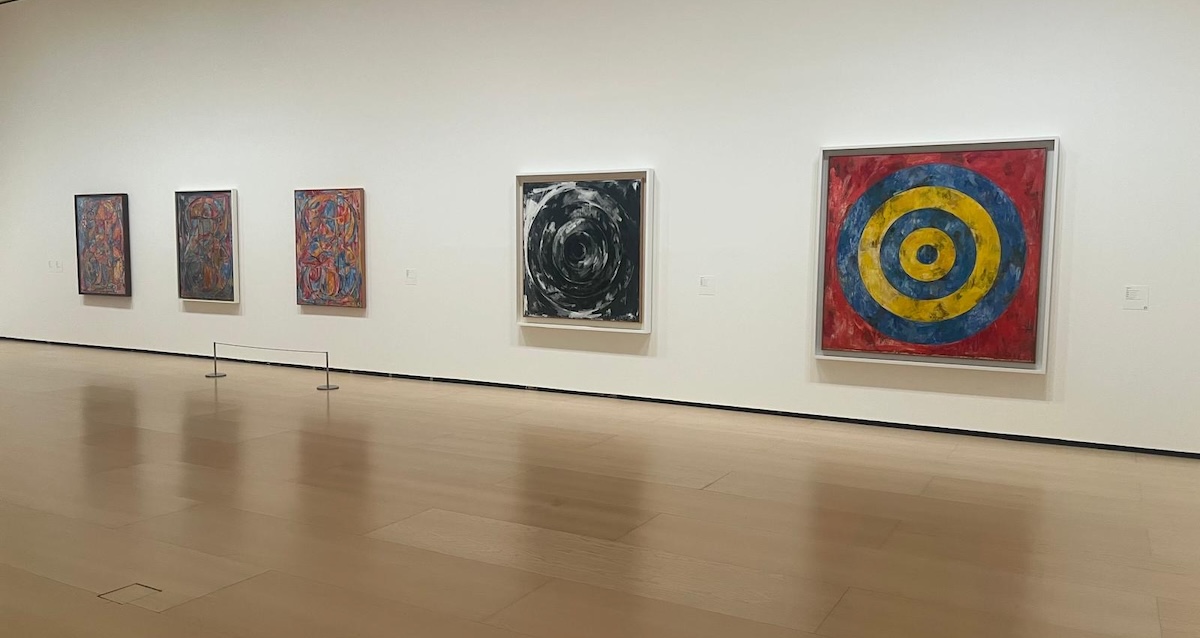
Jasper Johns, Guggenheim Bilbao, installation view
“For an instant I see the sky, the different skies, then they turn to faces, agonies, loves, the different loves, happiness too, yes, there was that too, unhappily. Moments of life, of mine too, among others, no denying, all said and done. Happiness, what happiness, but what deaths, what loves, I knew at the time, it was too late then. Ah, to love at your last and see them at theirs, the last minute loved ones, and be happy, why ah, uncalled for. No, but now, now, simply stay still, standing before a window, one hand on the wall, the other clutching your shirt, and see the sky, a long gaze, but no, gasps and spasms, a childhood sea, other skies, another body.”
Adjacent to this passage is a white outline or form on a grey background, a black spatter and drip encroaching on the white and the word TORSO in stencilled letters along the bottom of the print.
As I left these two rooms and reflected on the exhibition as a whole, what came to me was that Johns’s work is an expression of memory – love, loss, mortality, and finally grief. But they also reflect a pause, a space, the in-between, what’s not there, the silence. When Samuel Beckett won the Nobel Prize in Literature in 1969, he announced that he wouldn’t take part in any TV interviews, so there’s an infamous 3-minute film of him not speaking. Johns also collaborated with John Cage, renowned for his 1952 ‘silent’ piece 4’33”, Four Minutes and Thirty-Three Seconds, with instructions to the orchestra not to play their instruments, though there is never silence. Looking at a painting or watching a silent clip, you hear whatever you want to in your head. Likewise, in the concert hall, other peripheral sounds interrupt and are emphasised by the quiet of the orchestra. There’s a sense of time passing.
Jasper Johns: Night Driver, Guggenheim Bilbao, 29 May – 12 October 2026
Visit Here