
French police discovered a stolen Picasso during a drug trafficking raid in Champigny-sur-Marne, a suburb southeast of Paris, on 15 June. Officers from the Brigade des Stupéfiants, the French anti-narcotics unit, were searching a property for connections to a suspected drug network when they found cannabis resin, thousands of euros in cash, luxury clothing and a painting by Pablo Picasso.
Authorities have not named the work or released images of it, but have confirmed it is authentic and belongs to a series of portraits of Marie-Thérèse Walter, Picasso’s partner and a recurring subject of his work from the late 1920s and 1930s. The painting is reported to belong to a woman from Singapore. Its estimated value is between 12 and 15 million euros. The theft had not previously been made public.
Six people were arrested in connection with the investigation. Among them was a 37-year-old security guard employed by a Paris company that stores valuable art and luxury goods. He admitted to taking the painting from the storage facility. His stated reason was to expose weaknesses in the company’s security arrangements. Whether that explanation will carry any legal weight remains to be seen. The painting had not been reported stolen. It belongs to a Singaporean woman who had it stored in a private art depot in Paris. He admitted taking the Picasso and told police he did it to expose security flaws at his employer. He was charged with theft and drug involvement after officers also found 17 kilograms of cannabis, €200,000 worth of designer clothing, and €7,000 in cash across several properties.
Walter was the inspiration for some of Picasso’s most significant portraits. Works from that period have reached considerable prices at auction. In 2018, Woman in Beret and Checkered Dress, another portrait of Walter painted in 1937, sold for just under £50 million at Sotheby’s in London. The market for this particular strand of Picasso’s output has been consistently strong, which makes works from the series an obvious target.
Picasso: The Most Stolen Artist in History
Pablo Picasso has the distinction of being both one of the most celebrated artists of the twentieth century and the most stolen. More than 1,140 works attributed to him have been reported stolen, missing or subject to ownership disputes, according to records maintained by the Art Loss Register. No other artist comes near that number.
The reasons are not difficult to identify. Picasso’s output was extraordinary in its volume, spanning paintings, drawings, prints, ceramics and sculpture across eight decades of sustained production. His name carries enduring commercial weight. The combination of quantity and value makes his work an obvious target, and it has been targeted consistently across countries, decades, and categories of criminal enterprise.
Some cases have become well known. In 2010, thieves broke into the Musée d’Art Moderne de la Ville de Paris and removed five works in a single night, among them Le pigeon aux petits pois, a 1911 Cubist painting. The estimated total value of what was taken was around 100 million euros, making it among the most significant museum robberies in recent history. The works have not been recovered. In a separate case, two Picasso portraits valued at an estimated 50 million euros were stolen from the Paris home of the artist’s granddaughter. The theft was personal in a way that goes beyond the financial.
The paradox of a stolen masterpiece is well documented. A work famous enough to be worth stealing is also famous enough to be impossible to sell openly. Auction houses, dealers and institutional buyers maintain records and exercise due diligence. So works of this kind tend not to move through legitimate channels at all. Instead, they circulate within criminal networks, used as collateral or bargaining currency, exchanged privately at fractions of their actual market value. A Picasso worth millions functions in this context as a kind of portable asset, its cultural significance entirely beside the point.
Specialist police units and international investigators have recovered some works over the years. The recent discovery of a portrait of Marie-Thérèse Walter during a drug raid in a Paris suburb is one example, though the case remains unresolved and the painting has not yet been returned to its owner. Recovery is possible, but it tends to depend on luck as much as investigation: a raid conducted for unrelated reasons, an informant, a border check. Sustained, targeted recovery of stolen art is considerably harder than it looks.
Some losses are permanent. Accomplices fearing arrest have admitted to destroying stolen paintings rather than risk being found with them. Others have disposed of works in ways that left no trace. Each disappearance of this kind removes something irreplaceable, not just from the market but from the public record of what Picasso made. His archive is so vast that individual losses can seem minor in the aggregate. They are not. A stolen or destroyed work is gone in a way that no reproduction or digital record can compensate for.
More than fifty years after his death in 1973, the tally of missing Picassos continues to grow. The scale of the problem reflects something particular about how artistic value and physical vulnerability interact. The more significant the work, the greater the incentive to take it and the harder it becomes to return it safely. Picasso’s position at the top of that equation is unlikely to change.
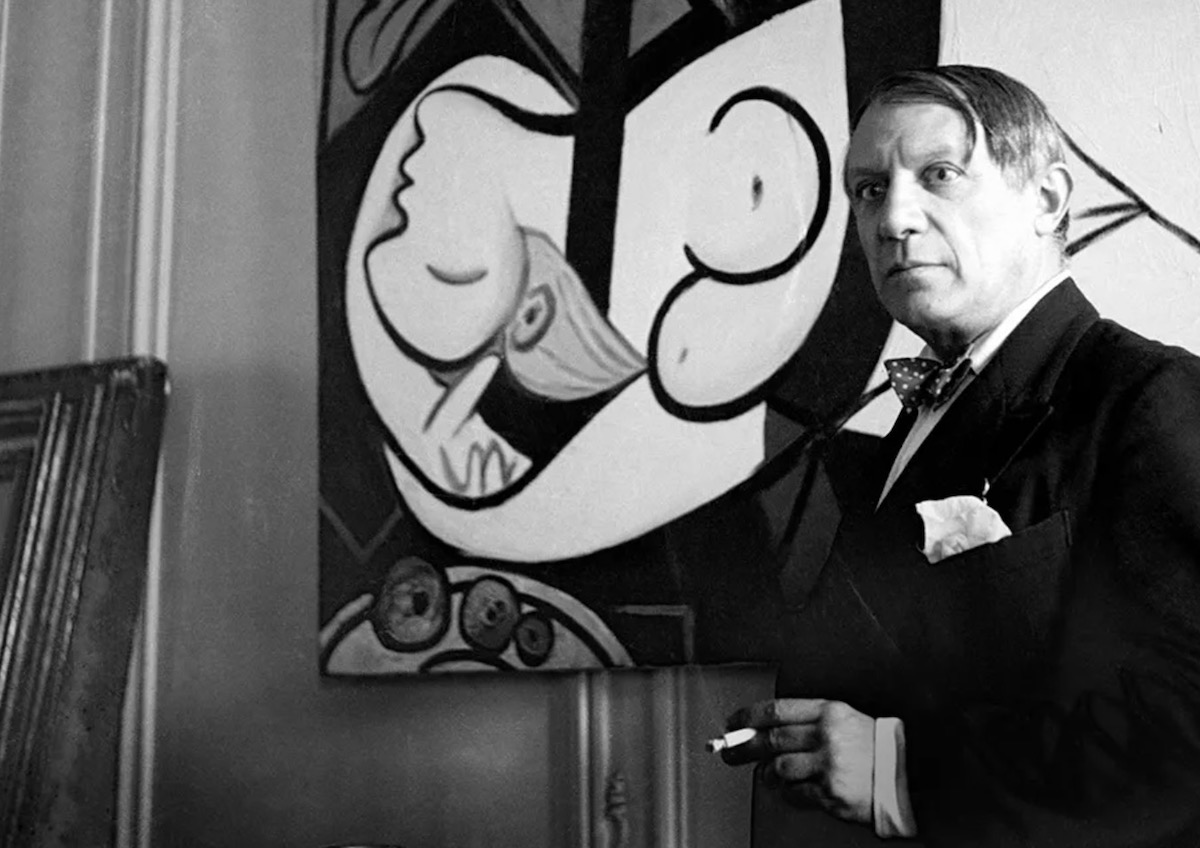
Pablo Picasso at his studio on Rue La Boétie1933 standing in front of a portrait of Marie-Thérèse Walter, © The Cecil Beaton Studio Archive at Sotheby’s