

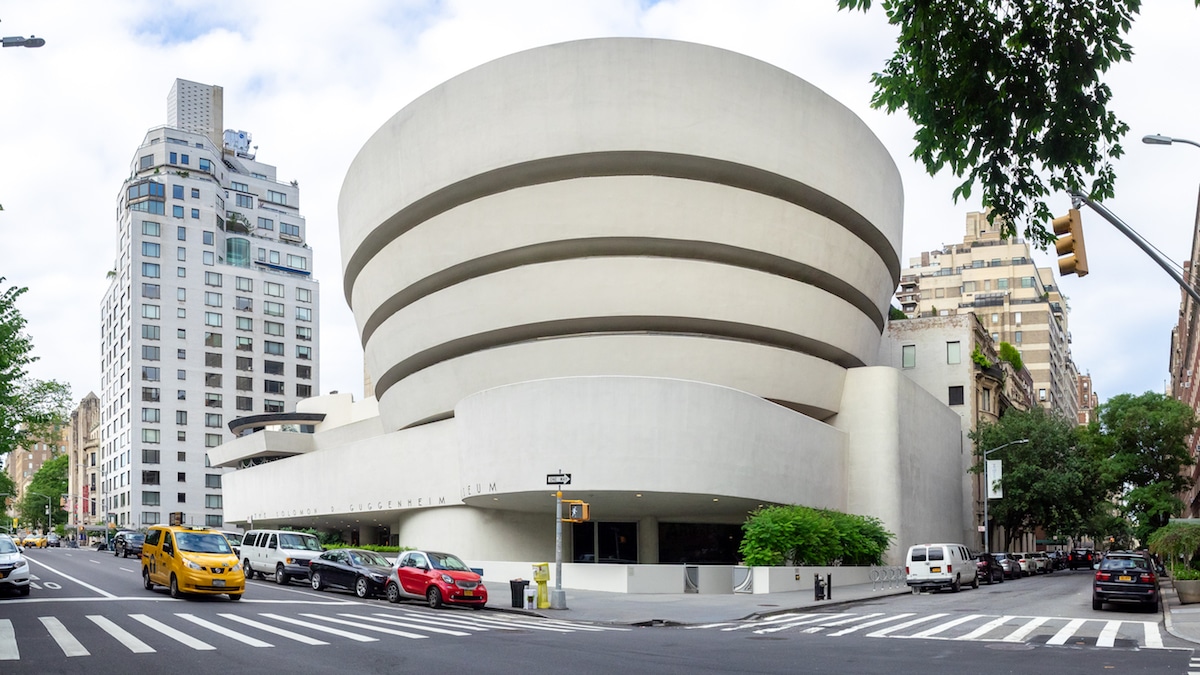
A Picasso painting stolen from the University of Pittsburgh in 1961 has resurfaced, prompting the Solomon R. Guggenheim Foundation to take legal action against its current owners. (First reported by Valentina Di Liscia in Hyperallergic)
Femme dans un fauteuil (1918), a small oil painting from Picasso’s Synthetic Cubist period, disappeared more than six decades ago while on loan to the university from the Guggenheim. The museum has now filed a lawsuit in New York seeking its return and $3.5 million in damages.
The painting was reported missing on 6 February 1961 from the Students Union building at the University of Pittsburgh. A graduate student and dormitory aide discovered that the 13.5-by-10.5-inch work had disappeared. The Guggenheim had lent it for an exhibition during the autumn semester and was due to return to the museum later that month.
Police and the FBI investigated the theft, while contemporary reports circulated widely and museums and other institutions across North America were alerted. A reward was also offered for information. Nothing came of the investigation, and the Picasso effectively vanished.
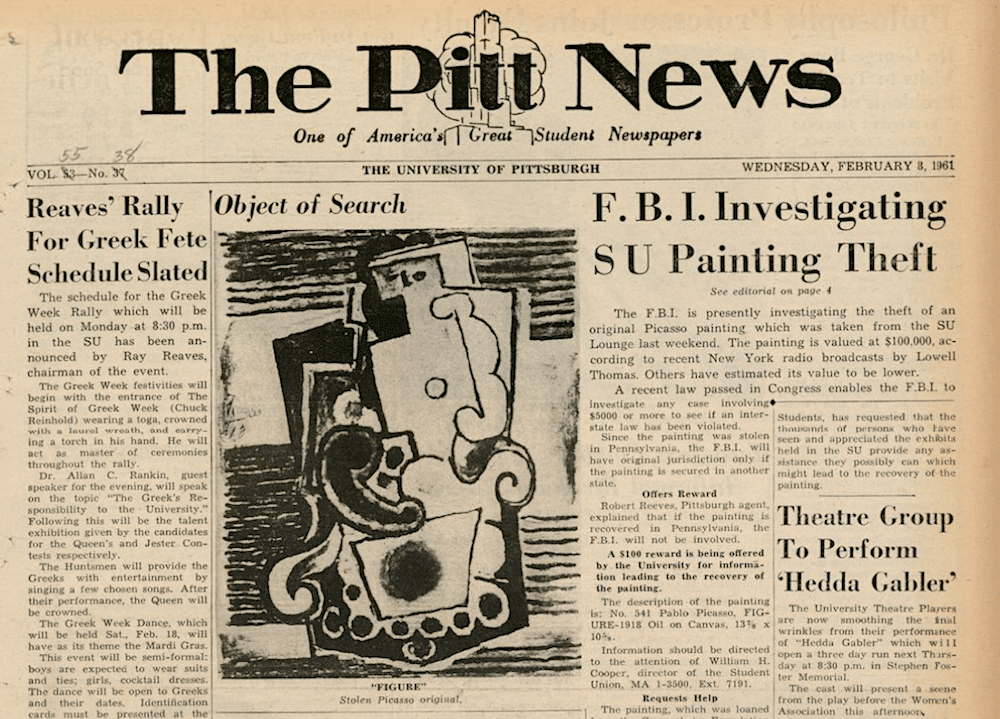
Picasso painting loaned by the Guggenheim to the University of Pittsburgh front page of the student newspaper in February 8, 1961. (image courtesy University of Pittsburgh)
Its whereabouts remained unknown until 2023, when a researcher at Christie’s encountered the work while investigating a potential private sale. The discovery was reported to the Guggenheim in July that year, more than 60 years after the theft.
The museum’s lawsuit, filed in New York State Supreme Court, names Massachusetts residents Lawrence Jay Handler and Wendy Cohen Handler as defendants. According to the court papers, the couple purchased the painting from Beadleston Fine Art, a Manhattan gallery, in 1999.
How the work reached the gallery remains unclear. The lawsuit does not establish whether the Handlers or Beadleston Fine Art knew that the painting had been stolen when it was sold. The former Fifth Avenue gallery has since closed.
The painting’s provenance, however, links it directly to the Guggenheim. Solomon R. Guggenheim, the industrialist and collector whose foundation became the basis of the museum, acquired the Picasso in 1936 from Gallery Zwemmer in London. Guggenheim is also recorded as the owner in Christian Zervos’s catalogue raisonné of Picasso’s work, published in 1949.
Picasso painted Femme dans un fauteuil in 1918 while honeymooning with his first wife, the Russian ballerina Olga Khokhlova, near Biarritz. The work belongs to a period in which Picasso was moving between Cubism and a more figurative language. However, the compact composition retains the fractured geometry associated with his earlier work.
Once the Guggenheim established that the missing painting had resurfaced, it contacted the Handlers in August 2023 and formally demanded its return. According to the court documents, that request was rejected.
The painting has subsequently remained at Christie’s while the dispute has unfolded. The Guggenheim says it attempted to resolve the matter without resorting to litigation. A museum spokesperson said that Femme dans un fauteuil had been “stolen in 1961 while on loan from the Guggenheim to a university” and that the foundation remains its rightful owner.
The museum is seeking a declaration confirming its ownership and $3.5 million in compensatory damages, excluding legal costs. The painting was valued at between $10,000 and $60,000 when it disappeared in 1961. Its value today is believed to be in the millions.
The ownership history is further complicated by an insurance payment made following the theft. The Guggenheim received $7,000 from Chubb at the time but says it repaid the money in late 2023 after the Picasso was located. According to the court papers, Chubb has confirmed that title to the work has returned to the Guggenheim.
The case also has echoes of an earlier legal battle involving the museum and another stolen work.
In the late 1980s, the Guggenheim pursued the recovery of Marc Chagall’s The Cattle Trader, a gouache it said had been stolen from the museum by a mailroom employee some two decades earlier. The work eventually reached a Madison Avenue gallery and was purchased by a couple who kept it in their home for years.
When the Guggenheim sought its return, the couple argued that they had bought the work in good faith and had no reason to suspect that it had been stolen. They also questioned the museum’s delay in pursuing the claim.
A New York court nevertheless allowed the Guggenheim’s action to proceed, reinforcing an important principle in the state’s treatment of stolen art: a purchaser’s good faith does not necessarily override the rights of the original owner.
The dispute was eventually settled in 1993. The earlier case has become an important reference point in the legal battle over stolen art in New York. In a 1991 opinion, Chief Judge Solomon Wachtler warned that placing responsibility on victims to locate stolen artworks could encourage the illicit trade in cultural property.
The newly resurfaced Picasso now puts that principle back under scrutiny. For the Guggenheim, the issue is straightforward: a work stolen from its collection has been found, and the foundation wants it back.
For the current owners, the question is more complicated. They acquired the painting through an established Manhattan dealer almost four decades after its disappearance and may argue that they did not know its history.
That conflict between the rights of an original owner and those of a subsequent purchaser lies at the heart of many restitution cases. In this instance, however, the Guggenheim has something increasingly valuable in such disputes: a clear record linking the painting to its collection and a documented history of its theft.
After 65 years, Femme dans un fauteuil has resurfaced. Its next destination will now be decided in court.
Top Photo: Wikimedia Commons Source: Solomon R. Guggenheim Museum Author: Ajay Suresh from New York, NY, USA