
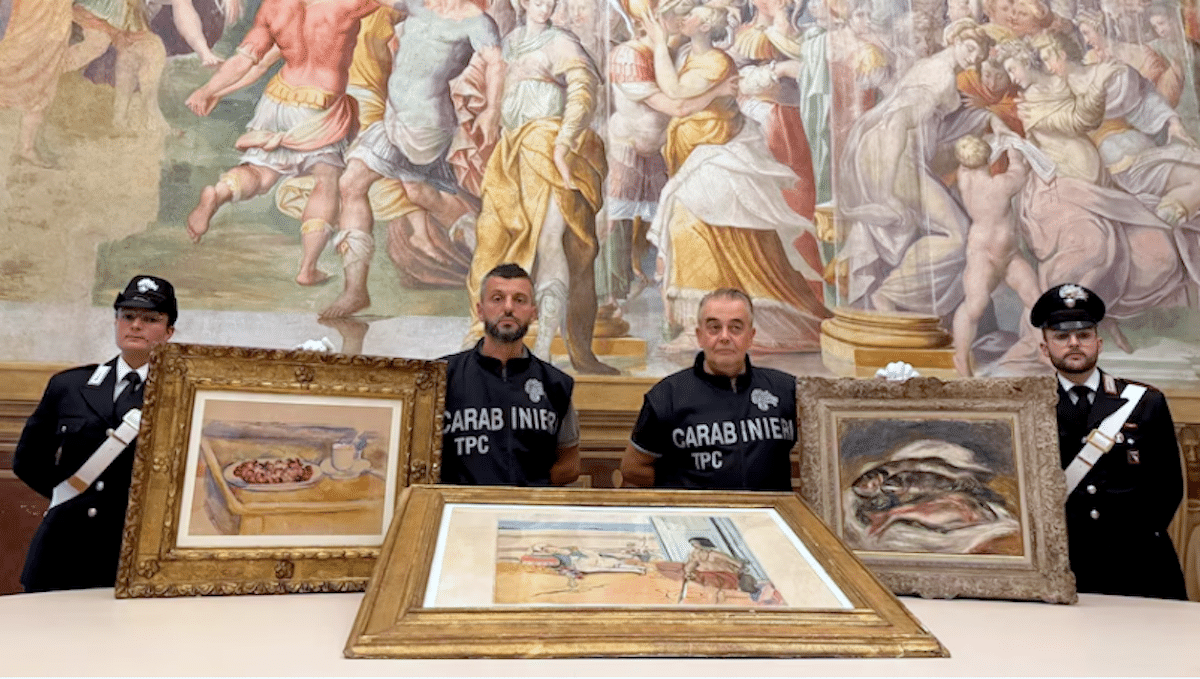
Italian authorities have arrested five people in connection with the theft of three paintings from the Magnani Rocca Foundation in Northern Italy and recovered all three works, which were found hidden inside an empty television box in the storage room of a Parma home.
The Carabinieri announced the breakthrough on Friday, describing the result of what Colonel Andrea Pagliaro, commander of the unit that led the investigation, called a complex operation overseen by the Parma public prosecutor’s office. The suspects are all Moldovan nationals who have been living in Parma, some for several years.
The theft took place in the early hours of 23 March, when two masked figures broke the glass panel of the villa’s front door and moved through the building to the room where the three works were hanging. Security camera footage released by police shows the pair moving quickly and efficiently, lifting the paintings from the walls before passing them through the door to an accomplice waiting outside. The whole operation took less than three minutes. According to Colonel Pagliaro, the thieves had used electronic devices to deactivate the alarm system.
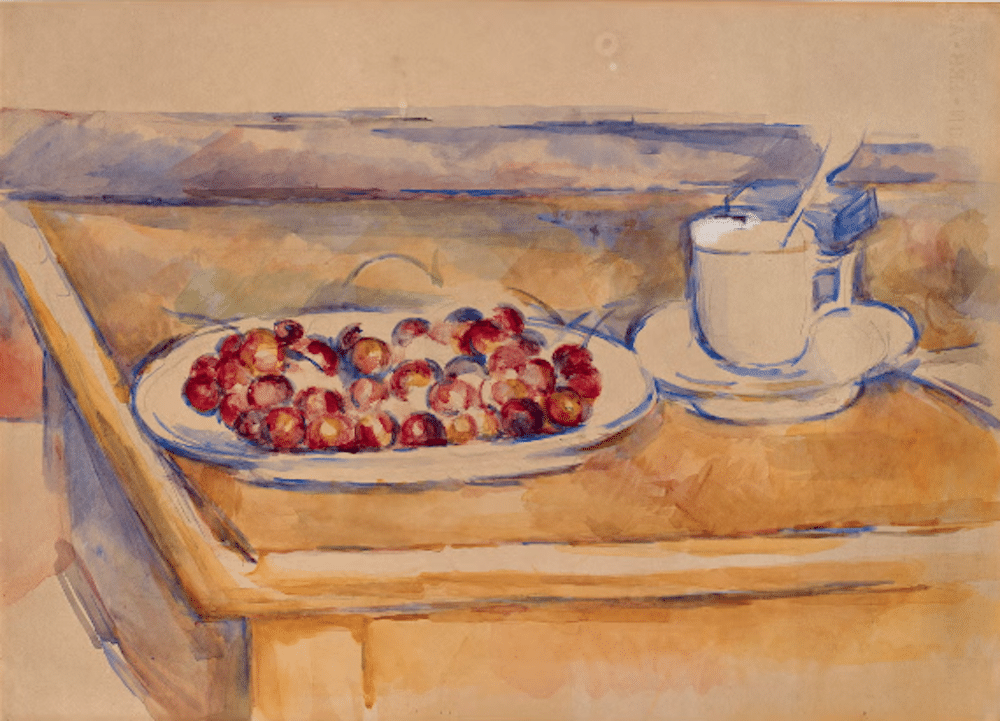
‘Still Life With Cherries’ by Paul Cezanne recovered by Italian Carabinieri after they were stolen
The three works recovered are Paul Cézanne’s Still Life With Cherries, a pencil and watercolour valued at approximately €6 million, Pierre-Auguste Renoir’s Les Poissons, an oil painting valued at around €3 million, and Henri Matisse’s Odalisque Sur La Terrasse, an etching valued at €20,000. Together they had been among the more significant losses from any Italian private collection in recent years.
Four of the five people arrested are believed to have participated directly in the theft. The fifth, in whose home the works were discovered, had been holding them. Lieutenant Colonel Giuseppe Marseglia, who oversaw the investigation for Italy’s art theft squad, said the group was not made up of art theft specialists, which in retrospect worked against them. “They thought it would be easy,” he said, but they had no idea how to sell the works through legitimate or even illegitimate art market channels. The investigators had identified the group relatively quickly after the theft but needed more time to track down where the paintings were being kept.
By the time they were found, the suspects had already begun making enquiries about potential buyers, including through international channels, Colonel Pagliaro said. Those enquiries came to nothing. Lieutenant Colonel Marseglia noted that all three works had been registered on international databases of stolen art, including Interpol’s, almost immediately after the theft. “That made them effectively unsaleable,” he said.
The recovery follows a bleak few months for the Magnani Rocca Foundation. Stefano Roffi, who oversees the collection, described the theft as having left colleagues devastated and said the return of the works called for a proper celebration.
The foundation was established in the 1970s by Luigi Magnani, an Italian intellectual and collector, and its holdings span several centuries and countries, including major works by Titian, Goya, Van Dyck, Dürer and Giorgio Morandi. The theft had attracted international attention in part because of its audacity and in part because of the quality of the works taken, and it arrived in the news cycle five months after a separate high-profile heist at the Louvre in Paris, where burglars had made off with eight pieces of crown jewellery valued at over $100 million.
The speed of the Parma recovery and the relatively straightforward circumstances in which the works were found reflect both the effectiveness of Italy’s art theft squad and the limitations of thieves who treated a museum robbery as a straightforward property crime without understanding the difficulty of moving stolen art of such visibility. The paintings are now back with the foundation.
The Magnani-Rocca Foundation serves as a cultural hub, not only for the visual arts but also for musical and literary activities, in keeping with the spirit of its founder, Luigi Magnani, who deeply appreciated the connections between various artistic expressions.
Top Photo: Italian police recovered three artworks from a heist at a villa museum in Parma. (photo Supplied/Italian Carabinieri)