
Investigators from the Manhattan district attorney’s office seized dozens of ancient artefacts from the Metropolitan Museum of Art in June, the latest in a series of removals that have been ongoing since 2017. Taken together, the artefacts seized from the Met over that period number more than 120 significant objects, plus hundreds of smaller items including pottery fragments, belt clasps, axe heads and figurines. Their total value, according to an inventory compiled by the office of district attorney Alvin L. Bragg, exceeds $95 million.
The items removed in June include a 3,700-year-old terracotta beak-spouted jug from Greece, a marble head also from Greece, a 2,000-year-old bronze statuette of Hermes from Turkey, and a golden headpiece from ancient Egypt. Independent appraisers working for the investigators valued these four objects at between $80,000 for the jug and $500,000 for the bronze Hermes. The removal was made under a stipulation dated 9 June and had not previously been disclosed.
The Met characterised the process as collaborative. In a statement, the museum said it had exchanged information with investigators and agreed to part with the items following internal review. Lucian Simmons, the Met’s head of provenance research, said the museum does not want stolen art in its collection and described the district attorney’s office as an invaluable partner, particularly for their ability to unlock information that would otherwise be inaccessible. The museum has expanded its provenance research team to 12 dedicated specialists as part of its Cultural Property Initiative.
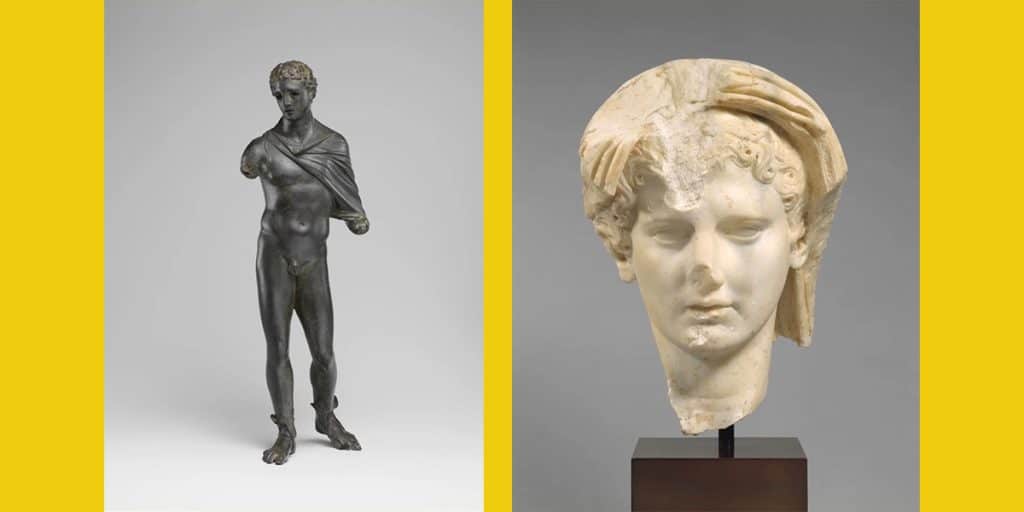
Left: Hermes bronze among the items seized by investigators. Credit: The Metropolitan Museum of Art. Right: A marble head of a veiled man from ancient Greece. Credit: The Metropolitan Museum of Art
Matthew Bogdanos, who leads the Antiquities Trafficking Unit in the district attorney’s office, was less diplomatic. The recurring seizures at the Met, he said, spoke for themselves. “The question has to be asked, ‘Why are we the ones doing this?'” The tension between the two institutions is also visible in something as basic as how each counts the objects involved. The Met says 198 items have been seized since 2017, including objects on loan. The investigators put the figure at 348.
The scale of the problem stems from the institution’s own history. The Metropolitan Museum was founded in 1870 and opened at its current Fifth Avenue site in 1880, considerably later than its counterparts in Paris and London. In its early decades, it was playing institutional catch-up, and under director Thomas Hoving in the 1960s and 1970s, the museum embarked on an aggressive acquisition programme intended to build an antiquities collection capable of rivalling those of the Louvre and the British Museum. The approach to provenance during this period was, to put it carefully, relaxed. Investigators say their current work has been materially assisted by their improved understanding of the underground international trafficking networks that dominated the post-war supply of antiquities to American museums and collectors.
The repatriations to date have covered a substantial geographic range. Italy has recovered a marble head of Athena, along with numerous other items, with proceeds from ongoing trafficking investigations. Hundreds of antiquities in the Met collection lack provenance or records tracing them to their countries of origin.
The gold Coffin of Nedjemankh was returned to Egypt. The centrepiece acquisition was obtained using falsified export papers, along with a golden headpiece and 12 additional antiquities, which were surrendered in early 2026. Cambodia and Thailand have received pre-Angkorian sandstone lintels, a tenth-century sculpture of Hiranyakasipu, and various Khmer statues, clearing all known ties to the dealer Douglas Latchford. Turkey and Greece have received the Hermes statuette, the terracotta jug, and a headless bronze statue of the Roman Emperor Septimius Severus. Iraq and Yemen have received Babylonian terracotta heads and ancient Sumerian alabaster vessels following provenance reviews and criminal investigations.
The Met has also introduced dedicated object webpages for all returned works and added gallery signage identifying artworks that changed hands involuntarily during the Nazi era, in compliance with New York State law. Whether these measures represent a genuine institutional reckoning or the minimum required response to sustained legal pressure is a question the museum’s critics continue to ask, and the recurring presence of investigators in its galleries suggests the answer is not yet settled.
Important Recent Repatriations (Via Country)
Cambodia & Thailand: Pre-Angkorian sandstone lintels, a 10th-century sculpture of Hiranyakasipu, and various Khmer statues. Dozens of pieces cleared out all known ties to Douglas Latchford.
Italy: Marble head of Athena, 21 items seized in a singular joint raid, and ancient Greek vases. Valued at tens of millions; returned via ongoing DA trafficking crackdowns.
Egypt: The famous gold Coffin of Nedjemankh, a golden headpiece, and 12 antiquities surrendered in early 2026. The Coffin alone was a centrepiece purchase made with falsified export papers.
Turkey & Greece: A headless bronze statue of Roman Emperor Septimius Severus and a 3,700-year-old terracotta jug. Multi-million-dollar values confiscated by the Manhattan DA’s Antiquities Trafficking Unit.
Iraq & Yemen: Babylonian terracotta heads and ancient Sumerian alabaster vessels. Returned following proactive provenance reviews and Symes criminal probes.
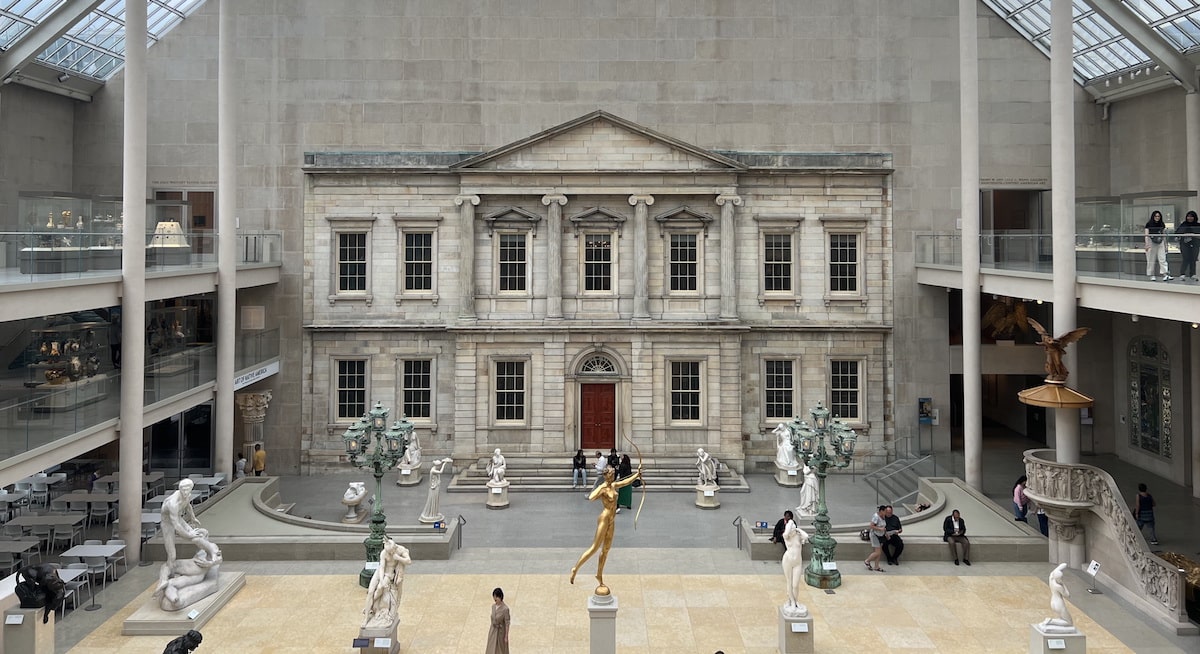
Charles Engelhard Court, Metropolitan Museum of Art Author 颐园居 Creative Commons