‘Be Rooted – Hold to This Earth’ reads one of sixteen text-based monotype prints from the series Defend Sacred Mountains, 2018, by Hock E Aye Vi Edgar Heap of Birds, Tsistsistas (Southern Cheyenne of the Cheyenne and Arapaho Tribes). It speaks to the relationship to land – at this moment when America celebrates 250 years since the signing of the Declaration of Independence, to hear the voices of these 38 artists from over 35 Tribal Nations with over 40,000 years of ancestral traditions, knowledge, and memory.
Here are works that reference the land, waters and skies that link us all, yet also a call to action about sovereignty and stolen land, the rape and pillage of ancestral lands, persecution, erasure and resilience. These recurring themes of marginalisation are presented by Indigenous artists across the oceans.
This exhibition was created in dialogue with the artists and Yorkshire Sculpture Park (YSP) alongside Tia Collection, which has, since its inception in Santa Fe in 2007, focused on contemporary Indigenous American art. Emerging artists are included alongside those with significant international reputations, with conversations across generations, media, and Nations.
Welcoming visitors to the Underground Gallery at YSP is a work by Dakota Mace, Diné (Navajo) Kéyah Yinílniih (The Land Remembers), 2026, a vast abstract painting commissioned for this exhibition. It incorporates charcoal from Mace’s homelands mixed with earth and wool from YSP, combining and connecting the two communities. Mace researched the history of local traditional woad and weld dyes and calls the piece “a love letter to Yorkshire, a sharing of stories and memories, working with natural materials and the local community here.”
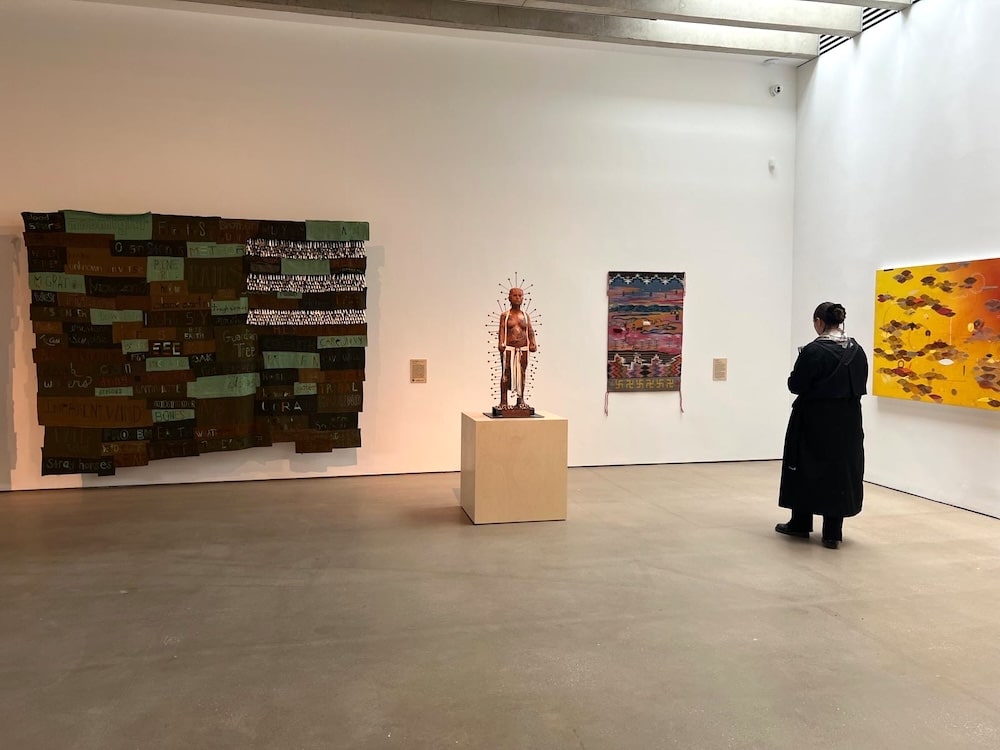
First Gallery installation shot including Rose B Simpson, Tonantzin
This work and most in the first gallery speak to materiality and the relationship to natural materials. A sculpture by Rose B. Simpson, Khaʼpʼo Owingeh (Santa Clara Pueblo), entitled Tonantzin, 2021, depicts a pre-colonial Aztec Empire earth goddess holding a piece of unfired clay in her hand, connecting her to the earth, with flowers growing at her feet. The ceramic figure is outlined by an array of brass pins representing rays of light. Spanish missionaries later morphed Tonantzin into a depiction of the Virgin of Guadalupe, those same rays emanating from her outline. Simpson’s mother is artist Roxanne Swentzell, and her work, Making Oneself, 2000, speaks to how similar traditions of working with clay have passed through their family, yet are expressed in very different ways. It shows a figure literally in the act of moulding the clay to create their own leg, like a claymation figure. This tradition dates back thousands of years through generations of Pueblo women.
The large central gallery features works that address the ongoing legacies of colonialism, stolen land and sovereignty, identity, activism, protest and resistance, and the protection of sacred sites. Zoë Urness, Ani’-Yun’wiya (Cherokee), Lingit Ch’aak’ Neix.Ádi (Tlingit from the Eagle Moiety, Eagle Clan), in her work No More Stolen Sisters, 2019, focuses on the Missing and Murdered Indigenous Women and Girls movement, placing a red handprint over their mouths. It’s an extremely powerful image: the women staring defiantly and directly at the viewer, the red more striking in contrast against the black and white photograph.
Blood and Arrows of Stereotypes, 2025, by DC Allen, Apsáalooke (Crow/Absaroka) incorporates an old poster from 1911 advertising stolen Native land for sale by the US government, a Crow Elder pierced Saint Sebastian-like with arrows superimposed over. It speaks to forced relocation and the reservations where many of the artists grew up and still live, highlighting those who fight to preserve ancestral knowledge, language, and culture.
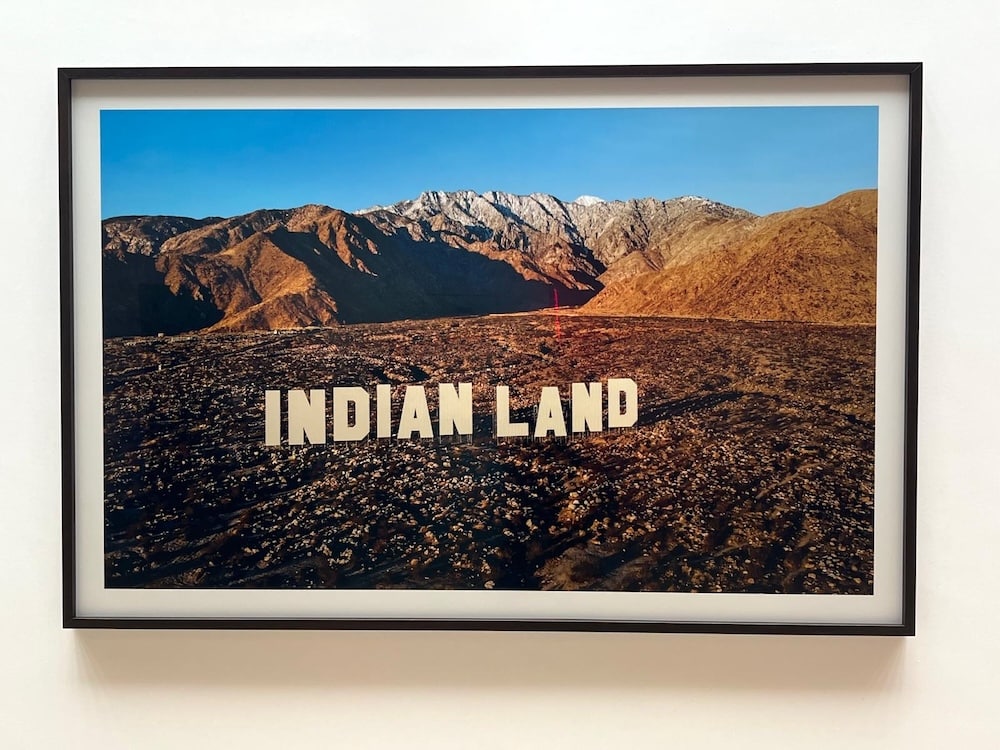
Nicholas Galanin, Never Forget 2021
The photograph Never Forget, 2021 by Nicholas Galanin, Lingit, Unangax̂, was taken from a massive land art work created near Palm Springs for Desert X 2021 on the traditional lands of the Agua Caliente. Huge letters spelling ‘Indianland’ recall the original 1923 real estate advertisement for the Hollywoodland development, the ‘land’ suffix subsequently removed to form the now eponymous sign. Here Galanin highlights a call to action to acknowledge Indigenous land rights.
The third gallery displays works using traditional techniques and materials, such as hide and beadwork. Jeffrey Gibson, Ani’-Yun’ wiya (Cherokee), Chahta (Mississippi Band of Choctaw Indians), who represented the US at the 2024 Venice Biennale, has a number of works here. In TO MY NATION, 2017, Gibson incorporates glass beads, weaving and fringing in this work, which is steeped in pop culture and dance music references from queer nightclubs of the ’80s and ’90s, yet also alludes to traditional dance. Gibson is exploring his indigenous identity from a queer perspective.
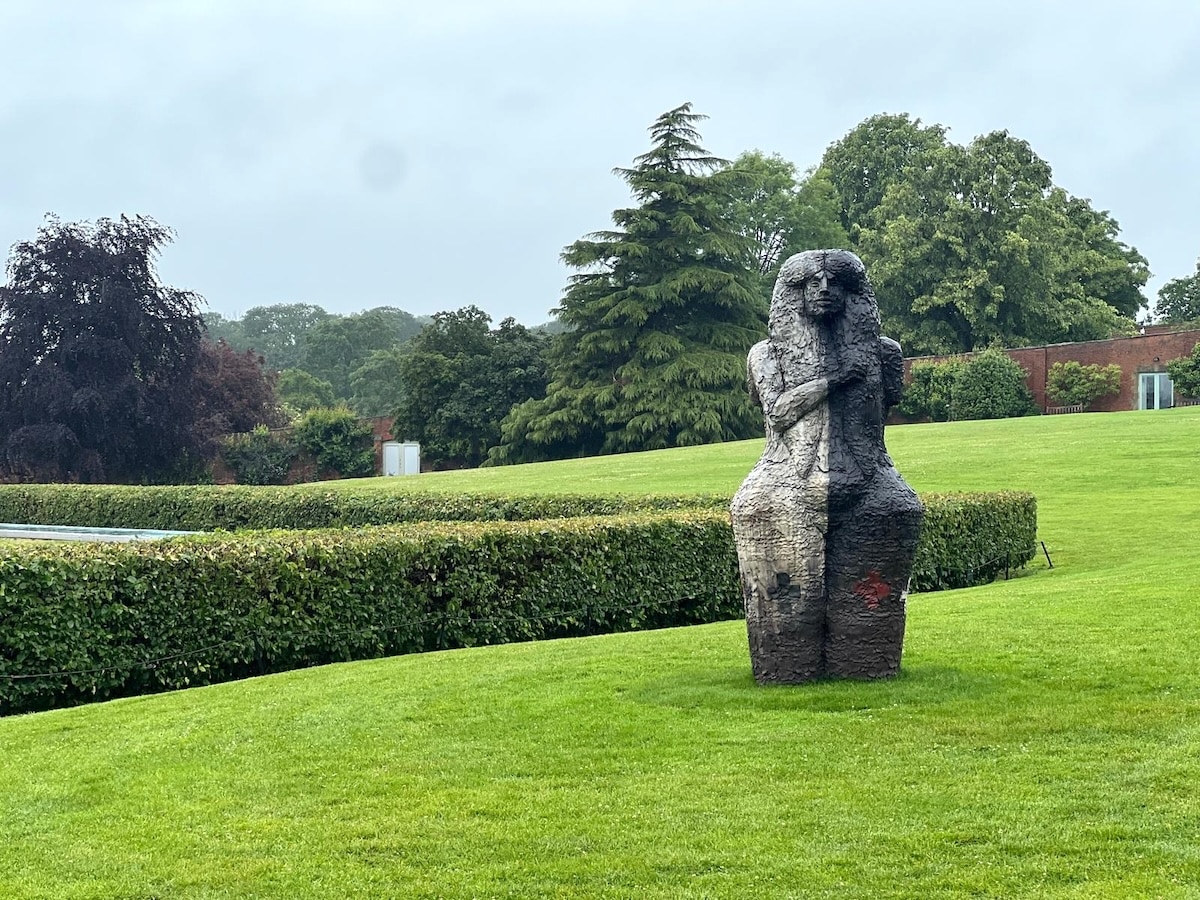
Outdoors are six works, including The Guardians, 2024, by Raven Halfmoon, Kadawdáachuh (Caddo Nation). This monumental bronze sits on the roof of the Underground Gallery like a sentinel, the figure split in half shadow, half light – Neesh and Soku, moon and sun, from Caddo origin stories. This powerful and solid piece emerging from the ground reminds me of Huma Bhabha’s work – the palpable texture created by Halfmoon’s fingers working the clay original.
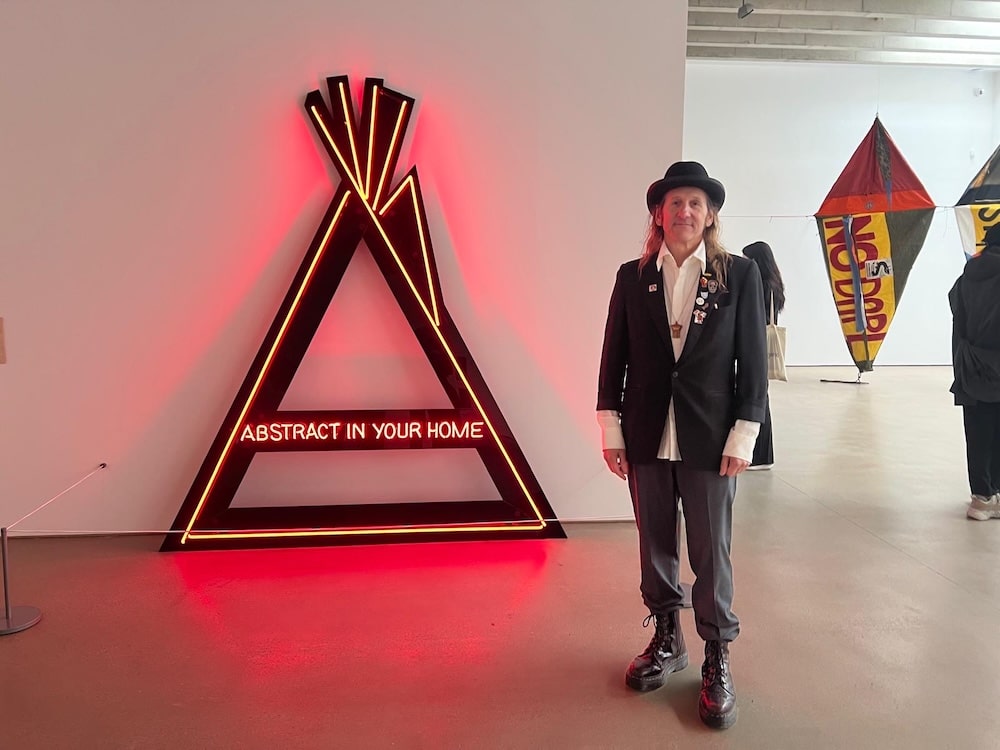
Neal Ambrose-Smith, alongside his work Abstract in Your Home
A number of artists are here for the opening, and I speak with Neal Ambrose-Smith, Sqelx (Confederated Salish and Kootenai Tribes of the Flathead Indian Nation) about his work Abstract in Your Home, 2009, in the central gallery. “I’m a descendant of the Flathead Salish in Montana, and I grew up with tipis; they form part of my identity. I saw a Pier Paolo Calzolari neon triangle in a book on abstract expressionism, ‘Abstract in Your Home’ from 1971. Looking at this image, I saw a tipi, not something abstract, so I decided to copy it and make it into a tipi with poles at the top. I showed it to my mom, Jaune Quick-to-See Smith. We always ran ideas by each other – she told me to add an air flap and drew one for me. This neon guy in Albuquerque made it for me – my first time using neon- and suggested I use ruby red.”
Ambrose-Smith spoke to me further about his mother Jaune Quick-to-See Smith’s works in the exhibition. Referring to her work Ronan Robe #4, 1977, he says: “She struggled making this piece; the pigments weren’t sticking to the fabric, the wax wasn’t bonding with the pigments, and she couldn’t get the edges of the canvas to fray. She put it in the washing machine, and it burned it out. She used a huge palette knife to scrape it. This whole process of washing, hanging, drying, trying to smoke it, actually turning this into a hide became cathartic, more like actually making a hide as the women traditionally would prepare it. What’s happening below the surface is like layers of memory—making paths through the land, dotted lines, trails, shapes that represent things, a moon or the sun. So she’s been an incredible artist for me to study and learn from, and her journey was mind-blowing. It’s a really formative piece for her.”
Outside is Jaune’s Trade Canoe: King of the Mountain 2025, which I’ve seen before in Frieze Sculpture 2025. It comprises the bare metal bones of a canoe containing a monolithic rock with a buffalo atop. Once again, mother and son collaborated on this piece. “She never got to see this cast in bronze before she passed. The Sisyphean boulder signifies the suffering we go through. It’s talking about Mother Earth, Mother Nature. It doesn’t matter what we do, nature will prevail. If we’re not here to cut the grass, the grass will take over; nature should take over, and it will come back. We’re not in control; the universe made us.”
Hold to This Earth: Works by Contemporary Indigenous North American Artists from Tia Collection,
Yorkshire Sculpture Park, 13 June 2026-18 April 2027
words and photos Miranda Carroll ©Artlyst 2026
Visit Here