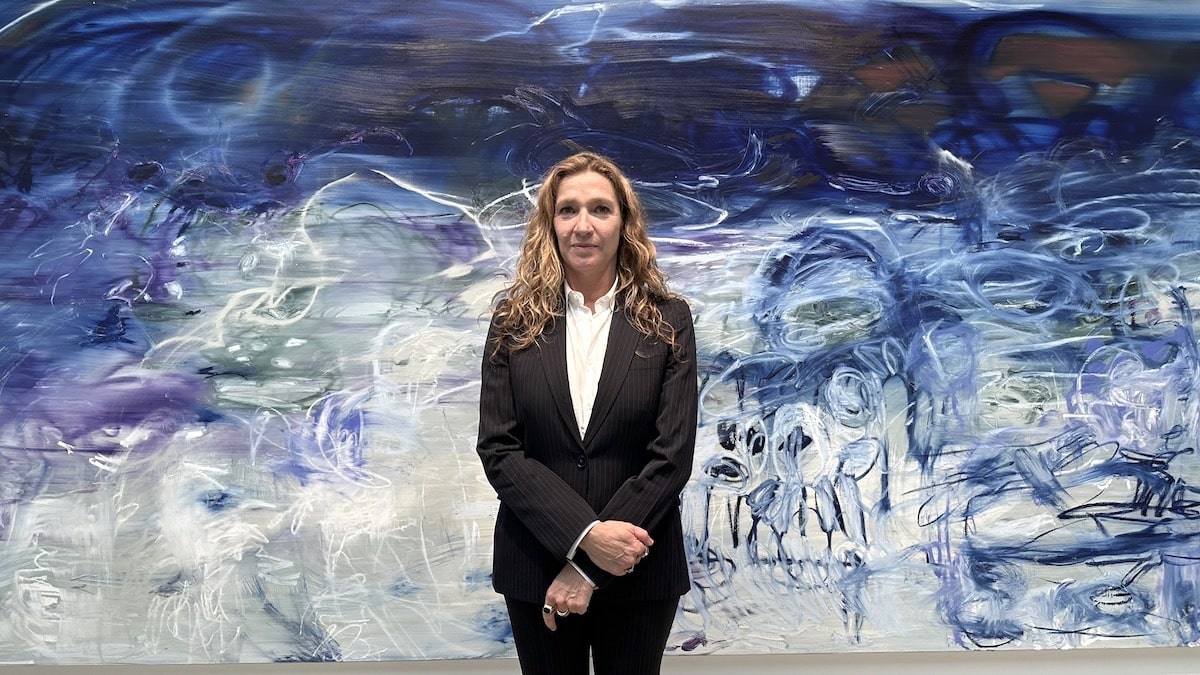
Hastings Contemporary is well worth a visit for the current three shows: Miguel Rothschild’s ‘Undercurrents’, a joint show of Lucian Freud and Henry Moore, and Janaina Tschäpe’s ‘Conversations with the sea’. The German-Brazilian artist, who has always been captivated by the notion of the sea as a gateway to mystical realms, responded to the gallery’s dramatic coastal setting by bringing the swell of the English Channel and the immensity of the world’s oceans into space.
How should we pronounce your name?
Zhah-nah-EE-nah CHEP-eh
Where does that come from?
My mother is Brazilian, and my father was from Germany. Janaina is the name of a Brazilian water spirit, and Tschäpe is possibly Czech, but I’m not certain. I grew up in Brazil, studied at the Art Academy in Hamburg, Germany, and came to New York on a grant in 1996. That was a different New York, a different America than today, but I loved it and decided to stay. I still spend one or two months working each year in Brazil and am close with my mother’s large family there, and mostly return to Germany these days for exhibitions and to see friends since my father passed.
I see you are wearing a suit?
I often wear a suit whether I’m working or not. It has a certain versatility that I appreciate, which allows me to move easily between the studio, meetings and openings without having to change. I also like its simplicity. Once it’s on, I don’t have to think about what I’m wearing.
You first became known as a performance artist, rather than as a painter?
I’ve painted since I was little, but the 90s were harsh for female artists, especially female painters. My professors in Hamburg were all male painters, and I felt more drawn to nontraditional media and to the amazing female artists working in performance, such as Rebecca Horn, Marina Abramovic, and Ana Mendieta. They were more inspiring and opened up new possibilities for what I could make.
I wasn’t as interested in photography and film as in using the camera as a tool to document my intimate performances and then show them afterwards. But after a while, I really missed the solitude, poetry, and physicality of drawing and painting so I started showing both together in dialogue with each other. Over time, the paintings grew in terms of scale and focus, though there is still a strong connection between the two.
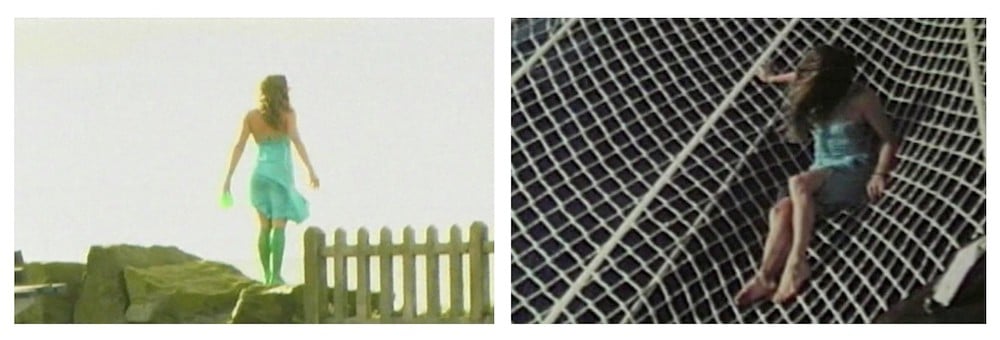
Janaina Tschäpe: Stills from video ‘He Drowned in her Eyes as she called him to follow’, 1999-2000, 20 mins. Photos Janaina Tschäpe
As here, where you show a suitably maritime film shot in 1999. ‘He Drowned in her Eyes as she called him to follow’?
I was reading about mythology and wondering why mermaids scared people so much and made ships sink. Why did the creatures responsible for ships sinking have to be women? Perhaps it came from the sailors’ longing for a woman while away at sea… Throughout the film I have the same blue dress on, in Blackpool and in other locations, bubbles full of water on my hands and feet, red contact lenses in my eyes…I was imagining how a mermaid might appear more deformed than beautiful coming to the surface after centuries in the ocean.
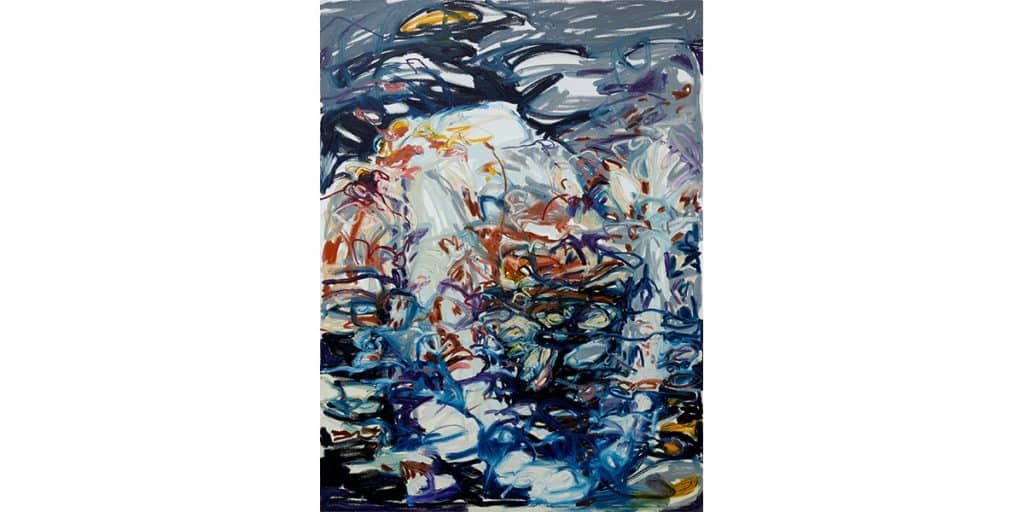
Janaina Tschäpe: ‘Sereias’, 2023 – Oil and oil stick on linen, 600 x 802 cm. Photo Janaina Tschäpe
And that links to the painting from 2023, ‘Sereias’ – or ‘Mermaid’?
Yes. That relates to the text – shown in the gallery – ‘Mermaids do Exist’, sent to me in 1997 by my friend the Brazilian artist Tunga, who did a lot of performances about mermaids and the sea. At that time, I was thinking more in terms of performance, but the text stayed with me through the years. When I found it again in 2023, it led me to make this painting.
I see he says that although ‘for a long time we have occupied ourselves with the constructive hypotheses of these beings’, they are as real ‘as a mouse or giraffe, however bizarre they may appear’. But it’s tricky to see quite how that feeds into the painting?
But it does! The painting is abstract, but for me it was about dealing with memory, the fragments of the text, the poetry and the idea of mermaids. And that’s why abstraction is so fantastic; you can read into it as you want. It’s more about the gesture and the performative act, creating space for the idea that mermaids exist… dealing with illusions and things you might or might not see, thinking about the movement and existence of a mermaid rather than its image.
And this is in oil paint, with extensive oil-stick drawing on top?
Yes, in 2023 I was primarily working with oil sticks and some paint. I like the question of ‘what is a sketch, what is not a sketch?’ Does a sketch always come first, or can it be the final gesture? That tension between painting and drawing interests me.
The more recent works are made in response to Hastings. How come?
I was here to see the gallery and meet the director Kathleen Soriano for just one day last November. It’s very rare for a museum to be right by the sea, and I got to walk on the beach on a misty, rainy day and really fell in love with the seaside here. The whole atmosphere—the shingle beach, the fishing boats, the net huts—put me under a spell. I got drenched, took photographs, and was blown away by the beautiful, melancholic air. It left a really big impression.
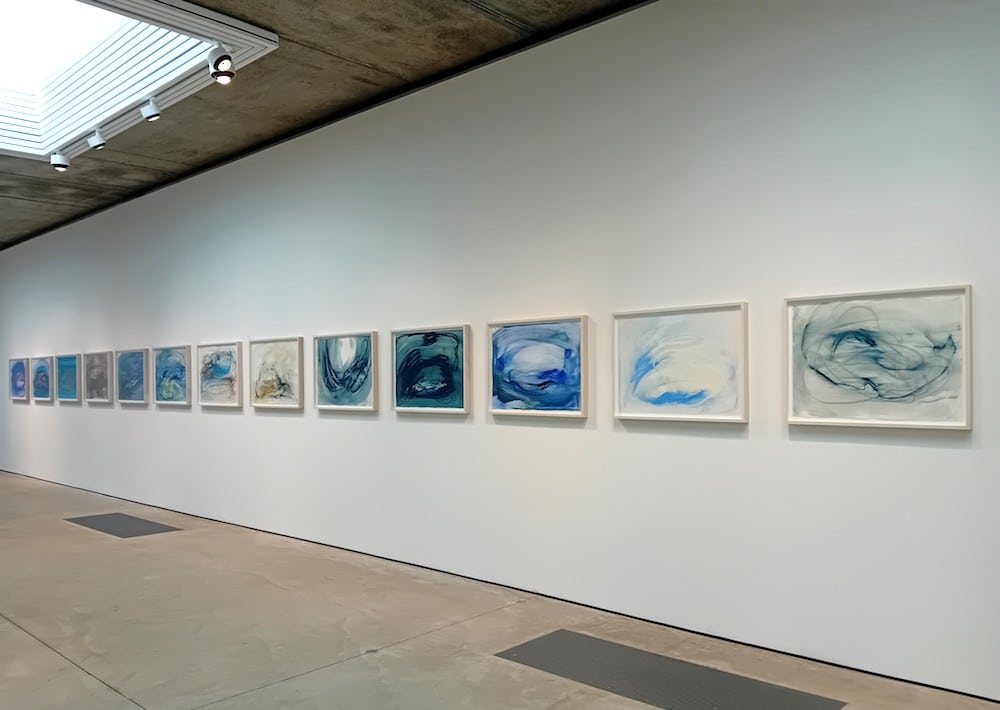
Janaina Tschäpe: Installation view of ‘Conversations with the Sea’, 2025. Photo Paul Carey-Kent
And that led to the row of fourteen watercolour and pastel works on paper?
Exactly. When I got back to New York, I started a sequence of watercolours, working on a tabletop at home in natural light from the windows. As the day went on the paintings became more intense and dramatic, as if I was going further into the sea, or deeper into a wave. As the title Conversations with the Sea suggests, it was more than trying to merely illustrate the sea; I was getting into the movement of the sea, into being swallowed by it.
Did you go swimming?
I went swimming in my head! I got into the breaking of the waves and the anatomy of the water, of translating its movements into gestures with watercolour and pastel.
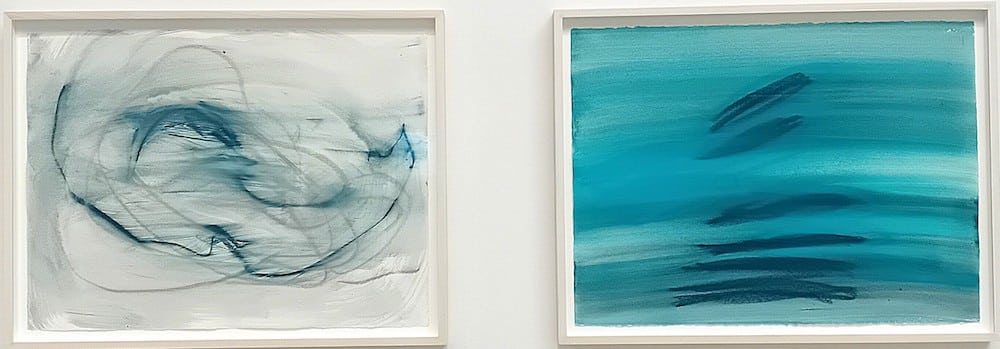
Janaina Tschäpe: From ‘Conversations with the Sea’ – left was ‘watercolour first’, right was ‘pastel first’. Photo Paul Carey-Kent
Does the watercolour come first?
Often, yes, but sometimes I start with pastel. That’s a bit of a game: there’s a battle between the drawing and the paint, between the fluidity and the mark-making, so sometimes I draw before and take it away again. Watercolour over pastel is difficult, but it can have its own magic, as it takes the pigment with it and kind of draws the movement of the brush. It’s also switching between being in control and not being in control…
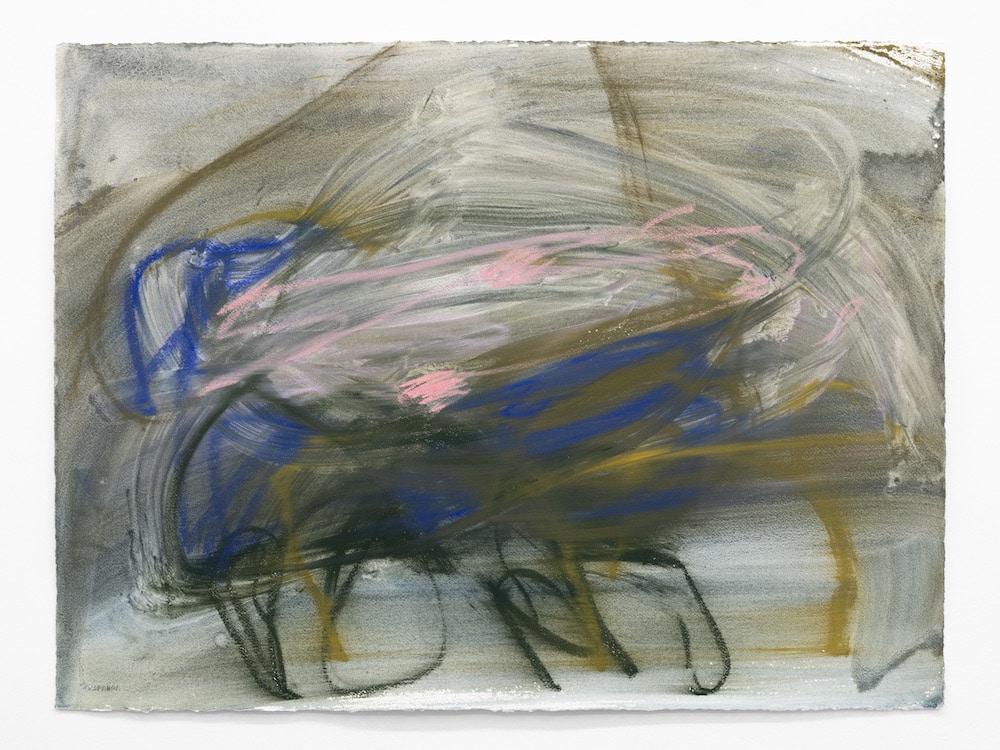
Janaina Tschäpe: from ‘Conversations with the Sea’. Photo Janaina Tschäpe
Or the tide coming in, tide going out?
Exactly. I was in that mindset for a week or so, and was very absorbed by thinking about the movement of the water, the waves, the undertow. Also the melancholy and silence, the haze and the clouds. Though it varies between seas, there is always a longing evoked by looking at the horizon, a longing for something we don’t even know what it is. That feeling changes between oceans – sometimes more intimate, shaped by solitude; sometimes more outward, more sunny…
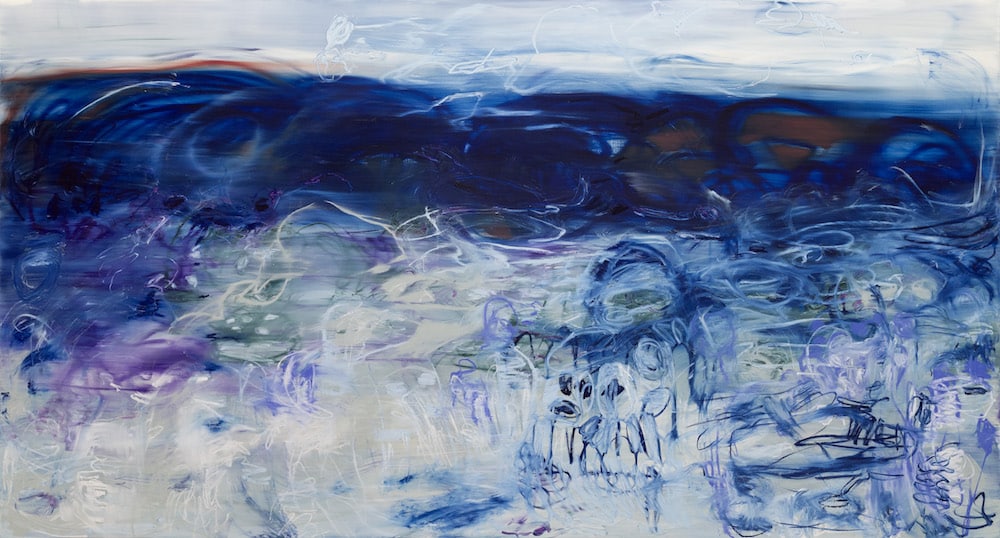
Janaina Tschäpe: ‘Meeresatem (Breathing the shore)’, 2025 – oil and oil stick on linen, 219 x 407 cm. Photo Janaina Tschäpe
And what about the big oil and oil stick painting ‘Breathing the shore’?
I went into the studio after finishing the works on paper. I had painted a canvas with a thin dark blue ground that could have become been any painting, but as I started to work on it, I realised it was Hastings. It was about the energy and urgency of the situation, the movement of the paint and of the sea, rather than trying to depict the exact landscape. It was intense and beautiful to work on, bringing me back to my experience of being in Hastings. The abandonment of the boats feeds into that sense of melancholy.
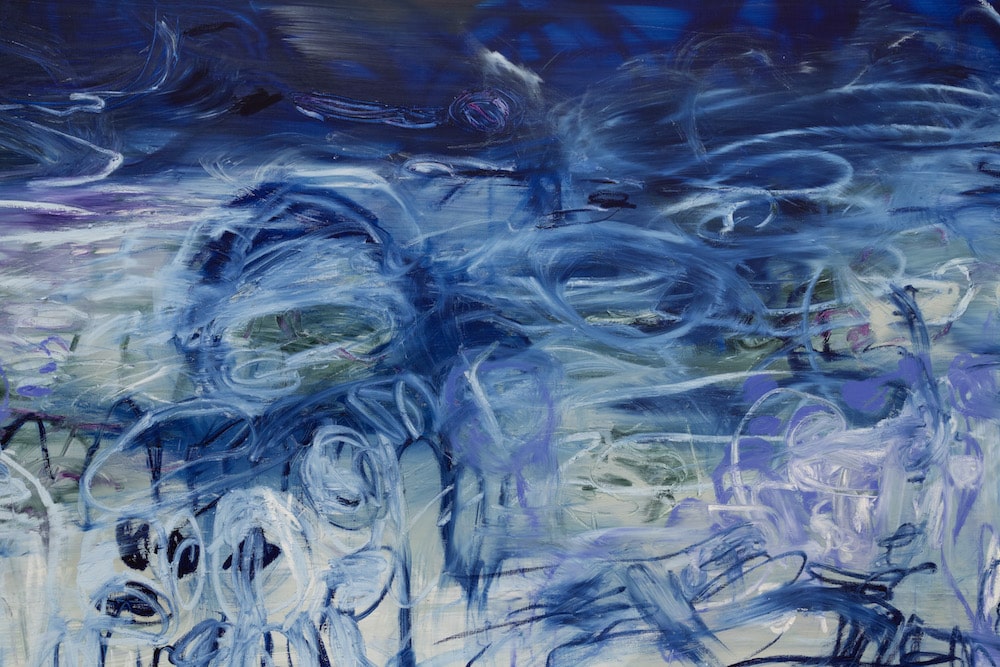
Janaina Tschäpe: ‘Meeresatem (Breathing the shore)’, 2025 – detail. Photo Janaina Tschäpe
Have you talked about ‘the landscape of the soul’?
Yes, because nothing is literally represented in the paintings… it becomes more like a diary of the mind and the markings. There is a play between foreground and background, with some areas erased or covered so it’s not obvious which came first. The drawing breaks up what’s painted below, while the painting transforms the drawing. As I said earlier, it’s all a part of the game!
Top Photo: P C Robinson © Artlyst 2026
Janaina Tschäpe: ‘Conversations with the sea’ continues to 13 September 2026 at Hastings Contemporary