The July 2026 Art Diary begins with group exhibitions at Hauser & Wirth Menorca and GRIMM exploring disorientation and complexity as zeitgeist themes emerging from contemporary culture. Exhibitions at The Whitworth, V&A, Cento, Gazelli Art House, and Hauser & Wirth Somerset engage with aspects of contemporary culture in different ways, using dialogical and relational approaches that connect with either the past or the environment. Exhibitions at Fitzrovia Chapel engage with aspects of that space’s history while exhibitions at Charleston and Waddington Custot explore artists and movements from the early years of Modernism. Finally, exhibitions at St Oswald’s Ashbourne and the American Visionary Art Museum focus on current expressions of Christian spirituality.
‘Directionless’ is a group exhibition organised by artist Rashid Johnson that begins with the recognition that we are living through a period marked not only by profound disorientation, but by exhaustion. Political certainties have frayed, collective narratives have weakened, ecological anxieties deepen, and inherited systems of meaning no longer provide stable points of orientation. In such a condition, directionlessness emerges not as a temporary loss of bearings but as a defining experience of contemporary life. The exhibition asks what forms of thought, feeling, and artistic practice become possible when certainty is no longer available and when exhaustion itself has become a shared social condition.
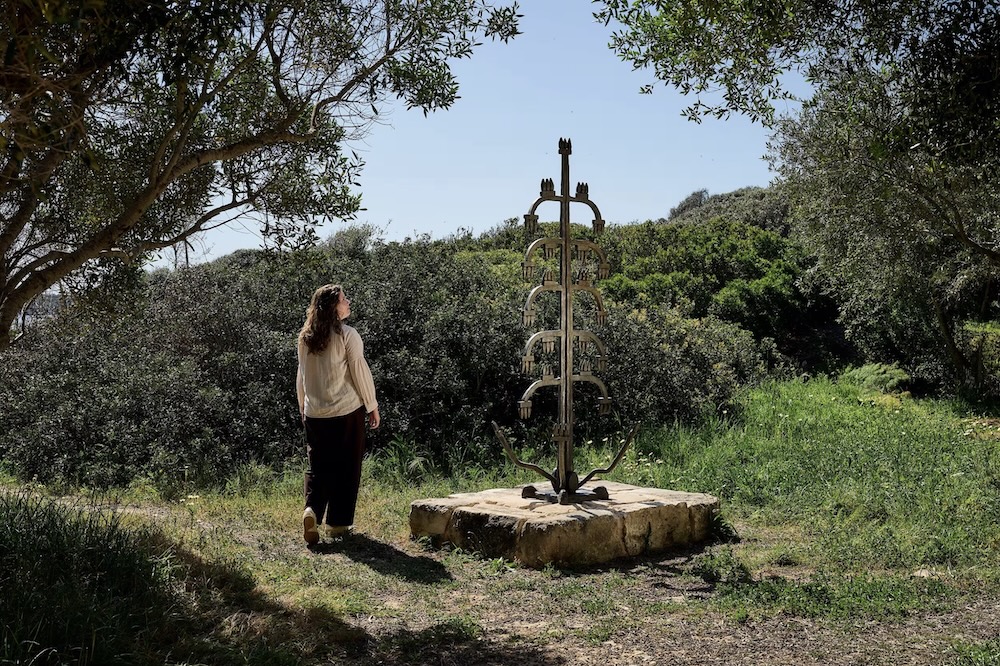
Ali Cherri, Tree of Life, 2023, Directionless at Hauser & & Wirth Menorca, Photo: Daniel Schäfer
Rather than seeking resolution, ‘Directionless’ considers how artists inhabit states of suspension, ambiguity, opacity, and fragmentation. The works gathered here do not offer maps out of uncertainty. Instead, they propose ways of remaining present within it. They explore what it means to navigate a world in which identities are increasingly unstable, histories remain unresolved, and the future appears both open and difficult to imagine.
The exhibition adopts a deliberately polyphonic structure. Johnson invited artists Charles Gaines, Firelei Báez, and Cristina Iglesias to nominate peers from beyond Hauser & Wirth’s roster, dispersing curatorial authority and allowing the exhibition to develop through affinity, divergence, and conversation. This artist-driven methodology reflects the exhibition’s central premise: that orientation is not fixed or inherited, but continuously negotiated through relationships, encounters, and acts of imagination.
Johnson says: “We are all living inside a shared sense of disorientation right now—one that is evolving with increasing momentum. That condition doesn’t paralyse the artists here; they’re animated by it. […] What they offer isn’t a map, but a set of strategies for moving forward when the terrain is unfamiliar.”
‘The Fountain Overflows’ at GRIMM London is a group exhibition curated by Yates Norton which takes William Blake as a poetic and philosophical companion in considering a number of artists whose works invite us to see and sense the world in all its ever-moving complexity.
Norton notes that, in his ‘Proverbs of Hell’, Blake wrote: “the fountain overflows, the cistern contains.” He explains that, for Blake: “the fountain symbolised exuberance and the generative, generous movement of relations shaped by imagination and love. Its baroque, gushing flow celebrated life beyond systems and categories, dogma and cynical rationalism. In counterpoint, the cistern (contained, still, rational) embodied at once the necessity of form, containment and preservation as well as repression and stasis.
Blake understood the necessity of both in life …
And yet, as in Blake’s time, we seem to be tipping the scales toward increasing categorisation and armoured individualism at the expense of the inherent profusion of life. In Blake’s philosophy of a vital, ever-flowing body and spirit, life’s continual movement exceeds any attempt to circumscribe and still it; indeed, for Blake, its restraint was death: “Expect poison from standing water”, he warned elsewhere.
The exhibition presents a selection of artworks by Adam Farah-Saad, Anj Smith, Benjamin Orlow, Daisy Parris, Divine Southgate-Smith, Ebun Sodipo, Emmanuel Awuni, Francesca Mollett, Gabriella Boyd, Jesse Wine, Leon Scott-Engel, Rachel Kneebone, Ramin Rokni Hesam, Rebecca Ackroyd and Vivian Suter. Norton suggests that: “Like Blake, they remind us that we might better glimpse the depth of this rich, entangled fabric of life (of which we are but a small part) if we allow ourselves to perceive dynamically, beyond habit and custom.”
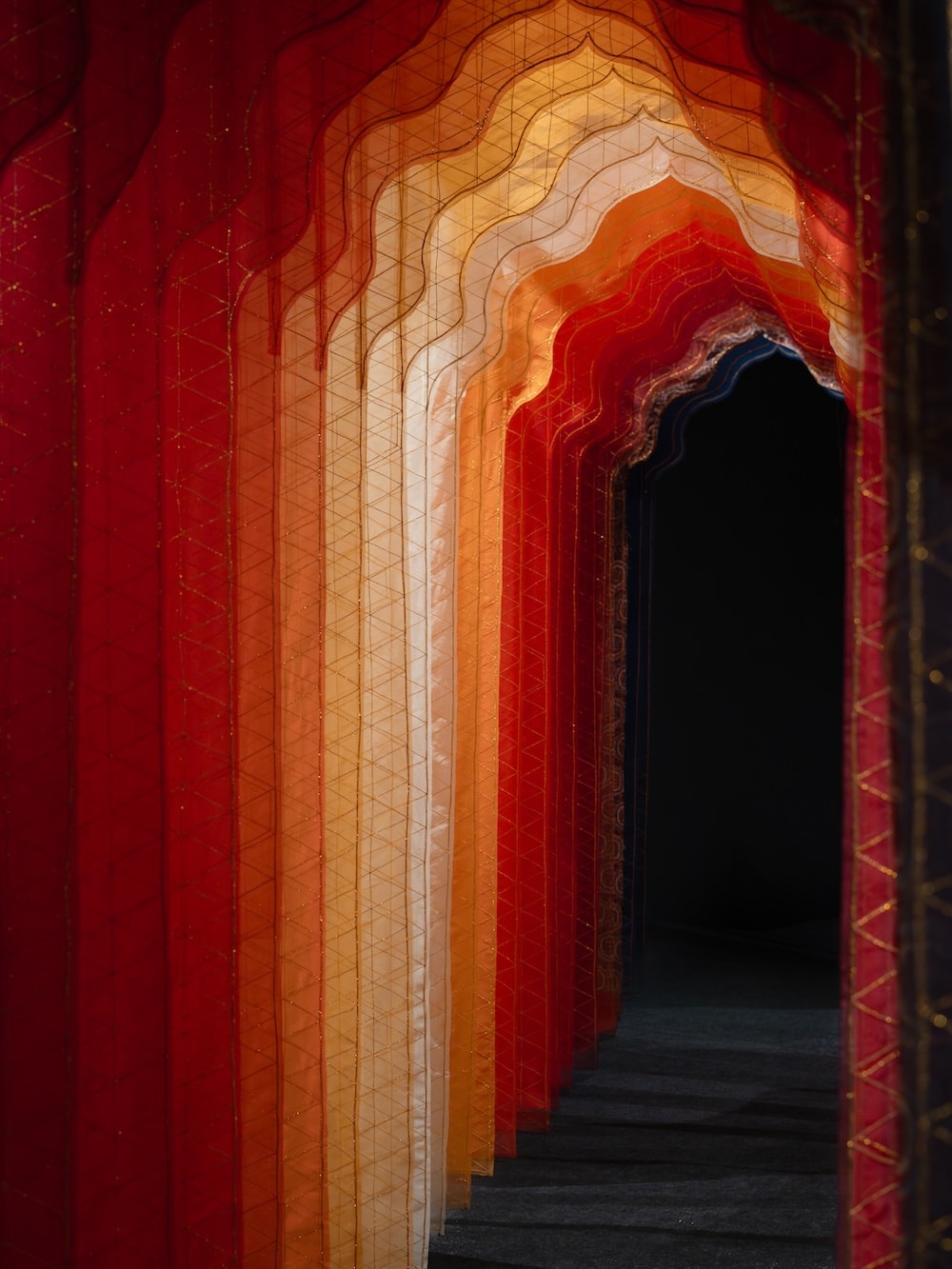
Jounghye Yoo, Gilded Veil, 2025, installation view in Hyundai Translocal Series: Entangled and Woven, National Crafts Museum & Hastkala Academy. Photo by Garima Bhaskar
‘Entangled and Woven’ at The Whitworth brings together new works by eight contemporary textile artists and collectives from Korea and India developed through research trips to each country and presents them alongside historic textiles from the Whitworth’s collection. As a result, the exhibition spans 400 years of textile history, bringing Manchester’s textile legacy into a wider global frame.
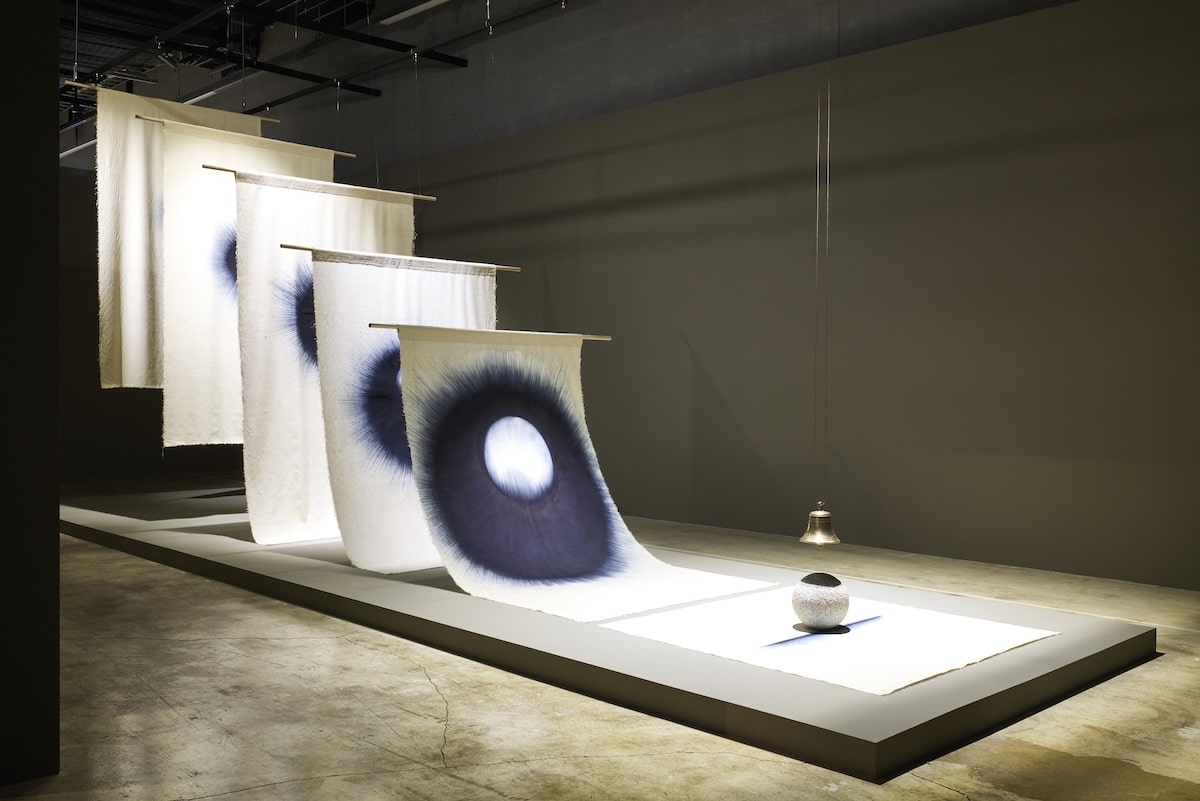
The exhibition approaches textile traditions not as static heritage, but as living practices shaped by movement, collaboration and change. Through weaving, dyeing, embroidery and fibre-making, it reveals how knowledge is carried hand to hand — across generations, borders and belief systems.
The exhibition foregrounds artists whose practices are rooted in long-term research and collaboration. Korean artist Yeonsoon Chang brings a meditative approach to textile labour, creating sculptural works that treat breath, air and repetition as material forces. Jounghye Yoo’s luminous installation ‘Gilded Veil’, a colourful series of archways inspired by the Vishwanath Temple in Varanasi, combines Korean silk embroidery with Indian Ajrakh block printing. Somi Ko presents works that merge Korean and Indian textile histories, working with hanji, a traditional Korean paper hand-spun into thread, and khadi, a fabric – also hand-spun – promoted by Mahatma Gandhi during India’s freedom struggle.
Elsewhere, Youngin Hong imagines alternative worlds (in which animals, humans, and environments coexist as equals) through flags made with hand embroidery techniques from the Kutch region of India, in collaboration with the local collective Kala Raksha. Also on display are works by art and fashion brand Boito; artist Sumakshi Singh, who is representing India at the Venice Biennale 2026; Kaimurai; PÉRO and 2018 LOEWE Foundation Craft Prize finalist Yeonsoon Chang.
Throughout these new works, the artists reference the rich craft histories, traditions, and contemporary practices of regions visited across India and Korea – from indigo dyeing to fibre-making – whilst also drawing on personal and political narratives, addressing themes of identity and resilience, and foregrounding often undervalued forms of labour, such as sewing and embroidery.
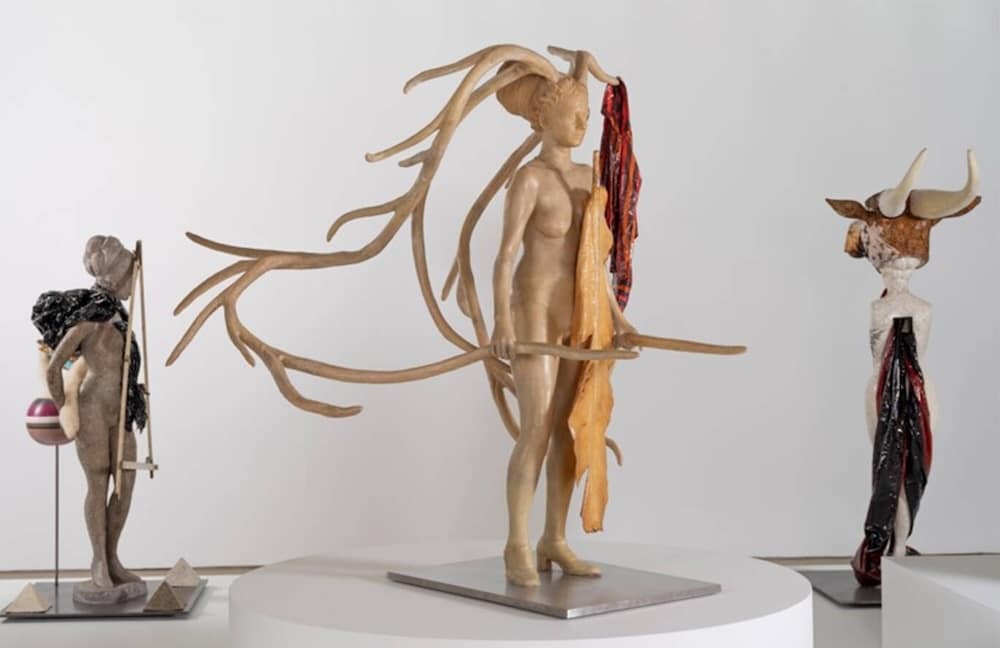
Bharti Kher, V&A South Kensington
‘Bharti Kher at the V&A’ is a new display of four contemporary sculptures by the internationally renowned British Indian artist, presented in dialogue with the museum’s historic collections. Kher’s sculptures and paintings are inspired by alchemy, magical transformation, the female body, and mythology. This display brings her work into conversation with the V&A’s historic collections, enabling her to delve into themes such as the body, womanhood, mythology, and cultural identity.
‘Finite Structures’ presents an interconnected set of sculptural, photographic, and animated film works by Bettina Grossman, known as Bettina, a conceptual artist who lived and worked in the Chelsea Hotel from 1972 until her death. Born in Brooklyn, New York, Bettina travelled between Europe and the United States as a designer during the 1950s and 1960s before settling in New York. Over the subsequent decades, she developed a prolific practice that rejected the singular art object in favour of a rich body of work encompassing photography, xerography, word art, film, computer-assisted animation, textiles, painting, and sculpture.
Engaging with themes of urban space, surface, rhythm, distortion, surrealism, and bodies in motion, ‘Finite Structures’ explores the topological and philosophical concerns that underpinned Bettina’s practice during the 1970s. Her artistic practice was characterised by a profound mathematical acuity, channelled through geometric, sequential, and modular forms. Her work consistently explored hypotheses on interrelation, regeneration, and evolution, frequently framed within the mystical-scientific concept of the fourth dimension. This approach anticipated procedural logics foundational to systems and digital-media art, yet her underlying conviction remained aligned with a modernist pursuit of spiritual insight through total abstraction. She often utilised serial presentations, emphasising the relationships between artworks rather than singular objects, reflecting her belief that a successful piece should evolve over time according to its own internal logic.
‘Reconstructed Landscape{s}’ is an exhibition by British-American artist Michael Takeo Magruder featuring recent pieces and in-progress studies that blend computational photography and bespoke AI techniques to reimagine specific locations of natural beauty. Each work is generated exclusively from the artist’s own field recordings captured on his Google Pixel phone, which are then recursively processed using traditional digital production tools and the latest generation of AI models.
This showcase also marks a key stage in Takeo’s development of ‘Sleeping Rivers, Vanishing Seas’, a new body of work exploring Azerbaijan’s culturally significant and environmentally fragile landscapes through the lens of climate change, digital imaging, and emerging technologies. The project is a collaboration between the artist, YARAT Contemporary Art Space, and Gazelli Art House, and is supported by the British Council’s ‘Connections Through Culture’ programme.
Takeo participated in the group exhibition ‘Parallel Worlds’ at Gazelli Art House Baku in 2024, presenting several works from the ‘Reconstructed Landscape{s}’ series. His visit to Azerbaijan for this exhibition was the catalyst for his subsequent research project.
Angel Otero has made his UK debut with a deeply personal body of work completed during an artist residency at Hauser & Wirth Somerset. Known for his physically immersive approach to paint as material, Otero transforms the medium itself—scraping, layering and peeling dried oil paint to create richly textured compositions that hover between abstraction and figuration. Paintings in this exhibition range from monumental compositions, including Otero’s largest figurative painting to date, that envelop the viewer in a fully immersive sensory experience to intimate encounters with smaller studies and works on paper, rarely presented outside the studio.
His signature mode of storytelling evokes how household objects become personified through the lens of memory. These objects, seemingly quotidian at first glance, serve as surrogates for family members and moments from the artist’s past. He has said that his work is about “the materiality of memory”, which, having grown up Catholic, involves some religious references.
Otero’s work is also included in the outdoor sculpture presentation at the Gallery in Bruton, which also features work by Jeffrey Gibson. Gibson is the Hauser & Wirth Somerset artist-in-residence during August. He is known for his immersive, multi-sensory installations that invoke and interweave disparate contexts, such as faith-based spaces of communion and nightclubs.
Over the past three decades, Gibson has developed a rich interdisciplinary practice that draws on American, Indigenous, and queer histories, as well as references to popular music, literature, and art-historical narratives. His distinctive visual language embraces a broad spectrum of cultural expressions and collaged identities in a way that is simultaneously intimate and radically expansive.
Gibson’s signature brightly coloured flags, which were first presented as part of his 2024 exhibition for the US Pavilion at the 60th Venice Biennale, are currently on display in front of Durslade Farmhouse in Somerset as part of the summer 2026 outdoor sculpture presentation. Each flag features a different pattern, text, lyric, or slogan that draws on American history, queer rights, and Indigenous perspectives.
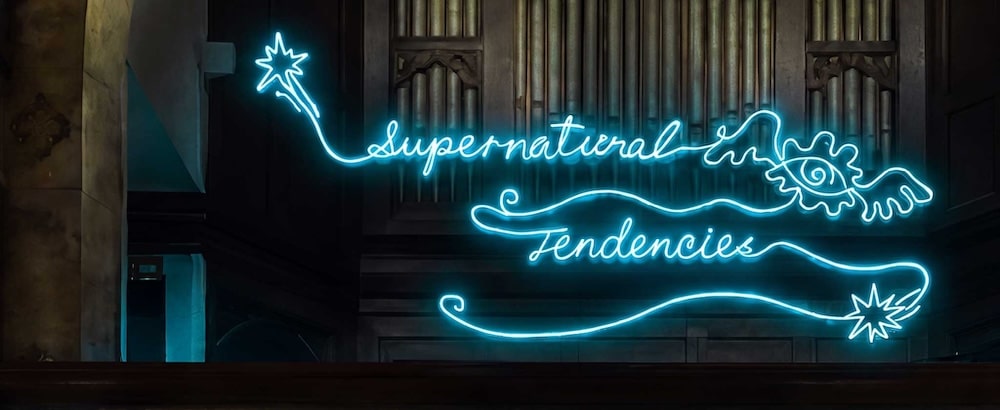
Charlotte Colbert, Fitzrovia Chapel
Following recent 30-foot-tall public installations across Manhattan and her Venice Biennale show ‘Possible Landscapes’, Charlotte Colbert returns to London with ‘Supernatural Tendencies’ at The Fitzrovia Chapel. This exhibition transforms the chapel into an immersive environment of sculpture, sound, and symbolic forms exploring dreams, ritual, memory, and unseen worlds.
New works in bronze and stainless steel include ‘Where Angels Live’, a monumental steel tree adorned with votive objects inspired by travels through Mexico and the Camino de Santiago, and the wishing well-inspired titular work, which offers a symbolic threshold between worlds. ‘Curiouser and Curiouser’ transforms a familiar form into a richly tactile sculpture evoking growth, connection, and storytelling. Colbert’s work has strong philosophical undertones and often explores themes of narrative, time, identity, dreams and the unconscious. The surreal and fantastical become ways to view our world anew and find space to question and reimagine.
Fitzrovia Chapel then presents a haunting new immersive sound installation by composer and sound artist Pete M. Wyer. ‘A Map of the Invisible’, created while Wyer was living in Venice, invites audiences to step inside sound and reflect on the unseen worlds that surround us. The result is a deeply moving encounter shaped by faith, care, suffering and beauty.
The richly decorated interior of the Fitzrovia Chapel – once the chapel of the former Middlesex Hospital – draws inspiration from Venice’s St Mark’s Basilica, one of the most influential buildings in music history. It was there that Renaissance composers pioneered the use of separate choirs in different galleries to create “spatial music,” centuries before the advent of modern audio technology.
Drawing on this legacy, Wyer has composed nine new vocal works for a 16-speaker immersive sound system within the Chapel walls. The pieces are interwoven with field recordings captured across Venice – church bells, footsteps, lapping water, voices and distant streets – creating a richly textured sonic environment. Reflecting the Fitzrovia Chapel’s own history, the works draw on deeply personal testimonies of illness, recovery, grief and resilience, alongside accounts of paranormal experiences associated with the site, including stories from former Middlesex Hospital staff.
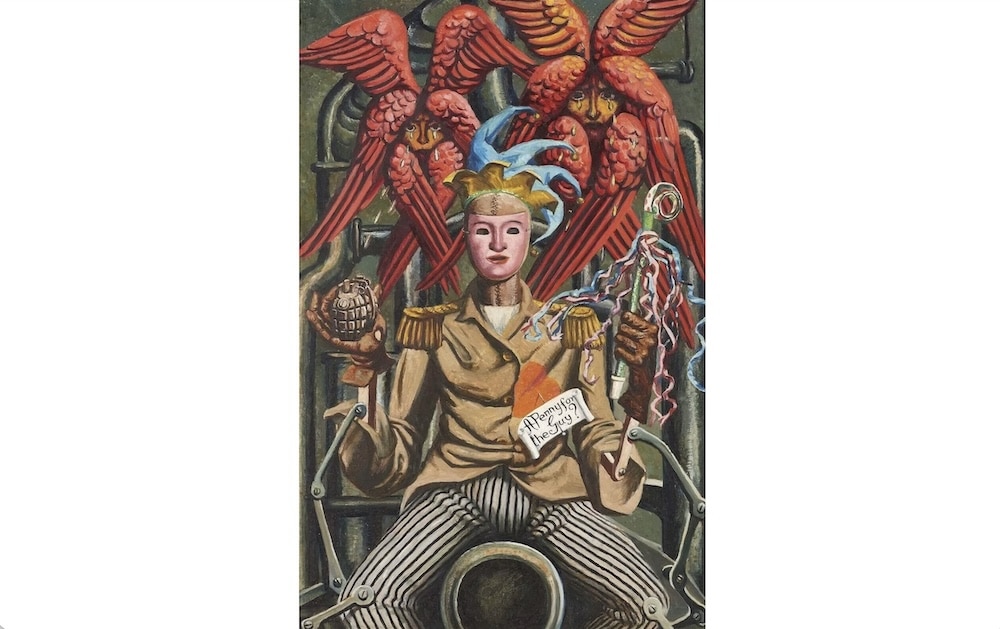
Gladys Hynes, Charleston
Charleston is hosting the first major exhibition devoted to Gladys Hynes, a pioneering artist whose work and politics were inseparable. ‘Radical Lives’ takes its title from the many lives Hynes lived within one lifetime: as an artist working across painting, sculpture, illustration and design, and as a pacifist, feminist, suffragist and Irish Republican. Moving through avant-garde circles including the Newlyn School, the Bloomsbury group’s Omega Workshops, Vorticism, and Surrealism, Hynes continually reinvented her practice in response to the world around her.
Seen today, her work speaks to questions of identity, belief and creative commitment that remain pressing. Received into the Roman Catholic Church in 1941, she was a feminist and suffragist, supporting St Joan’s Social and Political Alliance (originally called the Catholic Women’s Suffrage Society). The mid-1930s were a period of political and economic turmoil, during which many British artists engaged with anti-Fascist and pacifist causes. Many, like Hynes, supported the Republican faction in the Spanish Civil War and participated in charitable exhibitions, including ‘Artists Against Fascism and War’, held in 1935.
In 1916, after her brothers were sent to war, Hynes joined the Newlyn School in Cornwall, a community of artists committed to painting life as it was actually lived. She painted ‘Morning’ from Lamorna Cove, depicting a group of women in a moment of calm and solidarity as Britain was consumed by war. ‘The Chalk Quarry’ captures the economic strain of wartime Britain, while ‘A Penny for the Guy’ points the finger at the powerful men she believed drove conflict. She painted ‘Crucifixion’ in 1939 as one of several artistic statements against Britain’s declaration of war on Germany. As a devout Catholic from an Irish family, ‘Crucifixion’ symbolised how war affronted her Christian values. By 1941, her ‘Resurgimus’ painted hope out of the rubble of the Blitz.
‘Radical Lives’ brings together Hynes’s paintings, drawings, graphic designs and sculptures alongside works by her contemporaries and collaborators including Ithell Colquhoun, Gluck, Laura Knight, Evie Hone, Stanley Spencer, Marion Adnams, and Dod Procter.
‘The Nabi Shock’ brings together over 20 paintings by leading figures of the Nabi movement, Émile Bernard, Pierre Bonnard, Maurice Denis, Charles Filiger, Paul Ranson, József Rippl-Ronai, Ker-Xavier Roussel, Paul Sérusier and Édouard Vuillard. The paintings all date from a remarkably fertile period between 1888 and 1900, when the Nabis were actively working together in Paris.
In just 12 years, the Nabis radically redefined the possibilities of painting. Adopting the burgeoning view, as articulated by Denis, that a ‘painting – before being a warhorse, a nude woman, or an anecdote of any kind – is essentially a flat surface covered with colours, assembled in a certain order’, they heralded an artistic renewal. Paintings such as Bonnard’s ‘Étude pour ‘Le Corsage à carreaux’ and Vuillard’s ‘La Chambre verte, rue Truffaut’ are characterised by flat planes of unmodulated colour, distinctive outlines and textured surfaces that give Nabi painting its rhythm.
Several of the Nabis were committed Catholics, with Jan Verkade entering religious orders at the Beuron Monastery, where Fr Desiderius Lenz led its art school. Sérusier, after visiting Beuron, permeated his work with religious symbolism, including an exploration of the Golden Mean, while Denis established the Studios of Sacred Art together with George Desvallières.
The Nabis’ interests were wide-ranging: beyond canvases and works on paper, they designed theatre sets, posters and textiles. The exhibition presents Denis’ impressive stained-glass design ‘Le Cheval blanc’, Bonnard’s illustrations for musical scores and concert programmes, and Ranson’s Japanese-inspired ‘Le Grand Tigre’, a work that migrated from paper into carpets and painting.
Rather than depicting reality as it appeared before them, they wished to convey the experience of being enveloped in the world, engaging the viewer emotionally through the richness of the colours and the tactile quality of the brushstrokes. Guided by this interest in the inner life, Nabi subjects were often drawn from the immediate and personal: sisters, wives and mothers, or occasionally a celebrated stage actor. Most appear in quiet interiors or secluded gardens, exemplified by Roussel’s ‘Femmes au jardin’ and ‘Femme lisant’ by Vuillard.
‘The Nabi Shock’ celebrates the living history of a group that transformed modern painting with extraordinary boldness and places it amongst a new generation of artistic visionaries who reflect or reimagine that spirit.
John Rattigan’s current exhibition at St Oswald’s Church in Ashbourne comprises paintings on the theme of St Kevin and the Blackbird. This story is an Irish legend about the sixth-century Saint who, during Lent while praying with his arms outstretched, had a blackbird settle in his palm. The bird built a nest and laid its eggs. Kevin remained motionless for weeks, holding his hand steady through sun and rain, until the fledglings were old enough to fly away. The story is often interpreted as an act of profound selflessness, compassion and connection to nature. Rattigan says he had read the poem of the same title by Seamus Heaney and thought there was something outlandish yet touching about this tale that allowed him to add humorous touches and to capture a variety of this saint’s moods, from perplexed to bemused to exhausted.
‘The Strength to Be Joyful’ is a visionary art exhibition celebrating the life, spirit, and creative journey of Southern visionary artist Mary Proctor, also known to many as “Missionary Mary.” Raised by her grandmother in rural Florida, Proctor turned to art after a fire took her grandmother’s life. In the wake of this tragedy and during a deep depression, a spiritual vision told her to paint the door. Using salvaged materials and deeply personal memories, she creates powerful, joy-filled works layered with handwritten messages, broken china, house paint, and all sorts of odds and ends from her flea market past. Her astonishing life and luminous work speak to forgiveness, resilience, and the everyday miracles of love and faith.
This two-year exhibition at the American Visionary Art Museum (AVAM) features Proctor’s story in her own words and the many wisdoms she has gained throughout her life. ‘The Strength to Be Joyful’ invites viewers to reflect, heal, and carry forward the courage and joy that she has so generously shared for more than 30 years. In a world too often darkened by despair, AVAM shines a spotlight on a woman whose life and work sing like a gospel choir to the redemptive power of joy, love, and spirit-led creativity.
Lead image: Kaimurai , “The answers to all my prayers are in the questions I never asked”, 2025, installation view in Hyundai Translocal Series: Entangled and Woven, Cheongju Craft Biennale 2025 © Cheongju Craft Biennale Organizing Committee, photo by Wooil Kim.
‘Directionless’, 21 June – 25 October 2026, Hauser & Wirth Menorca – Visit Here
‘The Fountain Overflows curated by Yates Norton’, 4 June – 25 July 2026, GRIMM London – Visit Here
‘Hyundai Translocal Series: Entangled and Woven’, 10 July 2026 – 3 January 2027, The Whitworth – Visit Here
‘Bharti Kher at the V&A’, Opens Monday, 20 July 2026, V&A – Visit Here
‘Bettina: Finite Structures’, 5 June – 12 July 2026, Cento – Visit Here
‘Reconstructed Landscape{s}’, 29 June – 1 August 2026, Gazelli Art House – Visit Here
‘Angel Otero: Agua Salada’, 2 May – 18 October 2026, Hauser & Wirth Somerset – Visit Here
Outdoor sculpture presentation, 2 May – 18 October 2026, Hauser & Wirth Somerset – Visit Here
‘Supernatural Tendencies: Charlotte Colbert’, 1 July 2026 – 9 July 2026, Fitzrovia Chapel – Visit Here
‘A Map of the Invisible: A new immersive sound work by Pete M. Wyer’, 13 – 24 July 2026, The Fitzrovia Chapel – Visit Here
‘Gladys Hynes: Radical Lives’, 2 May – 11 October 2026, Charleston – Visit Here
‘The Nabi Shock’, 24 June – 12 September 2026, Waddington Custot – Visit Here
‘St Kevin and the Blackbird’, 20 June – 7 July 2026, St Oswald’s Church, Ashbourne – Visit Here
‘The Strength to Be Joyful: Messages from Mary Proctor’, 2 August 2025 – 2 August 2027, American Visionary Art Museum – Visit Here