
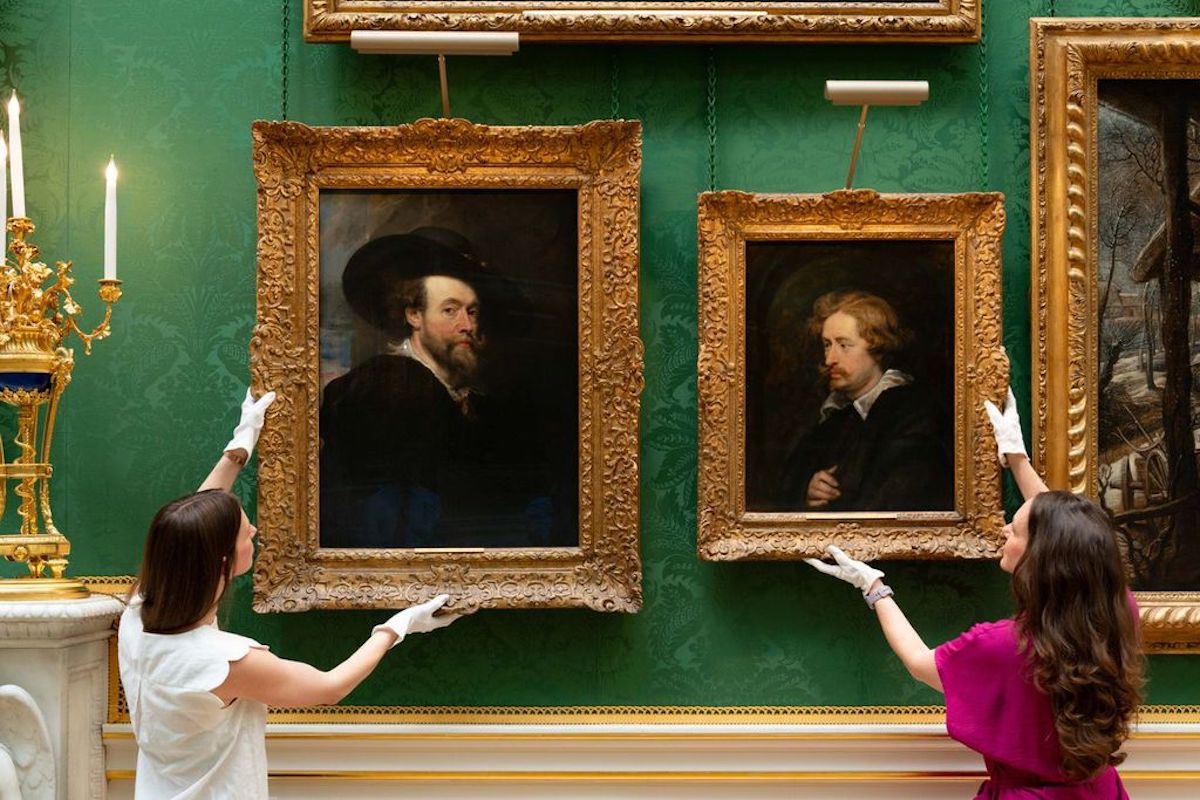
The Picture Gallery at Buckingham Palace reopens this week with its most significant re-display in a generation. From Thursday 9 July, visitors will find almost double the number of paintings on show, the total rising from 63 to 120, with new silk wall hangings in emerald green, updated lighting and a hang that took 875 hours to complete. The room now looks substantially different.
John Nash originally designed the gallery as part of George IV’s transformation of Buckingham House into a palace, specifically to showcase the king’s extraordinary collection of paintings. George IV died before seeing it finished. The first arrangement was in place by the time Queen Victoria came to the throne in 1837, and the room has been evolving since. Curators working on the current re-display drew on historic watercolours, photographs, inventories and architectural schemes to bring it closer to how the room looked at various points in its history, particularly the 1840s hang under Victoria.
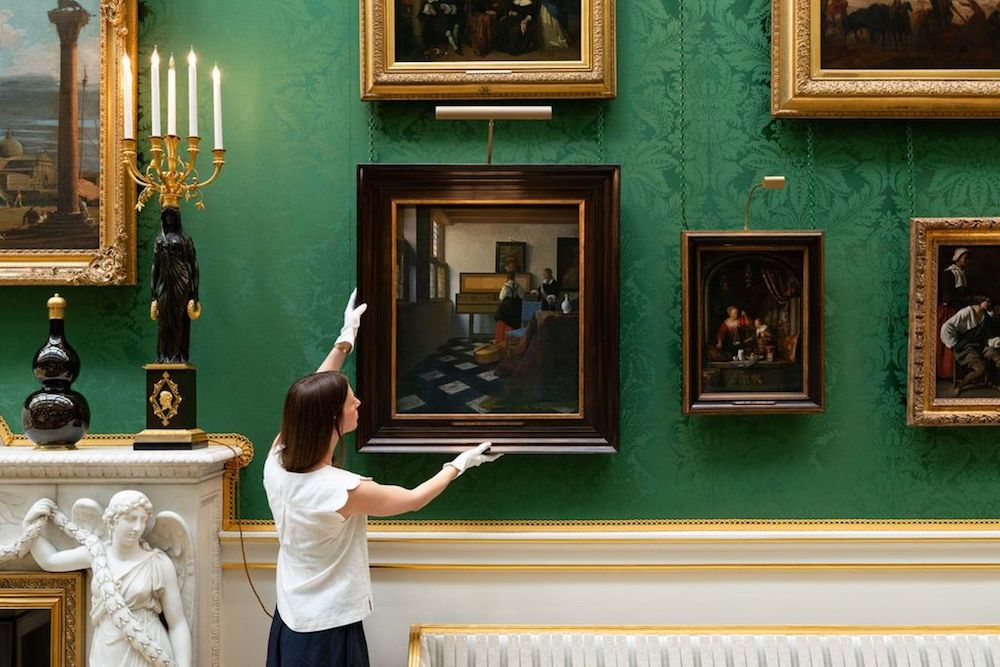
Rehanging the Royal Collection Buckingham Palace
The wall colour alone has changed numerous times. Golden yellow, lilac, crimson red, olive green, and coral pink velvets were installed in 1976 and remained for 50 years before the fabric deteriorated. The new emerald-green silk damask replaces it. The colour suits the paintings.
Among the highlights is The Tribuna of the Uffizi by Johan Zoffany, now making what feels like a natural return to the Picture Gallery, having been recorded there in 1841. The painting depicts the famous Florentine gallery filled with masterpieces and animated by visitors studying and discussing the works around them. Commissioned by Queen Charlotte, it reportedly displeased her with its crowded, unconventional composition and was never hung in her apartments. The irony of a painting about a picture gallery finding its proper home in a picture gallery is not lost.
Five Rembrandts and one work attributed to his studio are now hung together, allowing the breadth of his practice to register across a single wall. Seven works by Rubens have been brought into proximity, including a pairing that is one of the more historically resonant moments in the re-display: Rubens’s Self Portrait shown alongside his newly added portrait of Anthony Van Dyck. The two artists knew each other well, Van Dyck having entered Rubens’s studio as a teenager. The portraits were recorded hanging together at Whitehall Palace in the 1660s. Reuniting them here recreates something lost for more than three centuries.
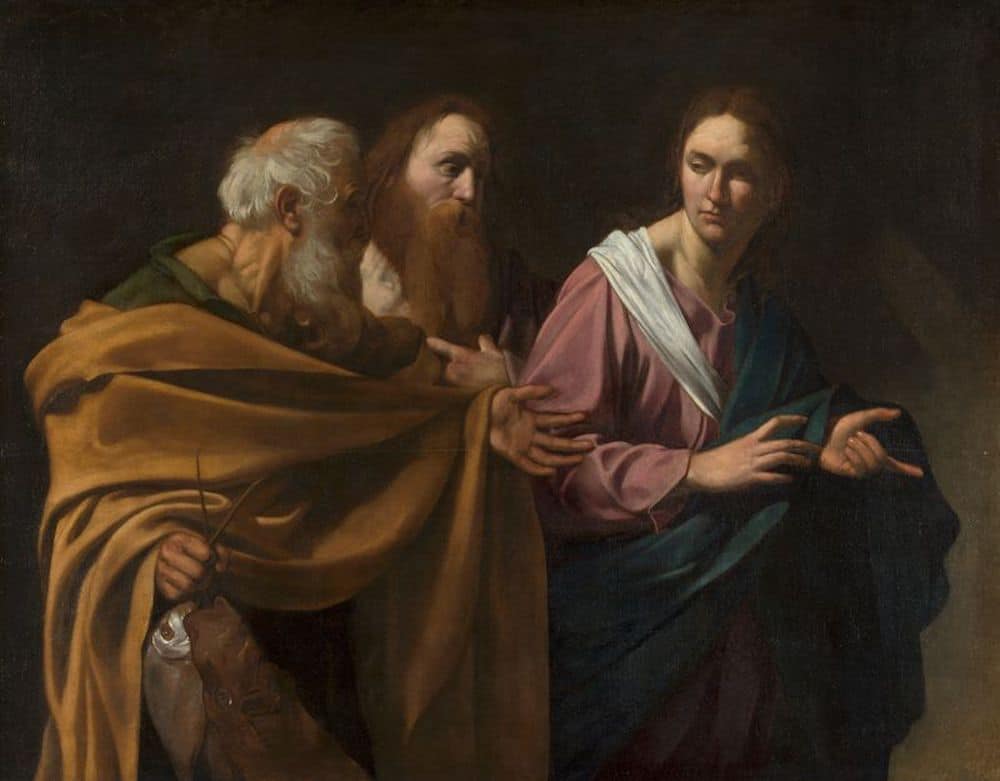
Caravaggio, The Calling of Saints Peter and Andrew, c.1602–4
Caravaggio’s The Calling of Saints Peter and Andrew has been added to the room, its characteristic dramatic lighting now in dialogue with Van Dyck’s Christ Healing the Paralysed Man and The Young Cardplayers by the Le Nain brothers, who were directly influenced by the Italian master’s narrative naturalism. The groupings throughout the re-display follow shared geography, period, or subject matter, but the more interesting connections are those that cut across those categories.
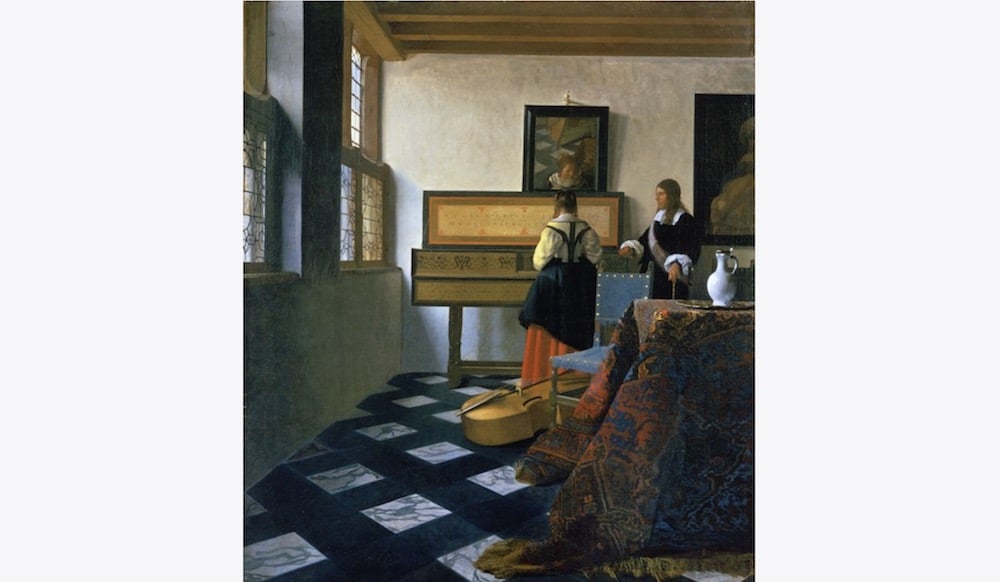
Johannes Vermeer, Lady at the Virginals with a Gentleman (‘The Music Lesson’), early 1660s
Vermeer’s Lady at the Virginals with a Gentleman remains in the 47-metre-long gallery, acquired originally by George III. It is now joined by The Letter by Vermeer’s contemporary Gerard ter Borch, an intimate scene of a woman with a letter whose sumptuous silk satin dress is painted with the kind of attention to material surface that places ter Borch among the most accomplished of his generation. He was celebrated in his own time and is still somewhat underrated in ours.
George Stubbs contributes A Rough Dog, believed to show George IV’s pet. Gainsborough’s portrait of Johann Christian Fischer, not previously thought to have hung in the Picture Gallery, is a new addition. The twelve Canaletto scenes of Venice remain, as does Frans Hals’s charismatic Portrait of a Man and a Titian Madonna and Christ Child.
Also on show this summer, though in the adjacent Silk Tapestry Room rather than the gallery itself, is a large oil study of King Charles III by Jonathan Yeo, made in 2023 in preparation for a portrait commissioned by the Drapers’ Company and recently gifted to the Royal Collection by the artist.
The Picture Gallery attracts more than half a million visitors each year. Tickets are bookable through the Royal Collection Trust, with concessions including half-price entry for children, discounted young-person tickets for those aged 18 to 24, and a £1 ticket scheme for visitors receiving Universal Credit and other benefits. Tickets purchased directly can be converted into a one-year pass for free re-admission.
The State Rooms open to visitors from Thursday 9 July.