
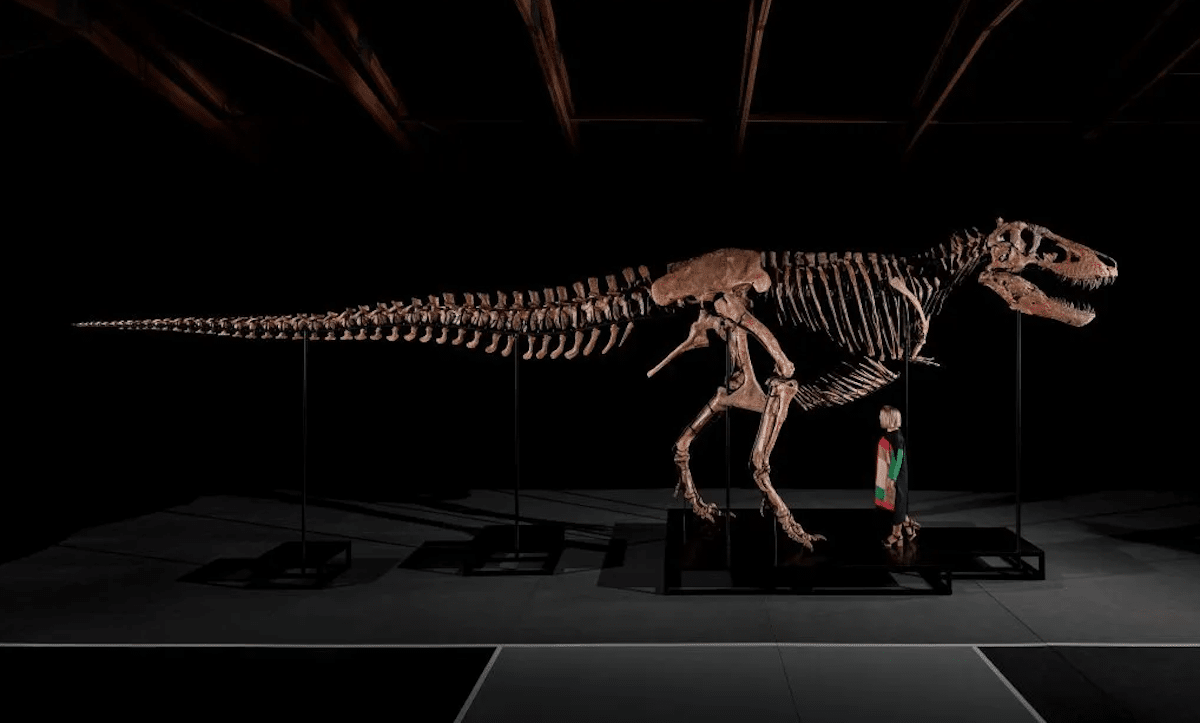
A Tyrannosaurus rex skeleton measuring nearly 40 feet long and standing over 12 feet tall has sold at Sotheby’s for $50.1 million with fees, setting a new world record for a fossil at auction and continuing the remarkable rise of prehistoric natural history as a serious collecting category.
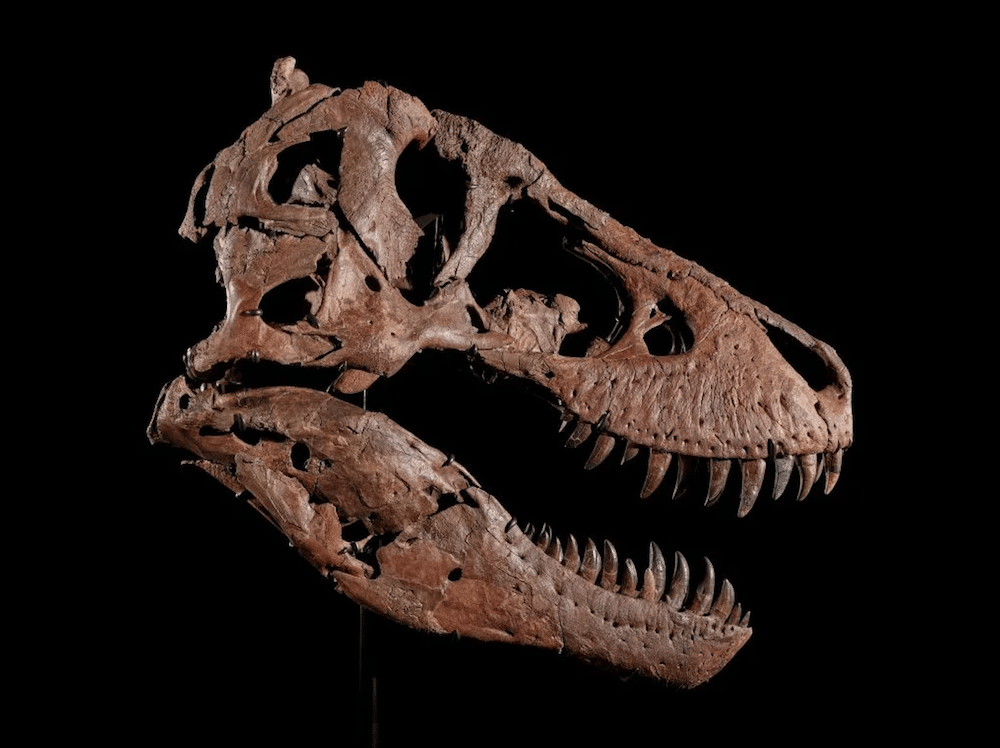
The specimen, known as Gus, dates back 67 million years and is among the largest and most complete T. rex skeletons ever recovered, with approximately 82 per cent of its bones preserved and an exceptionally well-preserved skull. The scale and density of bone development indicate that the individual is a large, fully mature adult. Gus was the headline lot of Sotheby’s Geek Week, a series of three sales grouped under the titles Natural History, Space Exploration, and History of Science and Technology. It carried a presale estimate of $30 million and comfortably exceeded it.
The result places Gus well ahead of the previous auction record for a fossil, set just last year when Sotheby’s sold Apex, a near-complete stegosaurus, for $44.6 million. Before that, Christie’s had taken $31.8 million for Stan, another T. rex, in 2020. The trajectory is steep. When Sotheby’s sold Sue, then the most complete T. rex skeleton known, for $8.4 million in 1997, the result was treated as a curiosity, a moment when the art world briefly intersected with palaeontology. Nearly three decades on, the market for significant fossil specimens has developed its own infrastructure of dealers, excavators and specialist preparators, and the prices being achieved place the best examples in the same conversation as major works of art.
Gus, the Tyrannosaurus rex. Photo: Matthew Sherman, courtesy of Sotheby’s
Whether that is a good thing remains genuinely contested. Natural history museums have long argued that significant fossil specimens belong in public institutions where they can be studied and viewed freely, and that the growing private market risks pulling scientifically important material out of reach of researchers. Auction houses and private sellers counter that excavation, preparation and conservation are expensive, and that the market provides resources that publicly funded institutions cannot always match. The debate has not been resolved, and sales like this one tend to reopen it.
What is not in dispute is Gus’s physical quality. The skeleton was prepared to exhibition standard, mounted and presented in a way that makes its sheer scale immediately apparent. At nearly 40 feet, it occupies a room in a way that very few objects can, and the preservation of the skull, in particular, gives it a presence that photographs struggle to convey. For the buyer, whoever they are, the question of where to put a 40-foot Tyrannosaurus rex is presumably as much part of the appeal as the challenge.
The $50.1 million result will not quiet the debate about where these specimens should end up. But as a demonstration of how far and how fast this market has moved since the late 1990s, the numbers are hard to dispute.
Gus the Tyrannosaurus rex. Photo: Matthew Sherman, courtesy of Sotheby’s