

Both Christie’s and Sotheby’s have reported substantial increases in their first-half 2026 figures, with public auction sales up sharply at both houses and private sales reaching record levels. The results reflect a market that has regained considerable momentum after a difficult 2025, driven by a combination of major estate sales, conservative estimates, increased bidder numbers and sustained growth in luxury categories.
Christie’s reported total revenue of $4.5 billion for the first six months of the year, with public auction sales reaching $3.5 billion, up 71 per cent on the same period in 2025. The sell-through rate by lot stood at 91 per cent. Private sales contributed just over $1 billion. Sotheby’s figures were closely comparable: public auction sales of $3.4 billion, up 59 per cent year on year, with a 90 per cent sell-through rate, and private sales of $826 million, a record for the house. Total turnover at Sotheby’s reached $4.4 billion, also a record.
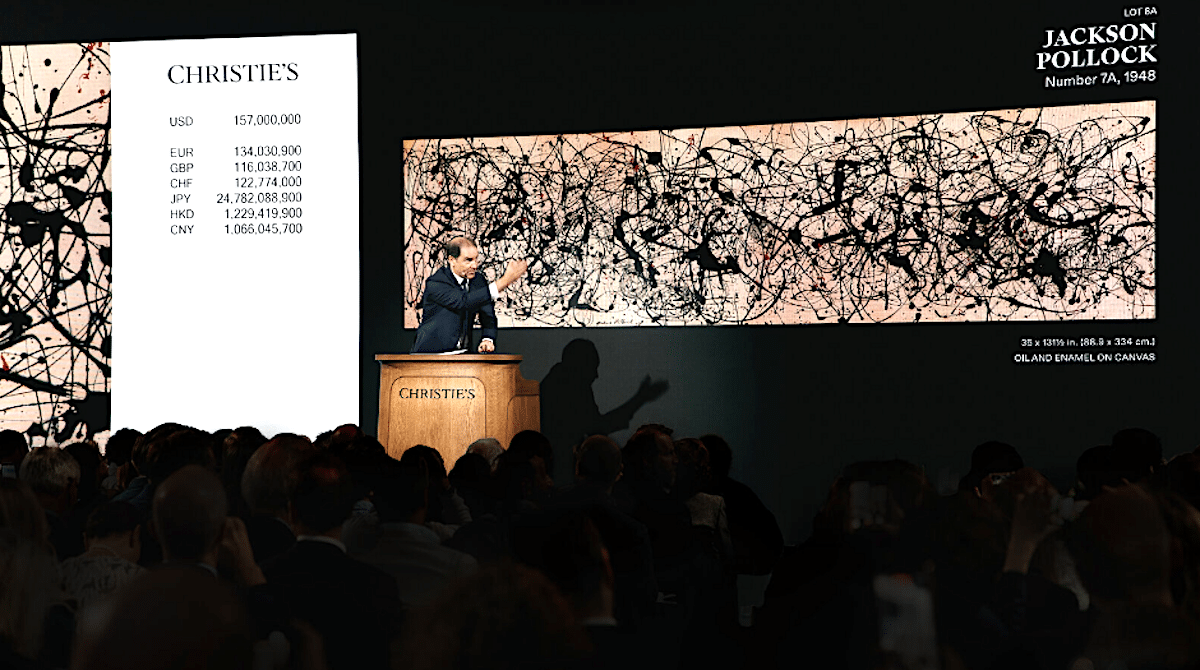
The standout result of the period was Christie’s May sale in New York of works from the collection of publishing magnate S.I. Newhouse, which totalled $630.8 million. The three most valuable lots of the entire half-year appeared in that sale and in the adjacent Agnes Gund collection offering: Jackson Pollock’s Number 7A from 1948 made $181.2 million, Constantin Brancusi’s Danaïde reached $107.6 million and Mark Rothko’s No. 15 (Two Greens and Red Stripe) from 1964 sold for $98.4 million. Christie’s Old Masters category, which generated $183 million including a record-breaking June evening sale, was up 232 per cent on 2025.
At Sotheby’s, the marquee week in May produced total sales of $908.6 million, led by the late dealer Robert Mnuchin’s collection at $173 million. The Lewis collection sale in London in June, which achieved $406.2 million, was described by Sotheby’s as the highest value sale of Impressionist, modern and contemporary art ever staged in Europe.
Twentieth and twenty-first-century art remains the dominant category at both houses, accounting for $2.3 billion at Christie’s and an estimated $1.9 billion at Sotheby’s. But luxury has emerged as the second-most significant revenue stream for both firms and, increasingly, their primary route to younger buyers. Christie’s luxury sales reached $539 million in the first half, up 15 per cent, encompassing watches, jewellery, cars, handbags and memorabilia. The sale of businessman Jim Irsay’s collection of Americana across five auctions totalled $105.2 million, the highest result ever achieved for a memorabilia collection.
The watch market has been particularly strong. Sotheby’s global head of luxury Josh Pullan described the first half as a record period for the category, driven by a younger and more internationally diverse buyer base. Millennials and Generation Z now account for roughly a third of watch bidders at Sotheby’s, and the average spend per bidder has risen around 60 per cent year on year to $129,000. Pullan attributed part of the growth to a shift in taste toward independent makers known for craft and rarity, naming F.P. Journe, Simon Brette and Rexhep Rexhepi as examples, and described this as a long-term structural change in the market rather than a short-term spike.
Christie’s chief executive Bonnie Brennan noted that 85 per cent of the house’s bids this year came via online platforms, and that 47 per cent of new clients so far in 2026 are Millennials or Generation Z. She described the current buyer base as disciplined and pricing-aware, and pointed to a strategy of conservative estimates as a key factor in the high sell-through rates. A Monet offered at $6 million to $8 million in May sold for $19.6 million. Brennan was equally direct about what happens when estimates are pushed: “where estimates got pushed, bidding was thinner.”
Art financing has become an increasingly significant part of both businesses. Sotheby’s completed a $900 million securitisation issuance in January, bundling art-backed loans into tradable notes and, for the first time, including loans secured against collectable cars. The issuance was described as significantly oversubscribed. Ron Elimelekh, co-head of Sotheby’s Financial, said the strong investor demand reflected confidence in the underlying loan portfolio and pointed to the growing institutionalisation of art-backed lending as a long-term development. Christie’s, which launched its financing arm five years ago, has extended the model to cover cars, handbags, watches and wine as well as art.
Brennan described the service as a way to deepen client relationships and offer a full range of options for managing and monetising collections, noting that many borrowers do not need capital but are simply choosing to optimise how they deploy it. Sotheby’s separately completed an $825 million bond issuance in April, refinancing existing debt and improving the company’s overall financial position.
Looking ahead, Brennan expressed cautious confidence, noting that several discretionary sellers had come to market in 2026 on the strength of the late 2025 recovery and that this trend seemed likely to continue. She was less willing to make predictions beyond the next three or four months. “Nobody has a crystal ball,” she said.
Top Photo: “Number 7A, 1948,” by Jackson Pollock. Photo Courtesy Christie’s