

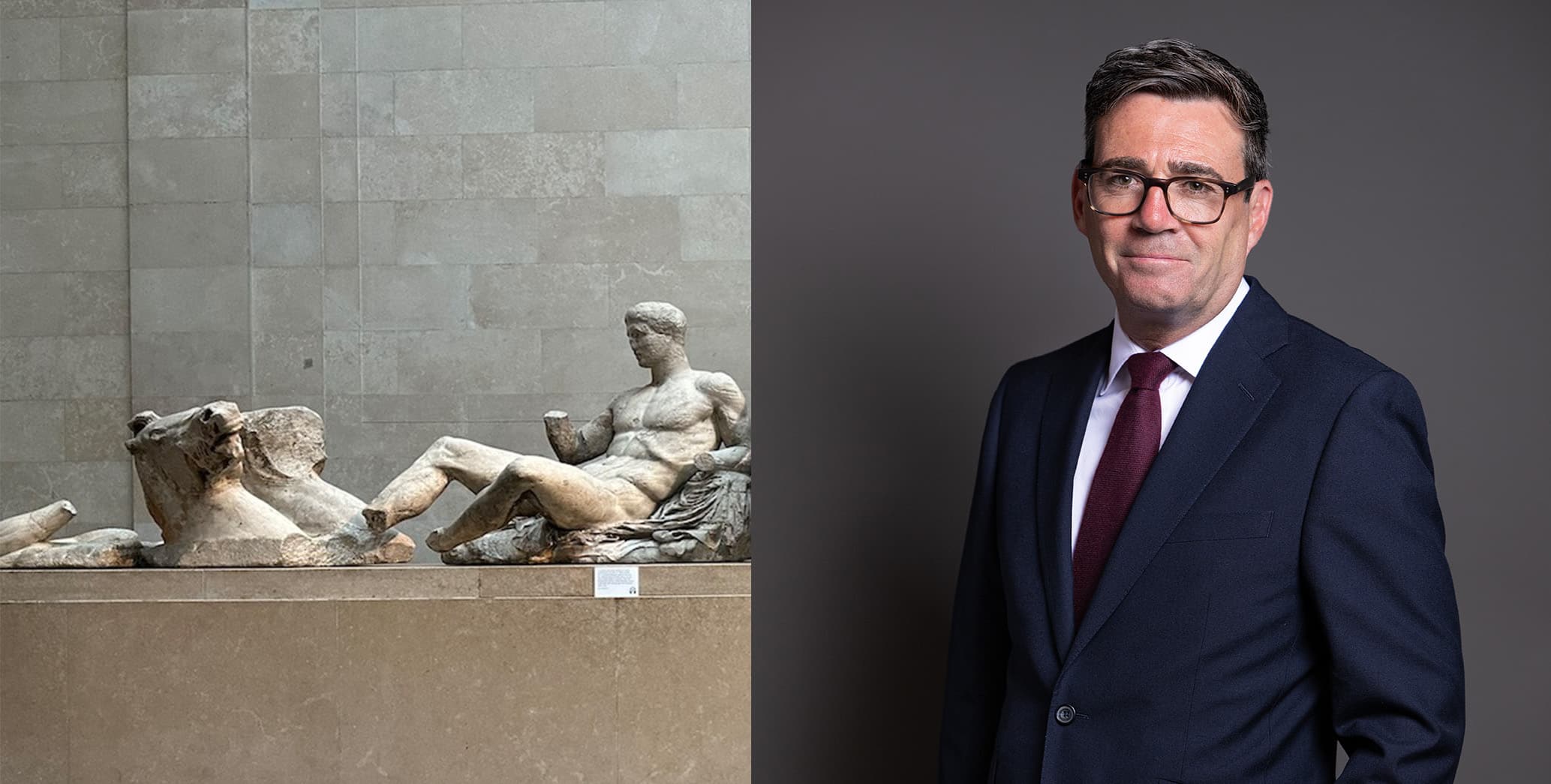
Andy Burnham is facing criticism after appearing to retreat from his long-standing support for the return of the Parthenon Sculptures to Greece. The Prime Minister has previously taken an unequivocal position on the disputed sculptures, calling in 2023 for the British Museum to “send them back, no strings attached”. He had also supported efforts to change the law to make their return possible.
But according to a new Financial Times report, Burnham has now shifted his position, saying that the future of the 2,500-year-old sculptures is a matter for the trustees of the British Museum to resolve. The change has prompted accusations that the Prime Minister is backing away from a position he maintained for many years. His earlier stance was unusually direct. In 2023, Burnham not only supported the return of the sculptures to Athens but also explicitly rejected the idea that Greece should have to offer anything in return.
His position had been consistent long before he entered Downing Street. In 2001, he supported calls for discussions with Greece over returning the sculptures, and in 2002 he co-introduced a Private Member’s Bill seeking to amend the British Museum Act 1963. Artlyst reported last month that Burnham had maintained his support for nearly a quarter of a century. The issue is complicated by the British Museum’s legal position. The museum is operationally independent of government, and decisions concerning its collection rest with its trustees. The British Museum Act 1963 also prevents the institution from permanently removing objects from its collection.
That distinction appears to be central to Burnham’s new position. Rather than pressing the government to intervene, he is now leaving the question with the museum. The timing is particularly significant. The British Museum has been exploring the possibility of a cultural agreement with Greece, with discussions reportedly centred on a potential loan of the sculptures. The museum’s director, Nicholas Cullinan, has pointed to the forthcoming British exhibition of the Bayeux Tapestry as an example of the kind of international cultural cooperation that could serve as a model for an agreement on the Parthenon Sculptures.
For Greece, however, a temporary loan does not resolve the central dispute. The Greek government has long sought the reunification of the sculptures in Athens, where the surviving elements of the Parthenon are displayed at the Acropolis Museum.
Burnham’s apparent retreat therefore marks a significant change from the position he expressed only three years ago. His earlier call for an unconditional return left little room for ambiguity. His latest comments place the responsibility firmly with the British Museum. The question now is whether this represents a permanent change in the Prime Minister’s position or simply a recognition of the legal and institutional barriers surrounding the collection. For supporters of the sculptures’ return, the distinction may prove important.
Either way, a politician who once demanded that the Parthenon Sculptures be returned “no strings attached” is now leaving their fate in the hands of the institution that has held them for more than two centuries.
Burnham is not the first Prime Minister to backtrack on support for the marbles’ return. Boris Johnson campaigned for the marbles’ return while a student at Oxford. This support ended when he entered into public office.
In an Artlyst article dated 20 July 2026, we reported that Burnham would become the first serving British Prime Minister with a publicly documented and consistently held record of supporting the return of the Parthenon Marbles to Greece, a position he has maintained for nearly a quarter of a century across roles as a backbench MP, Culture Secretary and Mayor of Greater Manchester. This has now changed.
The finding comes from a review by the Greek daily newspaper Ta Nea, which traced Burnham’s public interventions on the issue back to October 2001, just four months after he entered the House of Commons as MP for Leigh. On 31 October that year, he signed an Early Day Motion calling on Tony Blair’s government to enter immediate discussions with Athens with a view to returning the sculptures to the Acropolis Museum. He followed this in February 2002 by co-introducing a Private Member’s Bill that sought to amend the British Museum Act 1963, the legislation that currently prevents the museum from permanently transferring the sculptures. The bill did not proceed, but Burnham’s name appeared on two further parliamentary motions on the same subject before the year was out, and again on another Private Member’s Bill in July 2003.
These early interventions, at a time when support for returning the marbles was far from mainstream at Westminster, established a pattern that Burnham has never publicly reversed. When he served as Culture Secretary under Gordon Brown between January 2008 and June 2009, a Greek source told Ta Nea that he expressed willingness during official meetings to work with Athens toward a resolution. A cabinet reshuffle moved him to the Department of Health just six weeks after that engagement, cutting short what the source described as the most promising ministerial approach to the issue in years.
His most direct statements came more recently. In March 2020, as Mayor of Greater Manchester, he marked the death of Labour MP Eddie O’Hara, a longstanding campaigner for reunification, by writing on social media that O’Hara had persuaded him to support the return of the sculptures and that, given Britain’s changed position in the world following Brexit, “now is the time to return the Marbles.” In February 2023, asked about the issue during the reopening of Manchester Museum, his answer was brief and unqualified: “Yes, George Osborne should give the Elgin Marbles back.” The following day he went further still, responding to a journalist by writing: “Send them back, no strings attached. And let’s use culture to change how Britain is seen around the world.”
That final phrase is significant. In explicitly rejecting the idea that Greece should offer anything in exchange for reunification, Burnham went beyond even Greece’s own publicly stated negotiating position. Prime Minister Kyriakos Mitsotakis has said Greece would be willing to arrange temporary exhibitions of important Greek antiquities in London as part of a broader cultural partnership. Burnham’s formulation required nothing of the sort.
His position places him in sharp contrast to his predecessors. Boris Johnson argued, as Oxford Union president in 1986, that the sculptures should be returned to Greece. Still, he reversed that view well before entering Downing Street and defended their retention at the British Museum during his time as Mayor of London. Jeremy Corbyn declared unequivocally in 2018 that the sculptures belonged in Greece, but never reached Downing Street to act on it. Sir Keir Starmer made no public endorsement of reunification during his time as Labour leader or Prime Minister, despite early suggestions that a Labour government might facilitate progress between the British Museum and Athens.
A Greek official familiar with the negotiations told Ta Nea that Burnham’s record “gives cause for optimism that the new British government may take a different approach to the issue” and that for the first time a British Prime Minister has been shown to support reunification before taking office.
The negotiations themselves have been at a standstill. George Osborne, chair of the British Museum, has held talks with the Greek government since November 2021, pursuing what he has described as a mutually beneficial arrangement under which the marbles would be seen in both London and Athens. Ta Nea reported last November that Osborne proposed transferring approximately 20 per cent of the collection, specifically sections of the frieze, to Athens for a limited period. Athens rejected the proposal. Greece continues to seek the permanent reunification of the entire London collection: 15 metopes, 17 pedimental figures and 75 metres of the original frieze. Talks have been effectively deadlocked since last autumn, with no common ground found on the fundamental questions of how many sculptures would be transferred and for how long.
Sir Stephen Fry, who serves on the advisory board of the Parthenon Project, a UK organisation campaigning for permanent reunification, welcomed Burnham’s imminent arrival at Downing Street. “Over many years, he has spoken with admirable consistency and conviction about the Parthenon Marbles,” Fry told Ta Nea. “I very much hope that under his leadership we may finally witness the political will that has so often been the one missing ingredient.”
Sir Ben Bradshaw, who succeeded Burnham as Culture Secretary in 2009 and also serves on the Parthenon Project’s advisory board, described Burnham’s record as giving him renewed hope, while noting that momentum on a cultural deal had been lost in recent months. He pointed to growing public interest in the ancient world and the forthcoming release of a film adaptation of The Odyssey as factors likely to intensify attention on the issue. “Andy understands the unanswerable moral and cultural case for the reunification of the sculptures,” Bradshaw said.
Paul Cartledge, A.G. Leventis Professor of Greek Culture emeritus at Cambridge and Vice-Chair of the British Committee for the Reunification of the Parthenon Marbles, also welcomed the development, citing Burnham’s personal connection to O’Hara as particularly meaningful to those who have campaigned on the issue for decades.
Whether Burnham will seek to translate a quarter-century of personal advocacy into government policy is the question that Athens, London’s cultural community, and campaigners on both sides of the argument will now be watching very closely. The constitutional position remains that decisions about the British Museum’s collection rest with the museum itself, and the legislation preventing permanent transfer remains in place. But a Prime Minister who has said publicly, and more than once, to send them back with no strings attached is a rather different starting point than anything Greece has previously faced across the negotiating table.