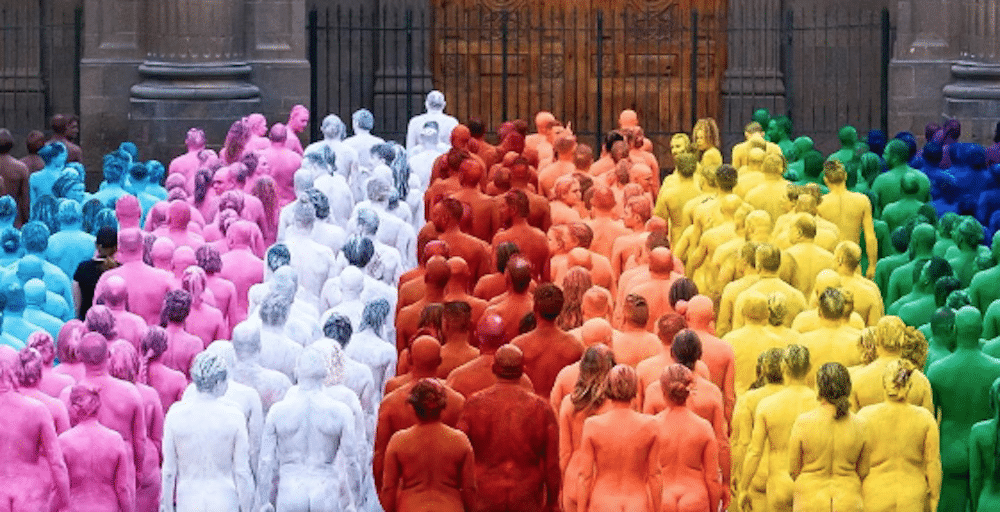
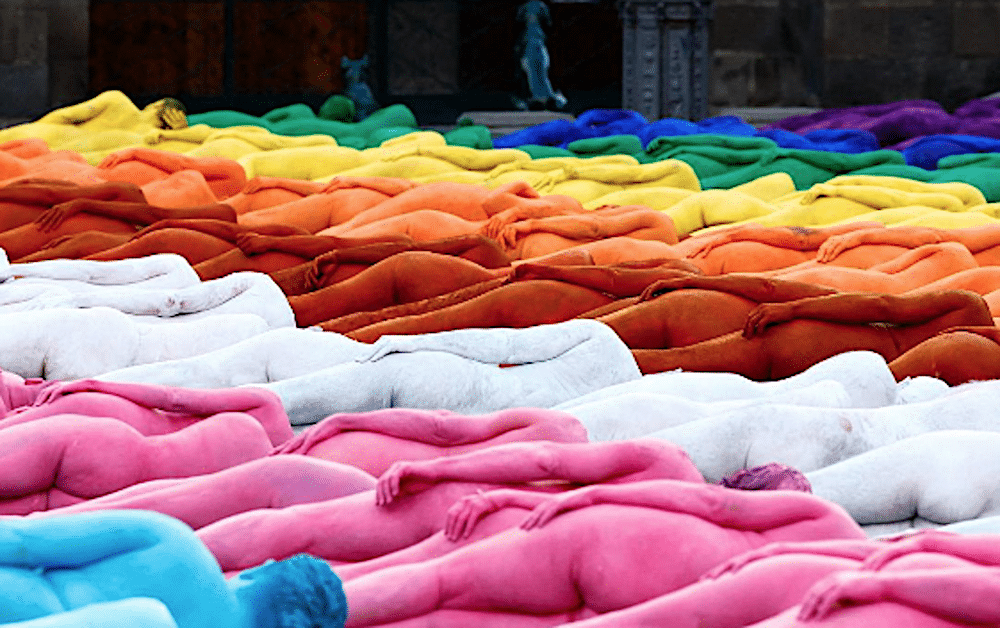
Spencer Tunick brought his latest large-scale nude action to Las Palmas, the capital of Gran Canaria, on 26 July, assembling between 400 and 500 volunteers in the public square in front of the Catedral de Santa Ana for a dawn gathering titled Gran Spectrum. The installation, organised as part of the Culture and Business Pride 2026 festival, marked a departure from Tunick’s usual approach of photographing unadorned or monochromatically painted bodies. This time, participants were painted in all eleven colours of the Pride flag, including white, pink, black and brown alongside the more familiar rainbow spectrum.
The action took place in the early hours of the morning with no public spectators present, only Tunick and his production team on site. The cathedral, a sixteenth-century Roman Catholic church in the historic centre of Las Palmas, provided the backdrop, and the Bishop of the Canary Islands, José Mazuelos, whose residence sits directly adjacent to the square, told El País that he had no objection. “When we go to the beach we see naked bodies, don’t we?” he said.
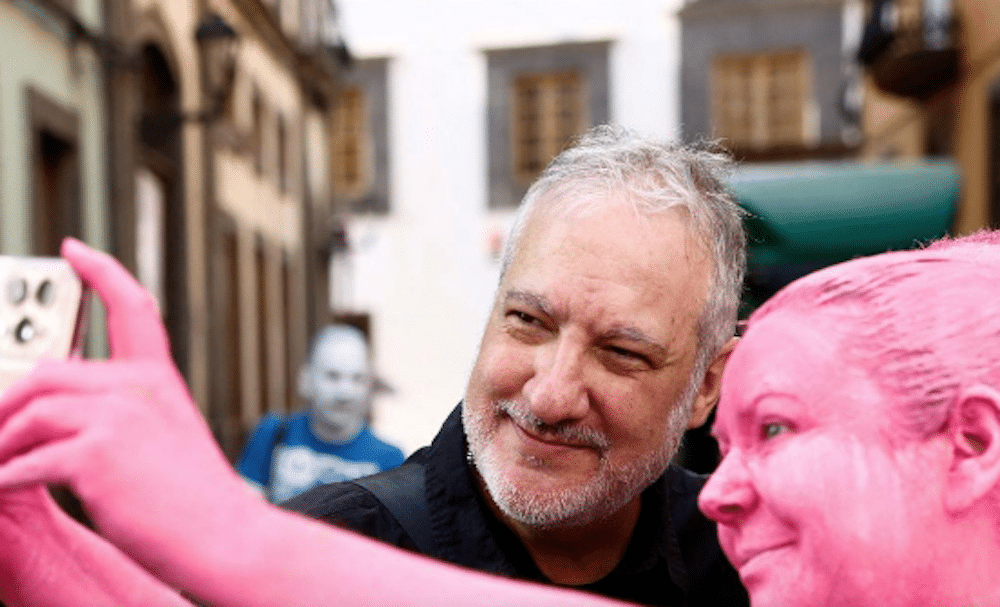
spencer tunick
Tunick has been staging these collective actions since the early 1990s, when he began photographing single nude figures in public spaces around New York City before quickly scaling up to the mass gatherings that have become his signature. He staged his first large-scale installation outside the United Nations headquarters in 1994 with 28 participants. Since then he has directed more than a hundred temporary installations across four continents, in cities including Sydney, Munich, Lyon, Barcelona, Cape Town, Moscow and on the surface of the Dead Sea. His largest to date remains the Mexico City action of 2007, when approximately 18,000 people lay down together in the Zócalo, the city’s vast central square.
Born in Middletown, New York in 1967, Tunick studied photography at Emerson College and the International Centre of Photography. His work has consistently tested the boundaries between art, public space and obscenity law, and he has been arrested multiple times in New York in the early years of his practice. The legal battles that followed helped establish important precedents around artistic freedom in public spaces in the United States.
spencer tunick
His approach treats the human body not as a subject of erotic imagery but as living sculptural material, anonymous individual forms combining to create abstract shapes and patterns that interact with the architecture and landscape around them. The addition of colour in recent projects, and in Gran Spectrum most explicitly of political colour, extends that logic into new territory, using the body as both form and symbol simultaneously.
The Gran Canaria installation is among the most overtly political of his career in terms of its visual language. However, Tunick has always maintained that the act of gathering large numbers of people to disrobe in public is itself a political gesture, one that challenges social conventions around the body, nudity and collective vulnerability. That a Catholic bishop in a conservative religious institution responded with equanimity rather than outrage perhaps says something about how far that conversation has moved since Tunick first started photographing strangers on the streets of downtown Manhattan more than thirty years ago.
Photos via TikTok
Read More