
A group of heirs to the Jewish banker Salomon Flavian has taken Sotheby’s to court in Paris, disputing the auction house’s 2024 sale of a Camille Pissarro painting they say was looted by the Nazis, and arguing that a settlement covering the sale left most of the family out entirely.
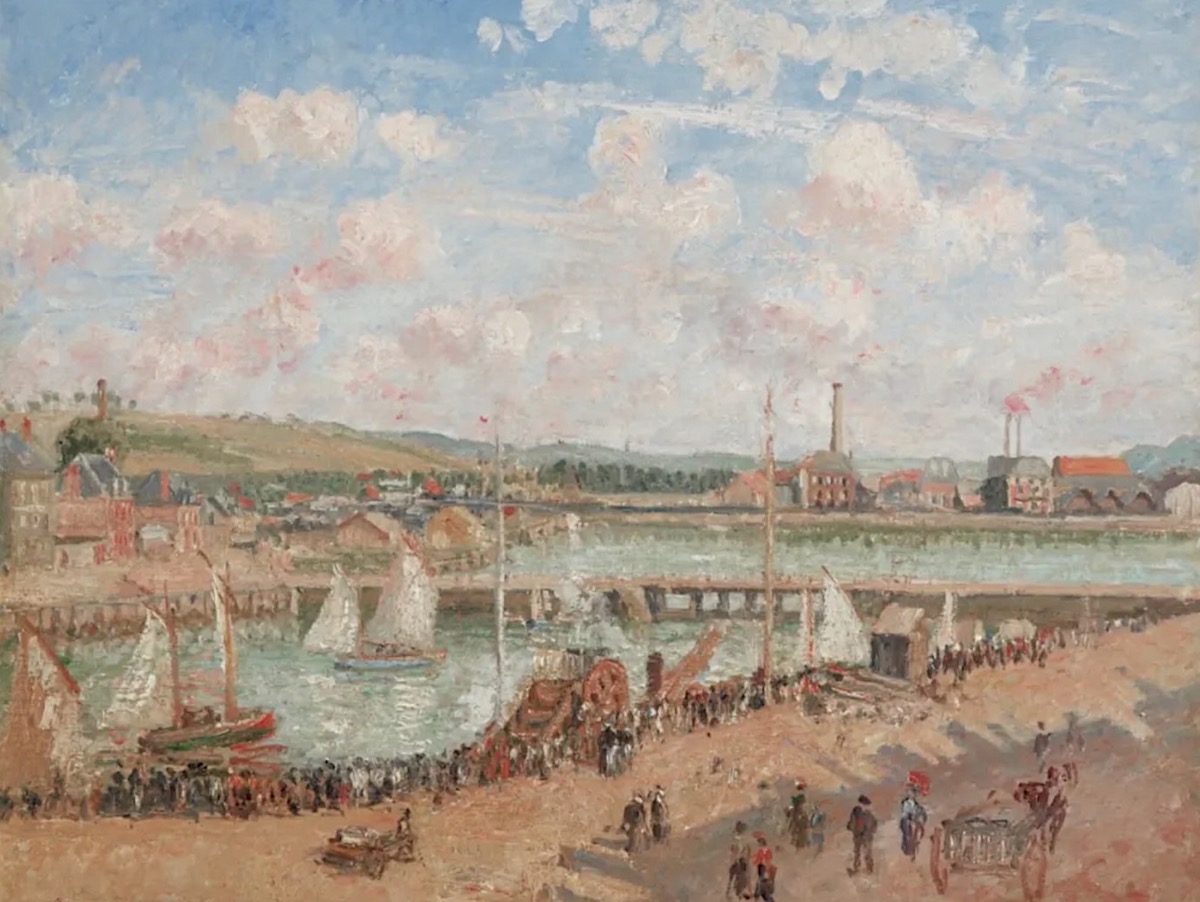
At the centre of the dispute sits Darse de pêche et bassin Duquesne, Dieppe, après-midi ensoleillée, a 1902 canvas depicting the port town of Dieppe on France’s western coast. Sotheby’s sold the painting in London in 2024 for £1.2 million, roughly $1.5 million at the time, describing the sale in its catalogue as having occurred pursuant to a settlement between the current owner and the heirs of Salomon Flavian, whose collection was seized by the Nazis in Paris in 1941.
According to reporting by The Art Newspaper, Sotheby’s lawyers told the court that consent from the Flavian heirs had been secured through Mondex Corporation, a firm specialising in recovering assets looted during the Second World War. Seven plaintiffs disputed that account directly in court on September 18, arguing that only two family members, Gilles and Nicholas Flavian, had actually signed the settlement agreement and that the remaining heirs were never consulted.
Those left out of the negotiation apparently learned of what had happened only through an October 2024 letter from Mondex. The company said it had accepted an 8 per cent share of the painting’s net sale price on their behalf, in exchange for what the letter described as their cooperation. The two heirs who had actually signed the agreement, by contrast, received a 16 per cent commission, according to an account statement that accompanied the letter.
Sotheby’s provenance research traces the painting to the Paris dealer Paul Rosenberg by 1937, and subsequently to the London dealer Edward Le Bas by 1939. Since then, it has been exhibited at major institutions, including Tate in London, the Metropolitan Museum of Art, and the Philadelphia Museum of Art, a fairly prestigious exhibition history that makes the current ownership dispute all the more consequential.
Sotheby’s sale materials had noted that the canvas was registered in a French government list of looted art released in 1947. Melina Wolman, an attorney representing Mondex, told the court that the firm maintains the painting was never actually looted, pointing to a provenance researcher hired by the sellers who found no record of the work on a Nazi-maintained list of confiscated pieces. The plaintiffs countered that such lists were frequently altered at the request of dealers with a vested interest in obscuring a painting’s true history, making the absence of a painting from a Nazi-era inventory considerably less conclusive than Mondex suggests. Wolman also described her firm as the victim of what she called relentless harassment throughout the dispute. Mondex did not immediately respond to a request for further comment.
Sotheby’s has additionally argued that the Paris court lacks jurisdiction altogether, given that the sale itself took place in London between clients with no direct connection to France. In an emailed statement, the auction house said its consignor had retained an independent provenance researcher who concluded there was no evidence that the painting had been spoliated, and that the consignor negotiated the eventual settlement with Mondex on that basis. “Those discussions resulted in a settlement agreement between the consignor and Mondex, which was fully disclosed in our catalogue and pursuant to which the work was sold,” the statement read. A verdict is expected on 5 November.
Pissarro himself remains one of the more quietly foundational figures in the development of modern painting, a career often overshadowed by the louder reputations of contemporaries like Monet and Renoir. Born on the island of St Thomas in 1830 to a merchant family of Portuguese Jewish descent, he moved to Paris in 1855 to pursue painting seriously, absorbing the influence of artists such as Corot and Courbet before settling into a practice centred on close, patient observation of rural and working life.
By the 1860s Pissarro had become part of the loose circle of painters, including Monet, Renoir, Sisley and Cézanne, who rejected the constraints of the official Salon system. He was older than most of the group and functioned as something of a steadying presence, and notably remained the only artist to participate in all eight Impressionist exhibitions held between 1874 and 1886. In the 1880s he briefly adopted the more systematic, scientific brushwork of Neo-Impressionism alongside Seurat and Signac, before eventually returning to looser handling, carrying forward what he had learned about colour and structure. His later Paris cityscapes, often painted from hotel windows overlooking busy streets below, remain among his most celebrated works, balancing urban bustle with a distinctly architectural sense of order.
He died in Paris in 1903 at the age of 73, having spent six decades returning again and again to the visible world with the same patient curiosity, and having mentored younger artists including Cézanne, Gauguin and Mary Cassatt along the way, a generosity that helped cement his role as a genuine bridge between generations of French painting.