

Christie’s 20th- and 21st-century evening auctions in London achieved £219 million, or $289.4 million, a decent result that sat at the lower end of the house’s estimates.
The top lot was an early Wassily Kandinsky, Das bunte Leben (1907), which sold for £31.6 million ($41.8 million), above expectations. Totals include fees unless noted, while estimates do not.
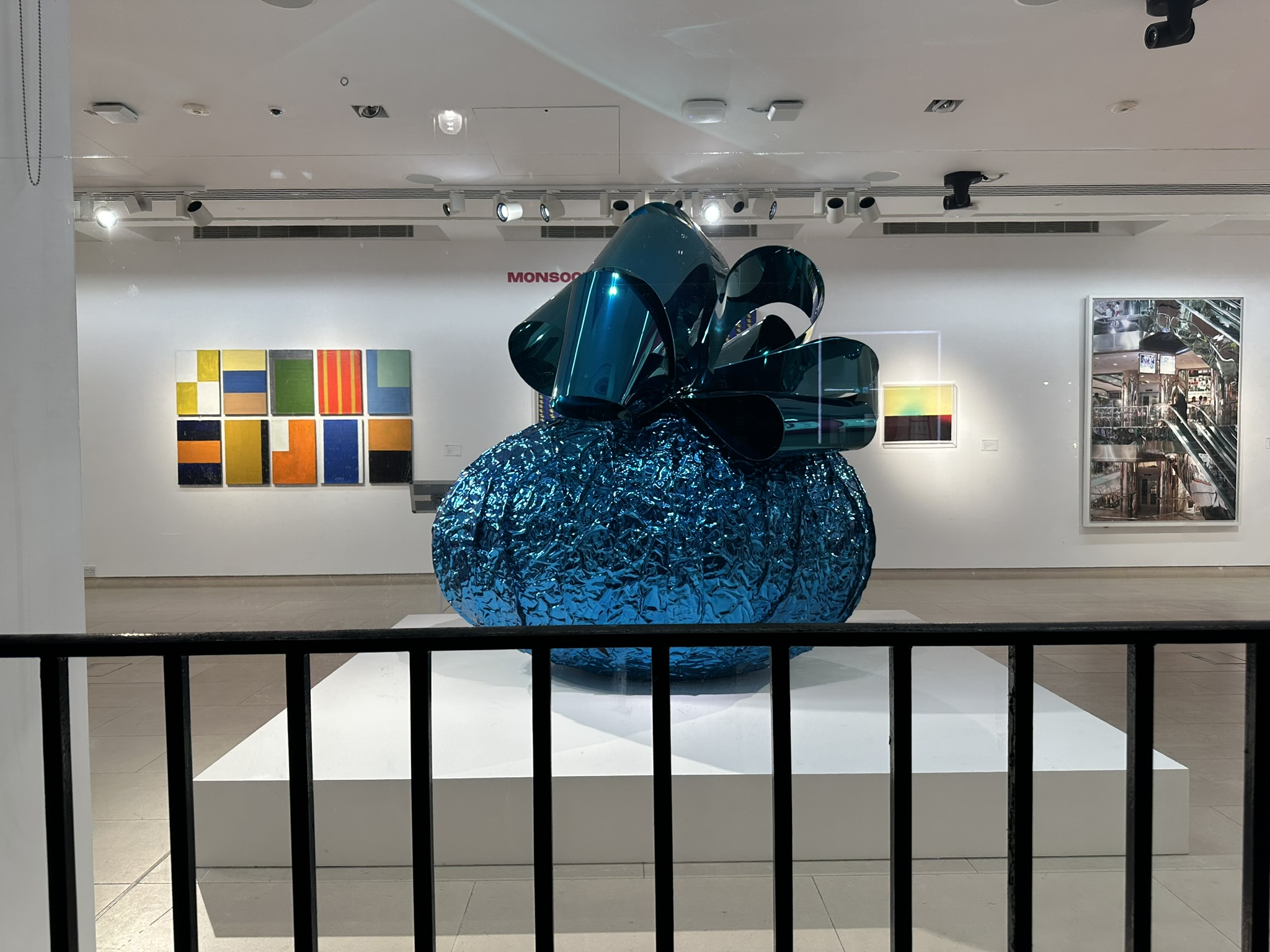
The evening came in two parts. The first was the single-owner collection of Peter Simon, founder of the fashion retailers Monsoon and Accessorise, which made £107.5 million ($142.3 million). The second was a multiple-owner sale of 45 lots by modern and contemporary names, about a third carrying third-party guarantees. It brought $147 million against a low estimate of $116 million. Five lots were withdrawn, and seven failed to sell. The comparable sale last year reached a seven-year high of $143 million across 61 lots. Jeff Koons’s Baroque Egg with Bow (Blue/Turquoise), 1994–2008, proved a less convincing proposition. The oversized, metallic-looking Easter egg, once displayed at Monsoon’s London headquarters, sold below its low estimate, fetching $1.94 million including fees. Simon had paid $4.1 million for the sculpture.
The sales success came from rare, high-quality blue-chip or undervalued works sold well with active bidding, she said, while the rest of the results were more uneven. She added that the room seemed ready to celebrate small signs of strength, perhaps reflecting a sense that a broader market rebound is becoming more plausible.
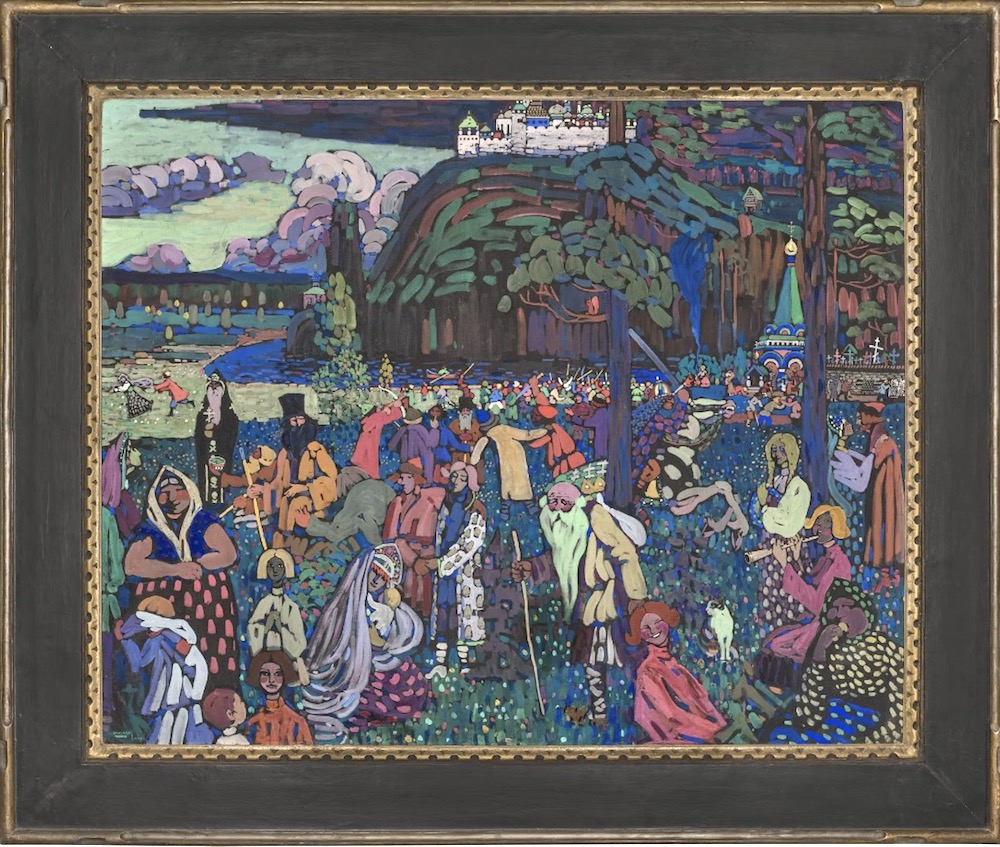
The Kandinsky was introduced by the auctioneer Adrien Meyer as the most important early example to come to auction. A busy pastoral scene mixing Russian folk art with avant-garde ideas, it reached Christie’s after a decades-long Nazi restitution battle. The German state returned it in 2023 to the heirs of the German-Jewish collector Hedwig Lewenstein-Weyermann. Bidding was steady, and the winner was a client of Maria Los, Christie’s head of client advisory for the Americas.
Piet Mondrian’s Composition III (Komposition No. XIII) of 1920 was also closely watched. It came from his Paris years, when he was settling into Neoplasticism, and it was the picture’s first appearance at auction, having spent much of the past century on loan to German museums including the Brandenburg State Museum of Modern Art and the Museum of Applied Arts Cologne. It hammered at $28.4 million, $33.4 million with fees, above its low estimate. Mondrian finished only eight paintings in 1920, and five of them are in major museums. The previous record for a work of that vintage was $8.9 million, paid at Christie’s Paris in 2009.
Several cheaper lots drew lively competition. David Hockney’s Dog Painting 17 (1995), introduced by Meyer as Stanley, the artist’s favourite dog, set off a four-way contest lasting several minutes and passed its high estimate of $4.67 million. A pair of Josef Albers works that opened the second part, R-I d-1 (1968) and Study for Homage to the Square: Warm Silence (1971), both cleared their high estimates, making $779,000 and $983,000.
The Simon collection of 41 lots totalled $147.1 million against a high estimate of $152 million, the largest estimate ever placed on a single-owner collection at Christie’s London. No lots were withdrawn and only one, a Frank Auerbach portrait, was bought in. It followed other London sales from big collectors: Joe Lewis’s Modigliani-led collection made $392.6 million at Sotheby’s, and Anita and Poju Zabludowicz sold a $20 million group at Christie’s.
A second Mondrian, Composition A, with Double Line and Yellow (1935), came from James Johnson Sweeney, the museum director who championed the painter in the United States. It was bought at Christie’s London in 2014 on a high estimate of $13.5 million. This time it made $12.9 million.
Francis Bacon’s Figure in Movement (1978), a blur of contorted flesh in front of a dark doorway, belongs to the group of paintings painted after the death of his lover, George Dyer. The record for the series is $52.2 million, paid for a 1976 painting of the same title at Christie’s New York in 2023. This one made $22.7 million, just over its low estimate, and drew muffled applause.
The warmest reception went to Liubov Popova’s Painterly Architectonic (1918). “It’s very rare and very early; you won’t find another like it,” Meyer said. Bidders agreed, taking it well past her previous auction record, and Alex Rotter, global president at Christie’s, won it for $10.1 million, more than double the high estimate. Portia Zvavahera’s This is where I travelled (2020), the opening lot of the Simon section, also set a record, at $407,000.
Hurvin Anderson’s Last House (2013), a dense tropical scene with the vivid patterning the Simon collection is known for, sold for $7.55 million against a high estimate of $3.9 million. His survey at Tate Britain earlier this year can hardly have hurt.
Top Photo: P C Robinson © Artlyst 2026