
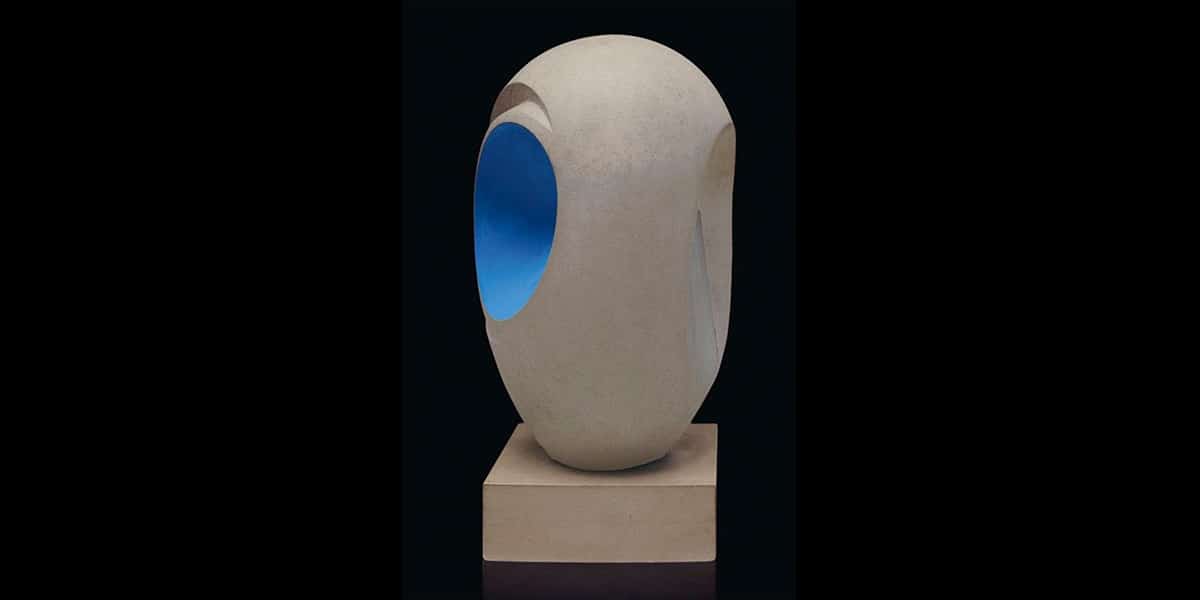
Christie’s has chosen a 1946 Barbara Hepworth to lead its Modern British and Irish Art Evening Sale in London on 21 October. Sculpture with Colour (Eos) carries an estimate of £5m to £8m, a range that puts it among the more expensive Hepworths to come to auction in recent years, though the house does not say so directly.
The piece is carved from a single block of pale Hopton Wood stone. It is an ovoid, swelling form, balanced on its narrowest point. Three hollows in the surface are picked out in paint, from a deep blue through a pale grey to an off-white. Christie’s says it is one of only three known stone sculptures from 1946 to carry applied colour, which matters for collectors who prize rarity within an artist’s output. The year itself is regarded as pivotal, when Hepworth was pushing her experiments, and colour became part of her sculptural vocabulary rather than a decorative addition.
Provenance and exhibition history are strong. The work was formerly in the collection of the philanthropists David and Geraldine Pincus. It appeared in Hepworth’s first solo show after the Second World War, at the Lefevre Gallery in London in 1946, and in the Whitechapel retrospective of 1954 and the Tate retrospective of 1968. It was also shown for the artist’s centenary in 2003 in St Ives. Most recently it was in Hepworth in Colour at the Courtauld Gallery, which ran from June to September this year. A fresh museum outing shortly before a sale is the sort of credential auction houses like to have.
There is a further selling point. Shortly after the sculpture was finished, Lee Miller photographed Hepworth in her studio for Vogue, with the work beside her. That picture ties the object to a documented moment and to a widely recognised image, and it will not have escaped the cataloguers.
The story told around the sculpture draws on Cornwall. Hepworth moved from London to St Ives in 1939 with Ben Nicholson and their young family at the outbreak of war, and lived in Carbis Bay from 1942 to 1949. The light, sea, cliffs and ancient stones there shaped her thinking, including her belief that light and space were as much a part of a finished work as the stone itself. Christie’s reads the colours as evoking daybreak, and links them to the subtitle, which refers to Eos, the Greek goddess of the dawn. The auction house suggests themes of emergence and renewal in the swelling form.
Hepworth was a committed direct carver. Christie quotes her preference for it over modelling because she liked the resistance of hard material and the need to form a clear idea before starting.
Alice Murray, head of Modern British and Irish Art at Christie’s London, said the sculpture has been central to Hepworth’s story for eighty years, from the Lefevre show to the Courtauld this summer. She pointed to the house’s long experience with the artist and its leading position in her market, and said Christie’s was delighted to help the work find its next home.
The sculpture is on view at Christie’s London until 14 October as part of the 20/21 Marquee week view, and again from 17 to 21 October during the sale exhibition.