

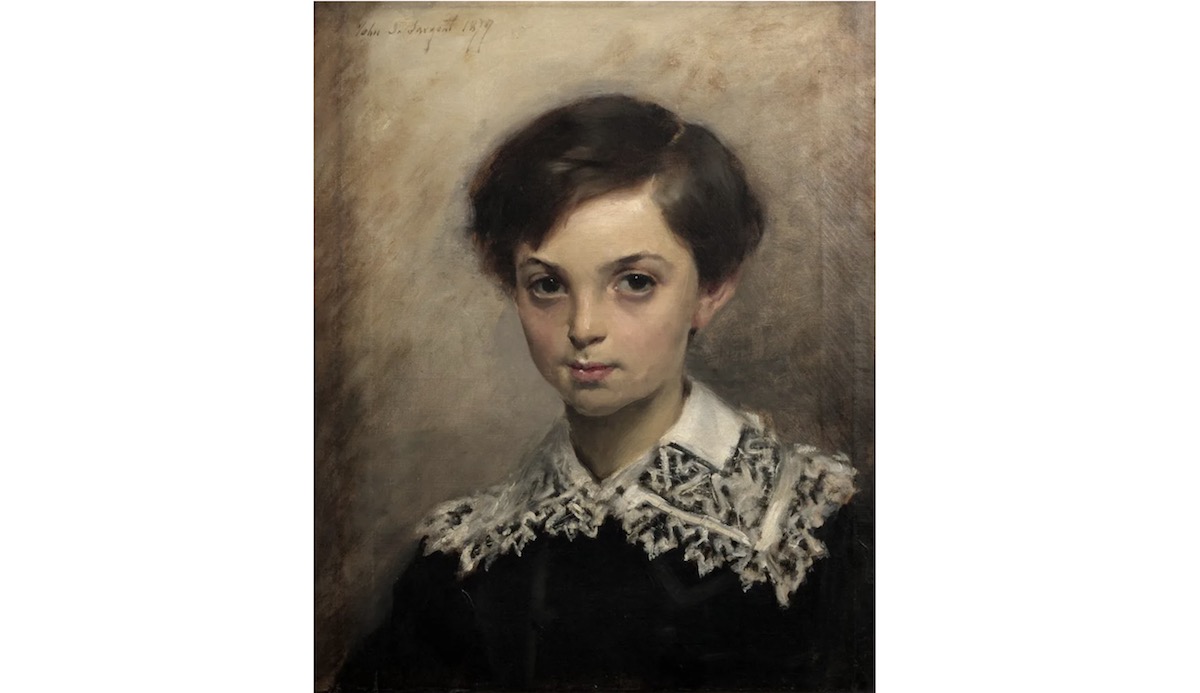
A small, rarely seen John Singer Sargent portrait, tucked away from public view for close to a hundred and fifty years, has sold for far more than expected at Hôtel Drouot in Paris this week, fetching €170,000, roughly $195,000, against a pre-sale estimate of just €80,000 to €120,000.
The work, Portrait of a Child, dates to 1879, a period when Sargent was still in his early twenties and experimenting widely across genres, moving between landscapes, seascapes and portraiture before settling into the reputation that would eventually define him. Two years earlier, in 1877, he had painted his childhood friend Fanny Watts, a portrait that became his first work accepted by the Paris Salon and effectively launched his career. The portrait comes from that same formative stretch, a moment when Sargent was still working out exactly what kind of painter he wanted to become.
Elisabeth Maréchaux, the Drouot specialist who handled the sale, singled out what she called the vivacity of the child’s gaze, arguing that the painting already displayed the psychological sharpness that would later become one of Sargent’s defining strengths, even at this early, less confident stage of his career.
The strong result fits neatly into a broader surge of interest in Sargent’s work, one that peaked last year, during the centenary of the artist’s death. His overall auction record has held steady at $23.5 million since 2004, according to the Artnet Price Database. However, his second highest result came only last autumn, when the 1878 painting Capri sold for $11.5 million at Christie’s in New York, timed to coincide with a major Sargent retrospective at the Musée d’Orsay that included a near-identical composition.
Provenance on the Sargent portrait has descended directly through the sitter’s own family for generations. Sargent portraits from the 1870s are genuinely scarce on the market, and this particular work marks the first to appear at auction since 1999, when a portrait of Edouard Pailleron Junior sold for nearly half a million dollars through the French auction house Laurin, Guilloux, Buffetaud. A companion portrait of René Kieffer’s sister Jeanne, painted the same year, last surfaced at a New York sale in 1985, for an undisclosed sum.
Sargent’s profile in France remains noticeably lower than in Britain or the United States, where his mature society portraits are far more widely known and celebrated. Last year’s Orsay exhibition also introduced another long unseen work from his Paris years, Madame O’Connor, painted in 1882, which drew considerable scholarly attention for its striking resemblance to Madame X, completed just two years later. That later painting’s scandalous reception at the 1884 Salon famously drove Sargent out of Paris entirely, sending him to London, where he would go on to build his reputation painting the city’s wealthiest and most powerful residents.
John Singer Sargent was born in Florence in 1856 to American parents, though describing him simply as American undersells just how thoroughly international his life actually was. He trained first in Florence before relocating to Paris, where he studied under Carolus Duran, absorbing rigorous academic technique while quietly looking elsewhere for inspiration, drawn to Velázquez, Frans Hals and the great portrait painters of earlier centuries, even as he remained responsive to the looser brushwork and shifting light of his own contemporaries.
By his twenties he was already commanding serious attention. His portraits dazzled technically, but they rarely functioned as simple likeness. Sargent understood how clothing, posture and gesture carried social meaning, and his sitters frequently appear caught in that strange in-between space, somewhere between formally posing and simply being themselves, a tension that became central to his appeal.
Paris ultimately proved inhospitable following the uproar over Madame X, his 1884 portrait of Virginie Amélie Avegno Gautreau, whose daring pose and low-cut black dress scandalised Salon audiences. London offered a fresh start, and British society provided him with an endless supply of aristocrats, politicians, writers and Edwardian establishment figures eager to sit for him. Works like Lady Agnew of Lochnaw and Carnation, Lily, Lily, Rose showcase just how wide his range actually was, the latter painted outdoors in rapidly fading evening light, forcing Sargent to work at speed as conditions shifted around him.
Portraiture, however, was never the whole story. Increasingly weary of commissioned work’s demands, Sargent turned toward landscape, watercolour and large-scale decorative commissions, travelling extensively through Venice, the Alps, North Africa and the Mediterranean, producing work that reads deceptively as almost effortless. His murals for the Boston Public Library occupied more than two decades of his career, allowing him to work at genuinely monumental scale, weaving together painting, architecture, mythology and religious imagery into a single sustained project.
Sargent died in London in 1925 at 69, by then established as one of the most sought-after society portrait painters of his generation. His reputation dipped as modernism reshaped how figurative painting was judged, but it has since fully recovered. Looking at his work now, the sheer intelligence embedded in the brushwork remains hard to ignore: a sleeve, a glove, a fleeting expression, any of which could carry nearly as much weight in his hands as the sitter’s face itself.