

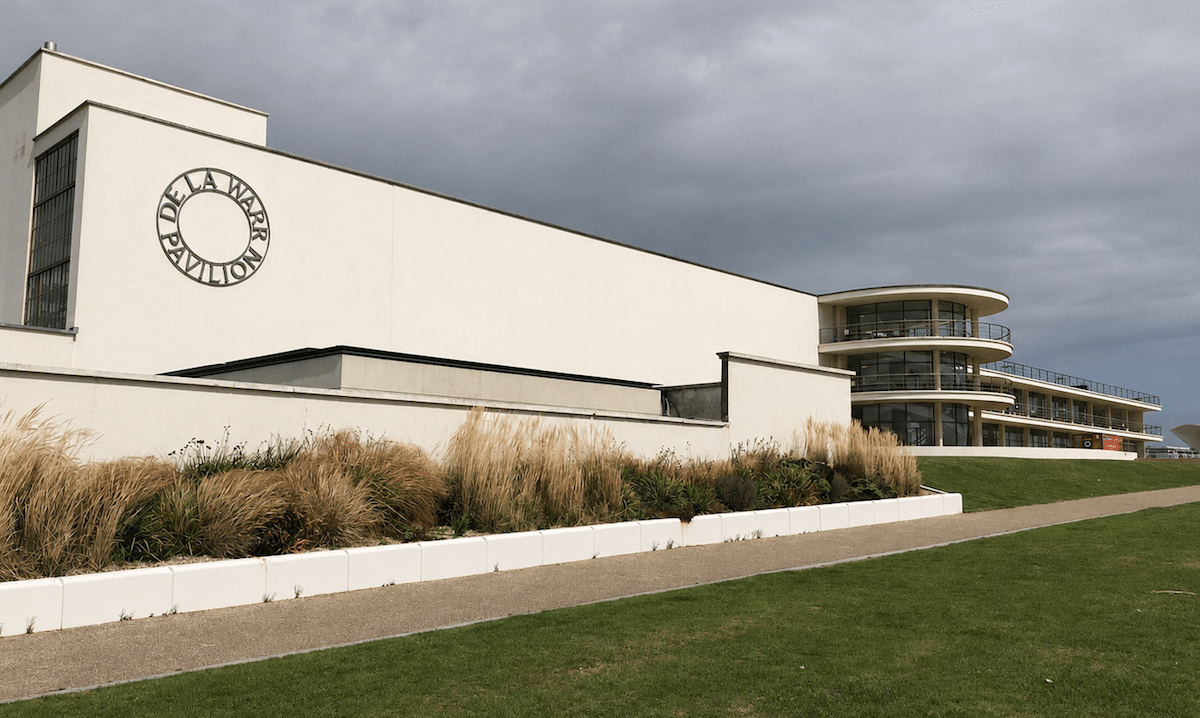
The De La Warr Pavilion in Bexhill-on-Sea has begun a significant restoration project for its celebrated staircase glazing, one of the most recognisable features of what is widely considered Britain’s first major public building in the International Modernist style.
The work forms part of the Pavilion’s broader transformation project, ‘An Icon For Everyone’. This includes refurbishment of its 1000-seater auditorium, the relocation of a key lift, plus the creation of a new designated area for the gift shop. It is being delivered in part with Rother District Council, with architectural oversight from Haworth Tompkins, recently shortlisted for the 2026 RIBA Stirling Prize.
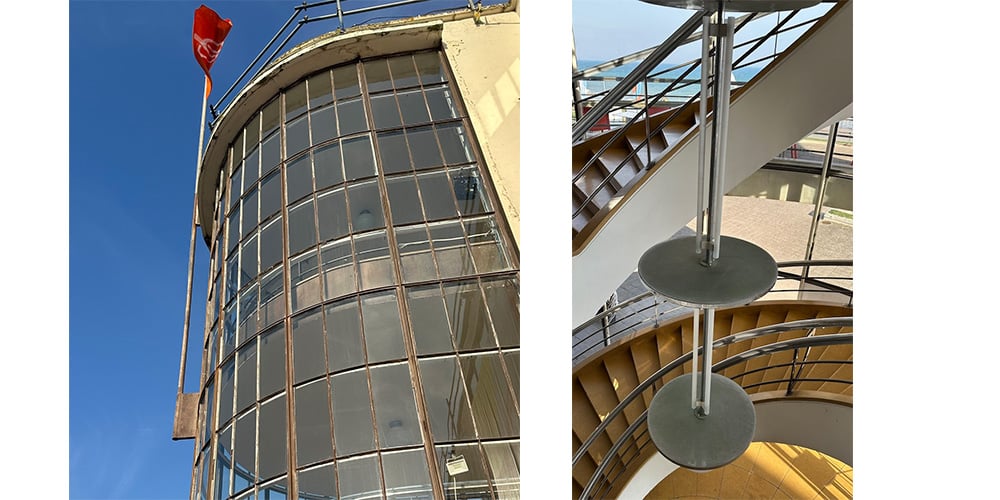
De La Warr Pavilion Exterior shot showing windows and internal staircase with Modernist lighting. Photos © Artlyst 2026
The stunning Pavilion was designed by Erich Mendelsohn and Serge Chermayeff, with engineering by Felix Samuely, and opened in 1935. It was commissioned by the 9th Earl De La Warr, a socialist peer who wanted a building that embodied Modernist civic ideals of culture, community and public access. The result was a radical structure of welded steel frame and concrete with sweeping panoramic glazing, its most distinctive element being the helical floating staircases enclosed in translucent semicircular glass towers overlooking the English Channel. The curved staircase windows are an Erich Mendelsohn signature feature, visible also in his Cohen House in London and the Metalworkers Union building in Berlin. Mendelsohn’s architectural legacy is currently being considered for UNESCO World Heritage inscription through an international transnational nomination.
Nearly a century of coastal exposure has taken a toll on the structure. Cracks in the curved glass windows have been expanding with each successive storm, and the original metal-framed single-glazed windows show significant signs of corrosion. The restoration is now essential to the building’s long-term survival as it approaches its centenary.
In the first phase, the windows will be carefully removed and transported to a Surrey workshop for repair and restoration, with new steel ring beams, curved metal beading and replacement glazing installed.
The project is designed to keep the Pavilion open and functioning throughout. Scaffolding will be in place, and some internal routes will be temporarily adjusted. Still, the building will continue to host its full programme of live music, comedy, exhibitions and community events, including free outdoor activities on the seafront terrace. The excellent restaurant on the first floor, with a view to die for, will also be open throughout the renovation.
The De La Warr Pavilion’s significance extends well beyond its architectural importance. Grade I listed since 1986, it is often described as a prototype for the modern integrated arts centre.
The pavilion has been credited as an influence on the Royal Festival Hall and the broader Southbank development. It is an Arts Council England National Portfolio Organisation, free to access, and has welcomed more than seven million visitors since 2005. It operates in one of the most economically challenged parts of the Southeast, with six of its surrounding wards among the twenty per cent most deprived in the country. Twenty-seven per cent of children in Bexhill live in poverty, and the Pavilion’s learning and community programmes, which reach over eleven thousand people annually, sit at the heart of the town’s cultural life.
This summer, the De La Warr is presenting ‘To Improvise a Mountain: Lynette Yiadom-Boakye Curates’. Yiadom-Boakye is one of the foremost painters in the UK, and this is an outstanding way to see her work juxtaposed with the likes of Walter Sickert and Lisa Brice. Looking to Autumn, the gallery will host an exclusive retrospective of Gordon Matta-Clark (1943–1978), an influential American conceptual artist famously known for his radical “building cuts” and his theory of “Anarchitecture”—a blend of anarchy and architecture.
The ambitious restoration project is funded through a partnership that includes the UK Government, the National Lottery Heritage Fund, the Wolfson Foundation, the Garfield Weston Foundation, the Chalk Cliff Trust, the Foyle Foundation and Suzy Eddie Izzard. Celebrating its 90th birthday, The De La Warr and Rother District Council recently announced that the Pavilion has been awarded £7,646,425 from The National Lottery Heritage Fund to deliver Phase 1. The landmark £51.9 million glazing replacement will reimagine Britain’s first modernist multi-arts centre.
Top Photo: P C Robinson © Artlyst 2026
The Pavilion is also actively seeking donations and sponsorship to support the works, with naming rights and supporter plaques available for major contributions. Enquiries can be directed to Head of Development Jessica Cheetham
Please give what you can to the De La Warr; every penny will go to the renovations fund.