A French judge has ruled that a lawsuit brought by descendants of Claude Monet against Wildenstein & Co. can proceed in Rouen. The case centres on a 2004 transaction involving the trading of paintings and some cash.
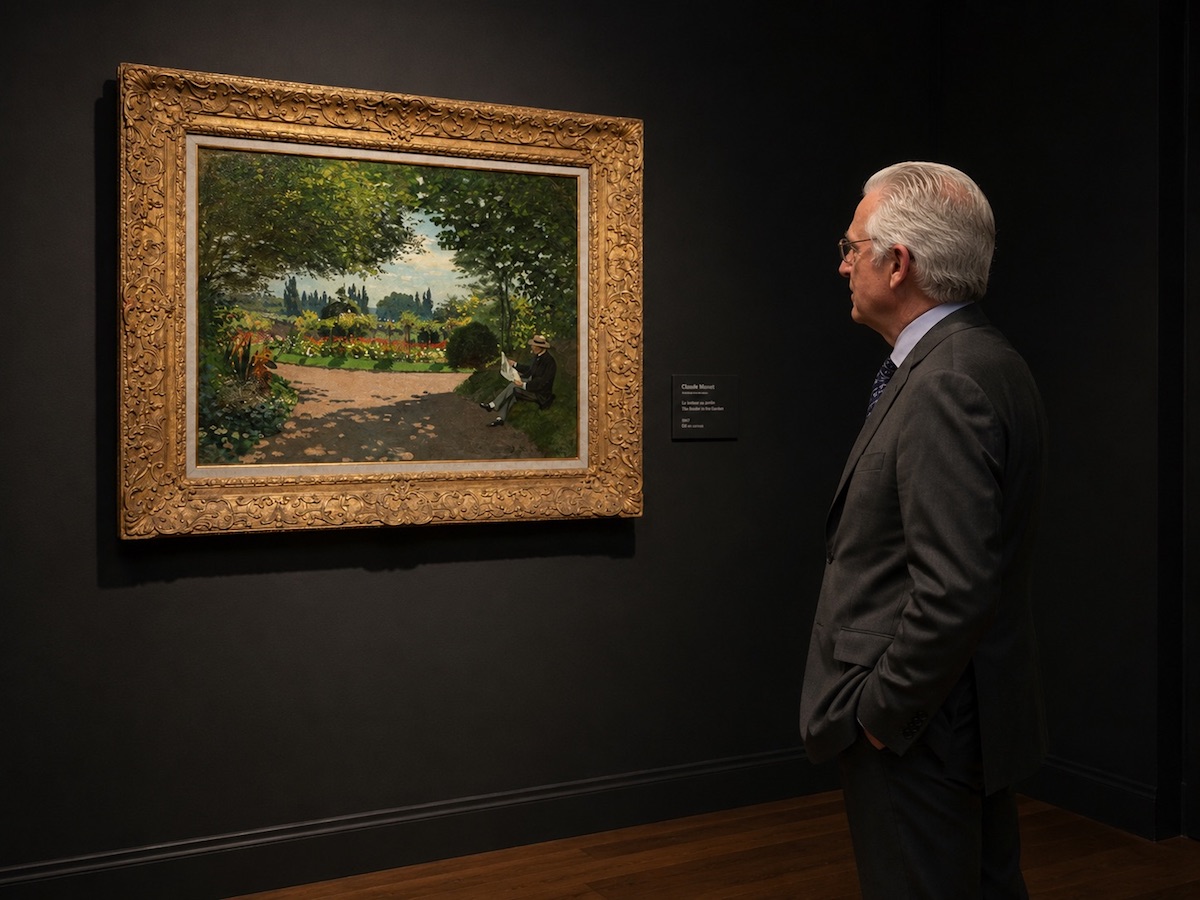
The Monet family says they were deceived. The case involves a damaged canvas, a portrait of the artist’s father, and Oracle CEO Larry Ellison. The 2004 deal was arranged between Monet’s great-nephew, a descendant of the artist’s brother Léon, and the gallery’s Guy Wildenstein. The family agreed to hand over a painting of Adolphe Monet, the impressionist’s father, depicted reading in a garden, in exchange for five works by other artists, including Pierre Bonnard and Alfred Sisley, plus a Monet landscape titled Marine, Amsterdam from 1874. The family’s lawyer, Corinne Hershkovitch, has said that the heir was genuinely reluctant to part with the Adolphe portrait but agreed to the swap to divide his inheritance fairly between his two children. He trusted the deal was equitable. It wasn’t.
The problem with Marine, Amsterdam, only became apparent in 2019, when the family tried to sell it. Experts examining the work found that the original wooden canvas support had been lost sometime before 2004, and that the canvas had been transferred to a different stretcher, thereby distorting it. Serious damage. Damage that, according to Monet’s family lawyer, they had not been aware of at the time the exchange was made.
“The family is humiliated to have been fooled this way,” she said. Hershkovitch also noted that Guy Wildenstein’s father, the late dealer Daniel Wildenstein, had apparently spent roughly twenty years working to persuade the Monet descendant to part with the Adolphe portrait. A long campaign that ultimately succeeded, and which the family now believes was built on incomplete disclosure.
Wildenstein & Co. has not been accused of physically damaging the painting. The allegation is one of bad faith in the transaction itself. What the family wants is, at minimum, reimbursement for the damaged Marine, Amsterdam, valued at around $3 million. What they might get, if the original 2004 agreement is voided under French law, is considerably more complicated. If the transaction is annulled because the value of one of the exchanged works was misrepresented, both parties would, in theory, have to return what they received. Which raises an immediate problem: Wildenstein & Co. has already sold the Adolphe portrait to Larry Ellison.
The painting is currently on loan to the Metropolitan Museum of Art in New York, where it hangs alongside Monet’s 1867 Garden at Sainte-Adresse, which has been in the Met’s collection since 1967 and also features Adolphe. Both works show the same man in what appears to be the same outfit during the same summer. It is an unusual pairing, and the circumstances now surrounding the smaller of the two works are considerably more unusual than the museum’s wall labels are likely to convey.
Wildenstein & Co. had argued the case should be heard in New York rather than France. That request was denied, the court finding that the plaintiffs qualify as general consumers of art rather than professional buyers, and that their residence in Normandy establishes the French court’s jurisdiction. The gallery now has until October to prepare its defence.
Guy Wildenstein himself stepped down from the gallery’s presidency last year, following a 2024 tax fraud conviction and accusations that he had concealed major works of art from the authorities. His son David has taken over. The gallery, founded in 1875 and long one of the most powerful Old Master and Impressionist dealerships in the world, is navigating this lawsuit amid an already turbulent period.
For the Monet family, the case is about more than money. They gave up a painting they cared about, and they feel they were not dealt with honestly.
Top Image is a Photorealist Illustration depicting Guy Wildenstein looking at Monet’s painting Adolphe Monet lisant dans le jardin 1866 © Artlyst 2026