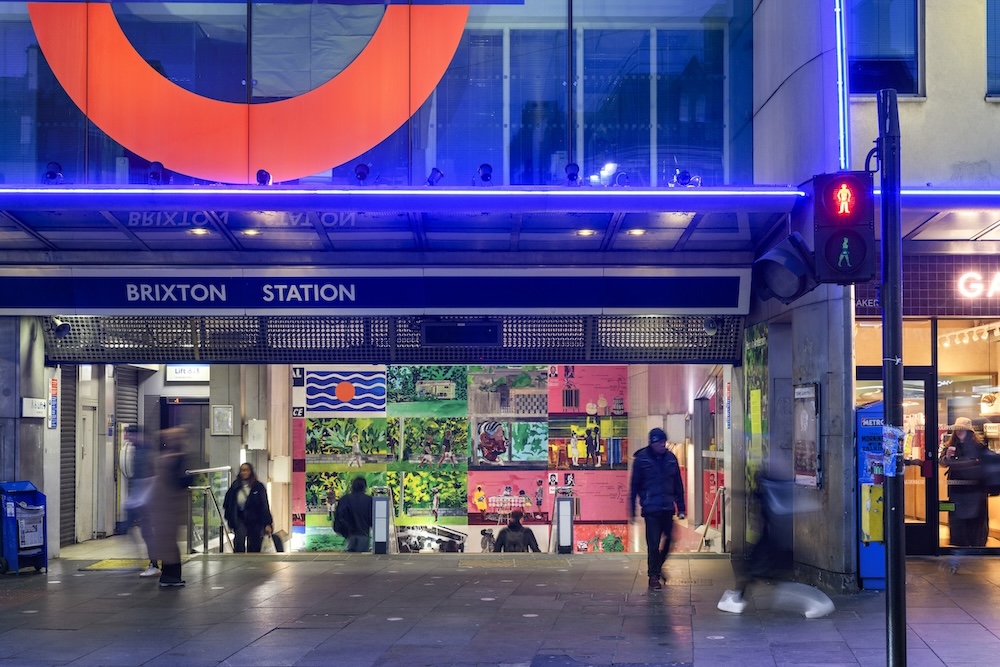
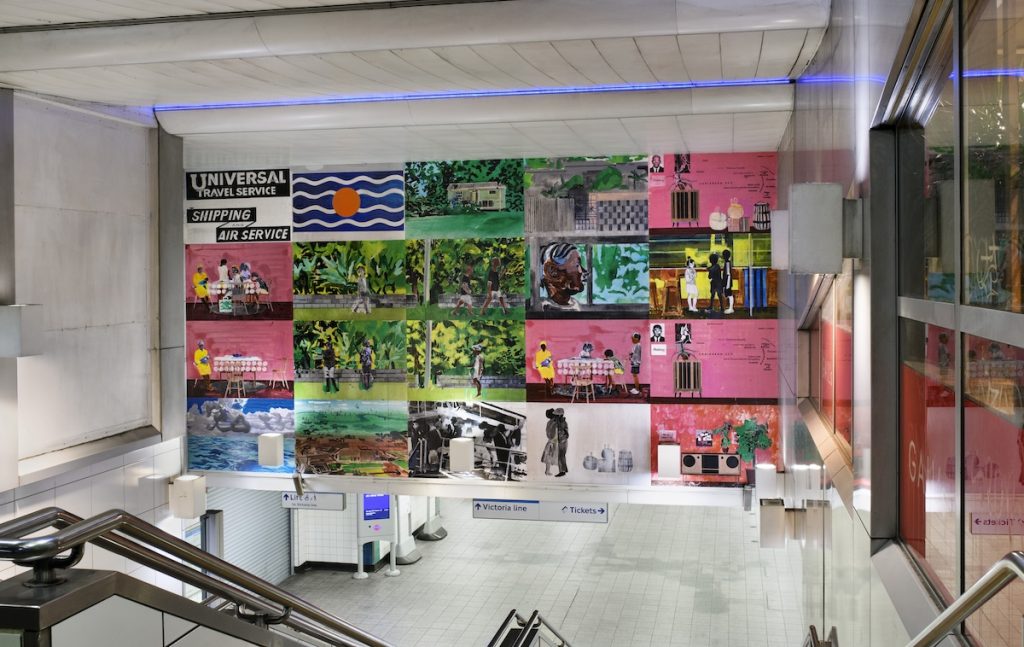
A new mural by the British artist Hurvin Anderson has gone on view at Brixton Underground station, bringing a story of Caribbean migration into one of London’s busiest public spaces.
Titled Universal Travel, the work is the tenth commission in Transport for London’s Art on the Underground Brixton Mural Programme. It is installed at the station entrance, where it will remain for a year.
Brixton has long been associated with the history of Caribbean communities in Britain. Anderson’s painting approaches that history through movement, memory, and separation, following a family’s journey from the Caribbean to London during the Windrush migration period.
Hurvin Anderson, ‘Universal Travel’, 2026. Brixton Underground Photo Benedict Johnson
Rather than presenting one fixed scene, Anderson moves between fragments of domestic life and views of Caribbean and British landscapes. A mother prepares to leave for Britain. The journey begins. The emotional distance created by migration becomes part of the subject.
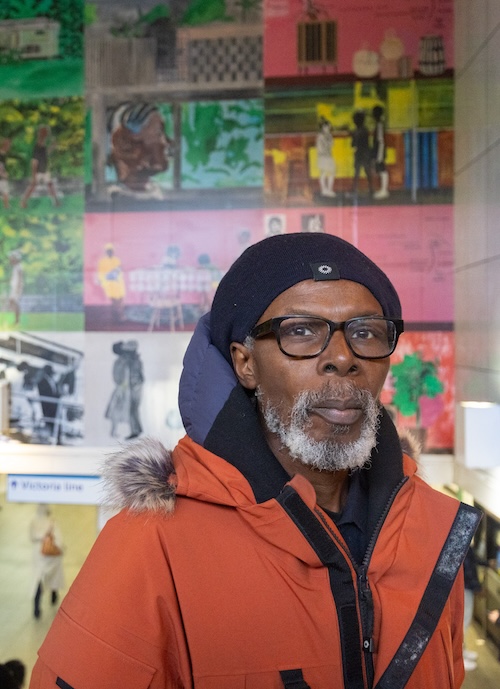
Anderson has spent much of his career considering travel and displacement. His Jamaican background, his upbringing in Birmingham and his connections to Lambeth all feed into the work. Time spent in Trinidad has also shaped his engagement with the Caribbean landscape and its postcolonial histories.
The title comes from a 1955 advertisement for passage to Britain published in the Jamaican Gleaner. Anderson reproduces the advertisement within the painting, bringing an actual piece of migration history into a work that also relies heavily on memory and imagination.
There are archival fragments. There are remembered places. There are imagined scenes. Together they create something closer to a visual recollection than a conventional historical account.
Anderson has also drawn on the work of Jamaican artist Carl Abrahams, whose mural at Kingston’s Norman Washington Manley International Airport commemorates aspects of Jamaica’s public history. That connection gives Universal Travel another dimension. Anderson is placing a story of Caribbean movement inside a London transport network that was itself shaped by migration.
Seventy years ago, London Transport began recruiting workers from the Caribbean. The Underground therefore becomes more than a backdrop for Anderson’s painting. It is part of the history that the work addresses.
The commission arrives as Art on the Underground marks the tenth work in its Brixton series. The programme began in 2018, building on Lambeth’s long tradition of public mural-making while commissioning contemporary artists to respond to Brixton, its changing social landscape, and the communities that have shaped it.
Njideka Akunyili Crosby’s Remain Thriving explored domestic life and shared cultural memory. Aliza Nisenbaum painted 15 London Underground staff members for London Underground, Brixton Station, and the Victoria Line Staff. Denzil Forrester returned to his earlier painting practice in Brixton Blue, connecting it to the music and racial tensions of 1980s Brixton.
Helen Johnson’s Things Held Fast brought together gardeners, archival material and questions about colonial history. Joy Labinjo’s 5 more minutes centred on the Black British hair salon as a place of memory and connection. Shanti Panchal’s Endurance presented a community portrait against recognisable locations across Brixton and London.
More recently, Jem Perucchini used allegory and Renaissance imagery in Rebirth of a Nation, while Claudette Johnson’s Three Women confronted the representation of Black women within Western art history. Rudy Loewe’s The Congregation, installed in 2025, brought together stories of resistance, gathering and everyday life in Brixton.
Hurvin Anderson’s mural doesn’t attempt to contain the whole history of Windrush migration. Instead, it focuses on a journey and on what that journey meant for the people making it. The separation between those who left and those who remained becomes one of the work’s central emotional threads.
Eleanor Pinfield, Head of Art on the Underground, described the painting as a work made from “small singular images”, linking those fragments to the arrival of the Windrush Generation and the continuing effects of separation across generations.
The wider programme has also become a way to bring contemporary painting into the city’s daily life. The works are encountered by commuters, schoolchildren, residents and visitors rather than by audiences who have deliberately entered a gallery.
The tenth commission will be marked by a special event at Ritzy Picturehouse on Thursday 26 November. The evening will include a screening by Other Cinemas featuring all ten Brixton commissions, followed by a discussion with artists Claudette Johnson, Joy Labinjo and Rudy Loewe. Art historian and critic Rianna Jade Parker will chair the conversation, with an introduction from curator Jessie Vaughan, who established the Brixton Mural Programme.
The subject’s core dates back decades, but the setting makes it clear that migration is not simply a matter of the past. The Underground remains a place of arrivals and departures. Every day, people move through it carrying their own histories. At Brixton station, Anderson has placed one of those histories directly in their path.