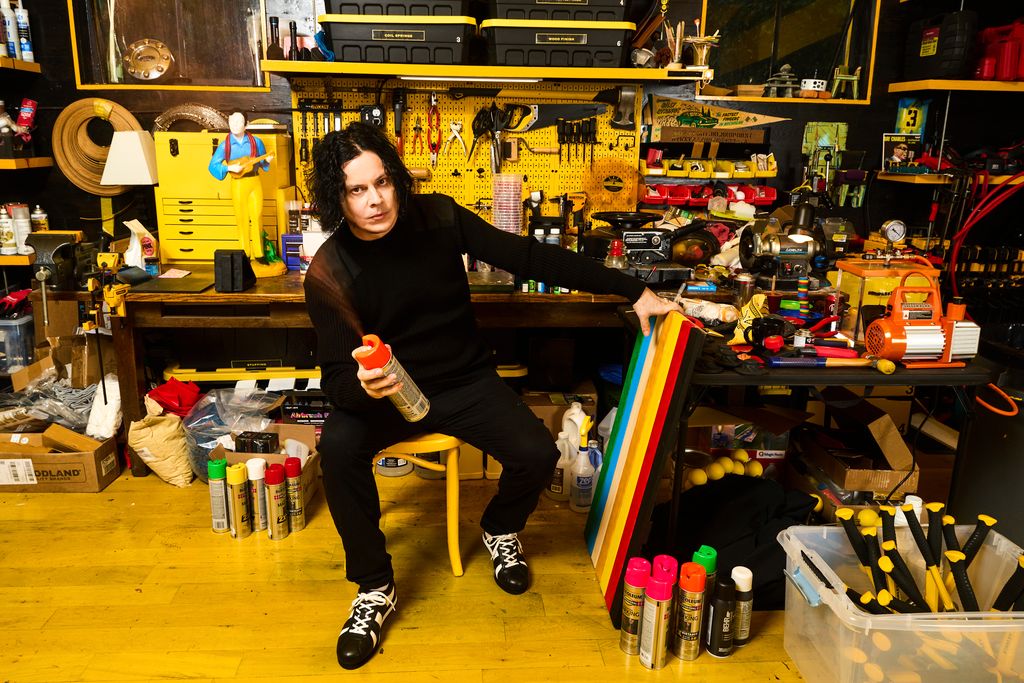
For the past two decades, Jack White has been making sculpture and furniture in relative privacy, a parallel practice running alongside one of the most celebrated careers in contemporary music. This spring, that changes. These Thoughts May Disappear, opening at Damien Hirst’s Newport Street Gallery on 29 May 2026 and running until 13 September, marks the first public exhibition of White’s visual art, a body of work that has been quietly developing its own logic and ambition for years.
The exhibition, curated by Connor Hirst (Damien’s son) and Jack White, brings together sculptures made from found objects, interactive works, installations and furniture design across the full span of the Newport Street spaces. A highlight is a remake of The Red Tree, a 2015 sculpture that takes a decaying tree and, through intervention, transforms it into something that reads as both monument and elegy, preserving the original concept while revisiting it with the distance the intervening decade has produced.
White’s visual practice is rooted, both literally and conceptually, in Detroit. Born there in 1975, he spent formative years in Southwest Detroit and the Cass Corridor, a neighbourhood that produced an influential group of artists working with industrial materials, found objects and the detritus of a city in economic crisis. Gordon Newton and Robert Sestok, two of the Cass Corridor’s most significant figures, are direct points of reference for White’s sculptural work, and his relationships with both artists have extended to active collaboration. He reimagined 1960s guitar amplifiers with Newton, and commissioned Sestok to produce a mural for Third Man Records. The connections are both personal and aesthetic.
White’s background in upholstery is equally foundational. He opened Third Man Upholstery in Detroit in 1996, a working shop that gave him practical fluency in manipulating materials and a craftsman’s understanding of construction that runs through everything he has made since. He describes his sculptural method as Hardware Store Art. This term captures something essential about his approach: assemblage and reappropriation using resins, paints, epoxies and utilitarian found objects, building outward and upward from existing materials rather than carving into them. The emphasis is on addition rather than reduction, accumulation rather than elimination, though the results retain what he describes as a minimalist sensibility. Tools and weapons appear frequently, encased in epoxy and rendered static, their functions suspended while their forms remain legible. Handmade axes and hatches sometimes remain portable, resisting the fixity imposed by the other works.
The visual references White draws on are broad and considered. Mid-century modern furniture design sits alongside De Stijl and Dada, a combination that reflects a genuine engagement with the twentieth-century tradition of finding art in the materials and processes of everyday manufacture. These are not passing references. They are the structural logic of a practice that has been developing, away from public view, for the better part of thirty years.
White has continued to explore his design instincts through the Third Man Records universe, the independent vinyl-focused record label he founded in 2001, which has become as much a design practice as a music business. From album graphics and photography to the architecture of the label’s spaces and the design of audio equipment, Third Man operates as an integrated aesthetic enterprise in which the boundary between music and visual culture is treated as a provocation rather than a given. For this exhibition, that world intersects with Hirst’s, with White collaborating with Hirst and other artists connected to the Third Man orbit, a convergence of two figures who have each, in their respective fields, made the relationship between commerce and art a central subject of their practice.
Newport Street Gallery, which Hirst opened in 2015 to exhibit works from his personal collection and to provide a platform for artists he admires, is a fitting venue for a debut of this kind. The space is large, serious, and unintimidating in equal measure, and its programme has consistently made space for work that sits outside conventional art-world categories. An exhibition by a musician whose visual practice has been conducted entirely outside the public gaze fits the gallery’s ethos more comfortably than it might elsewhere in London.
Here is a list of Actors/Musicians who have turned their hand to making art:
Dennis Hopper is a rare triple threat who achieved professional acclaim for his photography, paintings, and sculptures.
Bob Dylan is a prolific painter and creates massive metalwork and iron sculptures, including his Ironworks series.
David Bowie was a trained artist who produced paintings, sketches, and sculptures that often served as blueprints for his various stage personas.
Lucy Liu exhibits paintings, sculptures, and photography—often under the name Yu Ling—focusing on abstract themes and found objects.
James Franco works as a multimedia artist with a practice spanning painting, sculpture, photography, and large-scale film installations.
Jim Carrey focuses deeply on painting and sculpture, using large canvases and mixed media to express political and personal themes.
Brad Pitt has recently gained recognition for his sculpture work, debuting pieces made of plaster, wood, and clay at the Sara Hildén Art Museum.
Bryan Adams maintains a highly successful second career as a professional fashion and portrait photographer for major magazines like Vogue.
Ronnie Wood is a classically trained painter whose portraits of the Rolling Stones and other musical icons are widely collected.
Patti Smith is renowned for her minimalist drawings and her evocative black-and-white photography, often using a vintage Polaroid.
Adrien Brody is an active painter whose vibrant works frequently explore environmental and social themes.
Robbie Williams creates paintings and digital art to process his mental health and experiences in the spotlight.
Ed Sheeran is another musician who has turned to art. Jackson Pollock seems to be his inspiration.
Others include: Sylvester Stallone (abstract paintings), Viggo Mortensen (painting/photography), Shia LaBeouf (Conceptual work) and Anthony Hopkins. On the more serious side, I might add Tilda Swinton, Brian Eno and Jim Jarmusch.
But are they any good? I’ll leave you to decide… I can’t wait to read Eddy Frankle’s review of this…
Admission is free.
These Thoughts May Disappear is at Newport Street Gallery, Newport Street, London SE11 6AJ, from 29 May to 13 September 2026, Tuesday to Sunday, 10 am to 6 pm.