
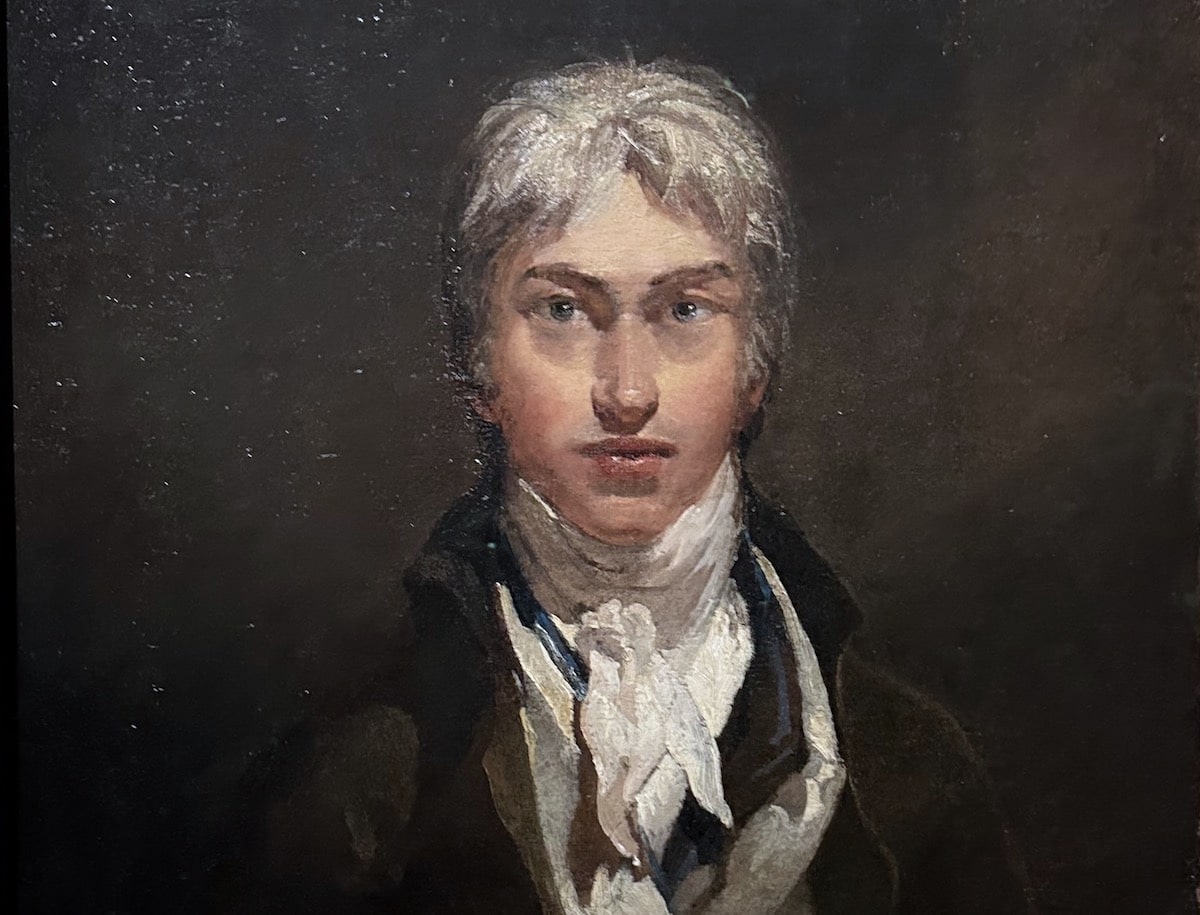
The image of JMW Turner has stared out from British cultural life for nearly two centuries, the portrait that appeared on the £20 banknote launched in 2020 alongside The Fighting Temeraire, and that has served as the definitive face of one of the greatest painters in the history of British art, may not be by Turner at all. A leading expert on the artist now argues that the painting, long held in the Tate collection and treated for generations as a self-portrait, is more likely the work of Turner’s contemporary John Opie. The claim, if it holds, would constitute one of the most significant misattributions in British art history.
The expert making the case is Dr James Hamilton, Turner’s biographer and the author of several books on the artist, whose research is published this week in Turner Society News. Hamilton’s conclusion is the result of sustained looking and sustained doubt, of the kind that takes years to crystallise into an argument. He had included the portrait on the cover of his 1997 biography, Turner: A Life, without questioning its attribution, later acknowledging that he had failed to think it through enough at the time. What eventually prompted closer scrutiny was a simple observation: there is nothing else like it in Turner’s body of work.
The painting, dated to around 1799 when Turner would have been approximately twenty-four years old, is a work of considerable accomplishment. Hamilton describes it as the product of a master portrait painter working with brilliant dexterity, a characterisation that raises questions in itself. By 1799, Turner was a prodigious talent in watercolour and landscape. Still, there is little in his known output to suggest the particular facility with oil portraiture this work displays. The tonal drama of the image, light emerging forcefully from deep shadow, is a quality that Hamilton associates not with Turner but with Opie, whose portrait practice throughout the period is characterised by exactly this approach.
The circumstantial case for Opie is built on several foundations. Hamilton identifies a portrait of an unidentified young man at the San Diego Museum of Art as a point of direct stylistic comparison, noting the full-face directness, the sparkly eyes, the energetic shadow play, and what he describes as a curious interest in untidy hair. The two portraits, in his assessment, are immediately comparable. Opie is known to have painted numerous artists of the period, including David Wilkie and Thomas Girtin, and at least four of those portraits ended up with the sitters’ families rather than remaining in commercial circulation. Hamilton suggests that Opie, who admired Turner’s talent, may have given the portrait to Turner directly, since it had little commercial value to its maker once completed.
The route by which the painting entered the Turner Bequest is, on Hamilton’s account, entirely explicable. Turner died in 1851, and his will, which stipulated that his works should be kept together in a dedicated gallery, was immediately challenged by his family. After a protracted legal battle, the court determined that the family could retain Turner’s money. At the same time, the nation received the pictures, and, crucially, not only the works Turner had specifically intended for public ownership but also everything by his hand found in his studio. Hamilton notes that Turner’s house in Queen Anne Street was in considerable disarray, with pictures hanging in disorder and without attribution. In those circumstances, a portrait of Turner hanging among Turner’s possessions would naturally have been assumed to be by Turner. There was, he points out, simply no way of knowing otherwise.
The history of the attribution reveals how the assumption gradually turned into fact. Hamilton notes that early inventories of the Bequest never described the painting as a self-portrait. It was catalogued as a portrait of Turner. Over time, the attribution became murky, and the work came to be regarded as a self-portrait.
The implications are significant and not only for art history. Turner would not have appeared on the £20 banknote, Hamilton argues, without so striking a portrait to represent him. The Bank of England’s choice of image was shaped by the painting’s presumed status, and that status may now require revision.
The Tate has responded carefully. A spokesperson welcomed Hamilton’s research and expressed interest in exploring it further, a formulation that commits the institution to very little. Dr Pieter van der Merwe, chair of the Turner Society, has described Hamilton’s case as well-made on documentary grounds while characterising the attribution to Opie as plausible but speculative. Dr Selby Whittingham, a former curator of Manchester Art Gallery and a longstanding Turner scholar, remains unconvinced, arguing that the painting’s light tonality is consistent with Turner’s practice.
Hamilton’s own position is straightforward. He is calling on the Tate to reattribute the work to Opie, or to demonstrate positively why the current attribution should stand.
Top Photo P C Robinson Artlyst 2026