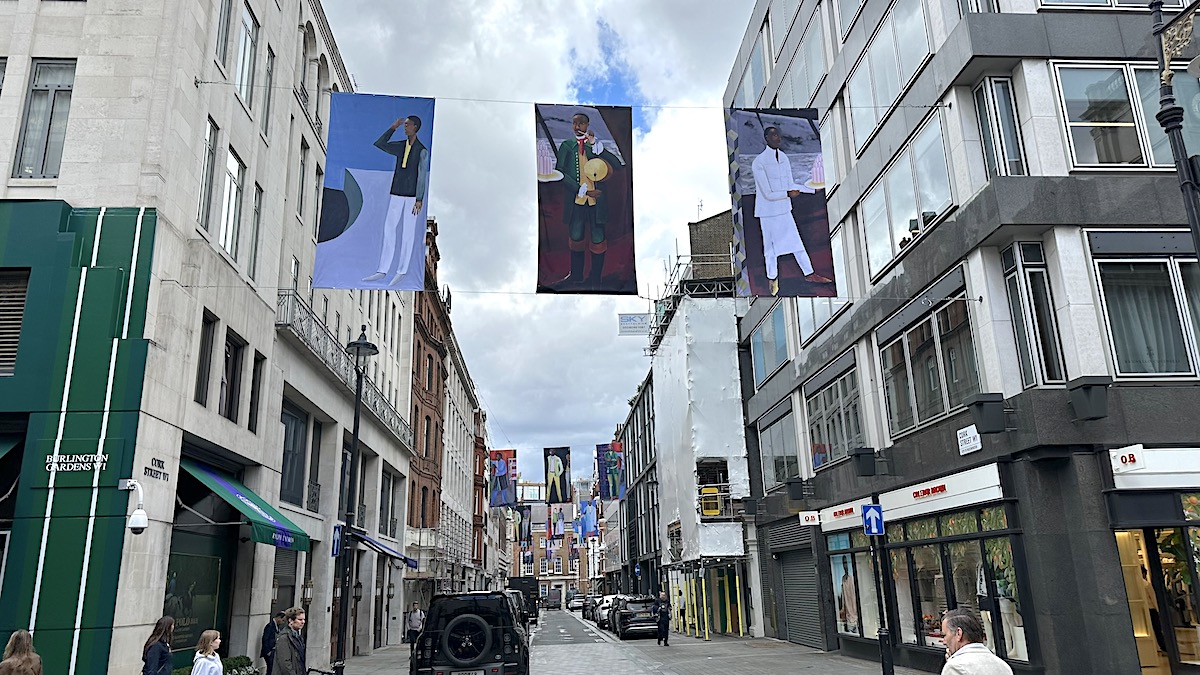
Lubaina Himid has taken over Cork Street. The banners have turned the street’s famous stretch of galleries and tailoring establishments into an extended meditation on what we wear and what that wearing means.
The commission, titled Reading the Label, was created by one of Britain’s most decorated artists. Over the past twelve years, Himid has been painting a selection of figures that explore dress, which is key to the subjects depicted on the panels. The garments carry unspoken conversations, signals readable only to those who know the code. It is a quietly subversive idea for a street that has long traded in the bespoke and the expensive, where the suit has always functioned as both social armour and status marker. Himid has been thinking about this language of dress for several years. Cork Street, it turns out, is exactly the right place to express it.
The commission comes at a significant moment. Himid is currently representing Great Britain at the 61st Venice Biennale, where her exhibition Predicting History: Testing Translation occupies the British Pavilion until November. Commissioned by the British Council and curated by Emma Dexter, the Venice show centres on belonging, on what it means to make a home in a place that was not always ready to receive you, and on the gap between what a place promises and what it actually delivers. Cork Street Galleries is supporting the British Pavilion as a partner, the first time an arts destination has taken on that role, which gives the London commission and the Venice show a genuine connection beyond the shared artist.
The Venice work involves large multi-panel paintings in dazzling colour, surreal and theatrical, with Himid functioning as writer, character-maker and performance director simultaneously. In collaboration with artist Magda Stawarska, who has worked with Himid across several recent projects, a soundscape runs through the pavilion, introducing a tension that the paintings’ vivid surfaces initially seem to resist. The neoclassical architecture of the British Pavilion is used rather than ignored; Himid frames Britain as a place of potential and welcome, while the sounds and texts quietly complicate that framing. It is, by all accounts, an exhibition that earns its complexity rather than simply asserting it.
Himid won the Turner Prize in 2017, the Maria Lassnig Prize in 2023 and the Suzanne Deal Booth Flag Art Foundation Prize in 2024. She is Emeritus Professor of Contemporary Art at the University of Central Lancashire, and she has been making rigorous, politically serious work since the 1980s, when her Thin Black Line exhibitions were among the first to insist on the visibility of Black women artists in British cultural life. The Venice selection, and this Cork Street commission, are recognitions of a practice that has always been ahead of the conversation it is now being asked to represent.
Reading the Label will be visible on Cork Street for the duration of the commission. It is the kind of public art that rewards slow looking, which is not always what a busy London street encourages, but which the work gently insists on anyway. The men in the paintings are not famous. They are dressed precisely and carry more information in their clothing than most people do in their words.
Top Photo: P C Robinson © Artlyst 2026
Lubaina Himid: Reading the Label is on Cork Street, London. Predicting History: Testing Translation is at the British Pavilion at the Venice Biennale until November 2026.