The Dutch multidisciplinary artist Mathijs Hunfeld’s recent exhibition at The Koppel Project explores innovative, futuristic practices. Hunfeld, who graduated from the Royal College of Art’s MA Contemporary Art Practice programme in 2024, has since rapidly carved out a distinctive niche at the intersection of contemporary art and design through a unique practice that combines digital art with an exploration of consumer culture.
Hunfeld’s work is distinguished by its ability to transform the seductive aesthetics of consumer culture into a critical examination of identity, desire and digital life. He is a compelling artist and visual innovator, whose intellectual and ambitious practice pushes through these boundaries.
Hunfeld moves fluidly between sculpture, installation, sound and spatial intervention. His work exists in a productive tension between attraction and critique, seducing viewers with the visual language of popular culture while simultaneously exposing the emotional and psychological mechanisms that underpin contemporary consumerism. Through his practice, Hunfeld references popular culture, advertising, computer games, consumerism and the all-consuming power of social media filters and algorithms.
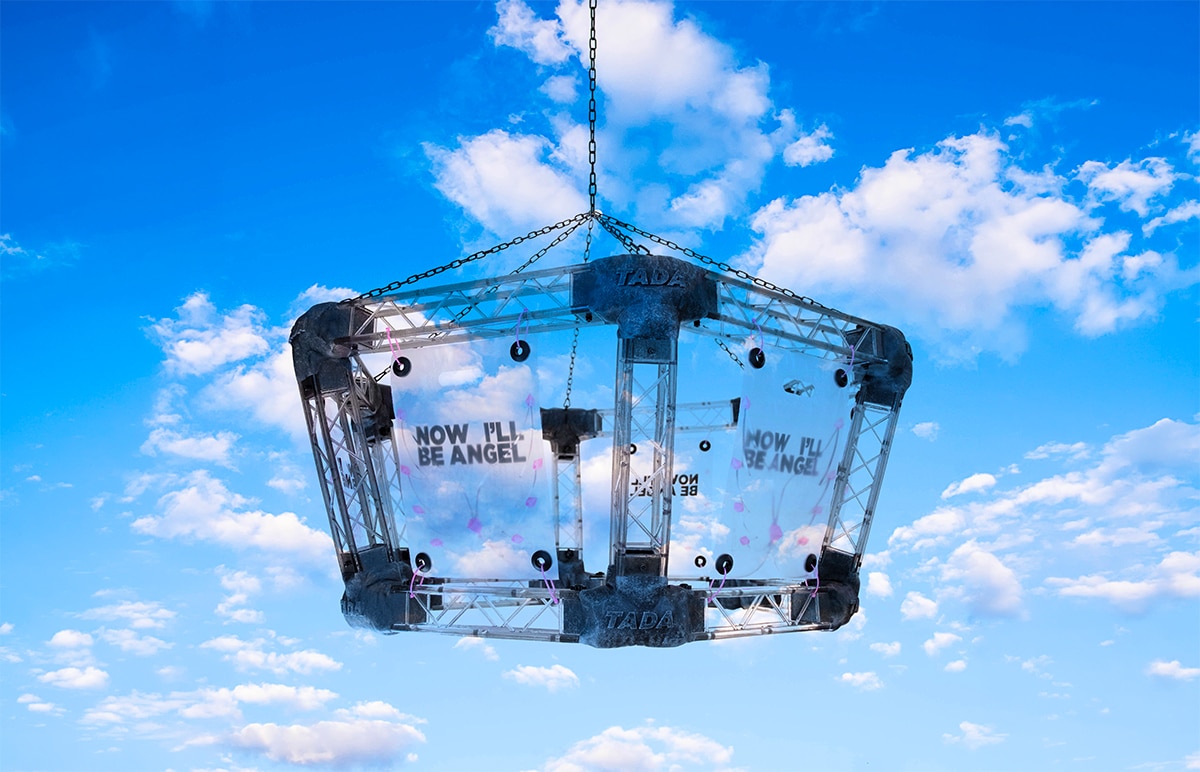
Multidisciplinary Dutch Artist Mathijs Hunfeld NOW I’LL BE ANGEL (TADA series) (2025). Image courtesy of the artist.
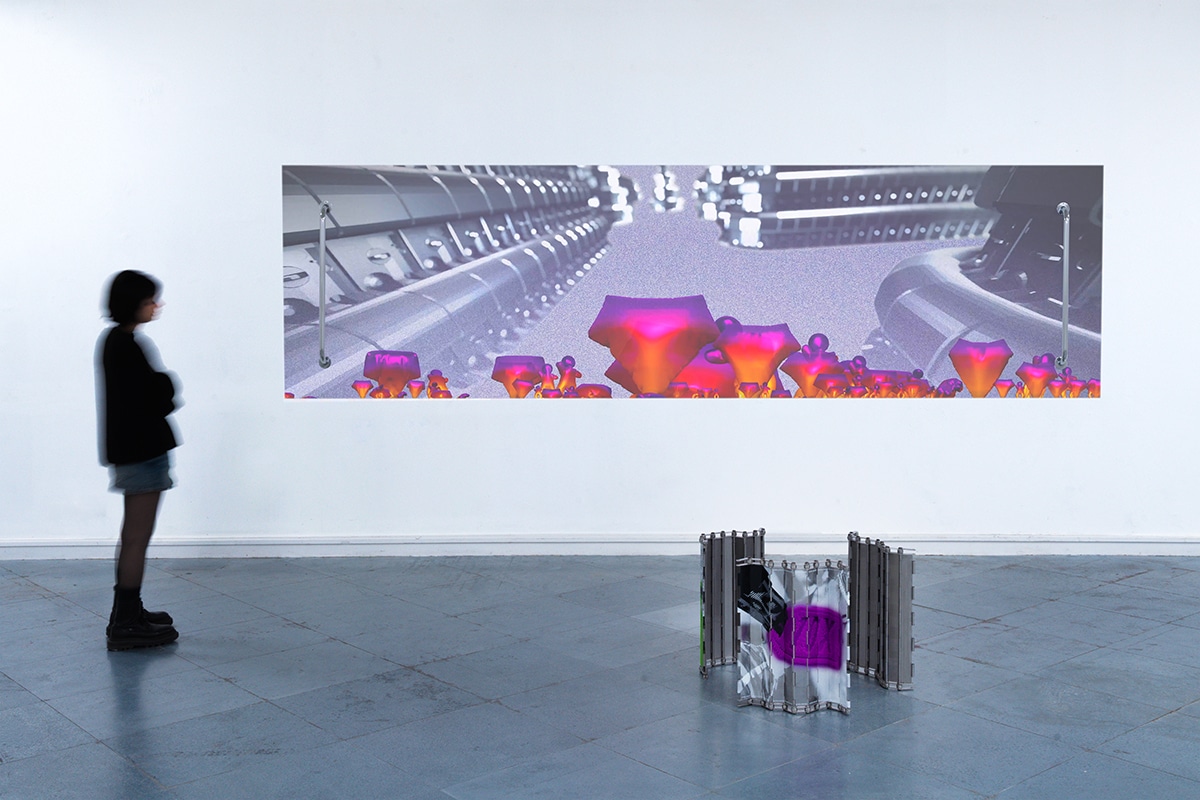
Hunfeld’s recent exhibition // NOTHING UNWANTED, presented with Attiyyah Rahman at The Koppel Project in May 2026, offered a powerful articulation of the artist’s concerns with the formation of our personal identity in a digital age where AI is confusing the divide between reality and fiction, and we spend much of our time engrossed in screens. The exhibition explored how our sense of self is increasingly constructed through consumer habits, online interactions and the endless circulation of pop-cultural imagery. The body of work Hunfeld conceived for // NOTHING UNWANTED is a subjective investigation into contemporary consumption and an increasingly screen-saturated future.
The exhibition’s conceptual framework revolved around the relationship between the horizontal and vertical plane. The horizontal represents material reality, while the vertical functions as a fictional screen, a surface onto which desires, fantasies and projections are endlessly mapped. This spatial logic transformed the gallery into a liminal environment where viewers occupied the uneasy position between active participant and passive consumer. The carefully curated artworks investigate the addictive nature of social media and gaming platforms which lure users into an inescapable cycle of clicks, likes and unattainable parallel universes. Hunfeld explores several thresholds in // NOTHING UNWANTED: those between reality and fiction, intimacy and spectacle, and the ever-changing relationship between physical space and digital experience. Visually and conceptually, Hunfeld’s works evoke Liam Gillick’s investigations of spatial systems, architecture and behaviour-shaping structures, as well as Olafur Eliasson’s focus on viewer activation and the embodiment of participation.
A focal point of the exhibition was three Gashapon machines, Japanese capsule vending machines that dispense collectable objects, which were displayed in the space to encourage audience participation. These playful interventions became incisive metaphors for the systems of reward, addiction and compulsive engagement employed by social media platforms to keep users engaged. These behavioural patterns echo laboratory experiments in which mice repeatedly sought food rewards, as well as the variable reward systems that keep players returning to slot machines in Las Vegas casinos. Rather than simply illustrating these behavioural systems, Hunfeld implicates the viewer within them, making participation itself the mechanism through which the critique operates.
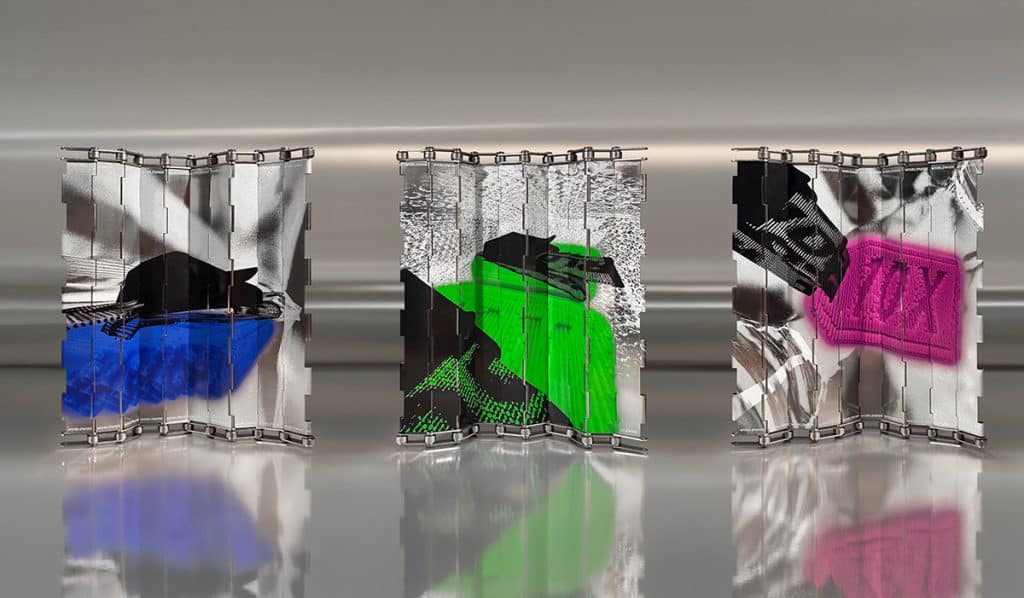
Multidisciplinary Dutch Artist Mathijs Hunfeld 10X (WORLDWIDE series) (2025). Image courtesy of the artist.
// NOTHING UNWANTED brought together sculptural works attached to pillars, placed on the gallery floor and suspended from the ceiling alongside moving-image installations. Working across materials ranging from chocolate and toy cars to plastic bags and packing tape, Hunfeld draws connections between art-historical traditions and the visual language of contemporary digital culture, reinforcing his multidisciplinary practice. By inviting visitors to participate in the mechanics of desire, the exhibition exposed the addictive cycles that underpin both consumer behaviour and online engagement. Works such as NOW I’LL BE ANGEL, HIGH RISK OF FALLING, ‘I’ll Let You Know When I Had Enough’, and WE HAVEN’T LOCATED US YET further suggest an artist whose carefully chosen titles are as integral to the work as the objects themselves. What distinguishes the exhibition is that it avoids reducing digital culture to a simplistic narrative of addiction, instead acknowledging the genuine pleasure and seduction that make these systems so persuasive.
He displays a philosophical inclination with works such as *[404 NOT FOUND] and NOW I’LL BE ANGEL that reference absence and excess, which he describes as “a punctuation of identity in flux”. NOW I’LL BE ANGEL elaborates on this by proposing a place “where heaven is halfway down”, as a metaphor for the way marketing convinces us we can be transformed by products we don’t need. Rather than promising transcendence, the work presents an identity shaped by consumer desire, one that remains suspended between aspiration and emptiness. In doing so, it evokes the ghost of Jean-Paul Sartre and his 1936 essay The Transcendence of Ego.
Hunfeld’s practice is distinguished by his ability to work across disciplines without allowing one medium to dominate another. His background in product design remains visible in his sophisticated understanding of materials, display systems and branding strategies. Yet unlike many designers who transition into contemporary art, Hunfeld does not simply aestheticise consumer culture. Instead, he draws on design methodologies as critical tools to dissect the systems that shape our aspirations and behaviours.
Projects such as TADA exemplify this approach. Through body-based accessories and carefully constructed environments, Hunfeld examines self-promotion and identity performance to the point of conceptual and physical collapse. He references Barbara Kruger’s visual investigations of advertising, branding and identity construction through consumer desire.
The playful title evokes a theatrical reveal, yet beneath its humorous exterior lies a darker meditation on loneliness, addiction and self-sabotage. Hunfeld’s use of irony and exaggeration recalls the strategies of Pop Art. It is also reminiscent of Erwin Wurm’s visual sense of humour and absurdity. Still, his concerns are distinctly contemporary, shaped by social media, algorithmic visibility, and the commodification of personal identity. At the centre of Hunfeld’s practice is the strength demonstrated in refusing to resolve whether these performative identities are empowering or imprisoning, leaving viewers suspended between aspiration and ridicule. His work has echoes of Cady Noland’s exploration of consumer mythology, spectacle and systems of power.
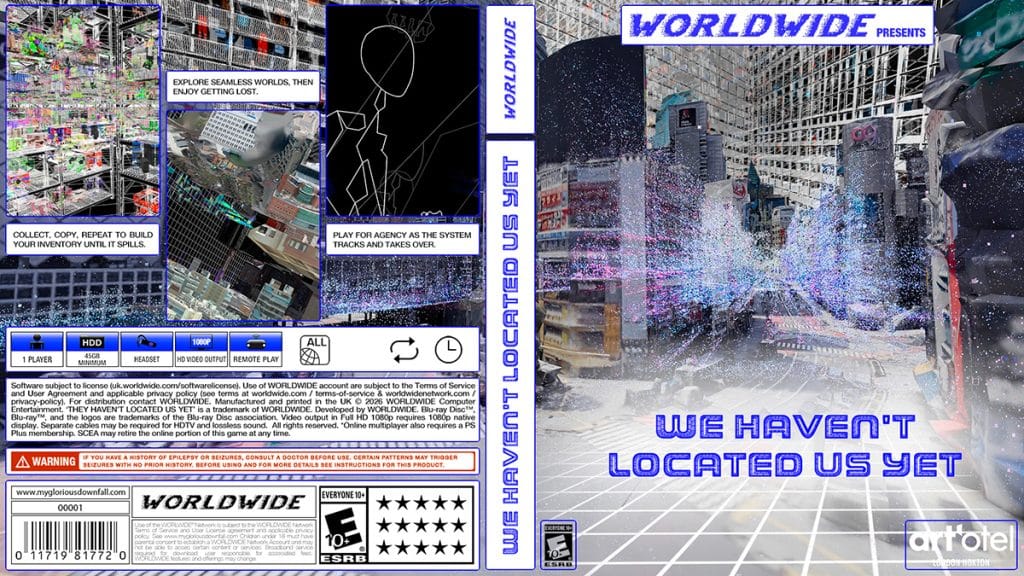
Multidisciplinary Dutch Artist Mathijs Hunfeld, cover art for WE HAVEN’T LOCATED US YET, art’otel London Hoxton (2026). Image courtesy of the artist.
Similarly, WORLDWIDE investigates the paradox of hyperconnectivity. We live in an era where trends, images and identities circulate instantaneously. Hunfeld reveals visibility itself to be a commodity, exposing the infrastructures that shape desire and flatten our differences. His oeuvre captures a generation’s experience of existing simultaneously everywhere and nowhere, connected yet isolated. Rather than presenting technology as the sole antagonist, Hunfeld suggests that visibility has become a commodity we willingly pursue, implicating both digital platforms and their users. With WORLDWIDE, we can detect influences of Jordan Wolfson’s immersive digital psychology and Ian Cheng’s evolving digital systems and simulated realities.
There is also a notable self-reflexivity in Hunfeld’s practice. He openly acknowledges the contradictions of critiquing a system within which he himself operates. His experience in luxury retail and set design has given him an insider’s understanding of aspirational environments and the seductive power of display. Rather than denying these contradictions, he embraces them, positioning himself within the very mechanisms he critiques.
Since graduating from the Royal College of Art, Hunfeld’s trajectory has been impressive. Yet despite this growing recognition, his practice retains an experimental energy and conceptual sharpness.
In an art world increasingly interested in the porous boundaries between media, Mathijs Hunfeld stands out as an artist uniquely equipped to navigate these intersections. His work captures the anxieties and contradictions of contemporary life with intelligence, humour and formal sophistication. As digital and physical realities continue to collapse into one another, Hunfeld’s practice offers a vital and timely examination of how identity, desire and belonging are manufactured, performed and consumed. If his recent work is any indication, Hunfeld is establishing himself as an important new voice in discussions around identity, technology and contemporary visual culture.
Top Photo: Multidisciplinary Dutch Artist Mathijs Hunfeld Installation view of HIGH RISK OF FALLING, 2024, at // NOTHING UNWANTED, ANNEX by The Koppel Project, London (2026). Image courtesy of the artist.
Words Lee Sharrock Photos Courtesy The Artist © 2026