
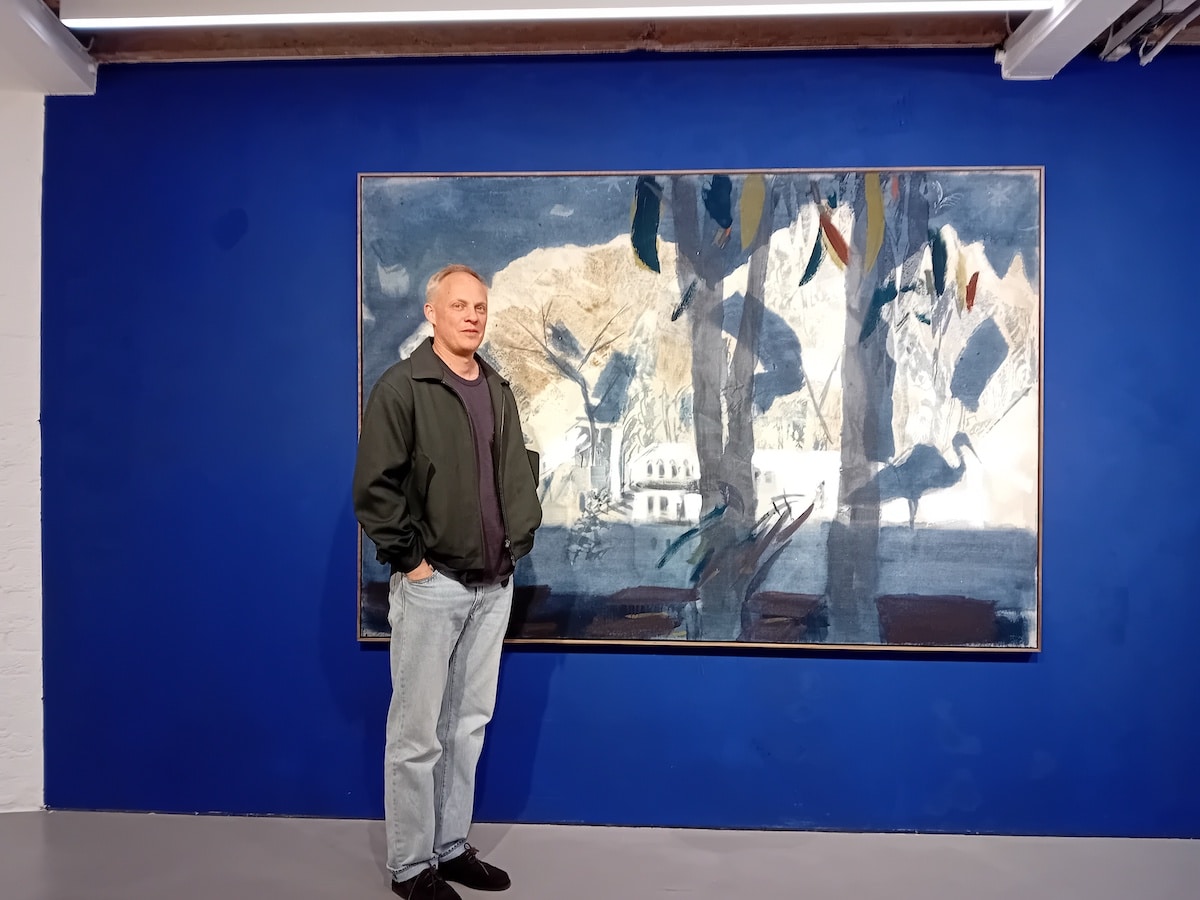
Anglo-Dutch painter Nick Goss’s new exhibition at Josh Lilley Gallery is set on Eel Pie Island, a now-private marshy nine acres on the Thames in Twickenham. It has a bohemian history: Eel Pie Hotel was a rock venue in the 1960’s – The Rolling Stones, The Who, and Pink Floyd played there – but it was run-down and unsafe by 1969, became the site of a hippie commune, and burned down in 1972. Goss uses the island and hotel as inspiration for eleven new paintings, positioning the river as a site of memory, imagination, and historical drift. In the words of Emily le Barge’s accompanying essay ‘geographical locations (urban, swampy, waterside, overgrown), like rooms (hallways, interiors, exteriors, tables and chairs, windows and views), are plucked from what we might call the real world, in order to make another world, old but new, and just as real — because imagination is, real, and what is life, but an extravagant, beguiling bricolage, in any case?’
PCK: Do you expect many viewers to have visited Eel Pie Island?
NG: No, I’ve met just a couple of people who’ve been there, so I assume few will know it. Normally, the island isn’t easy to access, but I visited an artist, Juliette Losq, who has a studio there. It’s very JG Ballard, very ‘drowned world’, very overgrown. I want to have that feeling of something half-remembered, and the hotel was a perfect stage – and staging post – to put that sort of world together. I’m really interested in the idea of being unsure what’s fact and what’s fiction, and I want that to come through in the paintings.
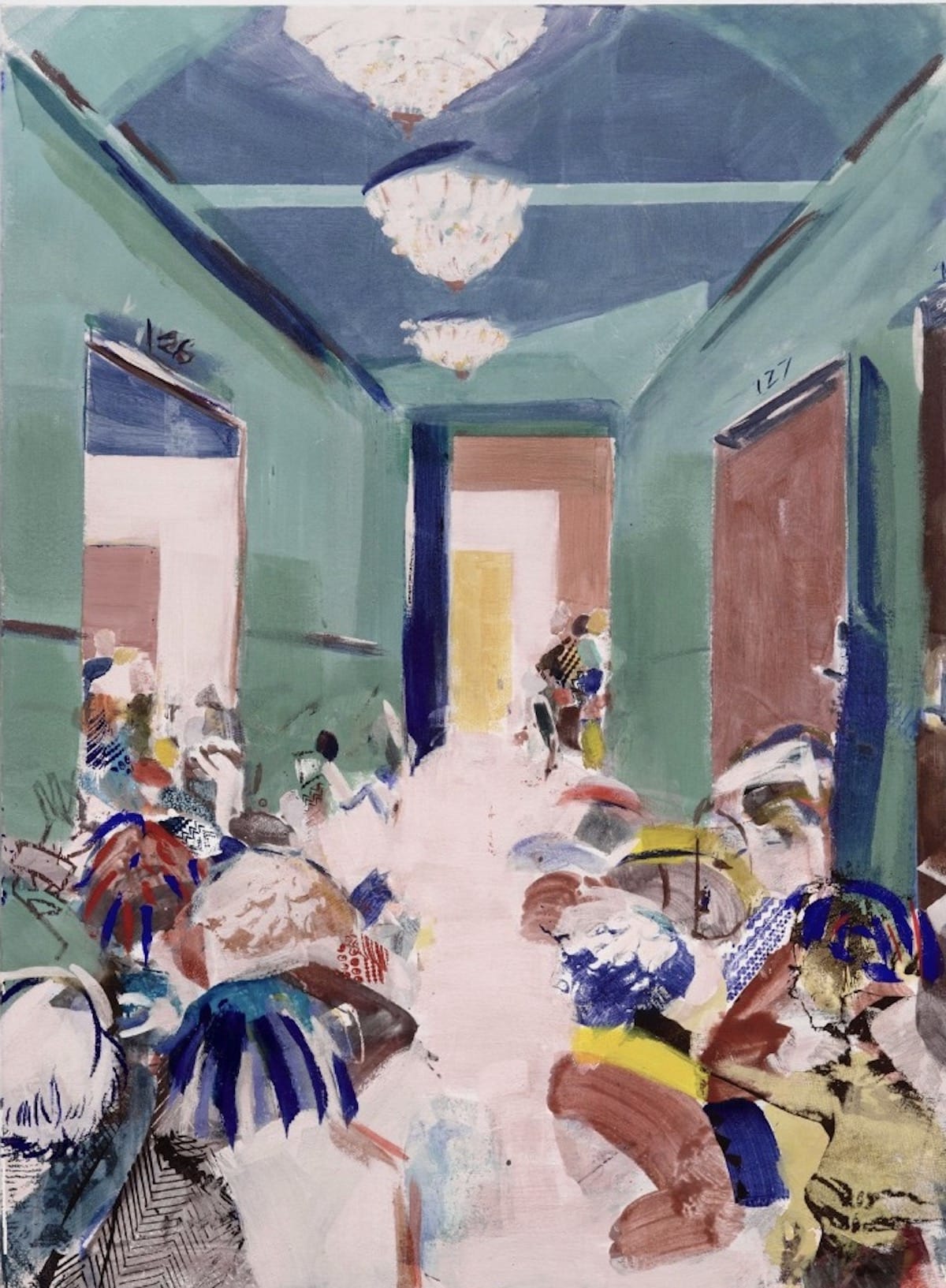 Nick Goss: Room 126, 2026 – Distemper, silkscreen and oil on linen, 190 x 140 cm
You tend to combine many sources into a single painting. Is that true of Room 126?
Yes, it’s like an amalgamation of many different hotel corridors that I’ve either seen or been to. The chandeliers come from my photos of a pub in Greenwich, the labyrinth-like corridors come from the Chelsea Hotel in New York. There are lots of photos of the exterior of the Eel Pie Hotel, but not many of the interior. I love that, because I’ve got tons of ideas for interior paintings, and the most important thing for me in the studio to have a narrative to think about when I’m painting, and try to piece together the elements. I went to the Eel Pie Island Museum, which is really interesting because all the people who work there used to go to the concerts. A lot of the photographic material informing Room 126 comes from the posters for events on the island, but other bits come from very different times and places – some are from Pompeii, for example. I love the idea that the crowd transcends time and place, that there’s a sort of unconscious memory of civilizations embedded. Another jumping-off point was the Sergeant Pepper cover, and the idea of heroes and villains all stood next to each other.
The corridors make for a geometric setting…
The architecture is quite delineated for me, yes – I tend to like more ambiguity. Having those strong perspectives meant that the crowd needed to be quite elusive – it’s been painted over and rubbed out repeatedly. Silkscreening is brilliant because it’s a language you fight against, one that gives you the friction you need to make a painting. Most of the time, you’re destroying it, but then the remnants become the corner of an eye or the side of a nose, and you think – that figure is starting to form. I add fabric patterns from photos I take near my studio in Dalston, which I also turn into silkscreens. I like how they can have multiple possible readings. It’s really a way of adding that grit you need in a painting: if the language becomes too fluid, I find that tricky – whereas I like those little breaks, the ambiguity.
Do you begin with a silkscreened image?
No. After priming the canvas, I start with charcoal drawings. I cut out their shapes and put them onto the canvas like big stencils, then fill those areas with distemper – it’s like a layer of wet glue. That establishes the main elements and alters the look of the layers of paint that come next. The silkscreens come in at the later, more detailed stage.
Is that glitter?
I’ve been making my own paint for a few years now, but what’s new for this show is that I got really excited by strange minerals you can put directly into the medium, and the medium evaporates when it’s dry so you’re left with pure pigment that’s attached to the site, almost like a fresco. It’s less flat than straight paint, and hard to use because it changes colour dramatically when it dries – rather like when you take a glazed ceramic out of the kiln. But that’s nice too: a little control, but not too much. Here I use fuchsite, a pale transparent green mineral, similar to malachite. You mix it in and add a tiny bit of cobalt blue, maybe a bit of burnt sienna, and get a really weird, slightly unplaceable green. And it glitters.
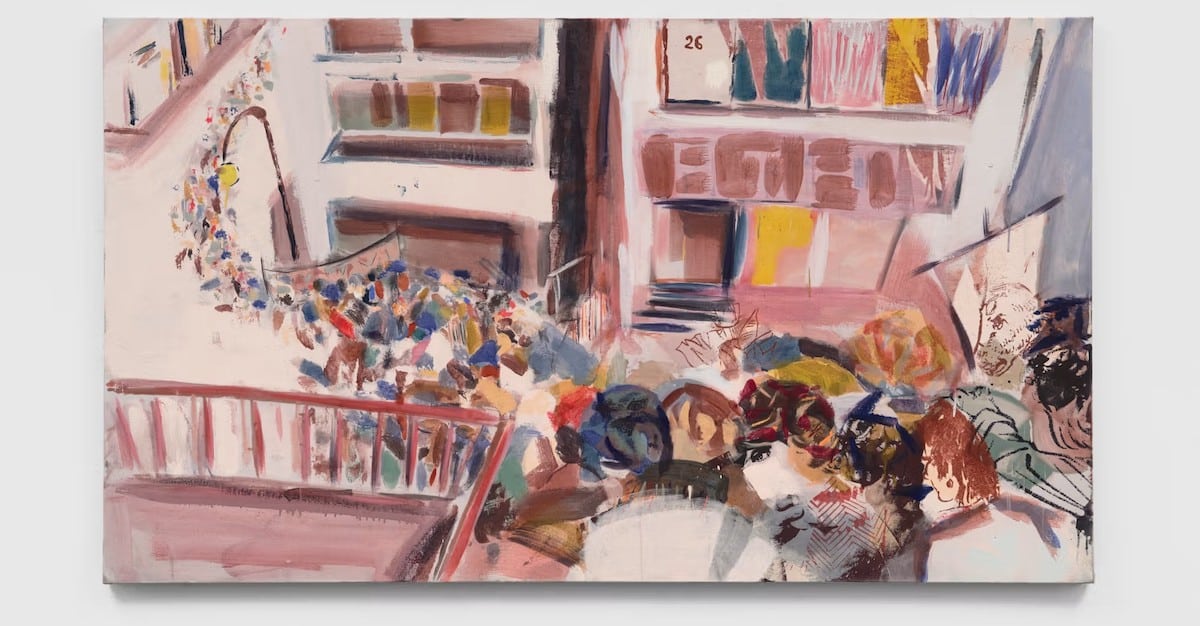
Nick Goss: Cortège, 2026 – Distemper, silkscreen and oil on linen, 120 x 210 cm
What’s the crowd doing in Cortège?
I wanted it to feel like you were in a protest, perhaps, or maybe a religious ceremony, or the running of the bulls in Spain. It’s not really focused on this hotel that’s perched on the edge of the river, though there is an abstracted hotel sign. It was more inspired by a trip to Ostend: I’d got really excited by James Ensor’s work, and wanted to go and see where he was born and where he painted. I was drawing from the window and then playing around with the perspective, and I like the idea that – as in an Ensor painting – you are simultaneously in the crowd and sort of hovering above it.
Could some figures be looking on from a balcony?
Maybe that might be like the Rolling Stones – there are lots of photos of them waving across the Thames from a balcony on the island.
Is it a friendly crowd?
I think so… I like Dan Hancox’s book ‘Multitudes: How Crowds Made the Modern World’, which explores how crowds have been perceived across literature and culture over the last hundred years. Crowds are often presented as toxic and dangerous, but he argues against that. And whenever I’ve been in large crowds of people protesting things, it’s usually very peaceful, and it’s only when police start pushing you together that it becomes more aggressive. Hancox sees crowds positively, as the ultimate force for change, the bringer of conviviality, euphoria, mass culture and democracy.
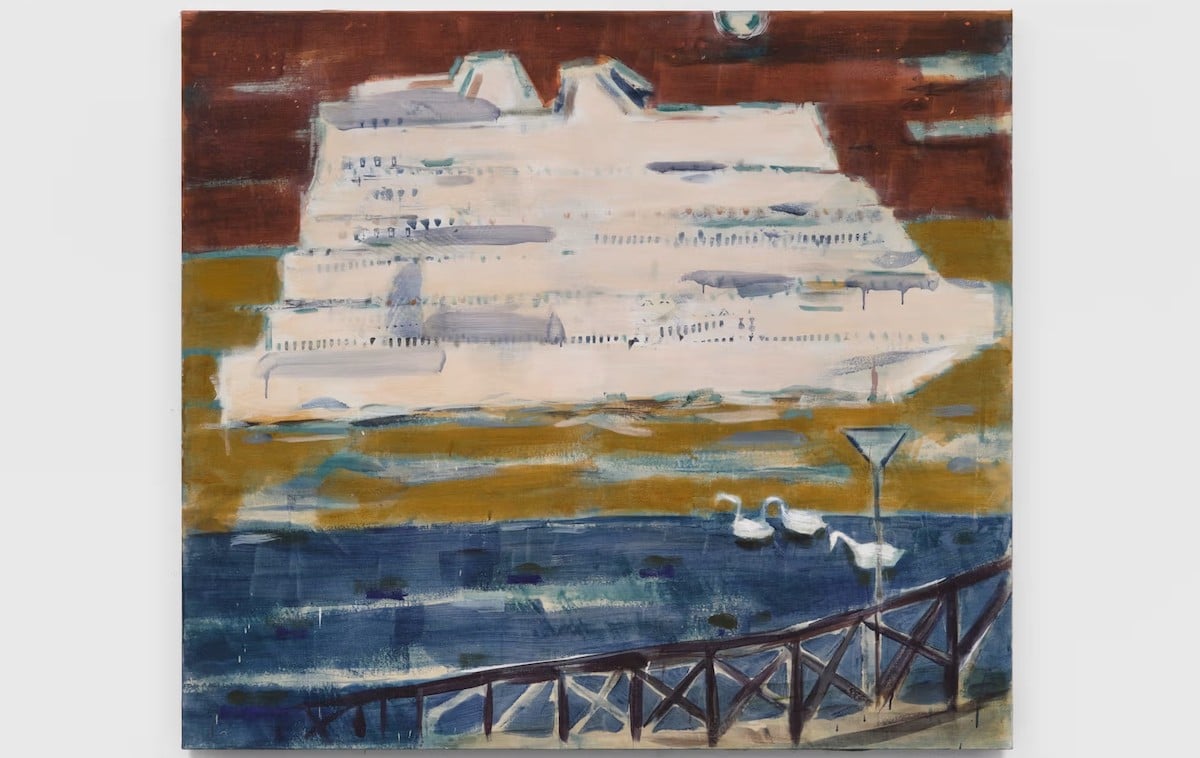
Nick Goss: Viking Jupiter, 2026 – Distemper, silkscreen and oil on linen, 160 x 230 cm
There are quite a few water birds in the show?
There are. We walked by at night, and there actually were three swans there – most of the pictures have those amalgamated sources, but this one is more literal. The Viking Jupiter is an enormous cruise ship that recently moved to Greenwich and is dragged up the Thames. It’s just such an otherworldly, incongruous thing to look at. I tried to embed various silkscreens of interiors and textiles I’d been working with into the ship, but thought ‘that’s not working’, and whitewashed them out. Then slowly, incrementally it become this ship. I like how cruise ships aren’t just floating hotels, but also casinos and concert halls. The base colour again is the fuchsite green shimmer. And this has a very horizontal action where most of the show uses strong verticals.
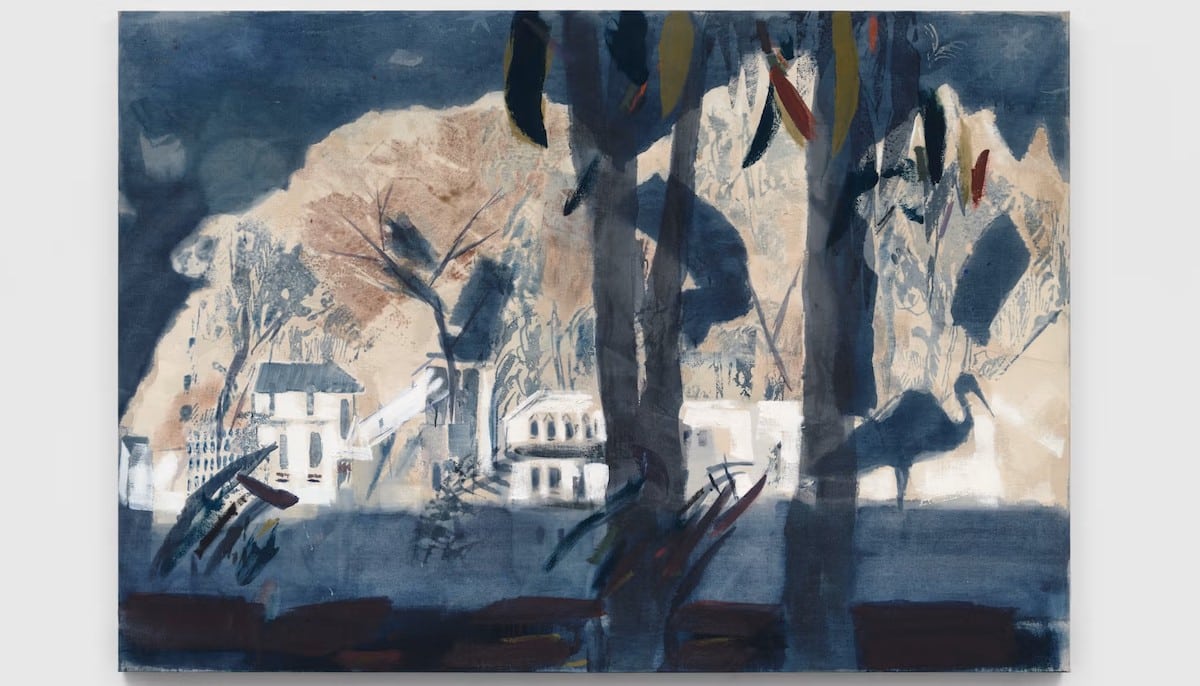
Nick Goss: The Waterline, 2026 – Distemper, silkscreen and oil on linen, 160 x 230 cm
The Waterline feels a little different from the other paintings?
That’s because it’s on unprimed canvas and uses lots of indigo. We look past the trees across the river into another world… It’s dark and stormy – I like to show weather events.
You often feature water… What’s the appeal?
Everything in the show has a sort of impermanence, and water for me is always changing but always the same. I like the idea that the Thames has been there for millennia…
Yet there might be dangerous changes to come?
Yes, and that was more explicit in my show ‘De Ramp’ (Dutch for ‘the disaster’) in 2017, which dealt with the North Sea Flood of 1953 in Zeeland, near where I grew up.
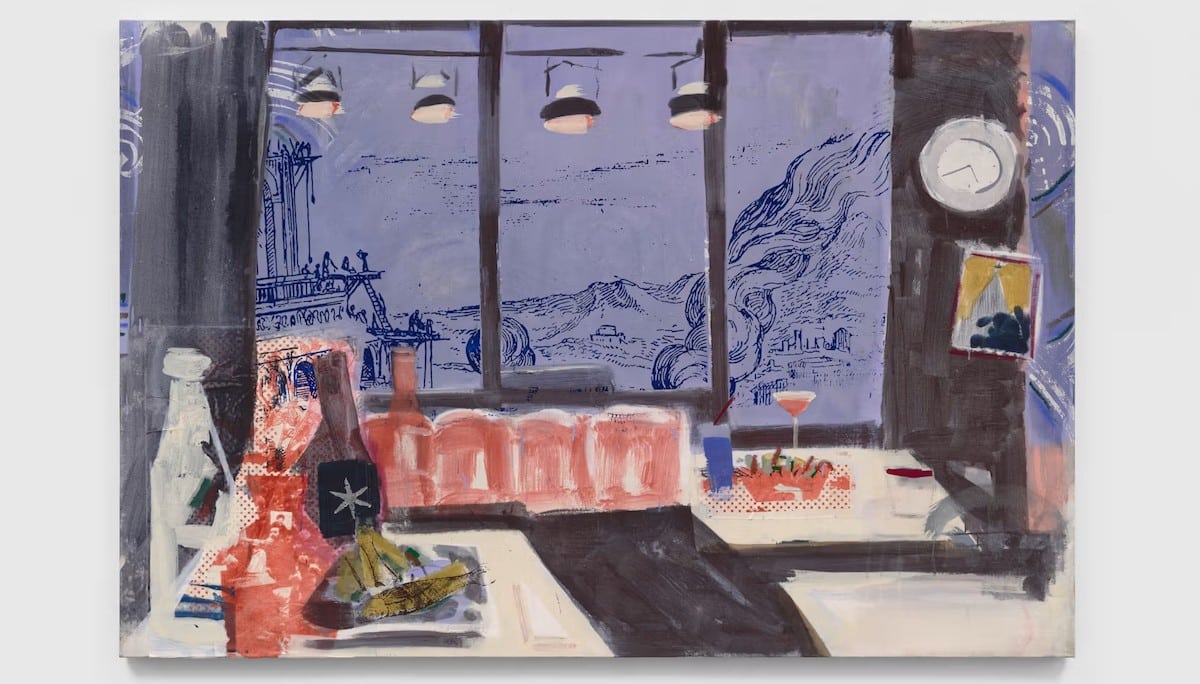
Nick Goss: Just Before Six O’clock, 2026 – Distemper, silkscreen and oil on linen, 140 x 210 cm
We see inside and outside in Just Before Six O’clock, a still life as well as a landscape…
I wanted a sense of time travel, and I found a 16th-century print in the British Museum, so we look out onto something that doesn’t exist any more.
Nick Goss: ‘Eel Pie Hotel’ continues to 23 May at Josh Lilley Gallery, London. Eel Pie Island has a vibrant artist community, and – though it is otherwise private – can be visited during the studio open days in early July and early December. You can learn about its history at the Eel Pie Island Museum, close by in Richmond.