
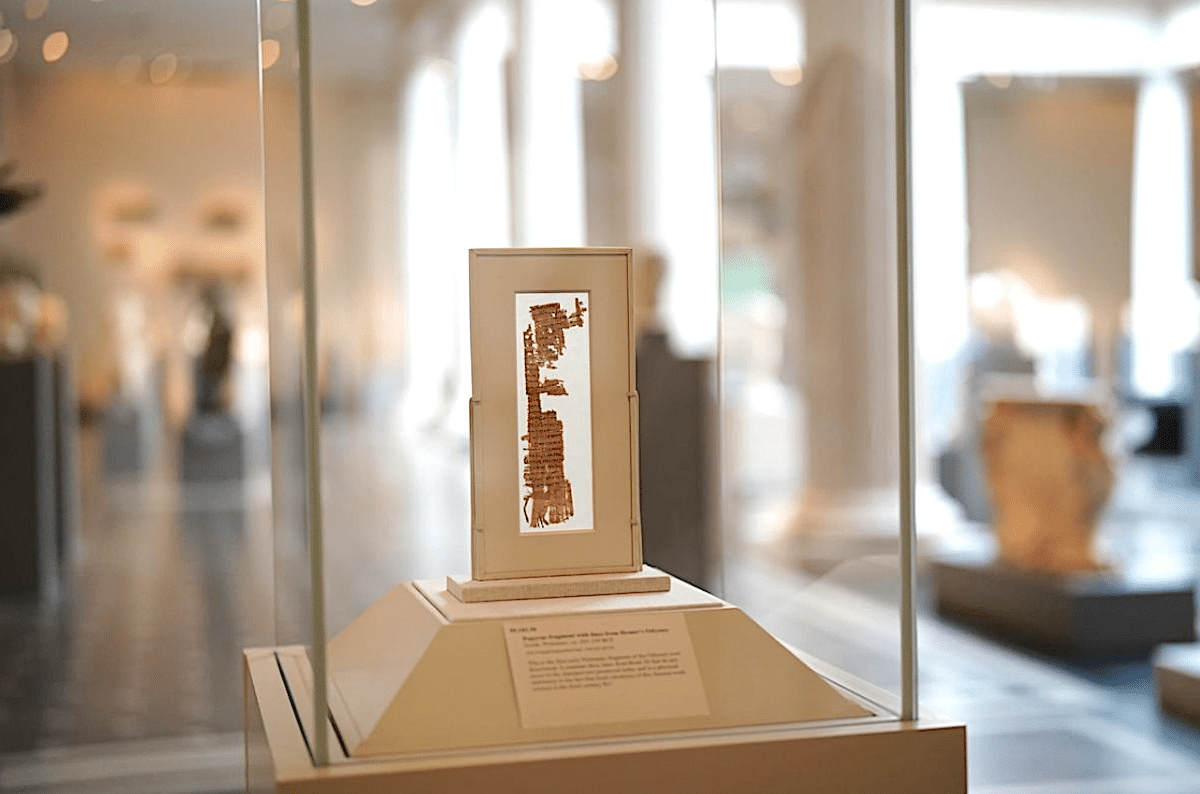
The oldest known surviving written fragment of Homer’s Odyssey has returned to public display at the Metropolitan Museum of Art in New York, installed in Gallery 162 after a period away from public view. The timing is apt: Christopher Nolan’s film adaptation of the epic opened this summer, bringing the story of Odysseus back into the wider cultural conversation, and the Met has taken the opportunity to draw attention to both the fragment and six further objects from its collection that are connected to the poem.
The fragment dates to approximately 285 to 250 BC and originates from the Ptolemaic period in Egypt. Written in ink made from lampblack and water, and applied with a stylus to papyrus, it is the earliest Ptolemaic fragment of the Odyssey ever discovered. It is displayed with both sides visible, and it carries a particular significance beyond its age: it contains three lines from Book 20 of the poem that do not appear in the standard text preserved today. Those additional lines are not errors or corruptions but evidence that the Odyssey, like other Homeric poems, existed in multiple local variations across the ancient Greek world before scholars at the Library of Alexandria undertook the task of establishing a definitive text in the early third century BC.
Homer’s Odyssey On Display Photo Courtesy Met Museum
That process of standardisation is part of what makes this fragment so valuable as a historical document. Homer’s poems were not originally written works at all but oral compositions performed by bards who would shape and embellish the narrative as they told them. The transition from spoken performance to written text was gradual and uneven, with different cities and regions maintaining their own versions. The Library of Alexandria, founded by the Ptolemaic kings as the first comprehensive public library of its kind, collected copies from Chios, Argos, Sinope and elsewhere, and one of its scholars’ first tasks was to produce a single authoritative edition from that diversity of sources. This papyrus predates that standardisation and preserves something of what was lost in the editing.
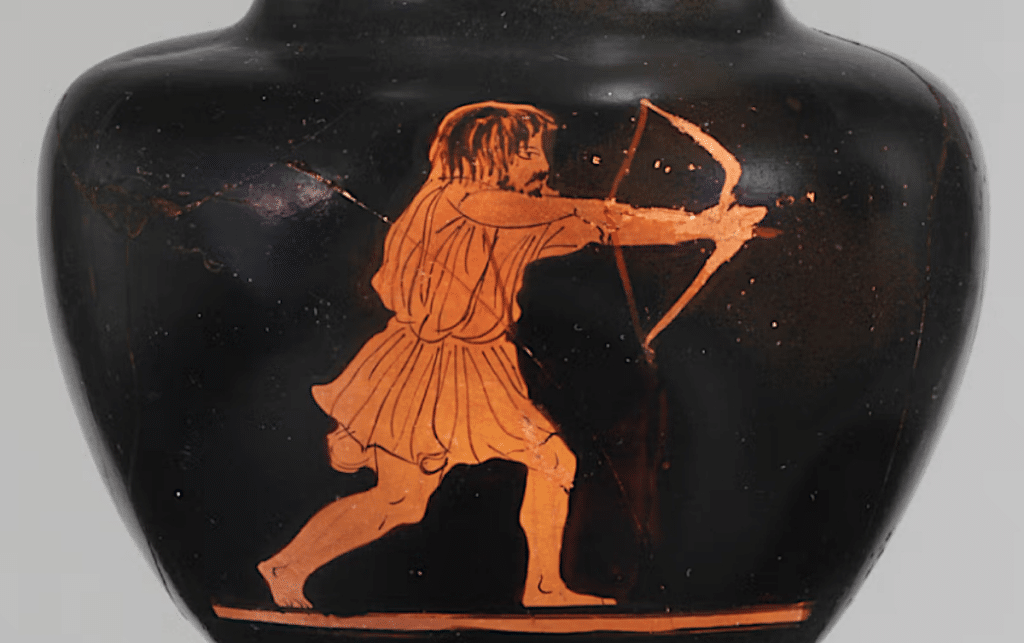
The fragment was gifted to the Met in 1909 by the Egypt Exploration Fund and has been part of the collection ever since. Its return to display is accompanied by the museum’s broader invitation to trace the Odyssey through its wider holdings. Six related objects are currently on view throughout the building, including a terracotta plaque from around 460 to 450 BCE depicting Athena intervening on behalf of Odysseus, a wine-mixing bowl showing Odysseus pursuing the goddess Circe, a fresco of Polyphemus and Galatea, and a carnelian Trojan Horse scarab dating to around 500 BC.
Taken together, these objects trace more than two and a half thousand years of artists returning to the same story, finding in it material for painted pots, carved gems, architectural decoration and now a three-hour Hollywood production. The papyrus fragment in Gallery 162 is where the written version of that story begins, or at least where the earliest surviving trace of it can be found.
Discovering Homer’s Odyssey at The Met: Seven objects in The Met collection take you on Odysseus’s famed journey. Department of Greek and Roman Art. From 6 August.