Peter Max, whose Day-Glo posters of flowers, butterflies, rainbows and planets sold in the millions and somehow managed to distil an entire decade’s worth of countercultural optimism into a handful of repeating shapes, died Monday in Manhattan. He was 88.
Max was a vegetarian and a teetotaler, and whatever expansion of consciousness he sought, he found through yoga rather than anything more chemical. That did not stop him from becoming one of the most commercially successful artists of his era, his work appearing on sheets, shower curtains, glassware, aeroplanes, and at least one postage stamp.
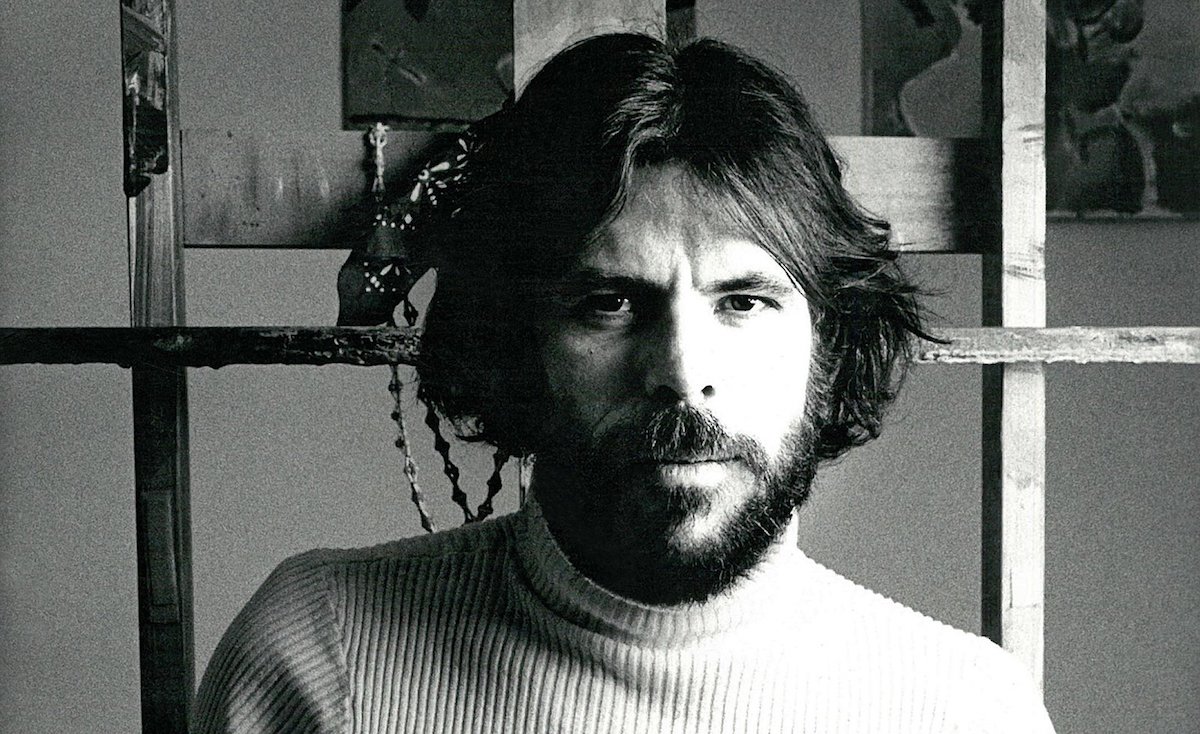
Peter Max
His visual language borrowed loosely from Art Nouveau, Op Art and whatever counted as psychedelic imagery at the time, producing bright, instantly legible pictures that read as an unambiguous endorsement of love, joy and universal togetherness, the core values of the moment he happened to be painting through. He developed what he called panopticon images, tight repeating patterns that produced a kaleidoscope effect not unlike Eastern mandalas, and his most enduring single figure, the so-called cosmic jumper, a barefoot young man striding across the globe surrounded by puffy clouds and rounded birds, eventually landed on a ten-cent stamp for Expo 74 in Seattle.
In his 2013 memoir, The Universe of Peter Max, he described his own subject matter in characteristically euphoric terms, writing of levitating sages, exploding cosmic butterflies and flowers perpetually blossoming into more flowers, work that he said drew directly from the youth movement of the era and, in turn, spoke straight back to it.
He was born Peter Max Finkelstein on October 19, 1937, in Berlin, where his father worked in import and export, and his mother had once been a fashion designer. As Nazism rose, the family fled to Shanghai, where his father became a pearl merchant. Peter attended an English-language school there and spent his free hours talking with monks at a nearby Buddhist monastery, an early exposure to a kind of spiritual openness that would resurface repeatedly in his later work. When the Maoist revolution gathered force, the family moved again, this time to Haifa, where Peter learned Hebrew and, already fixated on the stars, took astronomy courses at the Technion.
The family emigrated to New York in 1953, settling in Bensonhurst, Brooklyn, where Max attended Lafayette High School. He had already taken private art lessons in Israel. After graduation, he enrolled in summer classes at the Art Students League, quietly abandoning whatever vague ambitions he had for astronomy in favour of art. He worked first as a realist, drifted briefly into abstraction, and eventually settled into commercial illustration, landing his first real assignment designing an album sleeve for Riverside Records in 1962, a moody portrait of the pianist Meade Lux Lewis that won a gold medal from the Society of Illustrators.
With a partner, Tom Daly, he built a design studio that racked up more than sixty industry awards within two years, producing work ranging from book jackets to album covers. Max, feeling boxed in, left the partnership in 1965 and spent two years in near total seclusion in a Riverside Drive apartment, churning out thousands of drawings.
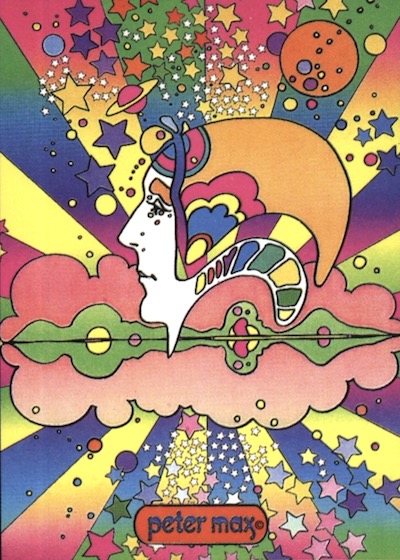
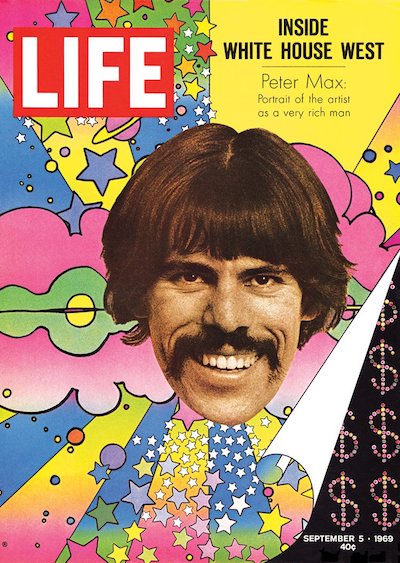
What followed was the period that made him famous. He decorated a themed restaurant called the Tin Lizzie with paisley wallpaper and Chaplin film collages in 1967, and his advertising posters for local shops began attracting attention from teenagers who wanted one for their bedroom wall. That demand turned into Peter Max Posters, a partnership with a local printer that eventually sold millions of copies of his designs. Soon he was producing posters for the American Cancer Society, the Peace Corps and the United Nations, and inadvertently naming an entire cultural event when his promotional materials for a 1967 Central Park gathering, reading “Be In,” were misread as a noun rather than an instruction. By 1968 he was designing transit posters for ten major cities, telling Time magazine he was bringing art to people who would never otherwise set foot in a gallery. Licensing deals followed with more than seventy companies, and Life magazine put him on its cover in 1969 under the headline Portrait of the Artist as a Very Rich Man.
He was not, contrary to popular assumption and his own occasional willingness to let the assumption stand, involved in the 1969 Beatles film Yellow Submarine, which was actually the work of German art director Heinz Edelmann.
By the mid-seventies, Max had burned out, shutting down his studio and retreating from public life, telling People magazine in 1976 that he had stopped, exhausted by the demands of being everywhere at once. He re-emerged gradually, producing a bicentennial book of paintings honouring all fifty states, designing the MTV logo in the eighties, and creating the official poster for the 1994 World Cup.
By the time dementia had fully set in, the Peter Max brand had, strangely, only grown larger, propped up by a relationship with Park West Galleries, which auctioned his work aboard cruise ships to enormous profit. Questions eventually arose over how much of the later work Max had actually painted himself, with friends suggesting he had largely stopped and was signing pieces produced by assistants. His son Adam, who oversaw that operation, was pushed out of the business in 2019 by Max’s daughter Libra and a court-appointed guardian concerned about exploitation.
Max’s first marriage, to Elizabeth Nance, ended in divorce. He married Mary Balkin in 1997, having approached her on a Manhattan sidewalk the year before with a line about having painted her profile his whole life. She died by apparent suicide in 2019, during a period marked by her husband’s declining health and a bitter legal dispute within the family.
He is survived by his two children, Adam and Libra Max. For those who grew up under his posters, Max will likely remain exactly what he always seemed to be, a permanent, sunny fixture of 1960s idealism, the mood of an entire decade rendered, again and again, in flowers and stars.
His son, Adam Max, confirmed the death, which occurred in a hospital. Max had lived with dementia for years.