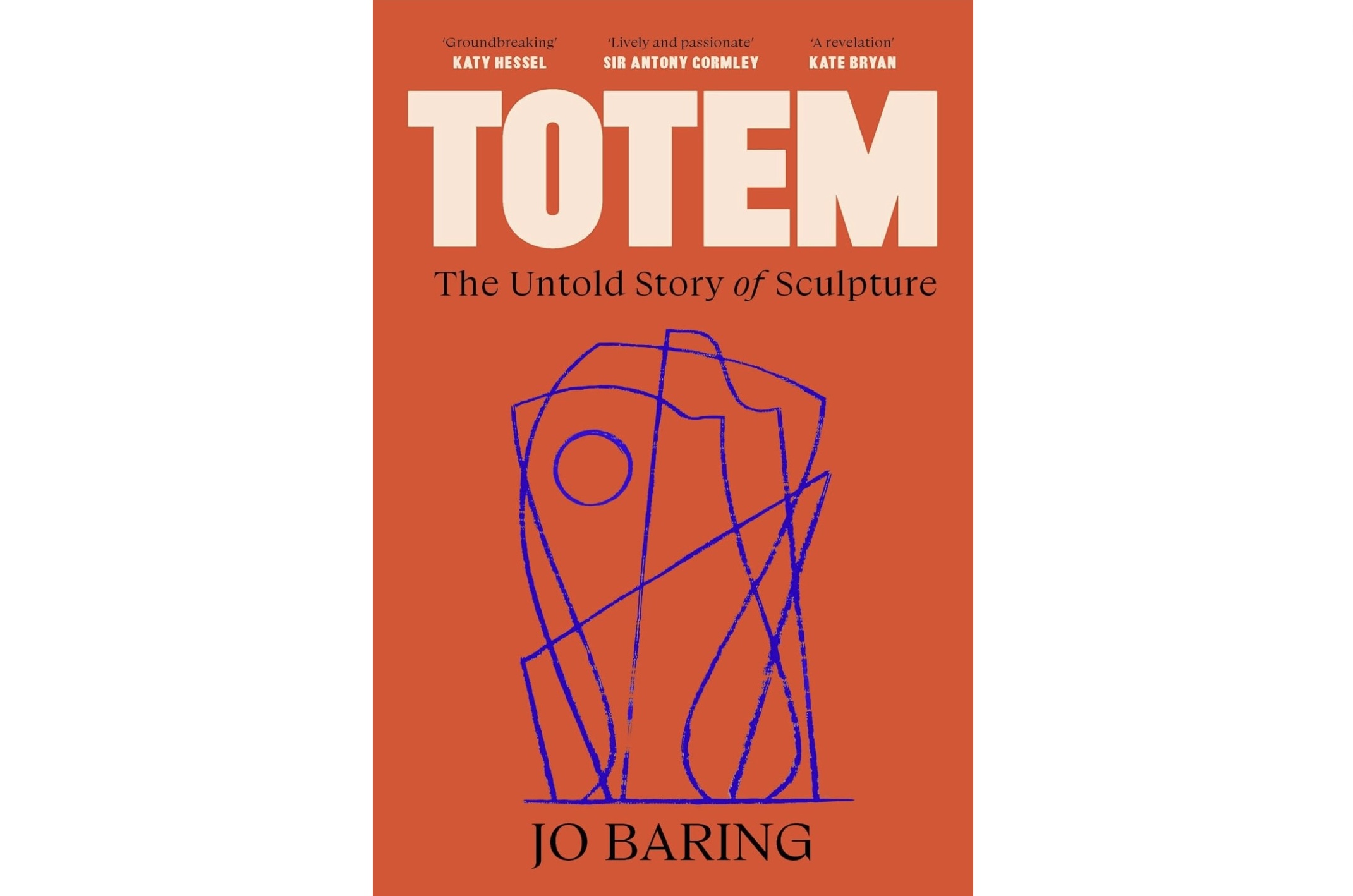
Since ancient monoliths, humans have had a love of the vertical, assertive landmark, whether as a sculpture, a burial site, or for collective gatherings. Baring chose the title Totem for her long, cast look at sculptural actions, representative icons, symbolic tribal markers, and contemporary artists’ works. As she says, “I have long believed that sculpture is a two-way relationship between us and it.” Whatever the scale, these interactions are a 40,000-year dialogue across time and space that concerns life itself. Baring approaches it all intuitively like a Pythagorean puzzle where all the pieces fit. In so doing, she brings the natural world and the many culture-specific sources into focus. Baring’s approach is less art historical and more about finding trace elements.
The Totem theme spans the world, ramifying into revealing contexts. Louise Bourgeois’ Maman at the Guggenheim Bilbao, Veronica Ryan’s sculptures of fruit and Japanese Yayoi Kusama’s renowned pumpkins all weave their way into a loose discourse on sculpture. Brancusi’s Endless Column in Tirgu Jiu, Romania, looms large, but there was strong opposition to Brancusi’s abstraction. We tend to see symbols as “abstract”, but abstraction was never a concept when ancient symbols were enacted through carving, painting, and inscription on stone. Baring has an openness with her interpretation of sculpture. If meanings are hidden, it is because they are abstract, real, or symbolic; these are transitory clues to lives lived in long-forgotten times.
One of the most interesting is Julie Brook, a contemporary land artist who has produced some remarkable sculptural gestures. Firestack (2015-2022), a stone cairn on the West of the Isle of Lewis where land and sea meet, becomes an ever-evolving performance with nature as co-creator and destroyer. The Surrag Path (2021-23), made of local Lewis gneiss stone, again embroiders nature – a human intervention or trace of human presence. Antony Gormley’s Another Place on Crosby Beach or Robert Smithson’s 1500-foot-long Spiral Jetty (1970) at Great Salt Lake, Utah, similarly express a kind of environmental integration. While Spiral Jetty was never intended to be a lasting monument, it expresses a profound understanding of entropy in art and broader archaeological and ancient contexts. Contemporary art often misses out on these connective contexts in the interest of “originality”.
A striking example Baring discovered is Eduardo Chillida’s Comb of the Wind (1976) on the Basque coast of Spain. She explains this is a sculpture that cannot be reduced to a visual experience, as it’s more an eternal presence, offset by the surrounding shoreline, climate, and weathering. Baring’s book is less a touristic spectator-driven Destination Art, and more insightful as a book. She teases us with tactile, environmental and cultural cues to reify the sculptural impulse – an unclassifiable and eternal mystery. The 40,000-year-old Lion Man, discovered in a cave in southern Germany, is a small mammoth-ivory human-animal hybrid, whose intense presence speaks of unknown cultural origins. The same goes for the 9,500-year-old totemic Shigir sculpture made of tamarack and found in Russia. And then we are back to Henry Moore and Stonehenge, who sourced ancient Mayan sculpture in his art, and Barbara Hepworth, whose remarkable sculptural integrations of nature developed into a dialogue with Dag Hammarskjold, who endorsed commissions with the UN in New York. Shortly before his plane crash in Rhodesia in 1961.
The book grows on you as you make your way through… Artists and cultural equations you never heard of broaden the scope. A studio visit to Mono-ha artist Kishio Suga is one of the most interesting accounts … Suga’s Law of Situation (1971), made of stone and fibreglass and sited partly underwater in Venice, has a suspended, temporal view of art and intervention – truly situationist Mono-ha art. Then there are others like Danh Vo, a Vietnamese artist whose object Totem portrait of her grandmother comprises simply objects; Barti Kher, whose goddess-like anomaly captures our attention; and Kim Lim, an artist in a way limited by her origins, never truly integrated into the West’s gallery and historical system.
Jo Baring’s Totem is one of those books that will have its own unique audience of art lovers. It is strangely reminiscent of the late Suzie Gablik’s The Re-enchantment of Art, for the experiential and spiritual sources abound, connecting art to experience throughout. There is a beautiful interweaving of place and artworks… The art is not sealed off from nature, more an extension of our relatedness to nature – the art we are a part of. The Ojibwe word ototeman or odoodeman (‘he is a relative of mine’ or ‘his clan’) suggests a totem with origins implying belonging or ‘to dwell together’. The art was part of a spirit of community, and when it was made, it became a manifestation of that great holistic union between the ancients and nature. Jo Baring’s Totem: The Untold Story of Sculpture suggests that, whatever stage of life we are in or what civilizational epoch we come from, we are all seekers.