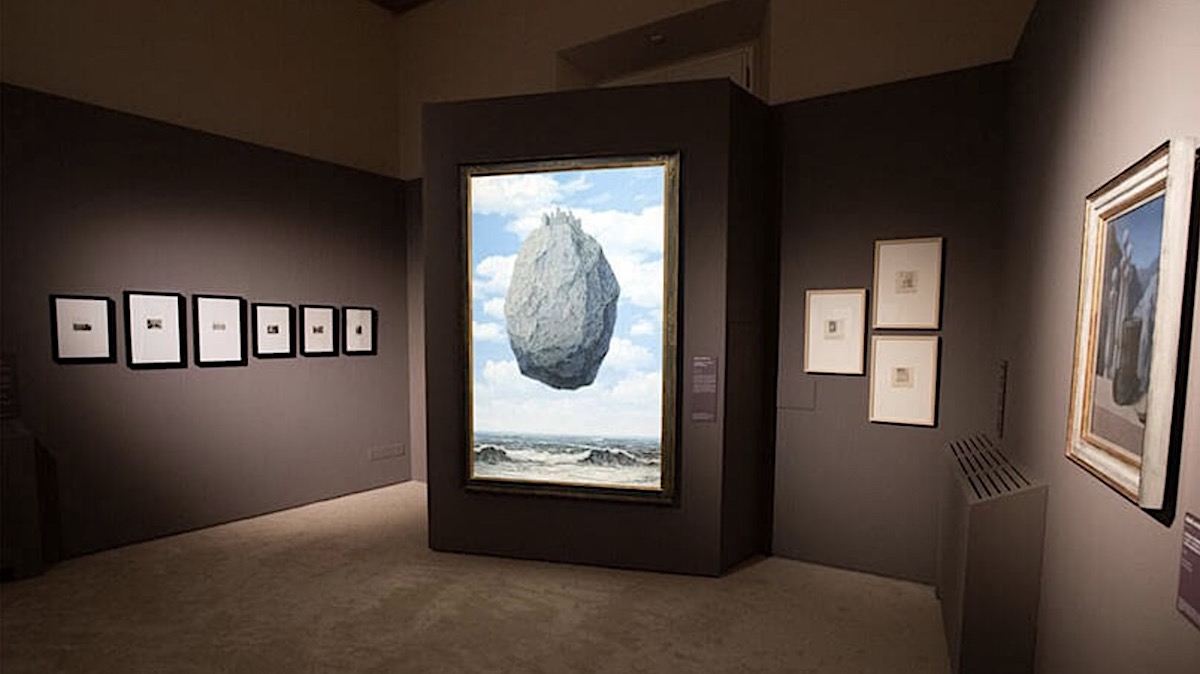
The Castle of the Pyrenees is one of Magritte’s best-known and most-reproduced images. It signifies the artist’s typically disturbing juxtaposition of familiar objects, with poetic mystery.
Last week, a child picked up a pinecone from the sculpture garden at The Israel Museum, Jerusalem, walked inside, and pushed it through the painting before a guard could stop him. The whole incident took seconds.
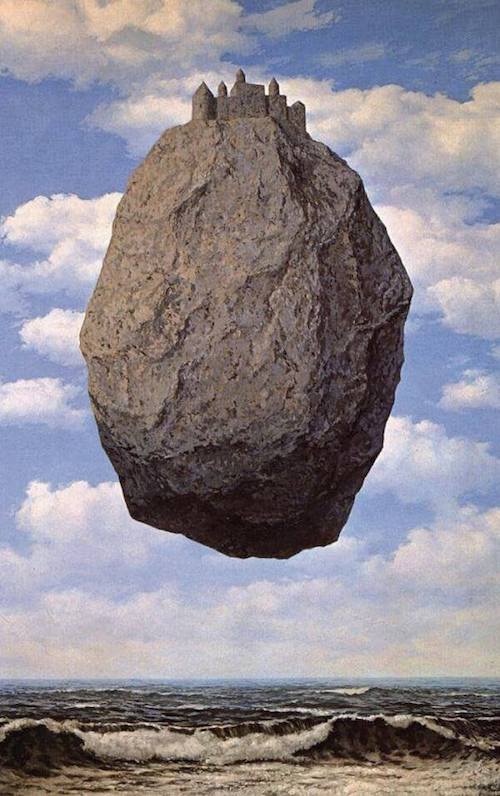
Rene Magritte: Le Chateau de Pyrenees 1959 Courtesy Israel Museum
The painting has been part of the Museum’s permanent collection since 1985. It depicts a massive rock topped with a castle, suspended in a clear sky above a churning sea. It is one of Magritte’s most reproduced images and one of the more quietly unsettling things he made. The canvas is now in the conservation laboratory. It will be there for several weeks.
Sharon Tager, who runs the museum’s conservation laboratories department, described the process to Haaretz in some detail. The first stage is the substrate itself: repairing the dent left by the puncture, restoring the canvas to its original level, then stitching it and working through the oil paint layers. Each step requires professional consultation, she said. When it’s done, most people looking at the painting won’t be able to tell anything happened.
The child was five or six years old. The family was nearby when it happened. Why? I blame the parents! The painting had no glass or motion sensor because the Israel Museum takes the position that visitors should be able to get close to the work without barriers mediating the experience. That philosophy has costs, apparently.
The Castle of the Pyrenees was commissioned by Harry Torczyner, a lawyer, poet and longtime friend of Magritte’s, and the correspondence between the two men documenting the commission was published by the Israel Museum in 1991. Torczyner had some input. From several drawings, Magritte chose the one with the rock and the castle. He also suggested the clear sky and the dark sea, writing that over the dark ocean rises the rock of hope, topped by a fortress. Magritte took the suggestion and then edited back, removing other proposed elements to keep what he called the avigora of the image as he’d conceived it.
This is not the first time something like this has happened in the region. In 2024, a child shattered a large Canaanite jar at the Hecht Museum at the University of Haifa. In 2025, a Mark Rothko painting at the Museum Boijmans Van Beuningen in Rotterdam sustained scratch marks after a child touched it. The Israel Museum has had its own share of bad luck: in 2023, an American tourist deliberately smashed two Ancient Roman sculptures on display. A pinecone is, relatively speaking, the more recoverable end of that spectrum.
The painting is expected to return to the permanent collection gallery once the restoration is complete.
Read More
Visit