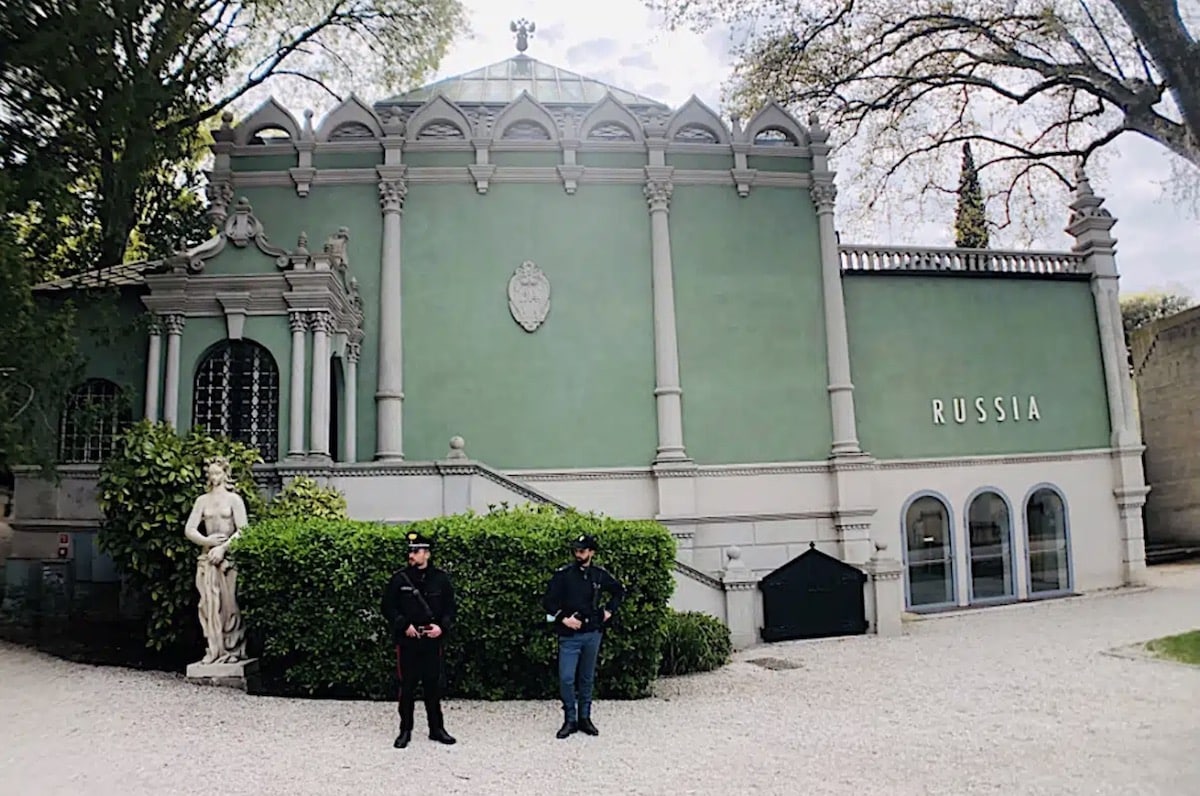
The controversy surrounding Russia’s return to the Venice Biennale after a two-year absence has produced an outcome that satisfies almost no one and resolves nothing. The Pavilion, whose reappearance in the Giardini for the 61st Biennale provoked immediate and sustained criticism from European governments, cultural institutions, and the awards jury itself, will be accessible to the public for a total of 4 days during the preview period from 5 to 8 May. From the official opening on 9 May through to the close of the Biennale on 22 November, the building will remain shut. Visitors wishing to engage with the exhibition, titled The Tree is Rooted in the Sky, will be directed to screens installed over the pavilion’s windows, which will play multimedia documentation of the performances staged during those opening days.
The arrangement is being presented as a workable compromise. It reads more like an institutional admission that the decision to readmit Russia was unmanageable from the moment it was made.
Email correspondence between Biennale Foundation President Pietrangelo Buttafuoco, General Director Andrea Del Mercato, and Russian Pavilion Commissioner Anastasia Karneeva, reviewed and published by the Italian outlets Open and La Repubblica, reveals that the path toward Russia’s participation was actively negotiated as early as June 2025. By January of this year, Karneeva had provided full details, didactics and renderings for the pavilion exhibition. A November 2025 email shows Del Mercato attempting to secure an Italian travel visa for the pavilion’s curator, Petr Musoev, by citing excerpts from conversations with officials at Italy’s diplomatic mission in Russia.
The Foundation has responded to the publication of this correspondence by insisting that Russia’s inclusion was achieved with absolute respect for applicable national and international laws and that no European sanctions were circumvented in the process. The statement was carefully worded, and the care with which it was worded is itself instructive.
The political fallout has been considerable. Italian Culture Minister Alessandro Giuli announced that he would not attend the Biennale’s preview days or the opening ceremony on 9 May, a significant gesture of dissent from within the government whose country hosts and partly funds the event. Giuli had previously requested that the Foundation hand over all communications with Russian authorities so that their compatibility with EU sanctions could be formally assessed. He also called for the resignation of the Ministry of Culture representative, Tamara Gregoretti, from the Foundation’s board, stating that she had failed to inform the Culture Ministry of Russia’s planned return and had, moreover, expressed support for its participation despite being fully aware of the international sensitivity of the situation.
The European Commission’s position has been more direct. Brussels has threatened to withdraw funding from the Biennale entirely, a lever that concentrates the mind considerably. The awards jury, meanwhile, issued its own statement last week, announcing that it would not consider for the Golden Lion any countries whose leaders are currently charged with crimes against humanity by the International Criminal Court. The formulation does not name Russia or Israel, both of whose participation has attracted protests, but the meaning is unambiguous.
Russia’s absence from the Biennale since 2022 was itself a statement of conscience by the artists and curator originally appointed to represent the country. Kirill Savchenkov, Alexandra Sukhareva and curator Raimundas Malašauskas withdrew the Russian pavilion exhibition in the weeks following the invasion of Ukraine, a decision that drew widespread admiration. In 2024, Russia ceded the use of its pavilion to Bolivia, which participated in the Biennale for the first time. The decision by the Foundation under Buttafuoco to approve Russia’s return this year, without, it appears, adequately consulting or informing the Italian government, has created a crisis that the screens-in-the-windows arrangement does not resolve so much as temporarily paper over.
What the episode reveals, beyond the specific question of Russia’s participation, is the structural fragility of an institution that must balance its founding commitment to international cultural exchange against the political realities of the world in which it operates. The Biennale Foundation’s insistence that it acted within its powers and in strict compliance with applicable law may be technically defensible. Whether it was wise, whether it served the interests of the artists, the public or the institution itself, is a different question, and the answer, on current evidence, appears to be no.
The 61st Venice Biennale Arte opens on 9 May 2026.