

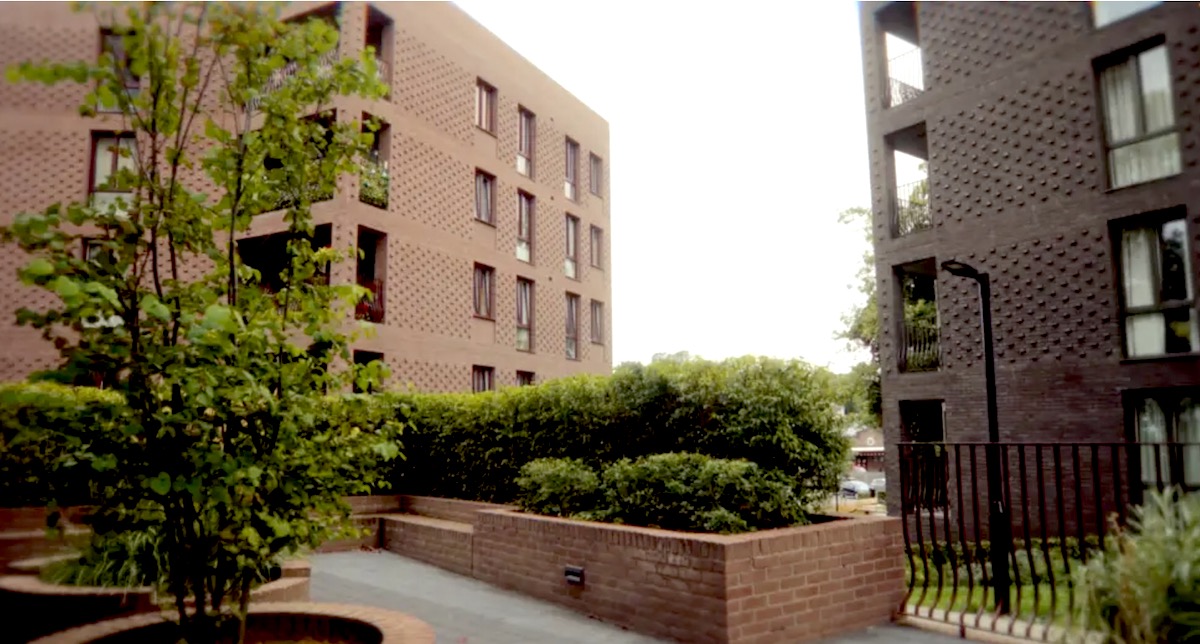
A suburban housing development in Coulsdon, south London, has taken the Stirling Prize, the Royal Institute of British Architects’ award for the UK’s best building. Lion Green Road, 157 homes in five thirteen-sided blocks, was designed by Mary Duggan Architects and built with RUFF Architects for Croydon Council. It mixes affordable and private housing.
The site was a former car park, and not an easy one. It slopes, varying in height by eight metres. RIBA president Chris Williamson called the result a new approach to higher density development, one that creates a connection between the busy Lion Green Road and a distinctive stretch of parkland beyond. The jury described it as an inventive and site-specific response to a highly constrained plot.
It sits among trees on the edge of the green belt, with low-rise housing on higher ground to the south and traditional suburban streets to the north. Soft purple and pink brickwork helps the blocks settle into the landscape, and small variations in pattern give each building its own identity. Williamson said the scheme fits into the hillside so well that it does not look like a large housing development. It has community gardens, he added, and is the sort of place he would have liked to grow up in.
Duggan said she wanted to move away from conventional suburban layouts built around roads, private gardens and clear front and back spaces. Winding paths and planting run between the blocks, linking the shared outdoor areas, and residents have access to green space and allotments. She hoped it would feel like a public space where people could belong. “Housing needs to be progressive,” she said. The project began in 2016 to create genuinely non-institutional housing, and she described it as a focus on the culture of dwelling, where architectural ambition, social value, and social realities can coexist. The win, she said, was extraordinary, unexpected and humbling.
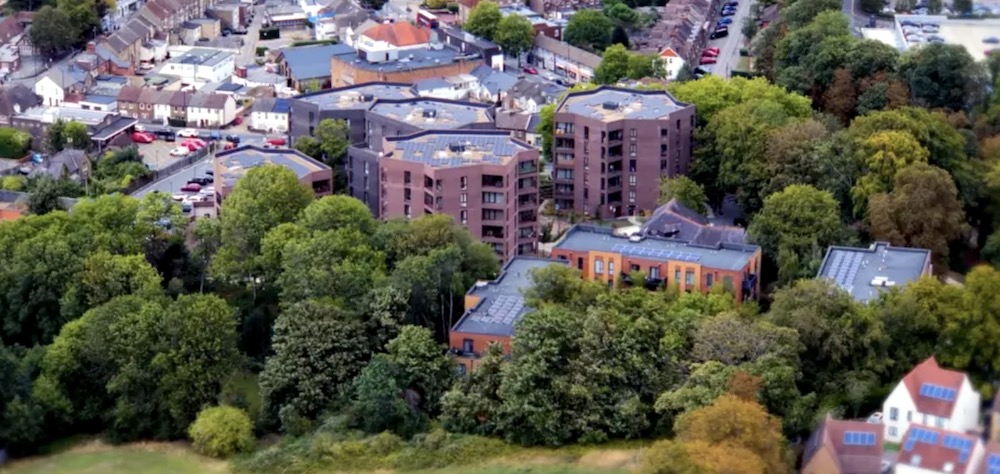 The scheme was paid for by Croydon Council as a public asset. A change in building regulations during its life meant it had to contend with five or six circumstantial problems beyond the usual ones.
Williamson spoke candidly about why it mattered to him. He grew up on a council estate in the East Midlands, until he left to study architecture, and says the houses there have since been sold into private hands and not replaced. He sees some good in a home-owning democracy, but, upon returning, he wonders where families like his would live now. Many people from that background, he said, are in temporary accommodation that is neither safe nor secure. He found judging this project inspirational and emotional.
At a time when housing is usually measured by cost and unit numbers, the prize recognises a scheme for how it answers its surroundings. Entries are assessed on design vision, innovation, sustainability, functionality and their ability to delight users and visitors.
The other finalists were a house at Fairmead, High Beach, in Epping Forest, by Sergison Bates; BEAM in Hertfordshire, by Bennetts Associates; Paddington Square, by Renzo Piano Building Workshop with Adamson Associates; Pembroke, Mill Lane, by Haworth Tompkins; and River Wing at Clare College, by Witherford Watson Mann Architects.