The May 2026 Art Diary begins by highlighting two of the Pavilions at the 61st International Art Exhibition of the Venice Biennale. These look to the past for contemporary inspiration, combined with reflection on contemporary issues. The latest exhibition by Richard Kenton Webb at Benjamin Rhodes Arts has a similar inspiration. Exhibitions of work by Hilma af Klint and Helaine Blumenfeld highlight the spirituality of abstract art. Contemporary issues are further explored through exhibitions by Barnaby Barford, Michael Petry, Michael Armitage, and Godfried Donkor, while exhibitions by Paul Rego and Olivia Plender examine the experiences of women. Finally, an exhibition and book explore responses to AIDS/HIV. Finally, ‘Comrades in Art: Artists Against Fascism’ at the Towner Eastbourne focuses on the Artists International Alliance.
Conceived in response to Koyo Kouoh’s curatorial proposal for the 2026 Venice Art Biennale, which invites us to slow down and tune into a more silent register, the exhibition for the Holy See Pavilion takes the form of a sonic prayer, an invitation to the contemplative act of listening, inspired by the life and legacy of Saint Hildegard of Bingen, a medieval abbess, poet, healer, and composer. Curated by Hans Ulrich Obrist and Ben Vickers and produced in collaboration with Soundwalk Collective, The Ear is the Eye of the Soul unfolds across two venues: the Giardino Mistico dei Carmelitani Scalzi in Cannaregio and the Complesso di Santa Maria Ausiliatrice in Castello. New commissions from 24 artists are on display, all inspired by the life and legacy of Hildegard.
Presented in Venice’s ancient Mystical Garden, a monastic green space nestled within a 17th-century convent cared for by the Discalced Carmelite community, the first part of the Pavilion features new sound works by 20 contemporary composers, musicians, poets, and artists. These works respond to Hildegard’s songs, writings, and visionary images through voice, instruments, and, at times, silence. In the garden, visitors are invited to reflect and listen to these new commissions, created in collaboration with Soundwalk Collective, via headphones, along with a site-specific instrument created by the same collective that “listens” to the garden in real time.
Across the city, in the Castello district, the Pavilion’s second location is the Santa Maria Ausiliatrice Complex, which has become a contemporary scriptorium (a place where books were once copied and illuminated). Structured around three main points, the space hosts a living archive, the final work of celebrated director and author Alexander Kluge, and the sound liturgy of the nuns of Eibingen Abbey. The archive was curated in close collaboration with Sister Maura Zátonyi OSB and the Academy of Saint Hildegard, whose teachings, research, and preservation of the saint’s legacy have helped inspire the Pavilion’s artists and collaborators. Inside, visitors find a multilingual library of Hildegard texts, artists’ books by Ilda David, and a new monastic architectural project by Tatiana Bilbao Estudio.
Kluge’s final work, completed before his death in March 2026, is a monumental installation of films and images consisting of twelve stations, distributed across three rooms according to the industrial logic of the building’s ongoing restoration. Kluge also gave the Pavilion its title: The Ear is the Eye of the Soul.
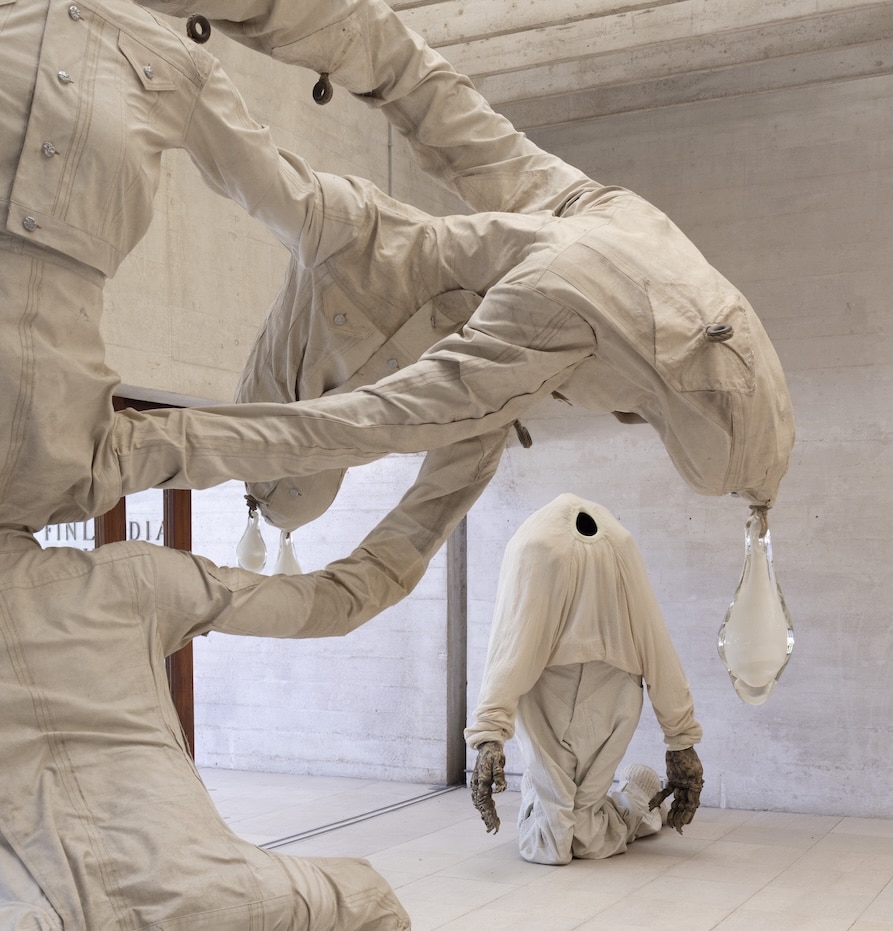
Tori Wrånes, Human Lace, 2026 in How Many Angels Can Dance On The Head Of A Pin?, Nordic Countries Pavilion at the 61st International Art Exhibition – La Biennale di Venezia. Photo: Kansallisgalleria | Finnish National Gallery / Pirje Mykkänen.
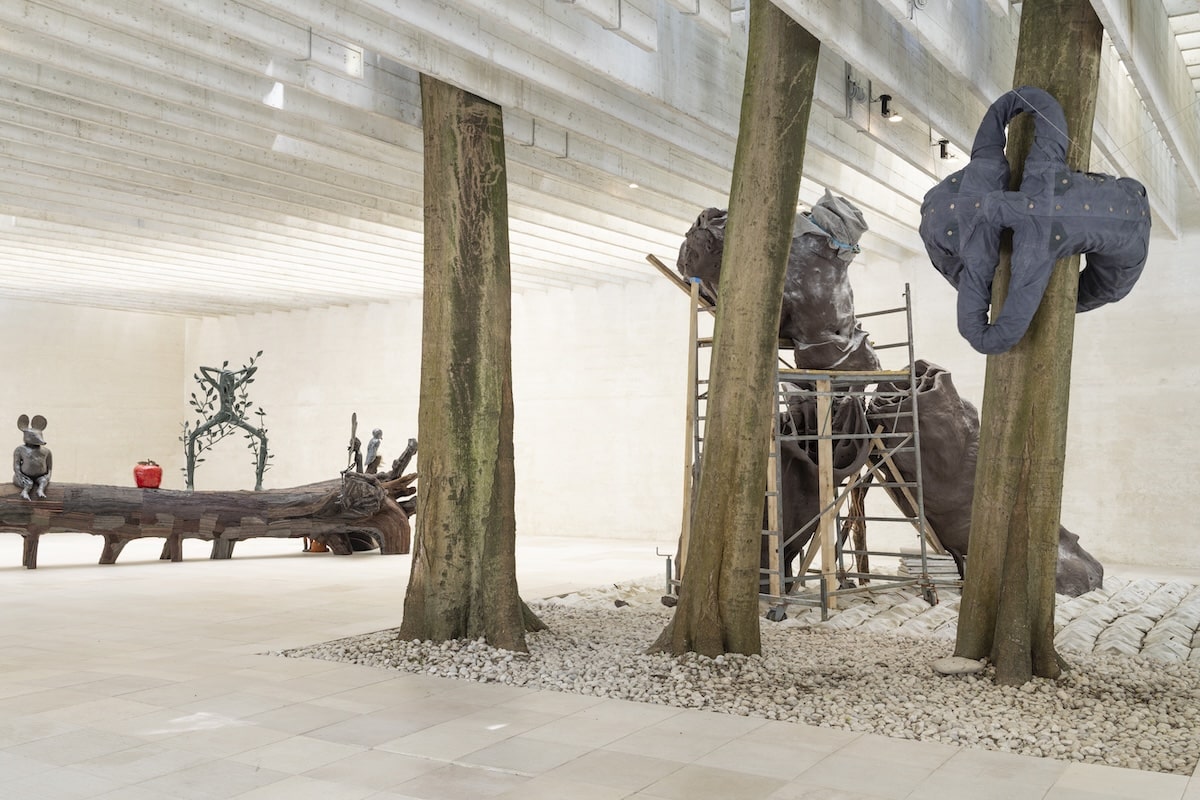
Also at the Biennale, the Nordic Countries Pavilion is presenting How Many Angels Can Dance on the Head of a Pin? Curated by Anna Mustonen (Chief Curator, Museum of Contemporary Art Kiasma), this collaborative exhibition by Klara Kristalova, Benjamin Orlow and Tori Wrånes transforms the Pavilion into a sculptural, mythical landscape that transcends cultural and national boundaries.
The exhibition’s title draws on a medieval philosophical question concerning how multiple entities may occupy the same space. Here, it opens onto broader reflections on coexistence – between bodies, systems and perspectives – at a time marked by increasing social, environmental and geopolitical division. Visitors are invited to consider their relationship to one another, to the natural world and to the passage of time.
The exhibition unfolds through a series of interconnected installations inspired by Nordic folklore, fairytales and stories such as the Kalevala – the 19th-century creation epic of Finland and Karelia – but resonating beyond. Across hybrid works that merge plant, animal and human forms, the artists harness the language of myth as a universal point of reference to explore cycles of decay, renewal and transformation, and the deep interconnectedness of all things. In an era marked by environmental disconnection, geopolitical instability and the disruption of borders and identities, myth becomes a lens through which to reflect on our shared human condition and to navigate contemporary global challenges.
Each artist contributes a distinct yet complementary practice. Klara Kristalova creates ceramic figures that combine fairytale imagery with the human body and the natural world, infused with uncanny details to suggest moments of vulnerability and transition. Benjamin Orlow produces monumental sculptures that give physical form to cycles of transformation, drawing on historic motifs and material culture. Tori Wrånes works across music, performance, and sculpture to construct dreamlike, otherworldly environments that alter our perceptions and shift how we experience space.
Together, their works span sculpture, sound, performance and spatial intervention, ranging from the monumental to the intimate. The installations extend across the interior and exterior of Sverre Fehn’s iconic 1962 Pavilion, a building defined by its porous relationship with the surrounding landscape and activated as an integral part of the exhibition. The result is a shared, evolving ecology where art, architecture and nature intersect, and the exploration of transformation becomes an ongoing, embodied experience.
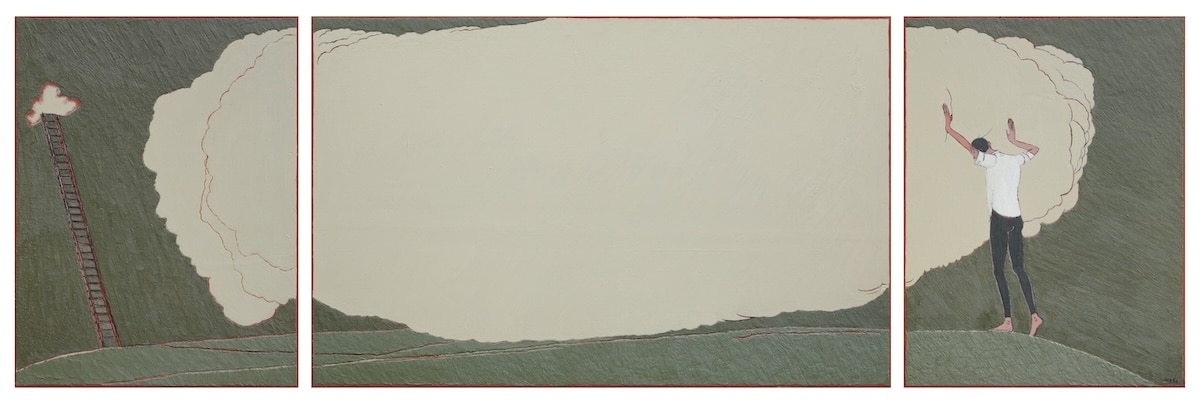
‘Acknowledging English Iconoclasm, No.1: Early English Mystics’ by Richard Kenton Webb. Benjamin Rhodes Arts, Photograph by Andy Green
Richard Kenton Webb is another artist who explores the past to open up our understanding of the present. Recently, he has begun to explore the pockets of academic disdain for painting. He argues that: “Since the 1990s, we have seen a shift towards concept-driven, word-based fine art study and research rather than practice-based learning with paintings, drawings and prints as the primary outcomes.” His “new work is a response to the northern European history of destroying the embodied arts, including painting, whilst promoting a word-based culture”:
“Between the 1300s and 1500s, there was so much creativity in England. I started researching and reading the medieval poets, plays, contemplatives, and mystics whose magnificent visual heritage had inspired: paintings, drawings, sculptures, tapestries, theatre, stained glass, and buildings. And yet, this heritage was destroyed and closed down. Tragically, we lost most of the visual references that had inspired the Romance Poets, the mystery/morality/miracle plays, Langland, Gower, the author of the Gwain poem and Chaucer; and mystics like Richard Rolle, Walter Hilton, Julian of Norwich and Margery Kempe.” His ‘English Iconoclasm’ series reflects on what was lost, while his ‘Passion’ drawings had their genesis in the COVID lockdown: “I had just completed my Conversation with Milton’s Paradise Lost when the second COVID lockdown came. I started reflecting on my professional circumstances over the last 15 years. I needed to make sense of what I had been through. Grief came upon me. I reached out to God and felt a deep sense of love. I started to draw. This is the result: a cycle of drawings inspired by the Passion of Christ. These were deeply personal, and I never expected to show them. For me, living in the hut, exhausted, broken and alone in the lockdown, I needed to make this work for my wellbeing. This was my song of companionship, love and survival. Knowing I was hoisting a particular flag, I thought, I don’t care – my relationship with my God is bigger than success, the art world, academia and, in fact, everything. By outscaping this experience and belief, I felt comfort, healing and restoration. This is how I could understand my own passion, in the Passion.”
Professor Hugh Adlington, who discusses both series of work in the book that complements the exhibition, says: “To help bring these remarkable drawings to light has been the greatest privilege and pleasure. The exhibition and book are both stunning, showing that what is most profoundly felt and finely wrought is always more than personal.”
‘Make Your Home in This Luminous Dark: Mysticism, Art, and the Path of Unknowing’ is a new book by philosopher James K. A. Smith in which he proposes a surprising source for modern consolation: the mystical experiences of St. Teresa of Ávila, St. John of the Cross, and the author of ‘The Cloud of Unknowing’. In the book, he argues that these mystics testify to a deeper truth beneath distraction, anxiety, and fear: love.
Drawing on ancient traditions of contemplation as well as on contemporary novels, poetry, film, and paintings, Smith speaks to the fundamental yearnings that persist in late modernity, including the philosophical quest for knowledge and certainty. He shows how the gifts of the Christian contemplative tradition and the riches of creative works embody a liberating spirituality that recovers the fullness of being human.
Emily Cash writes that: “He structures the book around four interrelated practices/postures that comprise the ‘mystical path: solitude (anachoresis), silence (hesychia), darkness/unknowing (docta ignorantia), and wonder (mysterion). He commends contemporary art as a companion for learning to befriend mystery, since it demands a contemplative posture that can help reform and heal our perception.”
The Grand Palais and the Centre Pompidou in Paris are dedicating a groundbreaking exhibition to Hilma af Klint, an artist whose abstract work revolutionised the chronology of modern art. Well before established figures of abstraction like Kandinsky and Malevich, af Klint created exceptionally bold paintings as early as 1906, combining geometry, flat planes of vibrant colour, and organic motifs that foreshadowed the major movements of the 20th century. Presented for the first time in France are the “Temple Paintings” cycle, her magnum opus, including the famous monumental series of the ‘Ten Greatest’, which testify to the visionary power of an artist resolutely ahead of her time.
Trained at the Royal Academy of Fine Arts in Stockholm, af Klint led a double artistic life: a conventional one, with traditional figurative works, and a secret one, with a resolutely avant-garde output. Nourished by her involvement in the Theosophical Society, she drew the freedom of her inspiration from séances with a group of women with whom she shared a utopian vision. Spirals, circles, and beams convey a search for cosmic harmony and the invisible forces that govern the world, lending her works a universal and timeless dimension.
Af Klint chose not to reveal her abstract work to her contemporaries, including in her will the wish to keep her works sealed for twenty years after her death. This contributed to the belated recognition of her work. It was only in 1986, at the exhibition ‘The Spiritual in Art, Abstract Painting 1890-1985’ in Los Angeles, that her abstract paintings were presented to the general public for the first time, marking the beginning of her international renown.
This is the first major solo exhibition of the artist’s work to be shown in France, even though her work has been the subject of significant re-evaluation in recent years, particularly within the context of a re-examination of the role of women in the field of artistic modernity, as exemplified by the 2021 exhibition ‘Elles font l’abstraction’ (They Make Abstraction) at the Centre Pompidou. Af Klint remains largely absent from French museums, although she is now considered an essential figure of artistic modernity and the historical beginnings of abstraction.
This exhibition highlights the multiple sources of inspiration for her work (esotericism, folklore and folk art, scientific culture) and questions how art history has long ignored women artists and their contributions to foundational movements. Af Klint emerges here as an essential figure, capable of transcending the boundaries between art, science, and spirituality, and of continuing to inspire new generations.
Helaine Blumenfeld, OBE, is one of the most esteemed sculptors working in the UK today. Born in 1942 in New York, she studied philosophy at Columbia University before moving to Paris to train in sculpture at the École de la Grande Chaumière with Ossip Zadkine. Blumenfeld carves in marble and wood and casts in bronze. Her sculptures often resemble organic, figurative or botanical forms that hover in that tantalising zone between abstraction and figuration. At Gainsborough’s House, she is showing three sculptures in the historic garden and one overlooking from inside.
Thomas Gainsborough and Blumenfeld, though separated by time, meet in their poetic sensibility, rhythmic fluidity of form, in dreamlike imagery and the universal language of beauty. When the art historian Michael Rosenthal described Gainsborough as “one of the most technically proficient and, at the same time, most experimental artists of his time “, he could also have been describing Blumenfeld today.
A master marble carver, testing the limits of her material, Blumenfeld creates impossibly thin, undulating structures through a profound understanding of her material’s boundaries. Like Gainsborough and his lightbox, Blumenfeld’s luminous works celebrate the light within. In bronze, she works with her foundry in Italy on innovations, including experimental patinas using silver nitrate.
Barnaby Barford’s new exhibition, ‘We Are Where We Are’, sees him thinking about the different ways we are coping a quarter of the way through the 21st century. This exhibition marks 20 years of working with David Gill Gallery and brings together 35 sculptures made using found figurines, the first time he has worked this way in over 14 years.
Working across drawing, sculpture, film, installation, and painting, Barford uses familiar iconography, such as the humble Apple, to subvert the telling of ancient cautionary tales in a contemporary context. Whilst his early porcelain figurines were characterised by witty cultural critique, his more recent sculptures, drawings, and digital paintings construct layered narratives through repetition and accumulation.
In Barford’s large-scale ‘Word Drawings’, abstract pictures are made by writing the same word over and over again. By incessantly repeating words such as Hope, Glory, Truth and Love, Barford asks us to reevaluate their meaning in today’s complex socio-cultural environment. Barford says: “I make art to make sense of the world and my place within it. Whether it is words, shops, or the apple, I fully immerse myself. I think through making, answering questions and gaining clarity through rigorous repetition and investigation.”
Although Barford produces work in a wide variety of materials, he consistently returns to ceramics. By using processes inherent to industrial manufacturing, he works with an accumulation of ceramic pieces to create works such as the monumental ‘Tower of Babel’, ‘The Apple Tree’ and ‘The Seven Deadly Sins’. Whether using shops, apples, flowers, or words, throughout his work, Barford holds up a mirror to society, prompting us to look again and reflect on inequalities, obsessions, and systems of belief.
Also responding to pressing contemporary issues is ‘The 365 Project: Michael Petry – The Civil War Project’ at the Vorres Museum in Athens. Petry’s ‘Civil War Painting Number 17 (CWP#17)’ is a monumental work (2 metres high by 10 metres long) which is the result of a three-week residency at the Vorres Museum. The work continues his artistic investigation of the current American Government’s attempt to provoke a hot civil war, through the occupation of cities, by troops and armed masked men who demand to see citizens’ papers, hauntingly similar to Berlin, 1939. Petry’s work clearly references Picasso’s large anti-war painting ‘Guernica’ in scale (nearly 8 metres long) as well as Greece’s own civil wars and military occupation.
‘CWP#17’ sits between a painting and installation as it has been made for the space of the 365 Project. Petry has added three colours to its palette that directly reflect Greece: the ochre earth, the terracotta roof tiles and the blue Aegean sky. His work is also a queer dialogue with Andy Warhol’s large camouflage paintings made shortly before his death. Petry has chosen to paint his marks physically rather than Warhol’s silk-screening, and ‘CWP#17’ thus also enters a discussion with other large-scale paintings like Monet’s ‘Water Lilies’.
‘Paula Rego: Visions of English Literature’ presents a major body of work by one of the most significant figurative artists of the late 20th and early 21st centuries. Developed by Hayward Gallery Touring, the exhibition explores Rego’s lifelong engagement with storytelling and literature through the medium of printmaking. One of the great printmakers and storytellers of our time, Rego drew inspiration from a vast range of sources – from traditional folklore and fairy tales, to literary classics and nursery rhymes. She said: “We interpret the world through stories… Everybody makes sense of things in their own way, but if you have stories, it helps.”
The exhibition includes three of the artist’s most ambitious and profound printmaking series: ‘Nursery Rhymes’, ‘Peter Pan’ and ‘Jane Eyre’, made over a decade of the artist’s life. Each series is accompanied by a variety of personal items from the artist, many of which have never been publicly displayed before. Unseen preparatory sketches, etching plates and Rego’s very own childhood copy of ‘Peter Pan’ offer audiences an intimate portrayal of the artist’s lifelong fascination with literature and insight into how the artist transformed this material into startlingly original and unexpected pictures.
From menacing oversized creatures etched into life from children’s nursery rhymes such as ‘Little Miss Muffet’ and ‘Three Blind Mice’, to the almost hallucinatory depictions of Neverland from ‘Peter Pan’ and the tumultuous relationships based on power read about in ‘Jane Eyre’, Rego’s work tells stories that combine fantasy and imagination, innocence and cruelty, in order to explore the complexities of life and the experience of women in particular, in all its strangeness and mystery.
Modern Art Oxford is presenting ‘Little Fennel’s Complaint’, a major solo exhibition by Olivia Plender, exploring historic and ongoing inequalities in women’s healthcare – from early modern witchcraft to contemporary debates on reproductive rights and medical authority. Plender developed this exhibition through research with leading Oxford institutions, including the Bodleian Library, the Oxford Botanic Garden, and the John Radcliffe Hospital. Across embroidered textiles, watercolours, drawings, mobiles, and sound works, she examines how women’s healthcare has been recorded, classified, and practised over time.
The exhibition combines new commissions, existing works, and historic manuscripts to highlight Plender’s multidisciplinary, research-led practice. Installations trace shifting approaches to medicine and diagnosis, opening with a presentation inspired by contemporary hospital architectures and waiting rooms. Historical perspectives include her series’ Bringing Down the Flowers’ and watercolours in the style of genteel 19th-century flower paintings of plants historically used to induce abortion, referencing orally transmitted reproductive knowledge. Three 17th-century manuscripts by astrologer-physician Richard Napier, on loan from the Bodleian Library, document consultations with women about their reproductive health, alongside other ‘women’s problems’ such as ‘green sickness’, a diagnosis formerly given only to unmarried women.
The exhibition culminates in a large-scale embroidered textile loosely based on scenes from the ‘Malleus Maleficarum’, a notorious treatise on witchcraft written by Heinrich Kramer, which portrayed women – particularly midwives and healers – as susceptible to demonic influence.
Pinault Collection is presenting a major exhibition dedicated to Michael Armitage. Navigating between narratives inspired by reality and dreamlike visions, Armitage’s work addresses issues of our time, including sociopolitical tensions, violence, seductive ideologies, and the global migration crisis. His paintings open with sensitivity and critical acuity to a broader reflection on identity, memory, and the meaning of humanity.
The Kenyan-British artist presents at the Palazzo Grassi a selection of forty-five paintings, including newly created pieces, and over one hundred studies that reveal his dense and vibrant pictorial language, staging figures in rich compositions with remarkable chromatic intensity, at the crossroads of several aesthetic canons. His choice of subject matter and interpretive undertones share the same expressive power. The painter does not shy away from violent and harsh themes, believing that art cannot ignore reality but must instead grapple with it: the consequences of war, corruption and instability in equatorial regions, the migration crisis, the weight of societal judgment, and abuses of power form the backdrop of some of his poignant works.
Based between Kenya and Indonesia, Armitage draws inspiration from a wide range of sources: historical and contemporary news, political demonstrations, literature, cinema, local rituals, colonial and modern architecture, flora and fauna, and global art history. At the heart of his iconography is East Africa, and Kenya in particular, which he explores with both critical, satirical insight and visionary depth. The exhibition delves deep into his exploration of inhabited landscapes and visions as he gives free rein to his visions, creating haunted or even hallucinatory landscapes.
Among his motifs are real and imagined figures, drawn from contemporary African literature and Greek mythology, who embody a certain inner state and testify to external conditions. At other times, anonymous individuals are depicted, as in the series on migration, which attempts to represent in large-scale tableaux the perilous journey of migrants across Africa, the often-deadly sea crossing to Europe, and the disillusionment of those who succeed.
The artist’s works are painted in oil on bark cloth, a traditional material sourced from Uganda and Indonesia, transgressing the canvas typical in Western tradition. The material’s natural irregularities – holes, creases, and rough textures – directly inform the visual composition. Executed in a distinctive, lush, and sensuous palette, Armitage’s works are built through a multi-layered process: paint is applied in layers, resulting in evocative, distinctive imagery. The practice of drawing, to which a large room in the exhibition is devoted, reveals the level of attention that the artist pays to details, composition and preparatory studies.
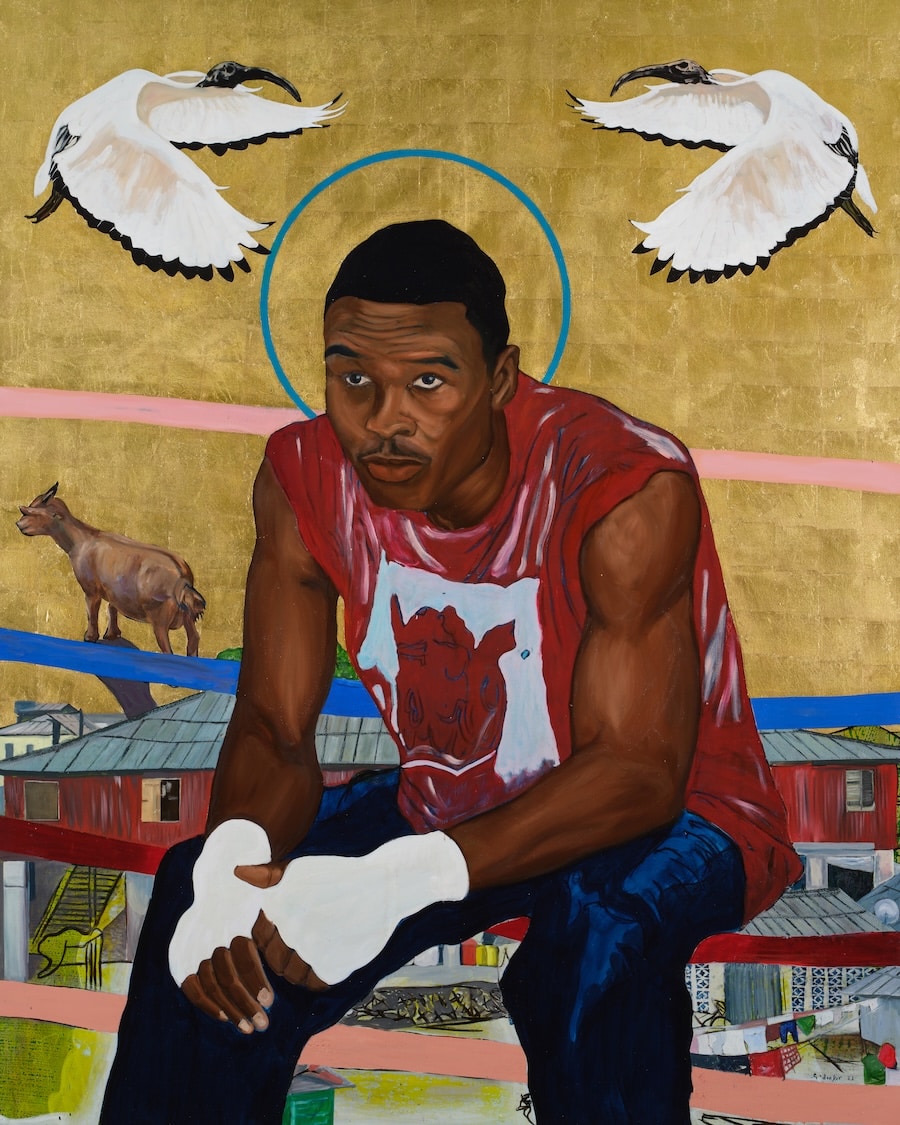
GODFRIED DONKOR, St Ike Quartey, 2023, Oil, Acrylic and Gold Leaf on Canvas, 200 x 160 cm. Courtesy of the Artist and Gallery 1957
Firstsite next presents ‘It’s a Numbers Game’, the first UK institutional exhibition by artist Godfried Donkor. Through a powerful body of new and existing work, Donkor transforms the gallery into a space where histories of empire, resistance, commerce and identity collide and are reimagined through the artist’s distinctive visual language.
Working across collage, painting, embroidery and installation, Donkor builds a vivid and layered world. A trained painter still in dialogue with the medium, he developed collage as a technique to study and build his paintings – a spontaneous way to blend narratives quickly. His choice of materials reflects a deeper philosophy: that history is not a fixed truth but a malleable narrative that can be told and retold through different lenses.
By combining archival photographs from a century ago with contemporary imagery, Financial Times pages with Ghanaian symbols, European heraldry with African textiles, Donkor embodies his conviction that ‘everything is mixed’ – that cultures blend, overlap and enrich each other. This layering – physical and metaphorical – invites viewers to think about history in entirely new ways, revealing how systems of power – financial markets, heraldic traditions, Ghanaian Adinkra symbolism – shape the stories we tell and our experiences of place, identity, and belonging.
In ‘It’s a Numbers Game’, these elements come together in a dynamic ‘call-and-response’ between media, echoing musical structures while interweaving multiple perspectives on shared histories. The exhibition examines the relationships between Britain, West Africa and the Caribbean – what Donkor describes as a ‘triangle of commerce’ – and how these historical relationships continue to shape contemporary identity and culture.
Visitors encounter large-scale collages featuring African figures emerging from fields of Financial Times text, revealing how global economics and human stories intertwine. Intricate embroideries become a cultural bridge, with European heraldic traditions merging with Ghanaian Adinkra symbols to explore symbolism and power. Monumental paintings revisit historical scenes through a contemporary lens. A dedicated gallery space is transformed into a boxing ring, drawing on Donkor’s long-standing interest in the sport as a metaphor for migration, resilience and cultural exchange.
Donkor says, “Histories are layered, repeated and reinterpreted over time. By combining different visual languages, materials, and archives, I explore how history and power are not fixed but entwined and shaped through exchange, memory, and perspective. At Firstsite, this is grounded in Colchester’s own story—connecting Boudicca’s resistance to that of Yaa Asantewaa, and to Sarah Bowditch’s 19th-century documentation of the Ashanti. These histories are not separate, but part of the same ongoing conversation—continuing to shift, overlap and reveal new meanings as they are seen again.”
The Fitzrovia Chapel and the charity National HIV Story Trust (NHST) are presenting ‘Survivors’, a powerful exhibition of photographs by Danielle van Zedelhoff featuring 16 striking portraits of long-term HIV survivors.
The NHST was established as a repository of real-life stories, to preserve the history of the HIV and AIDS pandemic of the 1980s and 90s, and to remember not only the stories of tragedy but also those of love, compassion and humanity. The charity holds an archive of filmed interviews with survivors and families, partners, and medical professionals. The portraits in ‘Survivors’ were commissioned during the filming of the first 100 interviews the charity collected, excerpts of which feature at the show.
Paul Coleman, Co-Founder and Chair of the NHST, said: “These portraits are such an important part of the story of HIV because they show real people’s vulnerability and strength. The immense challenges of an HIV diagnosis are well-known, but within often painful stories are also deep wells of hope, resilience and strength. Danielle’s portraits capture the dichotomy between these themes and remind us that at the heart of HIV are human beings and the complex, interwoven tensions between adversity and fortitude. We are immensely grateful to her for these beautiful portraits.”
When Paul Thek met Peter Hujar in the winter of 1956 in Coral Gables, Florida, a slow-simmering connection began to burn. Thek, twenty-three and living in Miami, was handsome and itching to make it as a painter; in the twenty-two-year-old Hujar, a shy, sensual photographer, he’d found a kindred spirit. By 1960, they were dating and living in New York, beginning decades of sex, love, competition, and reconciliation—an entanglement that changed American art forever.
Surrounded by a robust creative scene populated by Susan Sontag, Andy Warhol, Fran Lebowitz, John Waters, and David Wojnarowicz, Thek and Hujar’s profoundly influential careers, from the early 1960s through the late 1980s, differed as much as the men themselves. The unpredictable and often overlooked Thek crafted visceral installations and sculptures, while Hujar, celebrated and sociable, took penetrating portraits of his world, queer and otherwise. Yet even at their most estranged, and even after their deaths from AIDS, both men were united by a pursuit of liberation—from artistic and sexual limits, from anything short of changing the world.
Among the ground it covers, Andrew Durbin’s ‘The Wonderful World That Almost Was’ documents the original inspiration for Thek’s ‘Technological Reliquaries’. While on holiday in Sicily in 1963, they descended into Palermo’s Capuchin Catacombs, where photography was forbidden. Hujar, with his camera, ignored the rule. Paul reached into one of the glass coffins and picked up what he thought was a piece of paper. It was a bit of dried human thigh. “I felt strangely relieved and free,” he later said in a 1966 interview for Artnews. “It delighted me that bodies could be used to decorate a room, like flowers.”
Paul Thek’s ‘Technological Reliquaries’ are Plexiglas boxes containing convincing beeswax replicas of body parts and slabs of meat, an allusion to the sculptural containers Catholics have used for centuries to preserve the relics of saints, often including body parts. Of ‘Technological Reliquaries’, Ann Wilson writes: “Sexual dilemma, religious martyrdom, antiwar imagery—such layers of meanings and polyvalent metaphors constantly infused Paul’s personal autobiography with liturgical history and contemporary political statement, a complex interweaving that typifies all his work.”
Durbin’s book unravels, for the first time, the intertwined stories and work of two boundary-burning, paradigm-tilting, never more relevant American artists. Weaving together deft art criticism with moving portraits of both men’s inner lives, and assembled with exhaustive research, the book is an ode to a lost but still-living world—and two men who defined it.
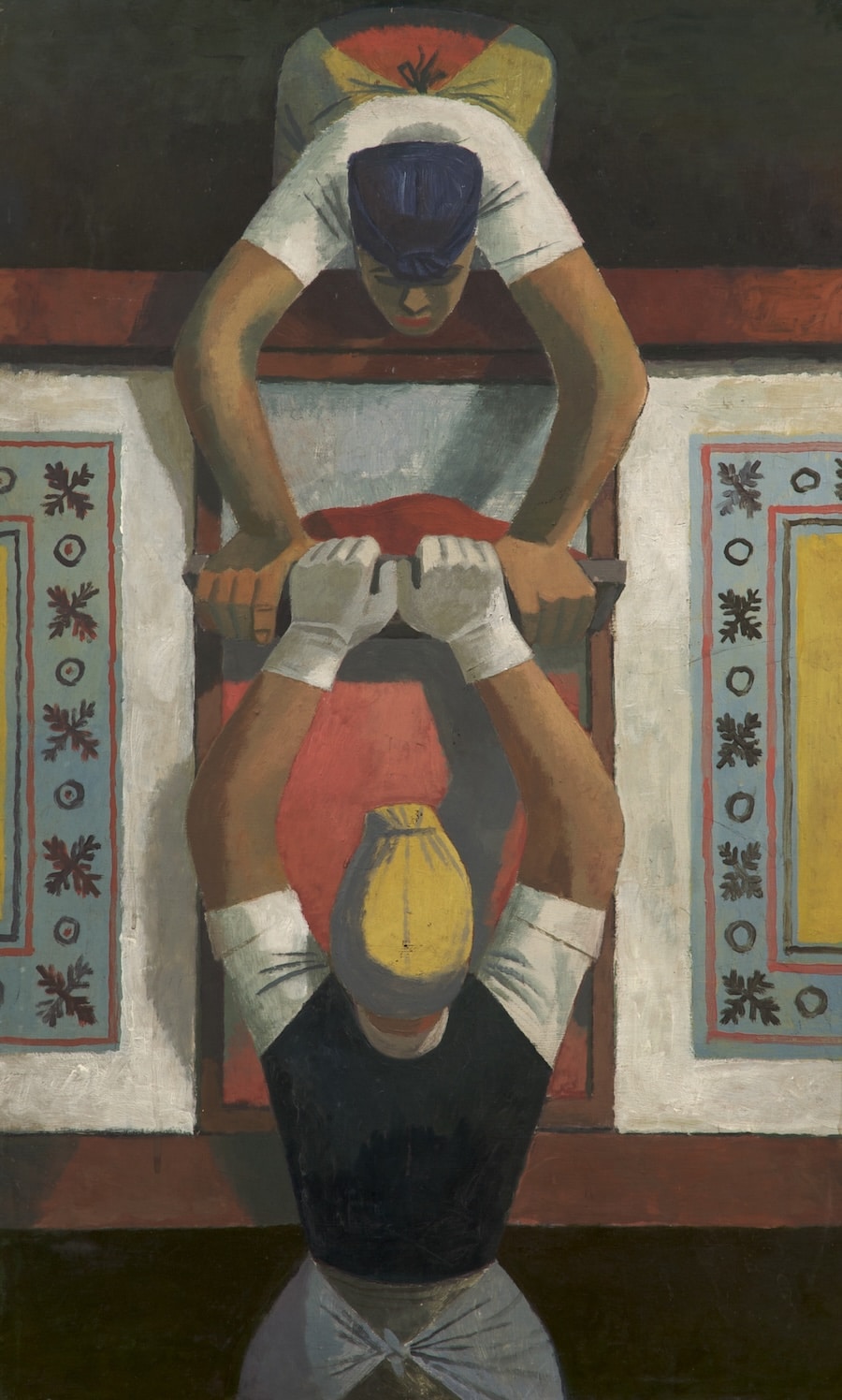
Cliff Rowe, Women Silkscreen Workers, post war. © Cliff Rowe Estate. Courtesy of the People’s History Museum
Finally, ‘Comrades in Art: Artists Against Fascism’ at the Towner Eastbourne focuses on the Artists International Alliance (AIA). Founded in 1933, the AIA sought to bring artists together in opposition to the rise of fascism in Britain and Europe. Its leading figures, Misha Black, Clifford Rowe and Pearl Binder, were united by their shared political convictions and their belief that art had a vital role to play in bringing about social change.
Forming an ideological barricade against fascism, the AIA used art as an explicitly political instrument. Travelling exhibitions, public murals and affordable prints brought its message to audiences well beyond the gallery walls. But with the outbreak of war in 1939, the association lent its voice to the government’s efforts to boost morale. With images of air-raid shelters, civil defence preparations, Home Guards and evacuees, the AIA’s prints held up a mirror to everyday life in wartime Britain.
‘Comrades in Art’ is the most comprehensive exhibition ever staged on the AIA — a history obscured in part by design, after records were deliberately destroyed in 1940 to protect members from reprisals in the event of a Nazi invasion. It brings together over 320 works, highlighting the lives and work of key members of the AIA’s founding generation. The 11 members of the founding generation of the Artists International Association (AIA) include: Peggy Angus, Pearl Binder, James Boswell, James Fitton, Margaret Fitton, James Holland, Percy Horton, Peter Laszlo Peri, Betty Rea, Cliff Rowe and Nan Youngman. Their work is being shown alongside works by prominent AIA exhibiting artists, including Ithell Colquhoun, Dame Laura Knight, Paul Nash and Lucien Pissarro, who supported the organisation and its campaigns for peaceful and cultural development and international understanding.
‘Pavilion of the Holy See: The ear is the eye of the soul’, 9 May – 22 November 2026, Holy See Pavilion at the 61st International Art Exhibition of the Venice Biennale –
Visit Here
‘How Many Angels Can Dance on the Head of a Pin?’, 9 May – 22 November 2026, The Nordic Countries Pavilion at the 61st International Art Exhibition of La Biennale di Venezia – Visit Here
‘Richard Kenton Webb: PASSION & ENGLISH ICONOCLASM’, 30 April – 26 June 2026, Benjamin Rhodes Arts –
‘Make Your Home in This Luminous Dark: Mysticism, Art, and the Path of Unknowing’ by James K. A. Smith –
Visit Here
‘Hilma af Klint: The Temple Paintings (1906-1915)’, 6 May – 30 August 2026, Grand Palais, Paris – Visit Here
‘Helaine Blumenfeld: Tree of Life’, 3 May 2025 – 11 October 2026 – Visit Here
‘We Are Where We Are’, 1 – 30 May 2026, David Gill Gallery – Visit Here
‘The 365 Project: Michael Petry’, 2 May – 30 June 2026, Vorres Museum – Visit Here
‘Paula Rego: Visions of English Literature’, 22 May – 6 September 2026, Newlands House – Visit Here
‘Olivia Plender: Little Fennel’s Complaint’, 23 May – 16 August 2026, Modern Art Oxford – Visit Here
‘Michael Armitage. The Promise of Change’, 29 March – 10 January, Palazzo Grassi, Venice – Visit Here
‘Godfried Donkor: It’s a Numbers Game’, 23 May – 30 August 2026, Firstsite – Visit Here
SURVIVORS: The Art of Defiance, 9 – 12 June 2026, The Fitzrovia Chapel – Visit Here
‘The Wonderful World that Almost Was’ by Andrew Durbin – Visit Here
‘Comrades in Art: Artists Against Fascism’, 7 May – 18 October 2026, Towner Eastbourne – Visit Here