
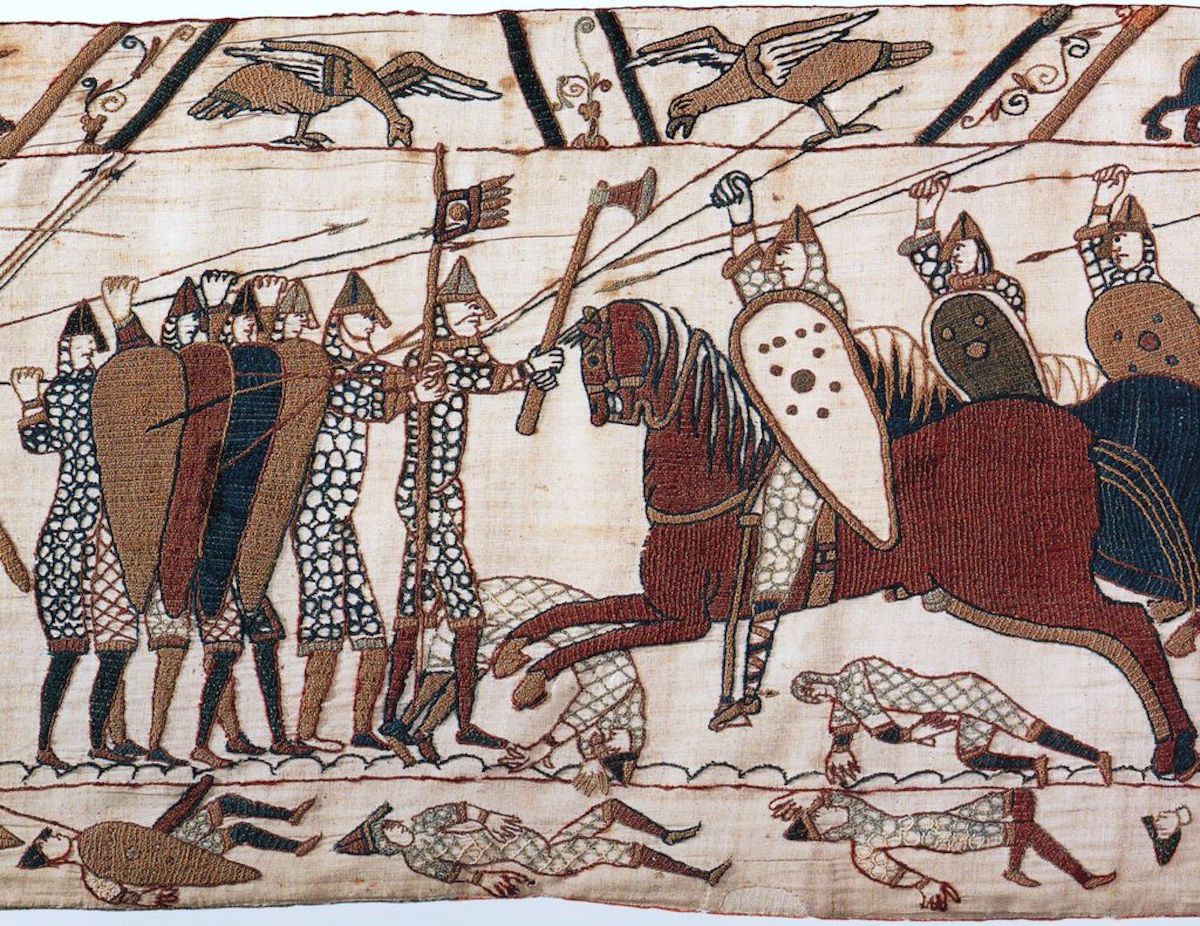
Nearly a thousand years after English embroiderers stitched the story of the Norman Conquest into seventy metres of linen, schoolchildren across the United Kingdom are being invited to finish the job. The ending of the Bayeux Tapestry has been missing for centuries, and a new national competition, Beyond the Battle, is asking Key Stage 2 primary school pupils to imagine what it might have shown and to create their own textile response to that historical gap.
The competition is being run jointly by Art Explora, the Franco-British arts organisation focused on widening access to culture, and English Heritage, which cares for the 1066 battlefield and more than four hundred historic sites across England. It launches in late September 2026 and runs alongside the Tapestry’s visit to the British Museum, where it will be displayed in Room 30, the Sainsbury Exhibitions Gallery, from 10 September 2026 to 11 July 2027. This is the first time the Tapestry has been in England since it was made there, probably at St Augustine’s Abbey in Canterbury, around 1072 to 1077. Public demand has been considerable: tickets for the entire period through to the end of December 2026 sold out within days of going on sale.
Beyond the Battle is designed to bring the moment to classrooms that may not be able to get anywhere near Bloomsbury. The competition is free to enter, with no cost to schools.
The creative challenge is straightforward and genuinely open. The Tapestry as it survives breaks off abruptly, its closing section believed to have depicted William’s coronation but lost long ago. The competition asks pupils, working as a class, to invent that missing panel for themselves. The brief is deliberately not about conquest. Children are asked to picture a better future and to fill their textile work with the people, actions and values that might help bring it about. It is an invitation to use a medieval form to say something about now.
Schools that take part receive a free learning resource created by the embroidery artist and educator Jessica Grady, whose own practice draws on unconventional and recycled materials including painted metal washers, hand-dyed plastic waste, packaging and stripped electrical cable. The resource comes with lesson plans, practical guidance and creative prompts designed so that classes can participate using materials already available in the art cupboard, the recycling bin or at home. No specialist equipment is required, and no prior experience of textiles is assumed.
The programme takes a cross-curricular approach, connecting the history of the Tapestry and the Norman Conquest with collaborative storytelling and a range of embroidery techniques. It links directly to the Key Stage 2 history and art and design curriculum. One of its stated aims is to build teacher confidence in using textile-based practice in the classroom and to raise pupils’ awareness of embroidery as both a craft and a viable artistic medium.
Winning classes will receive a fully funded trip to London to see the Tapestry at the British Museum, along with a visit to the 1066 Battle of Hastings Abbey and Battlefield, or another English Heritage Norman site. Those trips are planned for the summer term of 2027. Runner-up classes will receive a funded visit to their nearest English Heritage Norman site. Winning entries will be featured in a dedicated exhibition, and each winning school will receive a bespoke textile artwork by Jessica Grady to mark the achievement.
The context for the competition matters. The Bayeux Tapestry is not simply an artwork; it is one of the most remarkable surviving documents of medieval life and storytelling. Made to be read as a sequence of images at a time when most people could not read words, it communicates narrative, emotion, hierarchy and drama through stitch, colour and composition across an almost cinematic length of cloth. The fact that it was almost certainly made in England, by English embroiderers, for a Norman patron, gives it a particular complexity that goes beyond the simple story of who won at Hastings.
Iona Keen, Head of Learning and Interpretation at English Heritage, noted that visitors to Battle Abbey often arrive knowing about the arrow in Harold’s eye but leave with something less reducible and more affecting: the sensation of standing above the actual ground where real people died. Beyond the Battle connects that physical experience to the object that shaped its cultural memory, and then asks the next generation to take the story somewhere new.
Art Explora was founded in France in 2019 and in the UK in 2021 and operates across Europe through touring exhibitions, digital programmes and community initiatives. Its fleet of Mobile Museum trucks brings shows from major collections including the Centre Pompidou and Tate into communities across the UK and France, and it provides travel grants to schools in the most deprived areas of the country to support museum visits. In 2027 it will launch a dedicated UK Mobile Museum funded by the Department for Culture, Media and Sport.
English Heritage manages more than 400 sites, from prehistoric monuments to Cold War bunkers, and welcomes over 10 million visitors annually.
Further details on competition dates, eligibility criteria, the judging process and how to enter will be announced when Beyond the Battle officially launches in late September. For schools looking to give their pupils a connection to one of the most significant objects in British and European history, while also making something entirely their own, the timing could hardly be better.